

IEC | INDONESIA EXPORT CENTER
Your Global Sourcing Partner
Understanding Temperature Management for Crude Palm Oil
Temperature management is an important consideration in the storage, transportation, and handling of crude palm oil.
Unlike some liquids that remain uniformly fluid across a wide temperature range, crude palm oil contains different triglyceride components that influence its melting and crystallization behavior.
Depending on temperature and composition, CPO may become more viscous or develop solid fractions that affect pumping and transfer operations.
For industrial buyers, appropriate storage and heating practices can support operational efficiency while helping reduce avoidable quality risks.
Indonesia Export Center (IEC) facilitates sourcing inquiries involving potential Indonesian CPO suppliers. The actual storage operator, vessel operator, and qualified technical personnel must determine the appropriate operating conditions for each cargo.
Why Temperature Matters
Temperature can influence:
- Viscosity.
- Pumpability.
- Crystallization.
- Product homogeneity.
- Transfer efficiency.
- Storage operations.
- Energy consumption.
- Certain quality deterioration mechanisms.
Temperature management therefore involves balancing handling requirements with product integrity and equipment safety.
1. Understand CPO Physical Characteristics
Crude palm oil is a mixture of triglycerides and minor components.
Its physical properties vary with composition and temperature.
A single temperature does not necessarily represent a universal melting or handling point for every CPO cargo.
Buyers should request relevant product information and consult qualified operators.
2. Storage Tank Compatibility
Suitable storage arrangements should consider:
- Tank material.
- Tank condition.
- Previous cargo.
- Cleaning procedures.
- Heating capability.
- Temperature monitoring.
- Insulation.
- Product segregation.
- Pumping arrangements.
- Safety controls.
3. Heating Systems
Industrial storage and transport equipment may use heating systems designed for compatible bulk liquids.
The suitability of a system depends on its design, operating limitations, and the cargo.
Heating should be performed only by authorized personnel under approved procedures.
4. Risks of Insufficient Heating
If cargo conditions are unsuitable for pumping, potential operational problems may include:
- Reduced flow.
- Increased transfer time.
- Pumping difficulties.
- Uneven cargo condition.
- Delayed discharge.
The appropriate response must be determined by qualified operators.
5. Risks of Excessive Heating
Unnecessary or excessive thermal exposure may contribute to undesirable product changes.
Potential concerns include:
- Accelerated deterioration.
- Changes in certain quality indicators.
- Increased energy consumption.
- Equipment-related risks.
Heating conditions should not be selected solely for faster pumping.
6. Temperature Monitoring
A monitoring plan may include:
- Measurement locations.
- Instrument suitability.
- Calibration.
- Recording frequency.
- Operating limits.
- Alarm arrangements.
- Responsible personnel.
The actual monitoring procedure should be established by the facility operator.
7. Product Homogeneity
Temperature differences within storage tanks may influence physical condition and sampling.
Buyers should ensure that sampling and testing procedures account for the actual cargo condition.
8. Quality Parameters to Monitor
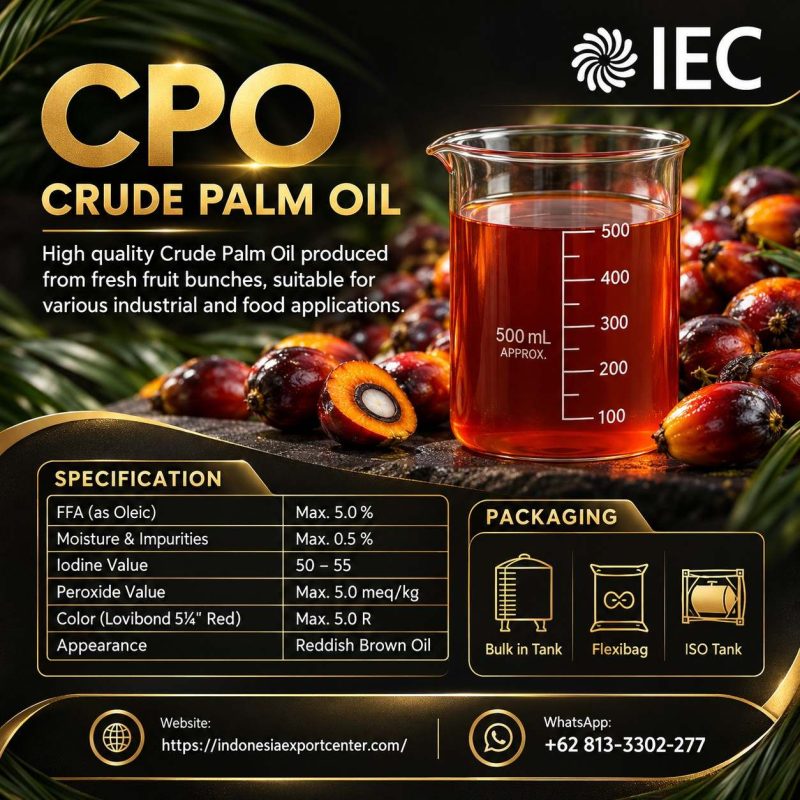
The IEC reference CPO specification includes:
| Parameter | Reference Target |
|---|---|
| FFA, as Oleic | Maximum 5.0% |
| Moisture & Impurities | Maximum 0.5% |
| Iodine Value | 50–55 |
| Peroxide Value | Maximum 5.0 meq/kg |
| Lovibond Color, 5¼-inch Red | Maximum 5.0 R |
| Appearance | Reddish Brown Oil |
These are brochure reference targets rather than verified results.
Heating and storage practices should be evaluated in the context of actual laboratory findings and operating conditions.
9. Storage Duration
Longer storage periods may create additional operational and quality management considerations.
Buyers should monitor:
- Storage time.
- Tank condition.
- Quality trends.
- Product transfers.
- Exposure conditions.
- Inspection records.
10. Moisture and Contamination Prevention
Storage systems should be managed to minimize unwanted contamination.
Relevant controls may involve:
- Suitable tank maintenance.
- Water ingress prevention.
- Appropriate cleaning.
- Product segregation.
- Transfer line management.
- Inspection.
11. Heating During Transportation
Transport requirements depend on:
- Cargo characteristics.
- Voyage conditions.
- Vessel or equipment design.
- Discharge arrangements.
- Carrier requirements.
- Safety procedures.
No specific shipping temperature or heating rate is guaranteed or recommended for all cargoes in this guide.
12. ISO Tank and Flexibag Considerations
ISO tank arrangements may require equipment-specific heating and operational planning.
Flexibag transport requires additional compatibility assessment, including temperature limitations and carrier approval.
Neither method should be assumed suitable without technical verification.
13. Temperature Management Checklist
| Control Area | Verification |
|---|---|
| Product Characteristics | Reviewed |
| Tank Suitability | Confirmed |
| Heating Equipment | Approved |
| Temperature Limits | Defined by qualified operator |
| Monitoring | Established |
| Sampling | Appropriate to cargo condition |
| Quality Testing | Agreed |
| Transfer Equipment | Compatible |
| Safety Procedures | Approved |
| Records | Maintained |
Common Storage and Heating Mistakes
- Assuming every CPO cargo has identical heating requirements.
- Using unverified temperature recommendations.
- Ignoring tank compatibility.
- Overlooking monitoring and calibration.
- Heating without approved operating procedures.
- Failing to consider sampling representativeness.
- Assuming packaging equipment supports heating.
- Treating temperature management as a substitute for quality testing.
Storage and Heating RFQ Template
Subject: Indonesian CPO Supply – Storage and Heating Requirements
Company: [Name]
Country: [Country]
Product: Crude Palm Oil
Quantity: [MT]
Destination Port: [Port]
Storage Arrangement: [Bulk Tank / Other]
Heating Capability: [Details]
Quality Requirements: [Details]
Shipment Method: [Details]
Inspection Requirements: [Details]
Shipment Period: [Dates]
Please advise on potential suppliers and the technical information needed to evaluate cargo handling and storage compatibility.
Frequently Asked Questions
Does crude palm oil require temperature management?
Temperature management may be important depending on the cargo and operating conditions.
Is there one universal storage temperature for CPO?
No. Appropriate conditions must be determined for the actual product and equipment.
Can excessive heating affect oil quality?
Inappropriate thermal exposure can contribute to deterioration.
Can CPO be stored in an ISO tank?
Potentially, subject to technical and commercial feasibility.
Is a flexibag always suitable for CPO?
No. Specific technical and carrier approval is required.
Does IEC operate heated CPO storage tanks?
IEC is a sourcing intermediary and does not claim to operate such facilities.
Request CPO Handling and Sourcing Information
Evaluate Indonesian crude palm oil sourcing opportunities with attention to product characteristics, storage compatibility, temperature management, and quality verification.
REQUEST CPO STORAGE AND SOURCING INFORMATION
IEC | INDONESIA EXPORT CENTER
Website: https://indonesiaexportcenter.com/
WhatsApp Inquiry: +62 821-4172-3508
Related Resources
Crude Palm Oil Bulk Tank Storage and Handling
Crude Palm Oil ISO Tank Feasibility
Crude Palm Oil Rancidity and Oxidation Prevention
