

IEC | INDONESIA EXPORT CENTER
Your Global Sourcing Partner
CRUDE PALM OIL MOISTURE AND IMPURITIES
Quality Specifications | Laboratory Testing | Storage Conditions | Refinery Feedstock
Understanding Moisture and Impurities in Crude Palm Oil
Moisture and impurities are important quality parameters in crude palm oil procurement.
For refinery operators and international commodity buyers, controlling unwanted water and foreign materials can support efficient processing, product quality, and storage management.
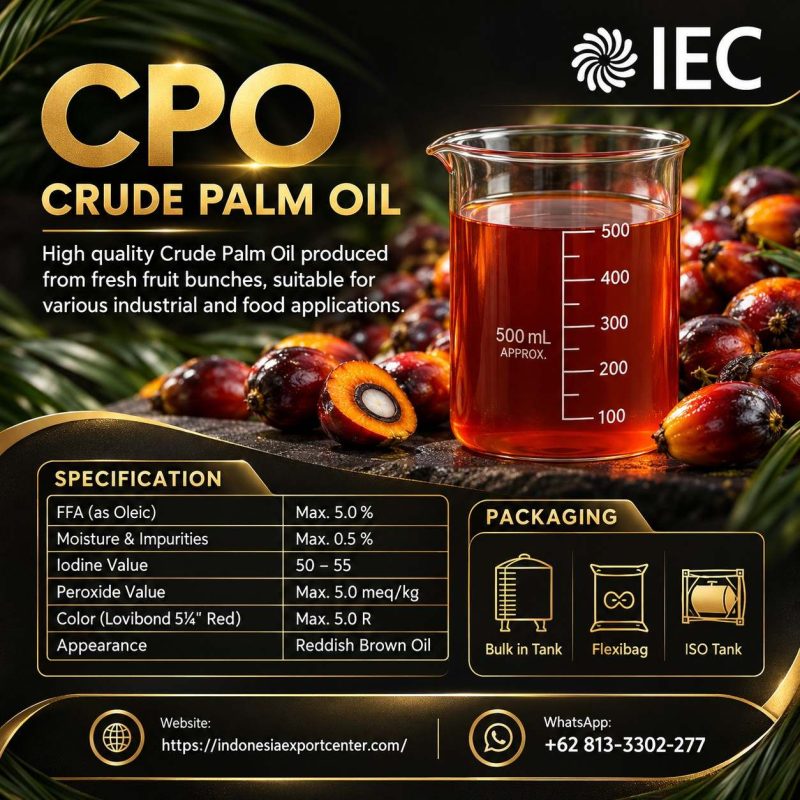
The IEC reference CPO specification identifies a combined Moisture & Impurities target of maximum 0.5%.
This figure represents a marketing reference limit, not a verified result for a particular cargo.
Indonesia Export Center (IEC) facilitates inquiries for Indonesian CPO sourcing and helps buyers communicate quality requirements to potential suppliers.
What Is Moisture in Crude Palm Oil?
Moisture refers to water present in the oil.
Water may enter or remain in the product through processing, storage, transfer, or other handling conditions.
Moisture content is relevant to both quality and operational performance.
What Are Impurities in CPO?
Impurities may include unwanted insoluble materials present in the oil.
Depending on the source and handling process, such materials may include fine solids or other foreign matter.
The precise analytical definition should follow the agreed testing method.
Why Moisture and Impurities Matter
Refinery Processing
Excess water and solids can complicate processing and may require additional separation or pretreatment.
Storage Quality
Moisture can contribute to undesirable quality changes under certain conditions.
Equipment Operation
Solid contaminants may affect filtration, separation, and transfer equipment.
Commercial Acceptance
Moisture and impurities are often included in quality specifications.
Product Consistency
Monitoring helps buyers compare different cargoes using a consistent basis.
IEC Reference Specification
| Parameter | Reference Target |
|---|---|
| Moisture & Impurities | Max. 0.5% |
| FFA, as Oleic | Max. 5.0% |
| Iodine Value | 50–55 |
| Peroxide Value | Max. 5.0 meq/kg |
| Color, Lovibond 5¼-inch Red | Max. 5.0 R |
| Appearance | Reddish Brown Oil |
The actual supplier must confirm these values through appropriate testing.
Combined Versus Separate Reporting
One important issue is whether the COA reports:
Combined Moisture and Impurities: A single result covering the specified combined parameter.
Separate Moisture and Impurities: Individual results for water content and insoluble materials.
These reporting formats should not be treated as identical without reviewing the methods and calculation basis.
Buyers should specify exactly how compliance will be determined.
How Is Moisture Measured?
Moisture testing may use established analytical procedures suitable for oils and fats.
The selected method should be identified in the laboratory report.
Different methods may have different scopes and limitations.
How Are Impurities Measured?
Insoluble impurities may be determined through a suitable analytical procedure involving separation and measurement of insoluble material.
The method and reporting basis should be specified.
Why Sampling Matters
Water and suspended solids may not always be distributed uniformly throughout a bulk oil cargo.
For this reason, sampling procedures are especially important.
The parties should define:
- Sampling location.
- Sample preparation.
- Representative sampling method.
- Container suitability.
- Handling conditions.
- Testing timeline.
- Laboratory method.
- Retained sample procedure.
Storage and Handling Considerations
Buyers should evaluate:
- Storage tank condition.
- Protection against water ingress.
- Transfer equipment cleanliness.
- Tank bottom condition where relevant.
- Cargo segregation.
- Temperature management.
- Loading and discharge procedures.
- Sampling and monitoring records.
Moisture and Impurities in Refinery Economics
Excess moisture or impurities may affect:
- Usable oil quantity.
- Pretreatment requirements.
- Filtration and separation.
- Equipment maintenance.
- Quality acceptance.
- Processing costs.
The financial impact depends on the actual cargo and refinery process.
How to Review a Supplier COA
A buyer should check:
- Product name.
- Lot or tank number.
- Sample identification.
- Sampling date.
- Moisture result.
- Impurities result.
- Whether results are combined.
- Units.
- Testing methods.
- Laboratory details.
- Acceptance limit.
Quality Disputes and Retesting
The purchase contract should define the accepted laboratory and sampling procedure.
Where results differ, retained samples and an agreed dispute-resolution process may help resolve the issue.
Moisture and Impurities RFQ Template
Subject: Indonesian CPO Moisture and Impurities Specification Inquiry
Company: [Name]
Country: [Country]
Product: Crude Palm Oil
Moisture & Impurities Requirement: [Maximum Limit]
Reporting Basis: [Combined / Separate]
Required Test Methods: [Details]
FFA Requirement: [Limit and Basis]
Other Specifications: [Details]
Quantity: [MT]
Required COA: [Details]
Inspection Requirement: [Details]
Destination Port: [Port]
Shipment Period: [Dates]
Please advise on potential suppliers, verified quality documentation, and commercial quotation.
Frequently Asked Questions
What is the IEC reference moisture and impurities limit?
The supplied marketing specification states maximum 0.5% combined moisture and impurities.
Is maximum 0.5% guaranteed for every cargo?
No. Actual compliance requires laboratory verification.
Are moisture and impurities the same parameter?
No. They represent different types of unwanted material and may be measured separately.
Why is the sampling method important?
Water and solids may be distributed unevenly, making representative sampling essential.
Can buyers request separate moisture and impurity results?
Yes, subject to laboratory capability and supplier agreement.
Does low moisture guarantee good CPO quality?
No. Other quality parameters must also be assessed.
Can IEC provide supplier COAs?
IEC can facilitate requests to potential suppliers.
Request Indonesian CPO Quality Documentation
Define your moisture and impurity limits clearly and request verified laboratory results before accepting a CPO cargo.
REQUEST CPO MOISTURE AND IMPURITIES INFORMATION
IEC | INDONESIA EXPORT CENTER
Website: https://indonesiaexportcenter.com/
WhatsApp Inquiry: +62 821-4172-3508
Related Resources
CPO Technical Specifications and Quality Parameters
CPO Certificate of Analysis and Laboratory Testing
Crude Palm Oil Bulk Tank Storage and Handling
