

INDONESIA EXPORT CENTER
Botanical Extract Specifications | Quality Assurance | Industrial Ingredient Procurement
Understanding Cinnamon Oleoresin Specifications
Industrial buyers evaluating cinnamon oleoresin specifications need a clear understanding of the parameters that define product identity, chemical composition, physical properties, quality, and suitability for a particular application.
A specification is more than a marketing description. It establishes the characteristics a product is expected to meet and provides a basis for laboratory testing, supplier qualification, and commercial acceptance.
Indonesia Export Center (IEC) facilitates inquiries with potential Indonesian cinnamon oleoresin suppliers and helps international buyers communicate technical requirements.
IEC does not guarantee that a particular specification can be supplied until the actual manufacturer or seller confirms its capabilities.
REQUEST CINNAMON OLEORESIN SPECIFICATIONS AND TDS
What Is Cinnamon Oleoresin?
Cinnamon oleoresin is a concentrated botanical preparation obtained by extracting cinnamon material.
Unlike ground cinnamon, which consists of milled botanical material, oleoresin is produced through an extraction process.
Its composition depends on several factors, including botanical species, plant part, raw material quality, extraction solvent, processing conditions, and any subsequent formulation.
Cinnamon oleoresin should also be distinguished from cinnamon essential oil, which is produced through a different process and may have a different chemical profile.
Botanical Identity: The Foundation of Product Specifications
A technically meaningful specification should identify the botanical source.
Indonesia is associated with Cinnamomum burmannii, but other cinnamon species exist.
The term “cinnamon oleoresin” alone does not establish the species.
Buyers should request the scientific name, plant part, raw material origin, and manufacturing location.
Preliminary Cinnamon Oleoresin Specification Table
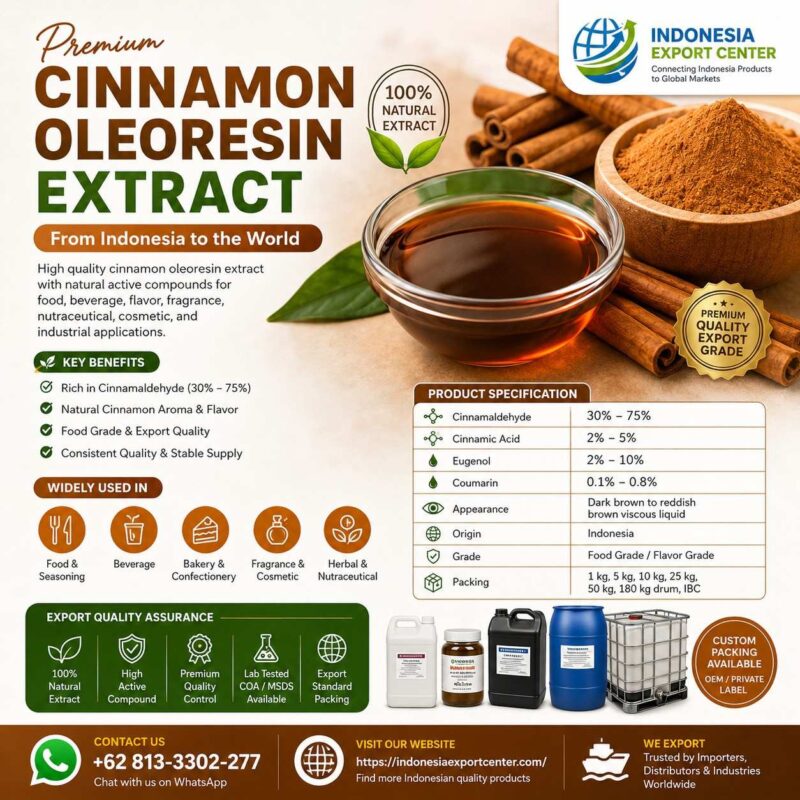
The following values are drawn from an initial commercial product brief. They are unverified reference values, not guaranteed specifications or measured batch results.
| Parameter | Preliminary Reference | Verification Required |
|---|---|---|
| Product Name | Cinnamon Oleoresin | Confirm product identity |
| Botanical Species | Not established | Botanical declaration |
| Plant Part | Not established | Supplier confirmation |
| Proposed Origin | Indonesia | Origin documentation |
| Appearance | Dark brown to reddish-brown viscous liquid | Visual inspection |
| Cinnamaldehyde | 30–75% | Validated analytical test |
| Cinnamic Acid | 2–5% | Appropriate analytical test |
| Eugenol | 2–10% | Appropriate analytical test |
| Coumarin | 0.1–0.8% | Quantitative analytical test |
| Extraction Solvent | Not specified | Process disclosure |
| Residual Solvents | Not specified | Relevant test report |
| Solubility | Not specified | Application testing |
| Viscosity | Not specified | Defined test conditions |
| Specific Gravity | Not specified | Laboratory measurement |
| Microbiological Quality | Not specified | Applicable tests |
| Heavy Metals | Not specified | Applicable tests |
| Pesticide Residues | Not specified | Applicable tests |
| Shelf Life | Not specified | Stability evidence |
| Packaging | Various proposed sizes | Supplier confirmation |
Chemical Composition
Cinnamaldehyde
Cinnamaldehyde is an important constituent associated with cinnamon aroma.
Its concentration may be relevant to product characterization and flavor performance.
However, a higher cinnamaldehyde percentage does not automatically indicate a better or more suitable product.
Cinnamic Acid
Cinnamic acid may be included in a chemical profile where relevant.
Its actual concentration should be established analytically rather than assumed.
Eugenol
Eugenol is an aromatic constituent that may be relevant to the overall profile and safety assessment.
Coumarin
Coumarin can be particularly important when assessing cassia-derived ingredients for certain applications.
Its concentration should be measured and evaluated against the applicable requirements for the intended market and finished product.
Physical Properties
Appearance and Color
Color and appearance can provide useful descriptive information, but they cannot independently establish product authenticity or quality.
Viscosity
Viscosity can affect handling, pumping, blending, and dosing.
Measurement conditions, including temperature, should be specified.
Density or Specific Gravity
These properties may support process calculations and quality control.
Solubility and Dispersibility
A buyer should specify the intended carrier or formulation environment.
Conventional cinnamon oleoresin should not automatically be considered water-soluble.
Extraction Method and Residual Solvents
The supplier should disclose the extraction method and relevant processing solvents.
Residual solvent testing should be aligned with the actual manufacturing process and intended application.
A generic claim of “solvent-free” should not replace process documentation or appropriate analytical evidence.
Quality and Safety Testing
Depending on intended use, relevant testing may include:
- Chemical marker analysis.
- Botanical identity verification.
- Residual solvent analysis.
- Heavy metal testing.
- Pesticide residue testing.
- Microbiological testing.
- Relevant contaminants.
- Stability testing.
- Sensory evaluation.
- Application-specific compatibility testing.
The appropriate tests and acceptance criteria should be established by the buyer and supplier.
Certificate of Analysis vs Technical Data Sheet
A Technical Data Sheet describes the product’s intended characteristics and specification.
A Certificate of Analysis reports analytical results for an identified batch or lot.
Buyers should compare actual COA results against the agreed specification.
Understanding Batch Variability
Botanical ingredients may vary due to differences in raw material, harvest conditions, extraction, and processing.
A reliable purchasing specification should establish acceptable ranges and appropriate testing methods.
Packaging and Storage Requirements
Packaging should be suitable for the ingredient and intended shipping conditions.
The preliminary product brief lists 1 kg, 5 kg, 10 kg, 25 kg, 50 kg, 180 kg drums, and IBCs.
Actual availability and packaging compatibility require supplier confirmation.
Storage instructions and shelf life should be supported by supplier evidence.
Technical RFQ Checklist
When requesting cinnamon oleoresin, buyers should provide:
- Required botanical species.
- Intended application.
- Target chemical composition.
- Solubility or carrier requirements.
- Required analytical methods.
- Contaminant and safety requirements.
- Packaging preferences.
- Sample quantity.
- Commercial order quantity.
- Delivery destination and Incoterm.
Frequently Asked Questions
What is the most important cinnamon oleoresin specification?
There is no single universal parameter. Suitability depends on identity, composition, safety, and intended use.
Is 30–75% cinnamaldehyde a guaranteed range?
No. It is an unverified reference from the preliminary brief.
Can cinnamon oleoresin specifications vary between suppliers?
Yes. Species, extraction, and formulation can affect the product.
Is a COA necessary?
A batch-specific COA is an important document for industrial quality assessment.
Is cinnamon oleoresin always food grade?
No. Food-use suitability must be established.
Can IEC help buyers request custom specifications?
IEC can communicate requirements to potential suppliers for feasibility review.
Request Cinnamon Oleoresin Technical Specifications
IEC welcomes inquiries from food manufacturers, flavor houses, ingredient distributors, laboratories, and international procurement teams.
REQUEST TDS, BATCH COA, SAMPLE AND SUPPLIER QUOTATION
INDONESIA EXPORT CENTER
Website: https://indonesiaexportcenter.com/
WhatsApp: +62 813-3302-277
Related Pages
