

IEC | INDONESIA EXPORT CENTER
CONNECTING INDONESIAN PRODUCTS TO THE WORLD
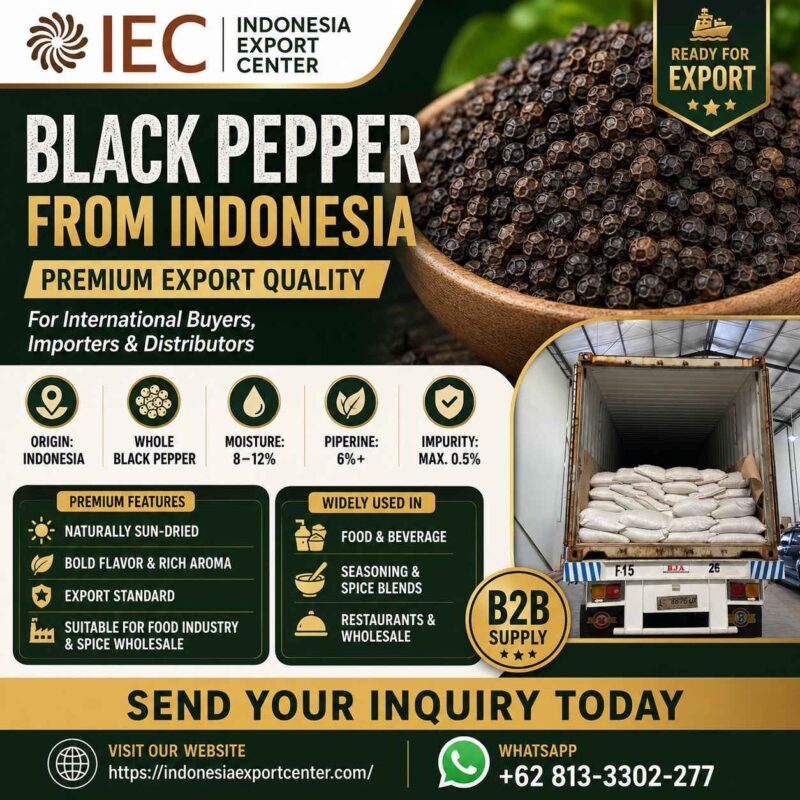
FOOD GRADE BLACK PEPPER FROM INDONESIA
PREMIUM EXPORT QUALITY
FOOD MANUFACTURING | MICROBIOLOGICAL TESTING | CONTAMINANT CONTROL | B2B EXPORT SOURCING
Looking for a Food Grade Black Pepper Supplier?
Are you searching for a reliable food grade black pepper supplier in Indonesia for food manufacturing, seasoning production, ingredient distribution, or international wholesale purchasing?
For professional food industry buyers, black pepper quality involves more than appearance, aroma, moisture, and piperine content.
Food manufacturers must also evaluate microbiological hazards, chemical contaminants, foreign matter, processing hygiene, product traceability, and relevant food safety documentation.
Whether you are importing black pepper into the United States, the European Union, or another international market, supplier qualification and documented product conformity are essential parts of responsible procurement.
IEC | Indonesia Export Center facilitates sourcing and export enquiries for Indonesian agricultural products, including potential whole black pepper supply for food industry buyers.
IEC can receive your technical requirements and seek confirmation of suitable Indonesian sourcing options, available product grades, laboratory documentation, samples, inspection arrangements, and export quotations.
Food-grade suitability must be established against the buyer’s intended use, agreed specifications, and applicable destination-market requirements.
Request Food Grade Black Pepper Specifications and Export Pricing
Send your required quantity, destination country, microbiological limits, contaminant requirements, packaging preferences, and food safety documentation checklist.
REQUEST A FOOD GRADE BLACK PEPPER QUOTE VIA WHATSAPP
WhatsApp: +62 813-3302-277
Website: https://indonesiaexportcenter.com/
Product conformity, supplier availability, laboratory testing, certifications, MOQ, packaging, pricing, and shipment schedules require confirmation.
Food Grade Black Pepper – Product Overview
| Product Information | Details |
|---|---|
| Product | Whole Black Pepper |
| Botanical Name | Piper nigrum L. |
| Country of Origin | Indonesia |
| Product Form | Whole Dried Peppercorns |
| Intended Market | United States, European Union, Global |
| Intended Buyers | Food Manufacturers and Ingredient Importers |
| Reference Moisture | 8–12% |
| Reference Piperine | 6%+ |
| Reference Impurity | Maximum 0.5% |
| Microbiological Limits | Buyer and Market-Specific |
| Salmonella Requirement | To Be Defined and Verified |
| Other Microbiological Parameters | As Applicable |
| Pesticide Residues | Applicable Destination-Market Limits |
| Mycotoxins | Applicable Destination-Market Limits |
| Heavy Metals | Applicable Destination-Market Limits |
| Foreign Matter | Buyer-Specified |
| Allergen Information | To Be Requested |
| Traceability | To Be Verified |
| Food Safety Certifications | To Be Confirmed |
| Lot-Specific COA | To Be Requested |
| Packaging | To Be Confirmed |
| MOQ | To Be Confirmed |
| Price per Metric Ton | Request Quotation |
The moisture, piperine, and impurity values are supplied reference specifications, not independently verified results for a particular commercial lot.
What Does Food Grade Black Pepper Mean?
Food grade black pepper is pepper intended for use as a food ingredient and evaluated against appropriate quality and food safety requirements.
The term food grade should not be treated as a universal certification or a guarantee of compliance.
The applicable requirements depend on factors such as:
- Destination country
- Intended application
- Processing method
- Customer specifications
- Applicable regulations
- Microbiological criteria
- Chemical contaminant limits
- Packaging and handling conditions
Food Grade Is More Than Visual Quality
Black pepper may appear clean and uniform while still requiring microbiological or chemical testing.
Similarly, a product may meet a moisture or bulk density specification without meeting the food safety requirements of a particular buyer.
Food-grade suitability should be supported by relevant evidence rather than marketing descriptions alone.
Food Safety Requirements for Black Pepper Imports
International food manufacturers commonly assess multiple categories of risk when qualifying spice ingredients.
Microbiological Hazards
Buyers may require testing for pathogens and other microbiological indicators.
Chemical Contaminants
Applicable limits may cover pesticide residues, mycotoxins, heavy metals, or other contaminants.
Physical Contamination
Foreign matter, stones, plant debris, and other extraneous material may require inspection and control.
Processing Hygiene
Buyers may review cleaning, drying, storage, and handling procedures.
Traceability
Lot identification and supplier records help support product tracking and investigation.
Documentation
Technical specifications, laboratory reports, supplier declarations, and other records may be required.
Requirements should be determined for the actual destination market and intended use.
Microbiological Limits for Food Grade Black Pepper
Microbiological quality is a critical consideration for food manufacturers purchasing dried spices.
Low moisture does not automatically eliminate microbial hazards.
Some microorganisms may survive in low-moisture foods, including dried spices.
Common Microbiological Parameters
| Parameter | Why Buyers Evaluate It | Acceptance Criteria |
|---|---|---|
| Salmonella spp. | Foodborne pathogen risk | Applicable Law and Buyer Specification |
| Total Aerobic Count | General microbiological indicator | Buyer-Specified |
| Yeasts and Moulds | Product quality and hygiene assessment | Buyer-Specified |
| Enterobacteriaceae | Hygiene-related indicator | Buyer-Specified |
| Escherichia coli | Potential hygiene indicator | Buyer-Specified |
| Bacillus cereus | Relevant to certain product and processing risk assessments | Risk-Based Requirement |
The appropriate testing panel depends on the product, intended use, buyer requirements, and applicable regulations.
Important
There is no single universal numerical microbiological specification that applies to every black pepper transaction worldwide.
The buyer and supplier should agree on the required limits, analytical methods, sampling plan, and acceptance criteria before purchase.
Salmonella Testing for Black Pepper
Salmonella is an important food safety hazard to consider in dried spices.
Its potential presence cannot be reliably assessed through appearance, aroma, or moisture testing alone.
Recommended Buyer Requirements
- Define the applicable Salmonella acceptance criterion.
- Specify the analytical method.
- Agree on the sampling plan.
- Identify the testing laboratory.
- Require traceability to the commercial lot.
- Review the laboratory report.
- Confirm any additional risk controls required for the intended application.
Example RFQ Specification Format
Parameter: Salmonella spp.
Acceptance Criterion: [Insert Applicable Regulatory or Buyer Requirement]
Analytical Method: [Specify]
Sample Size and Sampling Plan: [Specify]
Laboratory: [Specify]
Lot Number: [Required]
Test Result: [To Be Verified]
A negative result from a particular sample does not guarantee that every unit in a lot is free from contamination.
Testing should form part of a broader food safety control system.
Microbial Reduction and Treatment Options
Some food manufacturers may require a validated microbial reduction process for spices.
Potential technologies used in the spice industry include:
- Steam treatment
- Other appropriately validated decontamination processes
Treatment suitability depends on the process, regulatory requirements, and intended product application.
Questions Buyers Should Ask
- Has the pepper undergone a microbial reduction treatment?
- What treatment method was used?
- Is the treatment permitted for the destination market?
- Is the process validated for the relevant hazards?
- Are treatment records available?
- Is post-treatment contamination controlled?
- Are relevant microbiological results available?
IEC does not claim that a specific black pepper lot has been sterilized, steam-treated, or subjected to a validated microbial reduction process. Treatment availability must be confirmed.
Pesticide Residue Requirements for Black Pepper
Pesticide residues may be subject to legal maximum residue limits in the destination market.
The applicable limits can differ between countries and substances.
Recommended Verification
- Identify the destination market.
- Determine applicable pesticide residue limits.
- Specify the required testing scope.
- Request laboratory results where appropriate.
- Review the analytical methods and reporting limits.
- Confirm that results relate to the relevant lot.
US and EU Considerations
For the United States, buyers should review applicable US pesticide tolerance requirements.
For the European Union, buyers should review the applicable EU maximum residue limits.
Compliance with one market’s requirements does not automatically establish compliance with another market’s requirements.
Mycotoxin Control for Black Pepper
Mycotoxins are another category of contaminants that food industry buyers may need to assess.
Depending on the destination market and applicable requirements, buyers may request testing for relevant mycotoxins, including aflatoxins and ochratoxin A.
Recommended Mycotoxin Verification
- Determine which mycotoxins are relevant.
- Identify applicable legal limits.
- Agree on the sampling plan.
- Specify the laboratory method.
- Review lot-specific analytical results.
- Assess storage and moisture-control practices.
Why Sampling Matters
Contaminants may be unevenly distributed within a lot.
Representative sampling is therefore particularly important when assessing mycotoxins.
No lot-specific mycotoxin results have been independently verified.
Heavy Metals and Other Chemical Contaminants
Food manufacturers may also evaluate heavy metals and other contaminants when required by applicable regulations or their own risk assessments.
Potential parameters include:
- Lead
- Cadmium
- Other relevant contaminants
The testing scope and acceptance criteria should reflect the destination market and intended application.
Recommended Documentation
- Laboratory report
- Sample identification
- Lot number
- Test method
- Reporting units
- Detection or quantification limits where relevant
- Applicable acceptance criteria
Physical Contaminants and Foreign Matter
The supplied reference impurity specification is maximum 0.5%.
For food industry procurement, the definition of impurity should be agreed in writing.
Potential Physical Contaminants
- Stones
- Soil particles
- Dust
- Plant debris
- Stems
- Other extraneous material
Recommended Physical Quality Controls
- Visual inspection
- Sorting
- Cleaning
- Foreign matter testing
- Appropriate handling procedures
- Packaging inspection
The actual cleaning equipment, inspection controls, and processing procedures must be verified with the supplier.
Moisture Control for Food Grade Black Pepper
Moisture content is important for product condition and storage suitability.
The supplied reference range is 8–12%.
However, food manufacturers should establish a clear contractual maximum.
Why Moisture Matters
Excessive moisture may contribute to:
- Product deterioration
- Mould-related concerns
- Reduced storage stability
- Quality inconsistency
Recommended Moisture Verification
- Agree on the acceptance limit.
- Define the sampling procedure.
- Specify the analytical method.
- Obtain the actual lot result.
- Review storage and packaging conditions.
Moisture testing does not replace microbiological or chemical contaminant testing.
Piperine Content and Food Manufacturing Specifications
Piperine is a naturally occurring compound associated with black pepper’s pungency.
The supplied reference specification is 6%+.
Food manufacturers may evaluate piperine content for:
- Ingredient standardization
- Formulation consistency
- Product comparison
- Procurement specifications
- Quality documentation
Verification
The actual piperine result should be established using an appropriate analytical method.
The reference value is not a confirmed lot-specific result.
Food Grade Black Pepper – Reference Quality Specifications
| Quality Parameter | Reference or Requirement |
|---|---|
| Product | Whole Black Pepper |
| Origin | Indonesia |
| Moisture | 8–12% Reference |
| Piperine | 6%+ Reference |
| Impurity | Maximum 0.5% Reference |
| Bulk Density | Buyer-Specified |
| Foreign Matter | Buyer-Specified |
| Defective Peppercorns | Buyer-Specified |
| Salmonella | Applicable Regulatory and Buyer Criteria |
| Total Aerobic Count | Buyer-Specified |
| Yeasts and Moulds | Buyer-Specified |
| E. coli | Buyer-Specified |
| Pesticide Residues | Applicable Destination-Market Limits |
| Mycotoxins | Applicable Destination-Market Limits |
| Heavy Metals | Applicable Destination-Market Limits |
| Allergen Information | To Be Requested |
| Traceability | To Be Verified |
| Packaging | To Be Confirmed |
| Lot-Specific COA | To Be Requested |
The table is intended as a procurement checklist and does not certify that any particular product lot meets these requirements.
Food Safety Documentation for Black Pepper Importers
Documentation helps food manufacturers assess supplier suitability and product conformity.
Recommended Documentation Checklist
| Document | Purpose | Status |
|---|---|---|
| Product Technical Specification | Defines agreed quality parameters | To Be Requested |
| Certificate of Analysis | Provides analytical results | To Be Requested |
| Microbiological Test Report | Documents relevant microbiological results | To Be Requested |
| Pesticide Residue Report | Supports residue assessment | If Required |
| Mycotoxin Test Report | Supports mycotoxin assessment | If Required |
| Heavy Metal Test Report | Supports contaminant assessment | If Required |
| Allergen Statement | Provides relevant allergen information | To Be Requested |
| Traceability Records | Links product to identifiable lots | To Be Verified |
| Processing Information | Describes relevant production controls | To Be Requested |
| Food Safety Certification | Supports supplier qualification where applicable | To Be Confirmed |
| Packaging Specification | Defines packaging materials and requirements | To Be Requested |
| Inspection Report | Documents agreed inspection findings | If Required |
Certificate of Analysis Requirements
A useful lot-specific COA should identify:
- Product name
- Lot or batch number
- Sample identification
- Testing laboratory
- Test date
- Analytical methods
- Measured results
- Units
- Relevant acceptance criteria
A generic specification sheet is not a substitute for lot-specific analytical results.
Supplier Food Safety Qualification
Food manufacturers may require a supplier qualification process before approving a new black pepper source.
Recommended Qualification Areas
Supplier Identity
Confirm the supplier’s legal and operational identity.
Processing Facility
Review relevant processing and handling information.
Food Safety Management
Evaluate documented hygiene, hazard control, and quality management procedures.
Certifications
Request copies of relevant certifications where required.
Traceability
Confirm that lots can be identified and linked to supporting records.
Laboratory Testing
Review testing capabilities and available analytical reports.
Corrective Actions
Assess how the supplier handles nonconforming products and quality complaints.
Export Capability
Confirm commercial, logistics, and documentation responsibilities.
No specific supplier certification, audited facility, or food safety management system is claimed without verification.
HACCP, GMP, ISO 22000 and Other Food Safety Certifications
Some international food manufacturers request evidence of recognized food safety management practices or certification.
Potential requirements may include:
- HACCP-based food safety controls
- Good Manufacturing Practices (GMP)
- ISO 22000
- FSSC 22000
- Other buyer-required food safety schemes
Important Certification Checks
- Certification holder
- Facility covered
- Certification scope
- Issuing certification body
- Certificate validity
- Relevance to the product and process
Certification status must be confirmed directly with the relevant supplier.
A certification does not automatically guarantee that a particular shipment meets every buyer requirement.
Food Grade Black Pepper for the United States
US food manufacturers and importers should evaluate black pepper sourcing against applicable US food safety and import requirements.
Key Procurement Considerations
- Applicable FDA requirements
- Relevant FSMA obligations
- Foreign Supplier Verification Program (FSVP) responsibilities where applicable
- Hazard analysis and supplier verification
- Appropriate microbiological controls
- Applicable pesticide tolerances
- Product traceability
- Import documentation
- Required facility and shipment information
Foreign Supplier Verification
Where FSVP applies, the responsible US importer must establish and perform the required verification activities.
A supplier’s marketing claim that a product is “food grade” does not replace those obligations.
Recommended US Buyer Documentation
- Supplier identification
- Product specification
- Hazard-related information
- Relevant laboratory reports
- Lot traceability
- Processing information
- Applicable supplier verification records
Actual requirements depend on the product, parties involved, and applicable regulatory provisions.
Food Grade Black Pepper for the European Union
EU food manufacturers and importers should evaluate black pepper against applicable EU food safety and import requirements.
Key Procurement Considerations
- General food safety obligations
- Food hygiene requirements
- Applicable pesticide maximum residue limits
- Relevant contaminant limits
- Traceability
- Appropriate microbiological risk controls
- Product documentation
- Import requirements
EU Buyer Verification
Buyers should determine the current requirements applicable to the specific product, origin, and destination.
Relevant import controls and documentation obligations may change.
Recommended EU Buyer Documentation
- Product specification
- Supplier identification
- Lot traceability
- Relevant contaminant test reports
- Microbiological information
- Packaging information
- Required import documentation
No claim is made that any specific black pepper lot has been certified or approved for EU import.
Food Grade Black Pepper for Global Markets
Requirements differ across destination markets.
Buyers importing into Asia, the Middle East, Africa, Oceania, or other regions should identify the applicable standards and documentation requirements.
Recommended Information to Provide
- Destination country
- Intended application
- Required microbiological limits
- Pesticide residue requirements
- Mycotoxin requirements
- Heavy metal limits
- Packaging specifications
- Certification requirements
- Required import documents
IEC can receive these requirements and seek confirmation of suitable sourcing options.
Traceability and Lot Identification
Traceability is an important part of food ingredient procurement.
Recommended Lot Information
- Supplier identity
- Product name
- Country of origin
- Lot or batch number
- Relevant production or processing information
- Packaging date, where applicable
- Quantity
- Laboratory report references
- Shipment identification
Why Traceability Matters
Traceability supports:
- Product identification
- Supplier verification
- Quality investigations
- Complaint handling
- Recall procedures
- Shipment documentation
The actual traceability system and available records must be confirmed with the supplier.
Sampling and Independent Laboratory Testing
Representative sampling is essential for reliable quality evaluation.
Recommended Sampling Procedure
- Identify the commercial lot.
- Agree on the sampling method.
- Determine the appropriate number of sample increments.
- Prepare the representative sample.
- Record sample identification.
- Arrange relevant laboratory testing.
- Review results against agreed acceptance criteria.
- Link the report to the commercial lot.
Independent Testing
Buyers may request testing by an independent laboratory.
Laboratory selection, accreditation requirements, methods, costs, and timing should be agreed before purchase.
A laboratory result applies to the tested sample and must be interpreted in the context of the sampling plan and relevant lot.
Packaging for Food Grade Black Pepper Wholesale
Packaging should be suitable for food ingredients and the intended storage and shipping conditions.
Potential packaging options may include:
- Food-compatible woven bags with suitable liners
- Multiwall paper bags with suitable liners
- Other supplier-approved food-compatible packaging
Actual packaging availability and food-contact suitability must be confirmed.
Packaging Requirements
| Packaging Detail | Buyer Requirement |
|---|---|
| Packaging Material | [Specify] |
| Food-Contact Suitability | Required as Applicable |
| Net Weight per Bag | [Specify] |
| Inner Liner | [Required / Not Required] |
| Palletization | [Required / Not Required] |
| Lot Marking | [Specify] |
| Labeling | [Specify] |
| Moisture Protection | [Specify] |
| Destination Requirements | [Specify] |
Storage Considerations
Appropriate storage and handling should protect the product from moisture, contamination, pests, and packaging damage.
Applications of Food Grade Black Pepper
Food Manufacturing
Whole black pepper may be used as an ingredient in processed food products.
Seasoning and Spice Blends
Seasoning manufacturers may process peppercorns for spice formulations.
Sauce and Marinade Production
Black pepper may be incorporated into sauces, marinades, and related products.
Meat and Savoury Food Processing
Black pepper is used in various savoury food applications.
Foodservice Supply
Distributors may supply black pepper to commercial kitchens and foodservice operators.
Ingredient Distribution
Wholesale ingredient companies may supply peppercorns to food manufacturers and processors.
Suitability depends on the intended application and applicable food safety requirements.
Food Grade Black Pepper Wholesale Pricing
Pricing depends on technical, commercial, and logistics requirements.
Main Price Factors
- Required product grade
- Moisture specification
- Piperine requirement
- Impurity limits
- Microbiological criteria
- Contaminant testing
- Processing or treatment requirements
- Certifications
- Inspection requirements
- Order quantity
- Packaging
- Supplier availability
- Destination
- Freight
- Insurance
- Incoterm
- Payment terms
Food Safety Testing Costs
Additional laboratory testing or processing requirements may affect the commercial quotation.
Buyers should confirm which tests, documents, and services are included in the quoted price.
No current food-grade black pepper price, MOQ, or available quantity has been independently verified.
Export Shipping and Documentation
International shipments may involve:
- Full Container Load (FCL)
- Less Than Container Load (LCL)
- Air freight for suitable smaller consignments
The appropriate shipping method depends on quantity, packaging, destination, and logistics requirements.
Potential Export Documents
Depending on the transaction and destination, documents may include:
- Commercial Invoice
- Packing List
- Bill of Lading or Air Waybill
- Certificate of Origin, where applicable
- Phytosanitary Certificate, where required
- Relevant laboratory reports
- Other destination-specific documents
Document availability and requirements must be confirmed for the actual shipment.
How to Source Food Grade Black Pepper from Indonesia
Step 1: Define the Intended Application
Specify how the black pepper will be used.
Step 2: Identify Destination-Market Requirements
Determine the applicable food safety and import requirements.
Step 3: Submit Your Technical Specification
Include moisture, piperine, impurity, microbiological criteria, and contaminant limits.
Step 4: Request Supplier Qualification Information
Ask for relevant processing, hygiene, certification, and traceability information.
Step 5: Confirm Product Availability
Request confirmation of available quantity, grade, MOQ, and lead time.
Step 6: Request Samples
Where available, evaluate representative samples.
Step 7: Review Laboratory Documentation
Assess the COA and relevant microbiological and contaminant reports.
Step 8: Arrange Additional Testing or Inspection
Where required, agree on sampling, laboratory methods, and acceptance criteria.
Step 9: Review Commercial Terms
Confirm price, packaging, Incoterm, payment terms, and shipment schedule.
Step 10: Finalize the Purchase Agreement
Identify the contractual seller, exporter of record, and responsibilities of each party.
Ready-to-Send RFQ – Food Grade Black Pepper Supplier Indonesia
Subject: RFQ – Food Grade Whole Black Pepper from Indonesia
Dear IEC | Indonesia Export Center Team,
We are interested in sourcing food grade whole black pepper from Indonesia for our food manufacturing or ingredient distribution operations.
Our purchasing requirements include product quality specifications, microbiological limits, contaminant testing, food safety documentation, and commercial export terms.
Please advise whether suitable Indonesian supply options are available.
BUYER INFORMATION
Company Name: [Company Name]
Country: [Country]
Business Type: [Food Manufacturer / Spice Processor / Ingredient Importer / Wholesale Distributor]
Contact Person: [Name]
Email: [Email]
WhatsApp: [Number]
PRODUCT REQUIREMENTS
Product: Whole Black Pepper
Origin: Indonesia
Intended Application: [Specify]
Destination Market: [United States / European Union / Other]
Required Quantity: [MT]
Order Frequency: [Trial / One-Time / Monthly / Quarterly]
REFERENCE TECHNICAL SPECIFICATIONS
| Parameter | Requirement |
|---|---|
| Product | Whole Black Pepper |
| Origin | Indonesia |
| Moisture | 8–12% Reference; Confirm Contractual Limit |
| Piperine | 6%+ Reference; Request Verification |
| Impurity | Maximum 0.5% Reference |
| Bulk Density | [Specify] |
| Foreign Matter | [Specify] |
| Defect Limits | [Specify] |
| Salmonella | [Specify Acceptance Criterion and Method] |
| Total Aerobic Count | [Specify] |
| Yeasts and Moulds | [Specify] |
| E. coli | [Specify] |
| Pesticide Residues | Applicable Destination-Market Limits |
| Mycotoxins | Applicable Destination-Market Limits |
| Heavy Metals | Applicable Destination-Market Limits |
| Allergen Information | [Specify] |
| Microbial Reduction Treatment | [Required / Not Required / To Be Discussed] |
FOOD SAFETY DOCUMENTATION REQUESTED
Please advise whether the following can be provided:
- Supplier identity.
- Product technical specification.
- Lot-specific COA.
- Microbiological test report.
- Pesticide residue test report.
- Mycotoxin test report.
- Heavy metal test report, if required.
- Allergen statement.
- Processing and handling information.
- Traceability records.
- Relevant food safety certifications.
- Representative sample.
- Packaging specifications.
- Inspection arrangements.
COMMERCIAL REQUIREMENTS
Required Quantity: [MT]
Preferred Packaging: [Specify]
Destination Country: [Country]
Destination Port: [Port]
Requested Incoterm: [FCA / FOB / CFR / CIF / CIP / Other]
Target Shipment Period: [Month / Year]
Please confirm:
- Product availability.
- Minimum order quantity.
- Available quantity.
- Sample availability.
- Price per metric ton.
- Available food safety documentation.
- Laboratory testing arrangements.
- Packaging options.
- Payment terms.
- Shipment lead time.
- Relevant export documentation.
- Quotation validity.
We will review the supplier qualification information, laboratory results, product specifications, and commercial terms before proceeding.
Thank you. We look forward to your response.
Kind regards,
[Your Name] [Company Name] [Country]SEND YOUR FOOD GRADE BLACK PEPPER RFQ VIA WHATSAPP
Frequently Asked Questions – Food Grade Black Pepper Supplier
1. What is food grade black pepper?
Food grade black pepper is black pepper intended for food use and evaluated against applicable quality and food safety requirements.
2. Is food grade black pepper automatically FDA-approved?
No. “Food grade” is not a universal FDA approval or certification claim. Applicable US regulatory requirements must be assessed for the actual product and transaction.
3. What microbiological tests may be required?
Depending on the intended use and buyer requirements, testing may include Salmonella, total aerobic count, yeasts and moulds, E. coli, and other relevant parameters.
4. Is Salmonella testing important for black pepper?
Yes. Salmonella is a relevant food safety hazard for dried spices and should be addressed through appropriate risk controls and verification.
5. Does low moisture guarantee microbiological safety?
No. Low moisture does not automatically eliminate microbial hazards.
6. What contaminant tests may be required?
Depending on the market and risk assessment, buyers may request pesticide residue, mycotoxin, heavy metal, or other contaminant testing.
7. Can black pepper be imported into the United States?
Imports may be possible subject to applicable US regulatory, food safety, and customs requirements.
8. Can black pepper be imported into the European Union?
Imports may be possible subject to applicable EU food safety, contaminant, traceability, and import requirements.
9. Does IEC guarantee US or EU compliance?
No. Compliance must be established for the actual product, supplier, destination, and transaction.
10. Can buyers request a lot-specific COA?
A COA may be requested, subject to supplier and laboratory availability.
11. Can buyers request food safety certifications?
Buyers may request relevant certification information, subject to supplier status and verification.
12. Is steam-treated black pepper available?
Treatment availability must be confirmed. No specific treated product is claimed as available.
13. Can buyers request independent inspection?
Inspection may be arranged subject to agreement regarding scope, provider, costs, and timing.
14. What is the minimum order quantity?
No fixed MOQ has been independently verified.
15. Can IEC provide a food grade black pepper quotation?
IEC can receive technical and commercial enquiries and seek confirmation of suitable supplier quotations.
16. Is IEC the manufacturer or exporter of record?
IEC facilitates sourcing and export enquiries. The manufacturer, contractual seller, and exporter of record must be confirmed for each transaction.
Request Food Grade Black Pepper Wholesale Pricing from Indonesia
For international food manufacturers searching for a food grade black pepper supplier, product safety, supplier qualification, and documented conformity should be central to the purchasing process.
The supplied reference specifications provide a starting point for technical enquiries:
| Parameter | Details |
|---|---|
| Product | Whole Black Pepper |
| Origin | Indonesia |
| Reference Moisture | 8–12% |
| Reference Piperine | 6%+ |
| Reference Impurity | Maximum 0.5% |
| Microbiological Requirements | Buyer and Market-Specific |
| Contaminant Testing | As Applicable |
| Food Safety Documentation | To Be Requested |
| Lot-Specific COA | To Be Requested |
| Traceability | To Be Verified |
| Certifications | To Be Confirmed |
| MOQ | To Be Confirmed |
| Packaging | To Be Confirmed |
| Price | Request Quotation |
Actual food-grade suitability must be established through appropriate verification against the intended market and application.
IEC | INDONESIA EXPORT CENTER
CONNECTING INDONESIAN PRODUCTS TO THE WORLD
FOOD GRADE BLACK PEPPER SOURCING ENQUIRIES
FOR FOOD MANUFACTURERS, INGREDIENT IMPORTERS & INTERNATIONAL DISTRIBUTORS
SEND YOUR FOOD GRADE BLACK PEPPER ENQUIRY TODAY
WhatsApp: +62 813-3302-277
Website: https://indonesiaexportcenter.com/
Contact us for specifications, food safety documentation enquiries, quotations, and export inquiries.
Technical and Commercial Disclaimer: The moisture, piperine, and impurity values are supplied reference specifications, not independently verified lot-specific results. No particular product lot has been independently confirmed as compliant with US, EU, or other destination-market food safety requirements. Microbiological results, contaminant testing, processing methods, certifications, traceability, COA, supplier identity, MOQ, packaging, pricing, and shipment arrangements require confirmation. The term “food grade” does not independently establish regulatory compliance. IEC facilitates sourcing and export enquiries; the manufacturer, contractual seller, and exporter of record must be identified before purchase.
