

IEC | INDONESIA EXPORT CENTER
CONNECTING INDONESIAN PRODUCTS TO THE WORLD
COCONUT OIL PRODUCT RANGE
PREMIUM INDONESIAN EXPORT PRODUCTS
HIGH QUALITY | EXPORT READY | CONSISTENT SPECIFICATIONS | RELIABLE SUPPLY
Low Odor Refined Coconut Oil | Super Premium RBD Grade | Sensory Evaluation | Odor Panel Requirements | Bulk Ingredient Sourcing
Looking for Low Odor Refined Coconut Oil in Bulk?
Are you searching for low odor refined coconut oil bulk supply for food manufacturing, specialty ingredient formulations or industrial applications where the ingredient’s aroma must be carefully controlled?
For sensitive formulations, coconut oil’s odor profile can influence the sensory characteristics of the finished product.
Refined, Bleached and Deodorised (RBD) Coconut Oil is commonly evaluated for applications where a relatively neutral flavor and odor profile is desirable.
However, the term “low odor” must be defined and verified through appropriate sensory evaluation.
Indonesia Export Center (IEC) facilitates sourcing and export enquiries for Indonesian coconut oil products, including Super Premium RBD Coconut Oil.
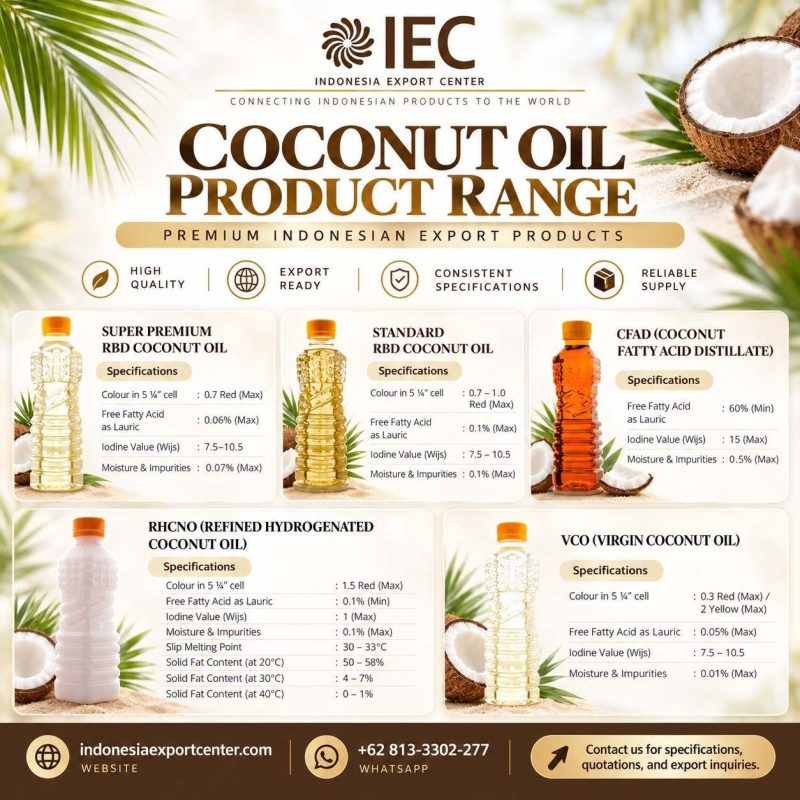
The supplied Super Premium RBD Coconut Oil reference specifies:
- Colour in 5¼-inch Cell: 0.7 Red (Max)
- Free Fatty Acid as Lauric: 0.06% (Max)
- Iodine Value (Wijs): 7.5–10.5
- Moisture & Impurities: 0.07% (Max)
These reference parameters support technical evaluation, but none directly establishes a numerical odor limit or confirms sensory neutrality.
Buyers requiring low odor refined coconut oil should request the manufacturer’s sensory specifications, representative samples, odor panel procedures and lot-specific quality documentation.
IEC welcomes enquiries from food manufacturers, specialty ingredient importers, formulation teams, QA/QC departments and international bulk buyers.
REQUEST LOW ODOR REFINED COCONUT OIL SPECIFICATIONS AND BULK QUOTATION
WhatsApp: https://wa.me/628133302277
Website: https://indonesiaexportcenter.com/
Odor performance, manufacturer identity, batch COA, availability, MOQ, packaging, certifications and shipment terms require verification.
1. Low Odor Refined Coconut Oil – Product Overview
| Procurement Item | Information |
|---|---|
| Product | Super Premium RBD Coconut Oil |
| Product Category | Refined Coconut Oil |
| Proposed Sourcing Country | Indonesia |
| Target Market | Global |
| Primary Buyers | Sensitive Formulation Buyers |
| Additional Buyers | Food Manufacturers, Ingredient Distributors, Importers |
| Product Grade | Super Premium RBD |
| Intended Sensory Requirement | Low Odor, Subject to Testing |
| Verified Odor Specification | Not Yet Established |
| Odor Panel Results | To Be Requested and Verified |
| Reference Colour | 0.7 Red (Max), 5¼-inch Cell |
| Reference FFA as Lauric | 0.06% (Max) |
| Reference Iodine Value | 7.5–10.5 |
| Reference Moisture & Impurities | 0.07% (Max) |
| Manufacturer | To Be Verified |
| Contractual Seller | To Be Confirmed |
| Exporter of Record | To Be Confirmed |
| Manufacturer Specification | To Be Requested |
| Batch COA | To Be Requested and Verified |
| Food-Grade Compliance | To Be Verified |
| Certifications | To Be Verified |
| MOQ | To Be Confirmed |
| Available Quantity | To Be Confirmed |
| Packaging | To Be Confirmed |
| Price per MT | Request Quotation |
| Shipment Lead Time | To Be Confirmed |
2. What Is Low Odor Refined Coconut Oil?
Low odor refined coconut oil is a commercial description for refined coconut oil intended to meet a defined odor requirement.
The term does not establish a universal odor threshold.
A buyer should define the required sensory characteristics and the method used to evaluate them.
3. What Does RBD Mean?
RBD stands for:
Refined
Bleached
Deodorised
These processing stages are intended to reduce certain undesirable components and modify color, odor and flavor characteristics.
4. Why Odor Matters in Ingredient Formulations
An ingredient’s odor may influence the perceived aroma of a finished formulation.
This is particularly relevant where the desired finished product has a subtle or carefully controlled sensory profile.
5. Is RBD Coconut Oil Naturally Odorless?
RBD coconut oil is generally associated with a relatively neutral odor profile.
However, completely odorless performance is not guaranteed.
Actual odor characteristics should be evaluated.
6. Is Low Odor the Same as Odorless?
No.
Low odor suggests a limited or acceptable odor intensity under defined conditions.
Odorless implies no detectable odor under a particular evaluation method.
Neither should be claimed without supporting evidence.
7. Does Super Premium Automatically Mean Low Odor?
No.
The supplied Super Premium reference does not include an odor test result or odor acceptance limit.
8. Why Sensory Testing Is Necessary
Sensory evaluation provides information about odor characteristics that cannot be inferred from FFA, iodine value, color, or moisture alone.
Super Premium RBD Coconut Oil Reference Specifications
9. Technical Specification Table
| Quality Parameter | Super Premium Reference |
|---|---|
| Colour in 5¼-inch Cell | 0.7 Red (Max) |
| Free Fatty Acid as Lauric | 0.06% (Max) |
| Iodine Value (Wijs) | 7.5–10.5 |
| Moisture & Impurities | 0.07% (Max) |
| Odor Intensity | Not Specified |
| Sensory Acceptance Criteria | Buyer and Supplier to Agree |
| Odor Panel Results | To Be Requested |
Important: The four numerical values are supplied reference specifications, not verified batch results. No odor specification or sensory test result has been provided.
10. Color: 0.7 Red Maximum
The supplied reference specifies:
Colour in 5¼-inch Cell: 0.7 Red (Max)
Color is not a direct measurement of odor.
11. Free Fatty Acid: 0.06% Maximum
The supplied reference specifies:
FFA as Lauric: 0.06% (Max)
FFA is a quality parameter, but it does not independently prove low odor.
12. Iodine Value: 7.5–10.5
The supplied reference specifies:
Iodine Value (Wijs): 7.5–10.5
Iodine value is not an odor measurement.
13. Moisture and Impurities: 0.07% Maximum
The supplied reference specifies:
Moisture & Impurities: 0.07% (Max)
This parameter does not directly establish sensory neutrality.
14. Odor Specification
No numerical odor limit has been supplied.
Buyers should establish an appropriate sensory specification.
15. Flavor Specification
Flavor characteristics should be assessed separately where relevant.
16. Appearance and Odor
Appearance and odor are different quality attributes.
Both may be relevant to sensitive formulations.
17. Oxidation and Odor
Oxidation-related changes can influence odor characteristics.
Appropriate testing may be relevant depending on the application.
18. Storage and Odor
Storage conditions may influence product quality and sensory characteristics.
19. Packaging and Odor
Packaging should be appropriate for protecting the product during storage and transport.
20. Batch-to-Batch Sensory Consistency
Consistency should be assessed through actual lot or batch records.
No blanket consistency guarantee is claimed.
Odor Panel Requirements for Refined Coconut Oil
21. What Is an Odor Panel?
An odor panel is a group of assessors evaluating the odor characteristics of a sample under defined conditions.
22. Why Use an Odor Panel?
An odor panel can help assess whether the product meets the buyer’s sensory expectations.
23. Sensory Specification
The buyer should define the odor characteristics that are acceptable.
24. Odor Intensity
Odor intensity describes how strongly an odor is perceived under the test conditions.
25. Odor Character
Odor character describes the type of odor perceived.
26. Off-Odor
An off-odor is an undesirable odor characteristic under the agreed sensory specification.
27. Reference Sample
An approved reference sample may help assess future deliveries.
28. Sensory Evaluation Method
The buyer and supplier should agree on a suitable evaluation method.
29. Sample Preparation
Sample preparation should be standardized.
30. Sample Temperature
Temperature may affect odor perception.
The agreed procedure should define the sample temperature.
31. Sample Container
The evaluation container should be appropriate and should not introduce interfering odors.
32. Sample Quantity
The sample quantity should be defined.
33. Panel Environment
Sensory testing should be conducted in a suitable environment.
34. Panelist Selection
Assessors should be appropriate for the evaluation method.
35. Panel Training
Training may improve the consistency of sensory evaluations.
36. Blind Evaluation
Blind or coded samples may help reduce certain sources of bias.
37. Replicate Testing
Replicate assessments may be useful where required by the testing protocol.
38. Sensory Scoring
A defined scoring system may be used.
No specific odor score or pass threshold has been supplied.
39. Acceptance Criteria
The buyer should establish acceptance criteria before testing.
40. Sensory Test Report
A report should identify the sample, method, conditions, results and conclusion.
41. Lot Identification
The sensory test report should identify the lot or sample tested.
42. Sensory Retesting
The parties should agree on retesting procedures where necessary.
43. Disputed Sensory Results
A contractual dispute-resolution procedure may be useful where sensory acceptance is commercially important.
44. Sensory Evaluation Limitations
Sensory testing involves human perception and requires appropriate procedures to support reliable interpretation.
Example Odor Evaluation Framework
45. Buyer-Defined Odor Panel Framework
The following is an illustrative evaluation framework, not an existing IEC or manufacturer testing procedure.
| Evaluation Item | Buyer-Defined Requirement |
|---|---|
| Product | Super Premium RBD Coconut Oil |
| Sample Identification | Lot / Batch Number |
| Sample Preparation | Agreed Procedure |
| Evaluation Temperature | Buyer and Supplier to Agree |
| Panel Size | Buyer and Supplier to Agree |
| Odor Intensity Scale | Defined Before Testing |
| Acceptable Odor Character | Defined Before Testing |
| Off-Odor Criteria | Defined Before Testing |
| Reference Sample | If Available and Agreed |
| Pass / Fail Decision | Based on Agreed Criteria |
| Retesting Procedure | Agreed in Advance |
| Report Format | Documented Results |
46. Example Odor Intensity Scale
A buyer might develop a scoring scale for its internal evaluation.
For example:
| Illustrative Score | Illustrative Description |
|---|---|
| 0 | No odor detected under test conditions |
| 1 | Very faint odor |
| 2 | Mild odor |
| 3 | Moderate odor |
| 4 | Strong odor |
| 5 | Very strong odor |
This is an illustrative scoring framework only. It is not a validated standard, supplier specification or claimed product result.
The buyer must determine the appropriate scale and acceptance limit.
47. Defining Acceptable Odor
The buyer should identify which odor characteristics are acceptable for the intended formulation.
48. Defining Unacceptable Odor
The buyer should identify which off-odor characteristics would result in rejection.
49. Testing at Relevant Conditions
Testing conditions should reflect the intended use where appropriate.
50. Recording Sensory Results
Results should be recorded consistently.
51. Linking Sensory Results to Lots
The sensory report should identify the tested lot.
52. Reviewing Lot-to-Lot Variability
Repeat buyers may review sensory records across deliveries.
53. Avoiding Unsupported Sensory Claims
No claim is made that every available or future lot is odorless or meets a specific odor score.
Low Odor Refined Coconut Oil for Sensitive Formulations
54. Bakery Applications
Low odor refined coconut oil may be evaluated for bakery formulations where ingredient aroma should not dominate the finished product.
55. Confectionery Applications
The oil may be considered for selected confectionery formulations.
56. Non-Dairy Creamer Applications
The oil may be evaluated for selected non-dairy creamer formulations.
57. Food Ingredient Blending
The product may be considered for ingredient blends requiring controlled sensory characteristics.
58. Specialty Food Manufacturing
Food processors may evaluate the oil for suitable specialty formulations.
59. Cosmetic Formulations
Refined coconut oil may be evaluated for certain cosmetic formulations, subject to applicable specifications and regulatory requirements.
60. Personal Care Formulations
The oil may be considered for suitable personal care applications.
61. Industrial Formulations
Suitability depends on the actual formulation and process requirements.
62. Flavor-Sensitive Products
Where flavor is important, buyers should evaluate flavor separately from odor.
63. Fragrance-Sensitive Products
Where fragrance compatibility is important, formulation testing should be performed.
64. Formulation Trials
Buyers should conduct relevant trials before commercial adoption.
65. Finished Product Sensory Testing
Testing the finished formulation may be necessary to establish suitability.
66. Application-Specific Approval
The buyer’s technical team should approve the product for the intended use.
Quality Assurance Beyond Odor
67. Odor Is One Quality Parameter
Odor evaluation does not replace technical and safety testing.
68. FFA Testing
The supplied Super Premium reference specifies 0.06% maximum FFA as Lauric.
69. Moisture and Impurities
The supplied reference specifies 0.07% maximum.
70. Iodine Value
The supplied reference specifies 7.5–10.5.
71. Color
The supplied reference specifies 0.7 Red maximum.
72. Peroxide Value
Peroxide value may be relevant to oxidation assessment.
No peroxide value limit has been supplied.
73. Fatty Acid Composition
Fatty acid composition may be relevant to product identity and formulation suitability.
74. Relevant Contaminants
Food and cosmetic applications may have additional requirements.
75. Food-Grade Compliance
Food-grade status must be verified separately.
76. Cosmetic-Grade Compliance
Cosmetic suitability and compliance must be verified separately.
77. Certifications
Relevant certification claims require verification.
78. Manufacturer Quality System
Request information about the manufacturer’s quality procedures.
79. Batch Traceability
Traceability should connect the product to relevant manufacturing and testing records.
80. Shelf-Life Information
Shelf-life claims require product-specific evidence.
COA and Sensory Documentation
81. What Is a COA?
A Certificate of Analysis reports analytical results for an identified batch or sample.
82. Does a COA Automatically Include Odor Results?
No.
The buyer should confirm whether odor or sensory evaluation is included.
83. COA vs Sensory Report
A COA may document analytical parameters.
A separate sensory report may be needed for a detailed odor panel evaluation.
84. Lot-Specific Documentation
The buyer should request documents linked to the actual offered lot.
85. Manufacturer Specification
Request the current manufacturer-issued specification.
86. Sensory Test Method
Request the applicable odor evaluation procedure.
87. Sample Availability
Representative samples may be requested, subject to availability.
88. Independent Testing
Independent sensory or analytical testing may be requested, subject to agreement and laboratory capability.
89. Pre-Shipment Inspection
Inspection arrangements should be agreed before shipment.
90. Arrival Evaluation
The buyer may conduct agreed receiving inspection and sensory evaluation.
91. Nonconforming Lots
The purchase contract should define procedures for nonconforming material.
92. Quality Claims
Any quality claim should be supported by relevant evidence.
Super Premium vs Standard RBD Coconut Oil
93. Reference Specification Comparison
| Quality Parameter | Super Premium RBD | Standard RBD |
|---|---|---|
| Colour in 5¼-inch Cell | 0.7 Red (Max) | 0.7–1.0 Red (Max) |
| Free Fatty Acid as Lauric | 0.06% (Max) | 0.1% (Max) |
| Iodine Value (Wijs) | 7.5–10.5 | 7.5–10.5 |
| Moisture & Impurities | 0.07% (Max) | 0.1% (Max) |
| Odor Specification | Not Supplied | Not Supplied |
Technical clarification: The Standard RBD color reference combines a range and maximum designation. The manufacturer should clarify the intended acceptance limit.
94. Does Super Premium Have Lower Odor?
Not established by the supplied specifications.
95. Can Standard RBD Meet a Low Odor Requirement?
Possibly, depending on actual sensory testing.
96. Does Lower FFA Prove Lower Odor?
No.
FFA alone does not establish odor intensity.
97. Does Lower Moisture Prove Lower Odor?
No.
Moisture and impurities are separate quality parameters.
98. Which Grade Is Better for Sensitive Formulations?
The appropriate grade depends on verified sensory performance and complete technical suitability.
99. Can Buyers Request Both Grades?
Yes, subject to availability.
100. Grade Selection Based on Sensory Results
For odor-sensitive applications, compare actual tested samples under an agreed method.
Bulk Packaging and International Sourcing
101. Bulk Quantity Requirements
Specify the required quantity in metric tons.
102. Minimum Order Quantity
No fixed MOQ has been verified.
103. Available Quantity
Availability must be confirmed.
104. Steel Drum Packaging
Buyers may request steel drum packaging information.
Availability must be confirmed.
105. IBC Tank Packaging
Buyers may request IBC packaging information.
Availability and compatibility must be confirmed.
106. Flexitank Packaging
Buyers may request flexitank arrangements.
Product suitability, carrier approval and loading conditions require verification.
107. Packaging Odor Compatibility
Packaging should not introduce unacceptable odors or contamination.
108. Packaging Cleanliness
Appropriate packaging cleanliness requirements should be established.
109. Storage Conditions
Storage conditions should protect the product’s required quality characteristics.
110. Transport Conditions
Transport arrangements should be appropriate for the product and packaging.
111. Temperature Management
Coconut oil may change physical state depending on temperature.
112. Packaging Traceability
Packaging should support lot identification.
113. Container Loading
Actual loading capacity depends on packaging and container restrictions.
Export Quotations and Delivery Terms
114. Price per MT
Request the actual price per metric ton.
115. Currency
Confirm the quotation currency.
116. FOB Indonesia
Under Incoterms® 2020, FOB risk generally transfers when goods are loaded on board at the named shipment port.
For certain containerised shipments, FCA may be more appropriate.
117. CFR Destination
Under CFR, the seller contracts and pays for carriage to the named destination port.
Risk generally transfers on board at origin.
118. CIF Destination
Under CIF, the seller contracts and pays for carriage and obtains the insurance required by the rule.
Risk generally transfers on board at origin.
For certain containerised shipments, CIP may be more appropriate.
119. Origin Port
The actual Indonesian shipment port must be confirmed.
120. Destination Port
The buyer should specify the destination port.
121. Freight and Insurance
Actual freight and insurance terms require confirmation.
122. Payment Terms
Payment terms should be agreed with the contractual seller.
123. Lead Time
No fixed production or shipment lead time has been verified.
124. Export Documentation
Depending on the transaction, documents may include:
- Commercial invoice
- Packing list
- Bill of lading
- Certificate of Origin
- Certificate of Analysis
- Insurance documents
- Other applicable certificates
125. Import Compliance
The importer should verify destination-market requirements.
Low Odor Refined Coconut Oil – Buyer Checklist
Sensory Requirements
-
Intended application confirmed
-
Low odor requirement defined
-
Acceptable odor characteristics identified
-
Unacceptable off-odors identified
-
Sensory evaluation method agreed
-
Sample preparation procedure defined
-
Evaluation temperature specified
-
Odor intensity scale defined
-
Acceptance criteria established
-
Sensory report requested
-
Lot identification verified
Technical Quality
-
Super Premium grade confirmed
-
Manufacturer specification obtained
-
FFA limit confirmed
-
Color limit confirmed
-
Iodine value confirmed
-
Moisture and impurities limit confirmed
-
Batch COA requested
-
Additional testing requirements identified
-
Food-grade or cosmetic suitability verified where relevant
-
Relevant certifications verified
Supplier Qualification
-
Manufacturer identified
-
Contractual seller confirmed
-
Exporter of record confirmed
-
Available quantity confirmed
-
MOQ confirmed
-
Packaging confirmed
-
Lead time confirmed
Commercial and Logistics
-
Quantity in MT specified
-
Price per MT obtained
-
Currency confirmed
-
Incoterm agreed
-
Named port confirmed
-
Freight reviewed
-
Insurance reviewed
-
Payment terms agreed
-
Export documentation reviewed
RFQ Template – Low Odor Refined Coconut Oil Bulk
Subject: RFQ – Low Odor Super Premium RBD Coconut Oil Bulk Supply
Dear Indonesia Export Center Team,
We are evaluating low odor refined coconut oil from Indonesia for a formulation-sensitive application.
Please provide the current manufacturer-issued specification, available batch COA, odor evaluation information, sample availability, packaging options and commercial quotation.
Buyer Information
Company Name: [Company Name]
Country: [Country]
Business Type: [Food Manufacturer / Cosmetic Manufacturer / Ingredient Distributor / Importer / Other]
Contact Person: [Name]
Email: [Email]
Phone / WhatsApp: [Number]
Product Requirements
Product: Super Premium RBD Coconut Oil
Intended Application: [Application]
Required Quantity: [MT]
Expected Order Frequency: [One-Time / Monthly / Repeat Orders]
Reference Technical Specifications
| Parameter | Reference |
|---|---|
| Colour in 5¼-inch Cell | 0.7 Red (Max) |
| FFA as Lauric | 0.06% (Max) |
| Iodine Value (Wijs) | 7.5–10.5 |
| Moisture & Impurities | 0.07% (Max) |
Odor Requirements
Required Odor Profile: [Describe]
Acceptable Odor Intensity: [Define]
Unacceptable Off-Odors: [Define]
Sensory Evaluation Method: [Specify or Request Supplier Proposal]
Evaluation Temperature: [Specify or Agree]
Reference Sample: [Available / Required / Not Available]
Lot-Specific Odor Test Report: [Requested]
Please confirm whether the supplier can support these sensory requirements.
Quality Documentation Requested
Please provide:
- Actual manufacturer name and address
- Contractual seller and exporter of record
- Current manufacturer-issued specification
- Batch-specific COA availability
- Odor or sensory specification, if available
- Sensory evaluation method, if available
- Lot-specific sensory report availability
- Product sample availability
- Relevant food safety or cosmetic documentation
- Certification information, if applicable
- Independent testing options, if available
Packaging Requirements
Preferred Packaging: [Steel Drums / IBC / Flexitank / Other]
Preferred Net Fill: [Specify]
Packaging Odor Requirements: [Details]
Shipping Requirements
Destination Country: [Country]
Destination Port: [Port]
Preferred Incoterm: [FCA / FOB / CFR / CIF / CIP / Other]
Target Shipment Period: [Month / Year]
Commercial Information Requested
Please provide:
- MOQ
- Available quantity
- Price per MT
- Currency
- Packaging specifications
- Incoterm and named port
- Freight quotation if applicable
- Insurance information if applicable
- Production lead time
- Estimated shipment period
- Payment terms
- Quotation validity
- Export documentation
- Any additional commercial conditions
We will evaluate the technical specifications, actual sensory results, formulation suitability and commercial terms before making a purchase decision.
Kind regards,
[Your Name] [Company Name] [Country]SEND YOUR LOW ODOR REFINED COCONUT OIL ENQUIRY
WhatsApp: https://wa.me/628133302277
Frequently Asked Questions – Low Odor Refined Coconut Oil Bulk
What is low odor refined coconut oil?
It is refined coconut oil intended to meet a defined odor requirement under an agreed sensory evaluation method.
Is RBD coconut oil odorless?
Not necessarily. RBD coconut oil is generally associated with a relatively neutral odor, but actual sensory performance must be verified.
What does RBD mean?
RBD stands for Refined, Bleached and Deodorised.
Is low odor the same as odorless?
No. The terms imply different sensory expectations.
Does Super Premium automatically mean low odor?
No. The supplied Super Premium specification does not include an odor limit.
What is an odor panel?
An odor panel is a group of assessors evaluating odor characteristics under defined conditions.
Why is an odor panel important?
It can help determine whether the oil meets the buyer’s sensory requirements.
Is there a universal odor score for RBD coconut oil?
No universal score has been established for this supplied product reference.
Can I request an odor test report?
Yes. Availability must be confirmed.
Can I request a product sample?
Yes, subject to availability.
Can I request independent sensory testing?
Yes, subject to agreement and laboratory capability.
Does low FFA guarantee low odor?
No. FFA alone does not establish odor intensity.
What is the FFA specification?
The supplied Super Premium reference states 0.06% maximum FFA as Lauric.
What is the color specification?
The supplied reference states 0.7 Red maximum in a 5¼-inch cell.
What is the iodine value?
The supplied reference states 7.5–10.5.
What is the moisture and impurities specification?
The supplied reference states 0.07% maximum.
Does a COA automatically include odor results?
No. Sensory results may require separate documentation.
Can low odor RBD coconut oil be used in bakery products?
It may be evaluated for selected bakery formulations.
Can low odor RBD coconut oil be used in confectionery?
It may be evaluated for selected confectionery formulations.
Can low odor RBD coconut oil be used in cosmetics?
It may be evaluated for suitable cosmetic applications, subject to relevant requirements.
Is the product automatically food grade?
No. Food-grade suitability requires verification.
What is the MOQ?
No fixed MOQ has been verified.
Can I request 20 MT?
Yes, as a buyer enquiry. Availability must be confirmed.
Is steel drum packaging available?
Availability requires confirmation.
Is IBC packaging available?
Availability requires confirmation.
Is flexitank packaging available?
Suitability and availability require confirmation.
Can I request FOB Indonesia pricing?
Yes. The named Indonesian shipment port should be agreed.
Can I request CIF destination pricing?
Yes, subject to supplier and freight confirmation.
Is monthly supply available?
Recurring supply capability must be verified.
How can I request a quotation?
Contact IEC with your odor requirements, intended application, quantity, packaging, destination port and delivery terms.
Source Low Odor Refined Coconut Oil with Defined Sensory Requirements
For sensitive formulations, the most important question is not simply whether an oil is described as low odor.
The key question is whether the specific product lot meets the buyer’s agreed sensory acceptance criteria.
The supplied Super Premium RBD Coconut Oil reference specifies:
Colour: 0.7 Red (Max), 5¼-inch Cell
FFA as Lauric: 0.06% (Max)
Iodine Value: 7.5–10.5
Moisture & Impurities: 0.07% (Max)
These reference values support technical evaluation, but they do not establish an odor specification.
Buyers should request appropriate sensory testing, representative samples, batch documentation and manufacturer confirmation before purchasing.
Indonesia Export Center welcomes enquiries from international buyers evaluating Indonesian Super Premium RBD Coconut Oil for odor-sensitive formulations.
Request Low Odor Refined Coconut Oil Bulk Pricing
Product: Super Premium RBD Coconut Oil
Proposed Sourcing Country: Indonesia
Target Buyers: Sensitive Formulation Buyers, Food Manufacturers, Ingredient Importers and Distributors
Odor Requirement: Buyer-Defined and Subject to Verification
Odor Panel Results: To Be Requested and Verified
Reference Colour: 0.7 Red (Max), 5¼-inch Cell
Reference FFA as Lauric: 0.06% (Max)
Reference Iodine Value: 7.5–10.5
Reference Moisture & Impurities: 0.07% (Max)
Manufacturer: To Be Verified
Batch COA: To Be Requested and Verified
Food-Grade Compliance: To Be Verified
Certifications: To Be Verified
MOQ: To Be Confirmed
Available Quantity: To Be Confirmed
Packaging: To Be Confirmed
Price per MT: Request Quotation
Shipment Lead Time: To Be Confirmed
IEC | INDONESIA EXPORT CENTER
CONNECTING INDONESIAN PRODUCTS TO THE WORLD
Website: https://indonesiaexportcenter.com/
WhatsApp: +62 813-3302-277
REQUEST LOW ODOR REFINED COCONUT OIL BULK QUOTATION
Please include your company name, destination country, intended application, odor acceptance requirements, required quantity in MT, preferred packaging, destination port, requested Incoterm and target shipment period.
Sensory, Quality and Sourcing Disclaimer: This page provides general technical sourcing and procurement information, not laboratory, food safety, cosmetic, legal or regulatory advice. The term “low odor” describes a buyer’s intended sensory requirement and does not establish a verified odor characteristic, universal sensory threshold or odorless guarantee. No odor panel result or numerical odor specification has been supplied. The Super Premium RBD Coconut Oil values shown are reference specifications, not verified batch COA results. No manufacturer, sensory report, food-grade approval, certification, stock, MOQ, packaging availability, production capacity, price, freight rate or lead time has been independently verified. Buyers should obtain appropriate manufacturer documentation, representative samples, sensory test results, batch-specific COAs and relevant compliance evidence before purchasing. IEC facilitates sourcing and export enquiries; the actual manufacturer, contractual seller and exporter of record must be confirmed for each transaction.
