

Source Cocopeat as a Raw Material for Commercial Potting Mix Production
Reliable raw materials are essential for producing consistent potting mixes at commercial scale. Cocopeat for potting mix is a coconut-derived growing medium that can be incorporated into substrate formulations to help manage water retention, aeration, and the physical structure of the final product.
Indonesia Export Center (IEC) facilitates connections between international buyers and Indonesian suppliers of cocopeat and coconut coir-based growing media. We support sourcing inquiries from potting mix manufacturers, growing media blenders, horticultural suppliers, and agricultural distributors seeking suitable materials for commercial production.
Whether you manufacture retail potting soil, professional horticultural substrates, nursery mixes, or customized growing media, selecting the appropriate cocopeat grade is an important part of developing a consistent formulation.
Why Use Cocopeat in Potting Mix Manufacturing?
Cocopeat is produced from coconut husk processing and is commonly used as a component in soilless growing media. Its suitability for potting mix production depends on its particle distribution, fiber content, moisture characteristics, chemical properties, and compatibility with the other ingredients in the formulation.
1. Helps Manage Water Retention
Cocopeat can retain water within its structure, making it a useful ingredient in formulations designed to maintain moisture around plant roots.
The effect on the finished potting mix depends on the proportion of cocopeat used and the characteristics of the other components. Manufacturers should test water-holding capacity in the final blend rather than relying only on the properties of the raw material.
2. Contributes to Substrate Structure
Particle size and fiber content influence the physical structure of a potting mix. Depending on the grade and formulation, cocopeat can contribute to the balance between water retention, drainage, and air space.
Manufacturers should assess the finished blend for compaction, drainage, and aeration to ensure that the formulation suits its intended plants and containers.
3. Supports Formulation Flexibility
Cocopeat can be combined with other growing media ingredients to develop products for different horticultural applications. Depending on the formulation objectives, manufacturers may blend it with materials such as compost, bark, perlite, or coco chips.
The appropriate combination depends on the target market, plant requirements, production process, and desired physical characteristics of the finished product.
4. Available in Different Processing Formats
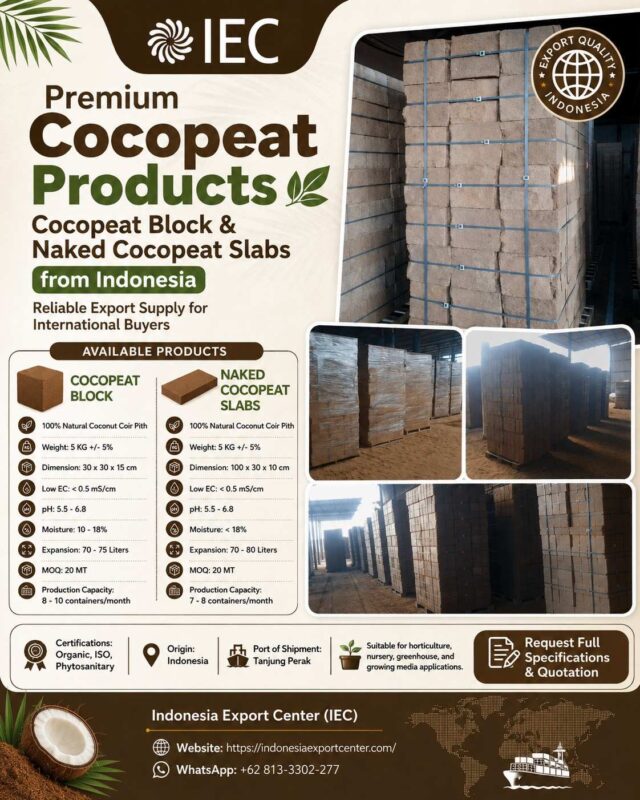
Cocopeat may be supplied as compressed blocks, loose coir pith, or other processed formats, subject to supplier availability.
For manufacturing operations, the preferred format may depend on storage capacity, handling equipment, hydration procedures, mixing machinery, and production volume.
Cocopeat Product Options for Potting Mix Producers
Different production lines may require different raw material formats. The following options can help guide your sourcing inquiry.
| Product format | Potential manufacturing application |
|---|---|
| Compressed cocopeat blocks | Bulk raw material procurement where rehydration and processing are part of production |
| Loose cocopeat | Direct handling and blending in suitable manufacturing systems |
| Fine-grade cocopeat | Formulations requiring a finer substrate component, subject to performance testing |
| Cocopeat and coco chips mix | Blends that require a different particle structure and air-to-water balance |
| Custom cocopeat blends | Manufacturing projects with defined formulation and performance requirements |
These are potential applications, not a guarantee of current availability or suitability. Confirm the actual product characteristics and available formats with the supplier before purchase.
Important Specifications for Cocopeat Raw Materials
Potting mix manufacturers should define raw material requirements before sourcing cocopeat for recurring production. Request relevant technical information and evaluate the following parameters.
- Particle size distribution: Determines how the material may influence texture, water retention, drainage, and aeration in the finished mix.
- Fiber content: Can affect the structure, handling, and consistency of the substrate.
- Electrical conductivity (EC): Helps assess soluble salt content. Confirm the measurement method and whether the result applies to the raw material or a prepared extract.
- pH level: Evaluate the cocopeat’s pH in relation to the target specification for the finished potting mix.
- Water-holding capacity: Review relevant data and verify performance in the final formulation.
- Air-filled porosity and drainage: Assess how the material affects the physical properties of the finished blend.
- Moisture content: Important for handling, storage, transportation, and calculating the usable quantity of material.
- Washing and buffering status: Confirm which treatments have been performed and request supporting details where available.
- Batch consistency: Discuss quality-control practices and tolerances for recurring commercial orders.
- Packaging and shipment: Confirm package format, order volume, loading arrangements, and delivery requirements.
No single set of specifications is appropriate for every potting mix. Requirements should reflect the finished product, intended plants, local market expectations, and manufacturing process.
IEC does not assume specific EC or pH values, certifications, or supplier capacities without verification.
How to Select Cocopeat for Potting Mix Formulation
The right raw material is the one that performs consistently within your formulation and production process.
For general-purpose potting mixes: Evaluate particle size, water retention, drainage, and the interaction between cocopeat and the other ingredients. Test the complete blend before finalizing the formulation.
For professional horticultural substrates: Establish clear physical and chemical targets for the finished product. Confirm whether the supplier’s technical data and quality-control process support your requirements.
For seedling and nursery mixes: Consider the needs of young plants, including moisture management, aeration, and salt sensitivity. Fine-grade cocopeat may be worth evaluating where the formulation requires a finer texture, but suitability should be confirmed through testing.
For customized growing media: Discuss the required grade, processing characteristics, and consistency with suppliers. Use trial batches to check whether the raw material works with your blending equipment and formulation targets.
For large-scale manufacturing: Prioritize repeatable specifications, batch consistency, dependable packaging arrangements, and a supply plan aligned with production demand.
Quality Control for Commercial Potting Mix Production
Incoming raw material quality can affect the consistency of the final potting mix. A practical quality-control process may include the following measures:
- Set a raw material specification. Define the required grade, particle distribution, EC, pH, moisture characteristics, and treatment status.
- Review supplier documentation. Request available technical data and any relevant quality-control records.
- Inspect incoming batches. Check the delivered material against your purchasing specification and internal acceptance criteria.
- Run a formulation trial. Evaluate the cocopeat in the intended blend, including mixing behavior, hydration, drainage, and moisture retention.
- Monitor batch consistency. Record relevant results and discuss deviations with the supplier before using nonconforming material in full production.
The exact testing process should reflect the manufacturer’s product standards and intended market. Any claims about finished-product performance should be supported by appropriate testing.
Source Cocopeat from Indonesian Suppliers
Indonesia Export Center helps international buyers connect with Indonesian suppliers for agricultural and horticultural sourcing inquiries, including cocopeat for potting mix manufacturing.
We welcome inquiries from potting mix producers, substrate blenders, horticultural product manufacturers, and growing media distributors seeking raw materials for commercial operations.
To help suppliers assess your requirements, include the following information:
- Intended application and type of potting mix
- Required cocopeat grade and particle size distribution
- Target EC and pH, including the preferred measurement method
- Washing or buffering requirements
- Estimated order quantity and purchasing frequency
- Preferred packaging and handling format
- Destination country and port, where applicable
- Technical documentation and quality-control requirements
- Expected delivery schedule
Product availability, technical specifications, pricing, minimum order quantities, packaging, documentation, and shipping terms are subject to confirmation by the relevant supplier.
How to Request a Cocopeat Quotation
Step 1: Describe Your Production Requirements
Explain the type of potting mix you manufacture, your expected production volume, and the role cocopeat will play in your formulation.
Step 2: Define the Raw Material Specification
Share your preferred particle grade, target EC and pH, moisture requirements, and any washing or buffering preferences.
Step 3: Confirm Commercial Details
Provide the required volume, packaging preference, destination, and expected order frequency.
Step 4: Review Technical Information
Request available product specifications and supporting documentation. Where appropriate, test a sample or trial batch in your production process.
Step 5: Confirm the Supply Arrangement
Agree on the product specification, price, order quantity, packaging, quality requirements, and shipment terms with the supplier before placing an order.
Frequently Asked Questions
Why is cocopeat used in potting mix manufacturing?
Cocopeat can contribute to water retention and substrate structure in potting mixes. Its actual effect depends on the grade, proportion used, and the other ingredients in the finished formulation.
Which cocopeat grade is best for potting mix production?
There is no universally best grade. Manufacturers should select material according to particle size, fiber content, water retention, drainage, EC, pH, and the target properties of the finished product.
Should potting mix producers buy washed or buffered cocopeat?
The choice depends on the raw material’s properties and the final formulation requirements. Washing is generally intended to reduce soluble salts, while buffering is used to manage exchangeable cations in coir. Ask the supplier which treatments have been performed and review supporting data where available.
Can cocopeat be blended with other growing media ingredients?
Yes. Cocopeat may be combined with other ingredients to adjust the finished mix’s physical properties. The blend should be tested for consistency, drainage, water retention, aeration, and suitability for its intended application.
What specifications should I request from a cocopeat supplier?
Consider particle size distribution, fiber content, EC, pH, moisture content, water-holding characteristics, treatment status, and batch consistency. Confirm the test methods used so that supplier data can be compared meaningfully.
Can I source cocopeat in bulk from Indonesia?
You can submit a bulk sourcing inquiry through Indonesia Export Center. Available volumes, minimum order quantities, pricing, packaging, and shipping arrangements must be confirmed with the relevant supplier.
Does Indonesia Export Center manufacture cocopeat?
Indonesia Export Center facilitates connections between international buyers and Indonesian suppliers. Buyers should verify supplier capabilities, product origin, specifications, and available documentation during the sourcing process.
Request Cocopeat for Potting Mix Manufacturing
Looking for cocopeat raw materials for your commercial growing media production line? Contact Indonesia Export Center to discuss your specifications and explore potential sourcing options from Indonesian suppliers.
Indonesia Export Center — Connecting Global Buyers with Indonesian Suppliers.
Website: https://indonesiaexportcenter.com/
WhatsApp: +62 813-3302-277
Submit your inquiry: https://wa.me/628133302277
