![Indonesia Export Center [IEC]](https://indonesiaexportcenter.com/wp-content/uploads/2023/07/logo-no-background.svg)
![Indonesia Export Center [IEC]](https://indonesiaexportcenter.com/wp-content/uploads/2023/07/svgviewer-output.svg)
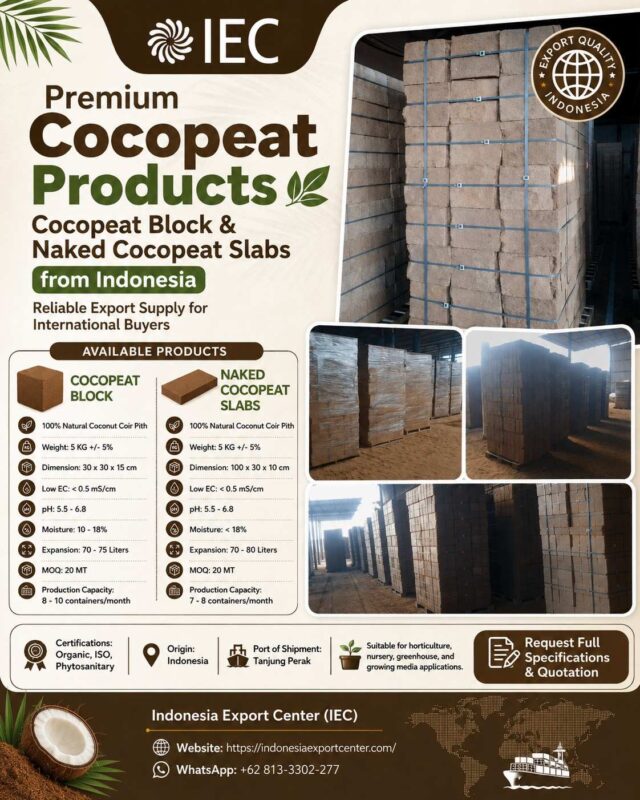
Cocopeat Growing Media from Indonesia
🌱 Welcome to the Cocopeat Growing Media information hub by Indonesia Export Center.
This category brings together educational articles about cocopeat products, technical specifications, agricultural applications, packing methods, export preparation, and international shipment.
The information is intended for international buyers, importers, distributors, greenhouse operators, hydroponic growers, nurseries, agricultural companies, and growing media manufacturers looking for reliable information about cocopeat growing media from Indonesia.
Through this category, buyers can learn more about:
✅ Cocopeat Block 5 kg
✅ Naked Cocopeat Slabs
✅ Low EC and High EC Cocopeat
✅ Hydroponic Growing Media
✅ Cocopeat Packing Methods
✅ Minimum Order Quantity
✅ Production Lead Time
✅ Container Loading
✅ Export Shipment
✅ Cocopeat Quality Control
This category page acts as a central hub that connects buyers to more detailed articles about each cocopeat product and export-related topic.
🌴 What Is Cocopeat Growing Media?
Cocopeat, also known as coconut coir pith, is a natural material obtained from the processing of coconut husks.
The fine coir material is collected, processed, dried, and compressed into blocks or slabs to make storage and international transportation more efficient.
Cocopeat is commonly used in:
- Hydroponic farming
- Greenhouse cultivation
- Plant nurseries
- Seedling production
- Horticultural growing media
- Potting soil mixtures
- Fruit and vegetable cultivation
- Ornamental plant production
- Soil conditioning
- Commercial agriculture
Compressed cocopeat expands after water is added. This characteristic allows a large volume of growing media to be transported in a compact form.
Explore Our Cocopeat Growing Media Topics
🧱 Cocopeat Block 5 kg
A 5 kg cocopeat block is compressed coconut coir pith formed into a compact block.
This format is widely used for bulk distribution because the blocks are easy to handle, stack, store, and load into export containers.
Based on the available Indonesia Export Center product specification, the product is made from 100% natural coconut coir pith.
Cocopeat Block 5 kg Specification
| Specification | Details |
|---|---|
| Product form | Compressed block |
| Raw material | 100% natural coconut coir pith |
| Weight | 5 kg ±5% |
| Dimensions | 30 × 30 × 15 cm |
| Electrical Conductivity | Less than 0.5 mS/cm |
| pH | 5.5–6.8 |
| Moisture | 10–18% |
| Expansion volume | 70–75 liters |
| Compression rate | 5:1 |
| Impurities | Less than 3% |
| Fiber content | Less than 2% |
| Packing | No single wrapping |
| Minimum order quantity | 20 MT |
| Production lead time | 25–30 days |
| Production capacity | 8–10 containers per month |
| Origin | Indonesia |
| Port of shipment | Tanjung Perak |
The specification document also mentions Organic, ISO, and Phytosanitary documentation. Availability and scope should be confirmed before an order is finalized.
Recommended Cocopeat Block Articles
- What Is a 5 kg Cocopeat Block?
- Cocopeat Block Specifications for International Buyers
- How to Expand a 5 kg Cocopeat Block
- Cocopeat Block Applications in Agriculture
- Cocopeat Block for Greenhouses and Nurseries
- How Cocopeat Blocks Are Loaded into Containers
- How to Evaluate Cocopeat Block Quality
- Cocopeat Block Export Packing Guide
📏 Naked Cocopeat Slabs
Naked Cocopeat Slabs are compressed cocopeat products formed into long slabs without individual wrapping.
Compared with standard cocopeat blocks, naked slabs have a longer shape and may be suitable for buyers who want to reprocess, repackage, or adapt the product to their own agricultural growing systems.
Naked Cocopeat Slab Specification
| Specification | Details |
|---|---|
| Product form | Compressed naked slab |
| Raw material | 100% natural coconut coir pith |
| Weight | 5 kg ±5% |
| Dimensions | 100 × 30 × 10 cm |
| Electrical Conductivity | Less than 0.5 mS/cm |
| pH | 5.5–6.8 |
| Moisture | Less than 18% |
| Expansion volume | 70–80 liters |
| Compression rate | 5:1 |
| Impurities | Less than 3% |
| Fiber content | Less than 2% |
| Packing | No single wrapping |
| Minimum order quantity | 20 MT |
| Production lead time | 25–30 days |
| Production capacity | 7–8 containers per month |
| Origin | Indonesia |
| Port of shipment | Tanjung Perak |
The current specification lists both Cocopeat Block and Naked Cocopeat Slabs as products originating from Indonesia and planned for shipment through Tanjung Perak Port.
Recommended Naked Cocopeat Slab Articles
- What Are Naked Cocopeat Slabs?
- Cocopeat Block vs Naked Cocopeat Slabs
- Naked Cocopeat Slab Dimensions and Expansion
- Applications of Unwrapped Cocopeat Slabs
- How Naked Cocopeat Slabs Are Packed
- Naked Cocopeat Slab Container Loading
- How to Inspect Cocopeat Slab Quality
- Naked Cocopeat Slabs for Bulk Buyers
💧 Low EC Cocopeat
Electrical Conductivity, commonly abbreviated as EC, is an important parameter when evaluating cocopeat.
EC indicates the concentration of soluble salts in the growing medium. Cocopeat with a lower EC level is generally selected for applications that require better control over salinity and nutrient management.
The available product specification for both Cocopeat Block and Naked Cocopeat Slabs states:
EC: Less than 0.5 mS/cm
This specification places the products within the discussion of Low EC cocopeat.
However, international buyers should confirm:
- The testing method
- The water-to-cocopeat extraction ratio
- The testing laboratory
- Whether the product is washed
- Whether the product is buffered
- The acceptable EC tolerance
- The required pre-shipment test report
Recommended Low EC Cocopeat Articles
- What Is Low EC Cocopeat?
- Why EC Levels Matter in Cocopeat
- How to Test Cocopeat EC
- Washed vs Unwashed Cocopeat
- Buffered vs Unbuffered Cocopeat
- Low EC Cocopeat for Hydroponics
- Low EC Cocopeat for Greenhouse Farming
- Understanding Cocopeat EC Test Results
🧂 High EC Cocopeat
High EC cocopeat generally refers to cocopeat with a higher concentration of soluble salts than Low EC cocopeat.
Its suitability depends on the intended application, plant type, irrigation system, growing environment, and any additional washing treatment carried out before use.
Educational articles in this section can help buyers understand:
- Low EC vs High EC cocopeat
- Sources of salt in cocopeat
- How EC affects plant growth
- How cocopeat is washed
- How to reduce cocopeat EC
- When High EC cocopeat may be suitable
- EC testing before planting
- Buyer specifications for High EC cocopeat
Important Product Note
The current Indonesia Export Center document only provides a specification of less than 0.5 mS/cm for Cocopeat Block and Naked Cocopeat Slabs. It does not provide a separate High EC product specification.
Therefore, any High EC product availability, values, packing, capacity, or commercial terms should be confirmed separately before publication or quotation.
🌿 Hydroponic Cocopeat Growing Media
Cocopeat is widely considered as a growing media component for hydroponic and greenhouse cultivation.
Its application depends on product quality, crop requirements, irrigation management, nutrient formulation, drainage, particle size, and the physical characteristics of the final growing media.
Important parameters include:
1. Electrical Conductivity
The EC value should be checked to determine the concentration of soluble salts in the cocopeat.
The available specification indicates an EC value below 0.5 mS/cm.
2. pH Level
The stated pH range is 5.5–6.8 for both product forms.
Buyers should still confirm whether the pH is suitable for the selected plant, nutrient system, and irrigation method.
3. Moisture Content
Moisture affects:
- Product weight
- Storage stability
- Mold risk
- Container condition
- Product quality during shipment
The specified moisture level is 10–18% for Cocopeat Block and less than 18% for Naked Cocopeat Slabs.
4. Expansion Volume
The product expansion stated in the specification is:
- Cocopeat Block: 70–75 liters
- Naked Cocopeat Slabs: 70–80 liters
5. Impurities
The listed impurities level is less than 3% for both products.
6. Fiber Content
The listed fiber content is less than 2%.
7. Compression Rate
Both products have a stated compression rate of 5:1, which helps reduce the product volume during storage and export transportation.
Recommended Hydroponic Growing Media Articles
- Is Cocopeat Suitable for Hydroponics?
- Cocopeat for Tomato Greenhouses
- Cocopeat for Strawberry Cultivation
- Cocopeat for Cucumber Growing Systems
- Cocopeat for Seedling Production
- How to Prepare Cocopeat Before Planting
- Cocopeat Water Retention and Aeration
- Cocopeat and Perlite Growing Media Mixtures
- Nutrient Management in Cocopeat
- Cocopeat pH and EC Management
📦 Cocopeat Packing for Export
Packing is an important part of international cocopeat shipments.
The packing system should protect the product while supporting efficient handling, storage, container loading, and transportation.
Based on the available document, both products are specified as:
No Single Wrapping
This applies to:
- Cocopeat Block 5 kg
- Naked Cocopeat Slabs
The final packing arrangement may depend on:
- Buyer requirements
- Product dimensions
- Pallet requirements
- Container loading method
- Private-label requirements
- Shipping marks
- Moisture protection
- Destination-country regulations
The document does not provide details about the number of units per pallet, total units per container, bale wrapping, pallet dimensions, or container loading configuration. These details should therefore be confirmed separately.
Recommended Cocopeat Packing Articles
- Cocopeat Export Packing Methods
- Palletized vs Non-Palletized Cocopeat
- How Cocopeat Blocks Are Packed for Export
- Naked Cocopeat Slab Packing Methods
- Cocopeat Container Stuffing Process
- Private-Label Cocopeat Packaging
- Export Labels and Shipping Marks
- How to Protect Cocopeat from Moisture
- Cocopeat Container Inspection Checklist
⚖️ Minimum Order Quantity
The stated Minimum Order Quantity for both products is:
MOQ: 20 Metric Tons
The MOQ applies to:
✅ Cocopeat Block 5 kg
✅ Naked Cocopeat Slabs
The final number of units and required container capacity will depend on:
- Actual product weight
- Packing configuration
- Pallet use
- Container payload limits
- Product dimensions
- Shipping regulations
- Destination requirements
When requesting a quotation, buyers should provide:
- Product name
- Required EC level
- Required pH range
- Product dimensions
- Order quantity
- Destination country
- Destination port
- Packing requirements
- Pallet requirements
- Certification requirements
- Target delivery schedule
- Preferred Incoterm
🚢 Production Lead Time and Shipment
The stated production lead time for Cocopeat Block and Naked Cocopeat Slabs is:
25–30 Days
This period refers to product preparation and production according to the available specification.
The total shipment schedule may also be affected by:
- Raw material availability
- Production scheduling
- Quality inspection
- Packing preparation
- Container availability
- Vessel schedules
- Export documentation
- Customs procedures
- Port conditions
- Destination-country requirements
Port of Shipment
The specification identifies:
Tanjung Perak Port, Indonesia
Monthly Production Capacity
The stated monthly production capacity is:
- Cocopeat Block: 8–10 containers per month
- Naked Cocopeat Slabs: 7–8 containers per month
Production capacity and vessel schedules should be reconfirmed for every order because availability may vary by production period.
🔍 Cocopeat Quality Control
Quality control is necessary to ensure that cocopeat complies with the agreed specifications before shipment.
Important inspection parameters include:
✅ Raw Material
The product should be checked to confirm that it is made from natural coconut coir pith.
✅ Product Weight
The stated standard weight is 5 kg with a tolerance of ±5%.
✅ Dimensions
Dimensions should be checked to maintain product consistency and loading efficiency.
The stated dimensions are:
- Cocopeat Block: 30 × 30 × 15 cm
- Naked Cocopeat Slabs: 100 × 30 × 10 cm
✅ Electrical Conductivity
The EC level should be tested using an agreed testing method.
✅ pH
The pH level should be checked to confirm compliance with the required specification.
✅ Moisture Content
Moisture testing helps reduce risks related to:
- Excess product weight
- Mold development
- Storage instability
- Product deterioration
- Container moisture
✅ Expansion Volume
Expansion testing measures the volume of cocopeat after hydration.
✅ Impurities
The material should be inspected for sand, stones, foreign matter, and other unwanted substances.
✅ Fiber Content
Fiber content should be inspected to confirm the consistency of the growing media composition.
✅ Packing Inspection
Packing should be checked for stability, cleanliness, labeling, and protection during transportation.
✅ Container Inspection
Before loading, the export container should be:
- Clean
- Dry
- Free from leakage
- Free from strong odors
- Free from chemical residue
- Structurally suitable for cargo
Recommended Quality Control Articles
- Cocopeat Quality Control Checklist
- How to Test Cocopeat Expansion
- How to Measure Cocopeat Moisture
- Cocopeat EC and pH Testing
- Cocopeat Weight and Dimension Inspection
- How to Identify Good-Quality Cocopeat
- Common Cocopeat Quality Problems
- Pre-Shipment Inspection for Cocopeat
- Export Container Inspection for Cocopeat
📑 Documents and Certification
The available product specification mentions:
- Organic
- ISO
- Phytosanitary
However, the document does not provide the issuing organizations, certificate numbers, validity periods, certification scope, or copies of the certificates.
Buyers should therefore confirm:
- Certificate availability
- Certificate validity
- Product coverage
- Exporter or manufacturer name
- Issuing authority
- Destination-country acceptance
- Inspection requirements
Other export documents may include:
- Commercial Invoice
- Packing List
- Bill of Lading
- Certificate of Origin
- Phytosanitary Certificate
- Fumigation Certificate, when required
- Quality Inspection Report
- Weight Certificate
- Laboratory Test Report
Required documents may vary according to the destination country, buyer agreement, and applicable regulations.
Cocopeat Block vs Naked Cocopeat Slabs
| Parameter | Cocopeat Block 5 kg | Naked Cocopeat Slabs |
|---|---|---|
| Product form | Compact block | Long compressed slab |
| Raw material | Natural coconut coir pith | Natural coconut coir pith |
| Weight | 5 kg ±5% | 5 kg ±5% |
| Dimensions | 30 × 30 × 15 cm | 100 × 30 × 10 cm |
| EC | Less than 0.5 mS/cm | Less than 0.5 mS/cm |
| pH | 5.5–6.8 | 5.5–6.8 |
| Moisture | 10–18% | Less than 18% |
| Expansion | 70–75 liters | 70–80 liters |
| Compression rate | 5:1 | 5:1 |
| Impurities | Less than 3% | Less than 3% |
| Fiber content | Less than 2% | Less than 2% |
| Packing | No single wrapping | No single wrapping |
| MOQ | 20 MT | 20 MT |
| Lead time | 25–30 days | 25–30 days |
| Capacity | 8–10 containers/month | 7–8 containers/month |
The correct product choice depends on the buyer’s application, handling system, packing requirements, and final market.
How to Choose the Right Cocopeat Product
Before choosing a cocopeat product, buyers should evaluate several factors.
🌱 Intended Application
Determine whether the cocopeat will be used for:
- Hydroponics
- Greenhouse cultivation
- Plant nurseries
- Seedling production
- Potting mixtures
- Repacking
- Growing media manufacturing
💧 Required EC Level
Confirm whether the application requires Low EC cocopeat or another EC specification.
📐 Product Format
Choose between Cocopeat Block and Naked Cocopeat Slabs according to the intended handling, processing, and growing system.
📦 Packing Requirements
Confirm whether the order requires:
- Individual wrapping
- Bulk packing
- Pallets
- Private labels
- Custom shipping marks
- Moisture protection
⚖️ Order Quantity
The available specification states an MOQ of 20 MT for both products.
🚢 Destination Port
The destination port is required to prepare an accurate FOB, CFR, or CIF quotation.
📑 Documentation
Buyers should communicate all certification and documentation requirements before order confirmation.
Frequently Asked Questions
What is cocopeat growing media?
Cocopeat growing media is a natural material made from coconut coir pith. It is commonly used in horticulture, hydroponics, greenhouses, nurseries, and potting mixtures.
What is the difference between Cocopeat Block and Naked Cocopeat Slabs?
The main differences are their shape and dimensions. Cocopeat Block measures approximately 30 × 30 × 15 cm, while Naked Cocopeat Slabs measure approximately 100 × 30 × 10 cm.
What is the weight of each unit?
Both products have a stated weight of 5 kg with a tolerance of ±5%.
What is the EC level?
The available specification states an EC level below 0.5 mS/cm for both products.
What is the pH range?
The stated pH range is 5.5–6.8.
How much does a Cocopeat Block expand?
The stated expansion volume is approximately 70–75 liters.
How much does a Naked Cocopeat Slab expand?
The stated expansion volume is approximately 70–80 liters.
What is the minimum order quantity?
The stated Minimum Order Quantity is 20 MT.
What is the production lead time?
The stated production lead time is approximately 25–30 days.
What is the port of shipment?
The listed port of shipment is Tanjung Perak Port, Indonesia.
Is High EC cocopeat available?
The current source document only states an EC specification below 0.5 mS/cm. A separate High EC specification is not provided and should be confirmed before being offered.
Are the products individually wrapped?
The specification states “No Single Wrapping” for both Cocopeat Block and Naked Cocopeat Slabs.
🌏 Cocopeat Information and Sourcing from Indonesia
Indonesia Export Center provides product information and sourcing support for international buyers interested in cocopeat growing media from Indonesia.
This category is designed to help:
✅ Cocopeat importers
✅ Growing media distributors
✅ Hydroponic farms
✅ Greenhouse operators
✅ Agricultural companies
✅ Nurseries
✅ Horticultural suppliers
✅ Private-label businesses
✅ Growing media manufacturers
Buyers can use the articles in this category to compare product forms, understand technical specifications, prepare order requirements, and evaluate export arrangements.
📩 Request Cocopeat Product Information
To receive more accurate product information or a quotation, please provide:
- Product name
- Required specification
- Required EC level
- Required pH
- Order quantity
- Packing requirements
- Destination country
- Destination port
- Required certificates
- Target shipment date
- Preferred Incoterm
- Company profile
- Letter of Intent
Indonesia Export Center
🌐 Website: https://indonesiaexportcenter.com/
📱 WhatsApp: +62 813-3302-277
📸 Instagram: @indoexportcenter
