![Indonesia Export Center [IEC]](https://indonesiaexportcenter.com/wp-content/uploads/2023/07/logo-no-background.svg)
![Indonesia Export Center [IEC]](https://indonesiaexportcenter.com/wp-content/uploads/2023/07/svgviewer-output.svg)
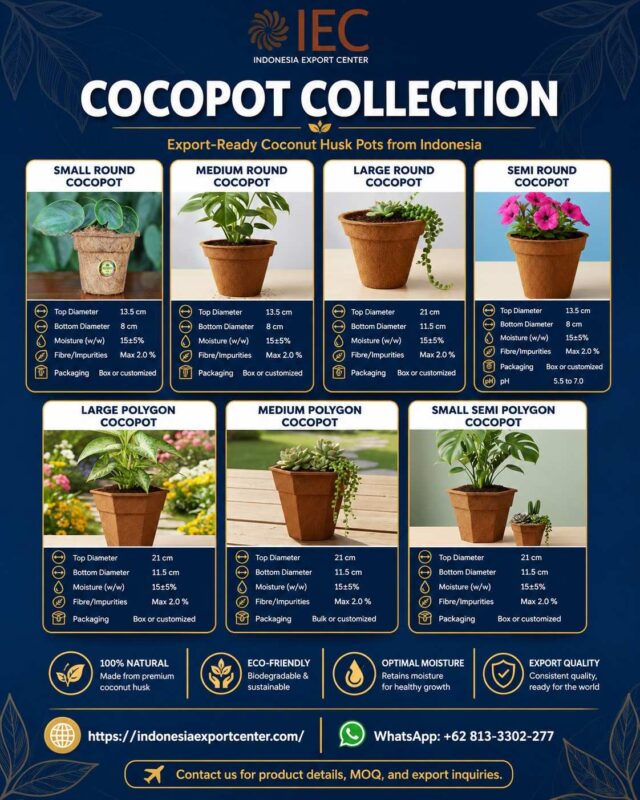
Coconut fiber pots—also known as cocopot, coir pots, coconut coir pots, biodegradable nursery pots, or plantable fiber pots—are increasingly used by nurseries, greenhouse operators, horticultural distributors, landscaping companies, and agricultural supply businesses.
Made primarily from coconut husk fiber, these pots offer a bio-based alternative to conventional plastic nursery containers. However, importing coconut fiber pots successfully requires more than simply finding the lowest quotation. International buyers must verify product composition, dimensions, moisture condition, production consistency, packing efficiency, customs classification, phytosanitary requirements, and shipping documents.
This guide explains how to import coconut fiber pots from Indonesia while reducing quality, regulatory, and logistics risks.
1. Define the Coconut Fiber Pot You Need
The term “coconut fiber pot” may refer to several different products. Before requesting a quotation, buyers should clearly define the intended application.
Common product categories include:
- Seedling and propagation pots
- Nursery transplanting pots
- Round cocopots
- Square coconut fiber pots
- Hanging coir baskets
- Decorative coconut fiber planters
- Custom-shaped horticultural pots
- Private-label coconut fiber pots
- Wholesale biodegradable pots for commercial nurseries
A pot designed for short-term seed propagation may require different strength, binder composition, wall thickness, and degradation performance than a pot intended for retail garden centers.
Your initial inquiry should therefore include:
- Pot diameter and height
- Top and bottom dimensions
- Wall thickness
- Drainage-hole requirements
- Product weight
- Pot shape
- Intended plant or crop
- Expected nursery-use period
- Required wet-strength performance
- Binder or adhesive restrictions
- Packaging method
- Private-label requirements
- Estimated order quantity
- Destination country and port
Providing these details allows an Indonesian cocopot supplier to calculate raw-material usage, mould requirements, packaging volume, production lead time, and shipping cost more accurately.
2. Confirm the Material Composition
Coconut fiber pots are generally manufactured by shaping coconut coir fiber with a binding material. However, formulations can vary significantly between factories.
Buyers should ask the manufacturer to disclose:
- The percentage of coconut fiber used
- Whether cocopeat or coir pith is included
- The type and percentage of binder
- Whether natural latex or synthetic adhesive is used
- Whether dyes, coatings, preservatives, or other additives are present
- Whether recycled material is mixed into the product
This information is particularly important when the product will be marketed as:
- Natural coconut fiber pots
- Plastic-free nursery pots
- Compostable plant pots
- Biodegradable seedling pots
- Organic nursery supplies
- Eco-friendly horticultural products
Avoid making absolute environmental claims unless the supplier can provide evidence supporting them. A coconut-based product may contain synthetic binder, coating, pigment, or packaging material that affects whether the finished product can accurately be described as plastic-free, compostable, or fully biodegradable.
A safer commercial description is often “bio-based coconut fiber pot” unless laboratory testing or recognized certification supports a stronger claim.
3. Verify the Import Requirements in Your Country
Coconut fiber is a plant-origin material. Consequently, customs, plant-health, or biosecurity authorities may regulate the shipment even when the fiber has already been processed into finished pots.
Requirements depend on several factors:
- Destination country
- Degree of processing
- Presence of soil, seeds, insects, leaves, or other plant residues
- Moisture condition
- Intended use
- Product composition
- Packaging materials
- Applicable tariff classification
For shipments to the United States, importers should check the current requirements through USDA APHIS because the agency regulates many plants, plant products, soil, wood products, and related agricultural materials. APHIS advises importers to determine whether an import permit, phytosanitary document, inspection, treatment, or other condition applies to the specific commodity. , the importer should search the Australian Government’s BICON system. BICON identifies whether goods are permitted, subject to biosecurity conditions, require supporting documents or treatment, or require an import permit. Union destinations, buyers can use the European Commission’s Access2Markets portal to review tariffs, taxes, customs procedures, rules of origin, and product requirements. tions may change. Therefore, obtain written confirmation from your customs broker or relevant plant-health authority before placing a commercial order.
4. Verify the Correct HS Code
Do not rely only on an HS code appearing on a supplier’s previous invoice.
Coconut fiber pots may be classified differently depending on their:
- Material composition
- Manufacturing method
- Function
- Level of processing
- Use as horticultural equipment or an article of vegetable fiber
- National tariff schedule
Indonesia’s official customs tariff publication, BTKI, is used as a reference for goods classification in Indonesian export and import procedures. However, the final tariff code accepted in the destination market must be checked against that country’s own tariff schedule. uld:
- Obtain the supplier’s proposed HS code.
- Send product photos and a detailed composition sheet to the destination customs broker.
- Confirm the applicable import duty, taxes, restrictions, and licensing requirements.
- Request an advance or binding ruling when the classification remains uncertain.
For example, the United States offers a binding-ruling program through Customs and Border Protection for pre-entry decisions on tariff classification and related import questions. ssification can lead to reassessment, delayed clearance, additional duties, penalties, or disputes after the cargo arrives.
5. Evaluate the Indonesian Supplier
A reliable supplier should be able to demonstrate both legal export capability and technical production capacity.
Company verification
Ask for:
- Legal company name
- Registered address
- Business identification number
- Tax registration
- Exporter or customs-access information
- Factory address
- Company bank-account details
- Production and warehouse photographs
- Export references, where available
Indonesian Customs states that exporters need customs access and that a valid Business Identification Number, or NIB, serves important registration functions for customs users. the beneficiary named on the invoice matches the legal company or an officially disclosed export partner. Payments to unrelated personal accounts should receive additional scrutiny.
Factory verification
During a physical or virtual factory audit, examine:
- Raw coconut fiber storage
- Fiber cleaning and preparation
- Drying facilities
- Moulding equipment
- Binder application
- Product drying or curing
- Trimming and finishing
- Moisture control
- Packaging area
- Finished-goods storage
- Pest-control practices
- Traceability and batch identification
Also determine whether the company is the actual manufacturer, an exporter working with partner factories, or a trading company. Any model can work, but the buyer should clearly understand who controls production, inspection, documentation, and corrective action.
6. Prepare a Detailed Product Specification
A written specification is essential for wholesale coconut fiber pots. Product photos alone are insufficient because differences in thickness, weight, binder, density, and moisture may not be visible.
A practical specification may include the following:
| Specification Item | Information to Define |
|---|---|
| Product name | Coconut fiber pot, cocopot, or coir nursery pot |
| Shape | Round, square, rectangular, hanging, or custom |
| Top dimensions | Diameter or length × width |
| Bottom dimensions | Diameter or length × width |
| Height | Finished external height |
| Wall thickness | Minimum and target thickness |
| Unit weight | Target weight and permitted tolerance |
| Fiber composition | Percentage and type of coconut fiber |
| Binder | Natural latex, synthetic binder, or approved formulation |
| Drainage holes | Quantity, position, and diameter |
| Colour | Natural brown or specified colour |
| Moisture | Maximum permitted moisture with agreed test method |
| Wet strength | Required handling period after irrigation |
| Foreign matter | Maximum permitted contamination |
| Odour | Free from strong chemical, rotten, or mouldy odour |
| Surface condition | No severe cracks, loose edges, or deformation |
| Packaging | Nested quantity, inner bag, carton, bale, or pallet |
| Labelling | Product code, dimensions, quantity, batch, and private label |
| Inspection standard | Agreed sampling and acceptance criteria |
All dimensional tolerances should be written numerically. Avoid vague expressions such as “standard size,” “good quality,” or “export quality.”
7. Request and Test Samples
A sample approval process should be completed before mass production.
Begin with several samples from normal production rather than only one specially prepared showroom sample. Evaluate the pots under conditions similar to their intended commercial use.
Recommended tests include:
Dimensional inspection
Measure the diameter, height, wall thickness, drainage holes, and unit weight of multiple samples. Differences between units can indicate inconsistent moulding or fiber distribution.
Dry-handling test
Stack, separate, pack, and handle the pots to determine whether rims crack, walls deform, or loose fiber creates excessive dust.
Wet-strength test
Irrigate filled pots repeatedly and record whether they remain stable during the expected nursery cycle. The supplier and buyer should agree on how many days or weeks the pot must retain sufficient handling strength.
Root and transplanting trial
Use the pots with the intended seedlings, substrate, fertilizer, and irrigation system. Observe drainage, root penetration, salt accumulation, algae growth, fungal development, and transplanting performance.
Leachate assessment
When relevant to sensitive nursery crops, test the water or substrate in contact with the pot for pH, electrical conductivity, odour, or visible residues.
Degradation trial
Do not assume all coconut fiber pots will break down at the same rate. Degradation depends on fiber density, binder formulation, wall thickness, moisture, temperature, soil microorganisms, and nursery conditions.
The approved sample should be signed, dated, photographed, and referenced in the purchase order as the quality benchmark.
8. Request a Complete Commercial Quotation
A professional quotation should include more than the unit price.
Ask the supplier to state:
- Product dimensions and unit weight
- Material and binder composition
- Quantity per carton, bale, or pallet
- Total pieces per container
- Net and gross weight
- Estimated cargo volume
- Minimum order quantity
- Production lead time
- Sample cost
- Tooling or mould cost
- Private-label cost
- Port of loading
- Incoterm and named place or port
- Quotation validity
- Payment terms
- Export-document charges
- Phytosanitary or quarantine charges, when applicable
- Inspection cost
- Estimated shipment schedule
International buyers commonly request comparisons under terms such as FOB, CFR, or CIF. Incoterms® clarify how delivery tasks, costs, and risks are divided between seller and buyer. They do not, by themselves, determine product quality, payment timing, transfer of ownership, or remedies for defective goods. the complete term and location, for example:
- FOB Tanjung Perak Port, Surabaya, Incoterms® 2020
- CFR Rotterdam Port, Incoterms® 2020
- CIF Jebel Ali Port, Incoterms® 2020
9. Calculate the Landed Cost
Coconut fiber pots are relatively light but can occupy substantial container space. Therefore, the cost per piece may be strongly affected by nesting efficiency and container utilization.
Calculate:
Landed cost per pot = product cost + inland transport + export handling + ocean freight + insurance + import duty + taxes + customs clearance + inspection + local delivery ÷ saleable quantity
Do not calculate using the invoiced quantity alone. Include a realistic allowance for:
- Deformed pots
- Moisture-damaged cartons
- Mould contamination
- Incorrect sizes
- Breakage during separation
- Port inspection
- Demurrage or storage
- Quantity discrepancies
Ask the supplier for a container-loading plan showing the number of pots per bundle, carton, pallet, and container. When comparing suppliers, evaluate cost per usable pot delivered—not only the factory unit price.
10. Agree on Packaging Before Production
Proper packaging protects the pots while maximizing container capacity.
Possible arrangements include:
- Nested pots in compressed bundles
- Bundles inside polyethylene liners
- Export cartons
- Woven sacks
- Palletized cartons
- Floor-loaded cartons
- Custom retail packaging
The selected packaging should keep the product clean and dry without creating excessive compression that permanently deforms the pots.
The purchase order should specify:
- Units per nested stack
- Stacks per carton or bundle
- Maximum gross weight
- Carton dimensions
- Inner moisture protection
- Label information
- Pallet dimensions
- Maximum stacking height
- Container-loading quantity
When raw-wood pallets, crates, or dunnage are used, they should comply with ISPM 15 requirements applicable to wood packaging in international trade. ISPM 15 establishes treatments and marking for regulated raw-wood packaging materials, while certain processed wood materials are excluded. m Export and Shipping Documents
The documents required for a coconut fiber pot shipment commonly include:
- Proforma invoice
- Commercial invoice
- Packing list
- Bill of lading or sea waybill
- Export customs declaration
- Certificate of origin, when requested
- Phytosanitary certificate, when required
- Certificate for a processed or non-regulated product, when applicable
- Fumigation or treatment certificate, when required
- Inspection certificate
- Insurance certificate under the agreed transaction
- Additional destination-specific declarations
Indonesian Customs requires exporters to submit a Pemberitahuan Ekspor Barang, or PEB, as part of the export customs process. Supporting documents must be prepared before export clearance, and physical inspection may be conducted under customs risk management. uarantine certificate verification system recognizes documents including a phytosanitary certificate for export and a certificate for processed products or non-regulated articles. The exact certificate for cocopots depends on the product condition and destination-country requirements. tial tariff treatment is available, ask whether an eligible Certificate of Origin can be issued. Indonesia National Single Window provides electronic Certificate of Origin services through its e-COO system. g documents should be sent to the buyer for approval before final issuance.
12. Conduct a Pre-Shipment Inspection
Inspection should take place after production and packing but before the cargo is released for shipment.
The inspection should verify:
- Product dimensions
- Unit weight
- Wall thickness
- Pot shape
- Drainage holes
- Binder and material declaration
- Moisture condition
- Mould and insect absence
- Odour
- Cracks and deformation
- Quantity per package
- Total quantity
- Labels and private-label printing
- Carton strength
- Container cleanliness
- Loading condition
- Container and seal numbers
For large orders, consider using an independent inspection company. The purchase contract should state what happens when the goods fail inspection, including rework, replacement, price adjustment, or rejection.
13. Inspect the Shipment After Arrival
When the container arrives, document its condition before unloading.
Check:
- Container and seal number
- Water stains or roof leakage
- Condensation and container odour
- Carton deformation
- Visible mould
- Actual quantity
- Product dimensions and weight
- Damage percentage
- Label accuracy
- Comparison with the approved sample
Photograph the container, pallets, cartons, labels, damaged areas, and representative products. Notify the supplier, carrier, insurer, and inspection company within the claim period stated in the contract or transport documents.
Common Mistakes to Avoid
Ordering based only on photographs
A photograph cannot confirm weight, thickness, binder composition, moisture, or wet strength.
Using an unverified HS code
Customs classification should be confirmed by the destination broker before shipment.
Making unsupported sustainability claims
Terms such as “100% biodegradable,” “plastic-free,” or “certified compostable” require evidence.
Ignoring moisture and mould risks
Natural-fiber products should be sufficiently dry and protected from rain, condensation, and contaminated storage.
Failing to test nursery performance
A pot may look acceptable when dry but lose shape too quickly after irrigation.
Comparing only unit prices
A lower factory price may be offset by inefficient nesting, high freight cost, weak packaging, or an excessive rejection rate.
Leaving the specification outside the contract
The approved sample, specification sheet, packing requirements, inspection procedure, and corrective actions should be incorporated into the purchase order or sales contract.
Frequently Asked Questions
Can coconut fiber pots be planted directly in the ground?
Many cocopots are designed for direct transplanting, but performance varies. Conduct a planting trial to confirm root penetration, wet strength, and degradation under your local soil and climate conditions.
Are coconut fiber pots completely biodegradable?
The fiber itself is plant-based, but the finished product may contain natural or synthetic binder, pigment, coating, or other additives. Request a full composition declaration and supporting test data before making biodegradability or compostability claims.
Do coconut fiber pots require a phytosanitary certificate?
Possibly. Requirements depend on the destination country, product condition, processing level, packaging, and presence of regulated contamination. Confirm the requirement with the importing authority and Indonesian quarantine service before shipment.
What is the minimum order quantity?
MOQ depends on size, mould availability, packaging, private labelling, and factory production planning. Buyers should request both trial-order and full-container options.
Can Indonesian suppliers produce private-label cocopots?
Private-label production may include custom dimensions, embossed logos, printed cartons, barcode labels, instruction sheets, and retail packaging. Confirm mould ownership, artwork approval, minimum quantity, and printing tolerance before production.
Which Incoterm should a first-time buyer use?
FOB allows the buyer to control the main freight, while CFR or CIF allows the seller to arrange ocean transport. The best option depends on the buyer’s freight rates, customs experience, insurance arrangement, and destination. Always specify the named port and Incoterms® 2020.
Conclusion
Importing coconut fiber pots from Indonesia can be an effective way for nurseries, horticultural wholesalers, agricultural distributors, and garden-supply companies to expand their bio-based product range.
Successful procurement depends on a controlled process:
- Define the application and technical specifications.
- Verify the material and binder composition.
- Confirm biosecurity and customs requirements.
- Validate the HS classification.
- Audit the Indonesian supplier.
- Approve representative samples.
- Compare landed costs, not only unit prices.
- Agree on packaging and container loading.
- Confirm export documents before shipment.
- Conduct pre-shipment and arrival inspections.
Buyers searching for a Cocopot Supplier from Indonesia should prioritize specification control, production transparency, export documentation, and consistent quality. Nurseries requiring Coconut Fiber Pots Wholesale for Nurseries should also test the product under actual irrigation and transplanting conditions before committing to recurring container orders.
For current cocopot sizes, wholesale quantities, custom packaging, private-label options, and export-shipping arrangements from Indonesia, buyers may submit a detailed request for quotation to Indonesia Export Center.
References
- Directorate General of Customs and Excise, Republic of Indonesia—Export Procedures and PEB Requirements. e General of Customs and Excise—Customs Registration and BTKI Classification Reference. Quarantine Authority—Export Certificate Verification. National Single Window—Electronic Certificate of Origin. nal Plant Protection Convention—ISPM 15 Wood-Packaging Requirements. nal Chamber of Commerce—Incoterms® 2020 Rules. —Importing Plants and Plant Products into the United States. Government—Biosecurity Import Conditions System. ommission—Access2Markets Import Requirements. ini dapat dikembangkan menjadi versi WordPress lengkap dengan SEO title, meta description, suggested URL, FAQ schema, dan internal-link placement untuk kedua landing page tersebut.
