![Indonesia Export Center [IEC]](https://indonesiaexportcenter.com/wp-content/uploads/2023/07/logo-no-background.svg)
![Indonesia Export Center [IEC]](https://indonesiaexportcenter.com/wp-content/uploads/2023/07/svgviewer-output.svg)
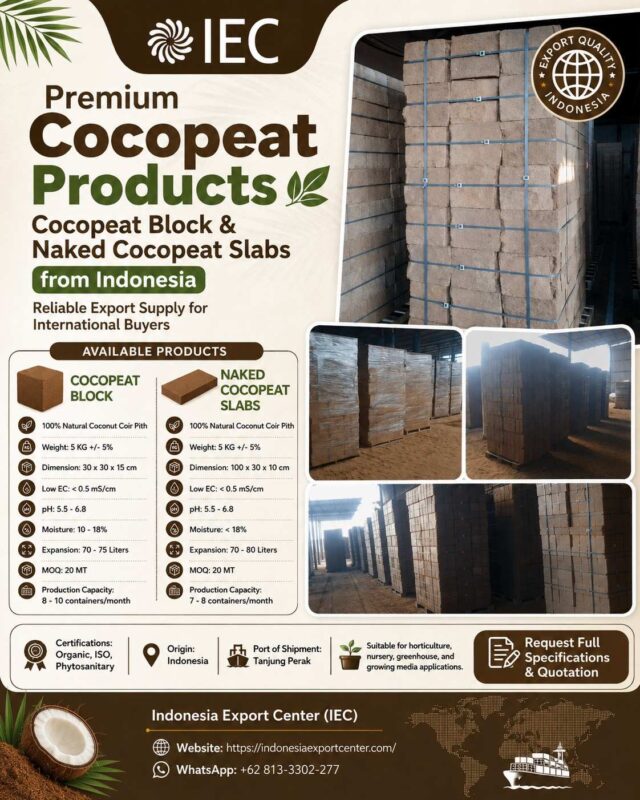
Cocopeat block is widely used as a growing-media component in hydroponics, commercial nurseries, greenhouse cultivation, seedling production, landscaping, and potting-mix manufacturing. When properly processed, cocopeat can provide a useful combination of water retention, aeration, low bulk density, and manageable handling characteristics.
However, cocopeat is a natural agricultural material rather than a fully uniform industrial product. Its chemical and physical properties can vary according to coconut origin, husk storage, fibre extraction, washing, drying, screening, ageing, compression, and warehouse conditions.
Research comparing cocopeat from different countries and processing sources found significant variation in salinity, pH, nutrient composition, cation-exchange capacity, particle characteristics, and other properties. This variation is why international buyers should evaluate each shipment against an agreed specification rather than relying only on the appearance of the compressed blocks.
This guide explains the most common quality risks in 5 kg cocopeat blocks and the practical steps buyers can take to reduce them.
1. Selecting the Wrong EC Grade for the Intended Application
One of the most common purchasing mistakes is choosing cocopeat based only on price without first identifying the required electrical conductivity grade.
Electrical conductivity, or EC, indicates the concentration of soluble ions in the water extract of the growing medium. Cocopeat may contain different concentrations of sodium, chloride, and potassium depending on the origin of the coconut husks and how thoroughly the material has been washed.
Studies of cocopeat from different sources have shown that salinity can vary considerably. Some samples also contain relatively high concentrations of sodium, chloride, and potassium, while calcium and magnesium may be comparatively low.
Low EC cocopeat
Low EC cocopeat is generally preferred for:
- Hydroponic cultivation
- Commercial nurseries
- Seed germination
- Young plants and sensitive crops
- Greenhouse vegetable production
- Professional substrate manufacturing
- Buyers who require greater control over nutrient formulation
A buyer searching for a Low EC Cocopeat Block Supplier should confirm that the stated EC is supported by an agreed laboratory method and representative batch testing.
High EC cocopeat
High EC cocopeat may be considered for:
- Buyers with their own washing facilities
- Potting-mix manufacturers that condition raw materials before blending
- Soil-conditioning applications
- Less salt-sensitive applications
- Markets where the buyer prioritizes lower processing levels
- Industrial users that do not require ready-to-use hydroponic media
High EC does not automatically mean that the cocopeat is defective. It means the material must be matched with an application capable of handling its soluble-salt content. A High EC Cocopeat Block Supplier should clearly disclose the test method, expected EC range, washing status, and intended application.
How buyers can reduce the risk
Before ordering, state in the purchase specification:
- The intended crop or industrial application
- Maximum acceptable EC
- EC extraction method
- Whether the material must be washed
- Whether the material must be buffered
- Maximum sodium and chloride levels, where relevant
- Whether additional washing will be performed after arrival
The correct grade is not simply the cocopeat with the lowest EC. It is the grade that fits the buyer’s production system, crop sensitivity, irrigation water, fertilization program, and post-import processing capacity.
2. EC Results That Cannot Be Compared
A supplier may report an attractive EC value, but the number is incomplete unless the testing method is stated.
Different substrate-to-water ratios and extraction procedures can produce different EC readings from the same material. Common methods include:
- 1:1.5 volume extraction
- 1:2 volume extraction
- 1:5 volume extraction
- Saturated media extract
- Pour-through testing
- Drainage-water testing
RHP explains that the European 1:5 extraction and the Dutch 1:1.5 extraction are different analytical methods. Results should therefore be interpreted according to the method used rather than compared as though they were identical.
EN 13038 provides a standardized method for determining electrical conductivity in a water extract of soil improvers and growing media. The purpose is to indicate the amount of water-soluble electrolytes in the material.
Example of the risk
Supplier A reports:
EC below 0.5 mS/cm
Supplier B reports:
EC below 0.5 mS/cm
These products may not be chemically equivalent if Supplier A used a 1:1.5 extraction while Supplier B used a more diluted extraction.
How buyers can reduce the risk
Write the requirement in the contract as:
EC: maximum 0.5 mS/cm, tested using the agreed 1:1.5 volume extraction method with demineralized water.
Alternatively, specify another recognized method required by the destination market or buyer’s laboratory.
The purchase contract, commercial invoice, product data sheet, certificate of analysis, and third-party inspection instruction should all use the same method.
3. High Sodium, Chloride, or Potassium Despite an Acceptable EC
EC measures the combined conductivity of soluble ions, but it does not identify which ions are present. Two cocopeat samples with similar EC values may have different concentrations of sodium, chloride, potassium, calcium, and magnesium.
Research has found substantial differences in the chemical composition of cocopeat from different origins. Sodium and chloride may be important concerns, while naturally high potassium can also influence nutrient management.
This issue is particularly important for:
- Salt-sensitive seedlings
- Recirculating hydroponic systems
- Crops with strict nutrient programs
- Propagation facilities
- Buyers producing standardized professional substrates
How buyers can reduce the risk
For sensitive applications, request a more complete analysis that includes:
- Sodium
- Chloride
- Potassium
- Calcium
- Magnesium
- Nitrate
- Ammonium, where relevant
- EC and pH
- Cation-exchange characteristics, when required
A basic EC test may be sufficient for general trading purposes, but an ion analysis provides more useful information for professional growers and substrate formulators.
4. Confusing Washed Cocopeat with Buffered Cocopeat
Washing and buffering are related but different processes.
Washing is primarily intended to remove water-soluble salts. Buffering is intended to condition the cation-exchange sites of the cocopeat, commonly by supplying calcium so that excessive sodium and potassium are displaced from exchange sites.
Consequently, a cocopeat block can have a low measured EC but still not be fully buffered. When such material is placed into a fertigation system, its exchange sites may interact with nutrients in the irrigation solution. This may affect the availability of calcium, magnesium, potassium, and other ions.
Scientific reviews note that EC can vary substantially according to the source and treatment of coir and that extensive washing can remove sodium chloride. However, chemical suitability still depends on more than the total EC value alone.
Questions buyers should ask
- Is the cocopeat unwashed, washed, or buffered?
- What solution was used for buffering?
- How long was the buffering process?
- Was the material washed again after buffering?
- Are sodium and potassium results available?
- Is the product supplied ready for direct crop use?
- Does the buyer still need to apply calcium and magnesium before planting?
How buyers can reduce the risk
Use separate terminology in the specification:
- Washed low EC cocopeat
- Washed and calcium-buffered cocopeat
- Unbuffered low EC cocopeat
- High EC unwashed cocopeat
Avoid using “low EC,” “washed,” and “buffered” as interchangeable descriptions.
5. Inconsistent pH
Cocopeat is usually mildly acidic, but its exact pH varies by source, processing, storage, and extraction method. In a study of multiple commercial coir samples, the average pH was approximately 5.6, although individual chemical and physical characteristics varied significantly between sources.
An unsuitable pH can influence nutrient availability and may require the buyer to adjust the growing-medium formulation.
The problem becomes more significant when:
- The crop has a narrow preferred pH range
- Cocopeat is the dominant substrate component
- The buyer uses a recirculating nutrient system
- The product is intended for young seedlings
- The buyer expects a ready-to-use growing medium
How buyers can reduce the risk
The contract should specify:
- Acceptable pH range
- Testing method
- Water quality used in extraction
- Testing temperature, when required
- Permitted batch tolerance
For example, a supplier may offer a specification such as pH 5.5–6.8. However, the buyer should confirm whether this range is appropriate for the intended crop and whether the same test method will be used by both laboratories.
6. Excessive Fine Particles or Incorrect Particle-Size Distribution
Particle-size distribution strongly affects the physical performance of cocopeat.
Fine particles generally increase water retention but may reduce large air-filled pore spaces when present in excessive quantities. Coarser particles and fibres can increase aeration and drainage, but a very coarse material may have lower capillary water movement and different container-filling characteristics.
Research has demonstrated that coir particle size significantly affects air content, water-holding capacity, and air–water relationships. Air content generally increases while water-holding capacity decreases as particle diameter increases.
Another study found significant differences in the physical properties of coir dusts from different geographical and processing sources. Total porosity was high, but air content and particle coarseness varied considerably.
Possible buyer problems
Incorrect particle distribution may result in:
- Waterlogging
- Insufficient root-zone aeration
- Excessively rapid drainage
- Uneven irrigation
- Poor capillary movement
- Inconsistent pot filling
- Shrinkage during crop production
- Different performance between production batches
How buyers can reduce the risk
Do not specify only “cocopeat block.” Also define:
- Particle-size or mesh range
- Maximum fine-particle percentage
- Maximum long-fibre percentage
- Required pith-to-fibre ratio
- Intended crop or container size
- Water-holding capacity
- Air-filled porosity, if critical
- Bulk density after expansion
Commercial nurseries may require a different particle distribution from potting-mix factories, hydroponic growers, or soil-conditioning companies.
7. Excessive Fibre, Sand, Dust, or Foreign Matter
Cocopeat is produced after long coir fibres are separated from coconut husks. Depending on screening efficiency, the final material may still contain fibre, husk pieces, sand, stones, plastics, metal fragments, wood, plant residues, or other foreign matter.
Some fibre can be intentionally retained to improve structure. The risk occurs when the delivered fibre content is substantially higher than the contracted specification or when the material contains uncontrolled contaminants.
How buyers can reduce the risk
Include measurable limits such as:
- Impurities: maximum agreed percentage
- Fibre content: maximum agreed percentage
- Sand content: maximum agreed percentage
- No visible plastics, stones, metal, or non-coir waste
- No objectionable odor
- No live insects
- No visible weed seeds
- No soil contamination
For example, a commercial 5 kg block may be offered with impurities below 3% and fibre below 2%. These figures should be treated as contractual supplier specifications rather than assumed universal standards.
The buyer should also define how impurities will be separated and measured. A result based on weight may differ from one based on volume or visual inspection.
8. Low or Inconsistent Expansion Volume
The economic value of a compressed cocopeat block is determined not only by its weight but also by how much usable medium it produces after hydration.
A nominal 5 kg block that expands poorly can increase the buyer’s real cost per liter of usable substrate. Low expansion may result from:
- Excessive compression
- High sand or impurity content
- Incorrect moisture
- Dense fine particles
- Inconsistent raw material
- Inadequate ageing
- Storage damage
- Incorrect hydration procedure during testing
How buyers can reduce the risk
The expansion test should define:
- Water quantity and quality
- Water temperature
- Hydration time
- Whether the block is manually loosened
- Container dimensions
- Measurement method
- Settling or compaction procedure
- Final moisture condition
For example:
One 5 kg block must produce 70–75 liters of loosened cocopeat after hydration under the agreed test procedure.
Without a defined procedure, one laboratory may report loose, aerated volume while another reports settled volume. Both may obtain different results from the same block.
Buyers should test several blocks from different pallets because a single block may not represent the whole shipment.
9. Incorrect Block Weight or High Moisture
A block marked as 5 kg may be lighter than specified, or its apparent weight may be increased by excessive moisture.
High moisture can reduce the quantity of dry cocopeat received per metric ton. It can also influence compression, block stability, freight efficiency, storage condition, and expansion performance.
The physical properties of coir pith change with moisture content and particle size. Studies on cocopeat-block production also show that moisture and compression ratio affect block formation and recovery performance.
How buyers can reduce the risk
Specify both:
- Block gross weight tolerance
- Maximum moisture percentage
For example:
- Weight: 5 kg ±5%
- Moisture: 10–18%
During inspection, blocks should be selected from different:
- Pallets
- Production dates
- Container positions
- Stack levels
- Batch codes
Moisture should be determined by an agreed laboratory method rather than estimated only with a handheld surface meter.
10. Broken, Crumbling, or Deformed Blocks
Blocks that break during loading or shipment create dust, handling losses, unstable pallet stacks, and difficulties for retail or mechanized production.
Possible causes include:
- Insufficient compression
- Excessively dry material
- Excessively wet material
- Poor block dimensions
- Weak strapping
- Inadequate palletization
- Rough container loading
- Water exposure during storage
- Long unsupported stacking periods
How buyers can reduce the risk
Request:
- Block dimension tolerance
- Drop or handling test
- Pallet and strapping specification
- Maximum pallet height
- Corner protection where necessary
- Container-loading photographs
- Dry container inspection
- Desiccants when appropriate
- Moisture-resistant outer protection
Buyers purchasing naked blocks without individual wrapping should pay particular attention to warehouse dryness, container condition, roof leakage, floor moisture, and pallet protection.
11. Mold, Musty Odor, or Biological Contamination
Cocopeat is a biological material and naturally supports microbial communities. It should not automatically be described as sterile unless a validated sterilization or treatment process has been performed.
Commercial growing substrates can contain diverse microorganisms, including beneficial, neutral, and potentially undesirable organisms. The microbiological condition depends on raw-material handling, processing, water quality, storage, and post-processing exposure.
International phytosanitary guidance also recognizes that coconut fibre, coir, and cocopeat can present pest risks depending on their level of processing. Processing, clean storage, treatment, inspection, sampling, and testing can reduce the risk.
Warning signs
- Visible mold
- Musty or fermented odor
- Wet internal sections
- Insects or larvae
- Weed seeds
- Soil deposits
- Dark, slimy material
- Heating inside packed blocks
- Excessive organic debris
How buyers can reduce the risk
Require the supplier to:
- Use clean processing water
- Keep washed material away from soil
- Dry the material before compression
- Store finished blocks under cover
- Apply pest-control procedures
- Maintain traceable production batches
- Inspect containers before loading
- Provide phytosanitary documentation when required
- Follow the destination country’s import conditions
Import requirements differ by commodity, processing status, origin, and destination. Buyers should verify current requirements with the relevant national plant-protection or biosecurity authority before shipment. For example, New Zealand maintains specific import-health requirements for cocopeat, coir fibre, coir pith, and other plant-origin growing media.
12. Differences Between the Approved Sample and Commercial Shipment
A supplier may submit a high-quality sample that does not fully represent the later production batch. This can happen when:
- The sample comes from an older batch
- The sample is manually selected
- Raw-material sources change
- Washing water quality changes
- Production is subcontracted
- Several small producers are combined
- The shipment is produced over several weeks
- The factory changes screening or compression settings
How buyers can reduce the risk
Use a controlled sample-approval process:
- Obtain a representative pre-shipment sample.
- Seal and label the approved reference sample.
- Record the batch and production date.
- Test the sample at an independent laboratory.
- Attach the approved specification to the sales contract.
- State that commercial production must match the approved sample and specification.
- Retain samples from the shipment for dispute resolution.
Sample approval should never replace batch inspection. It should be combined with pre-shipment testing.
13. Certificates of Analysis That Do Not Represent the Loaded Batch
A certificate of analysis is useful only when it is traceable to the actual shipment.
Common documentation problems include:
- No batch number
- No sampling date
- No production date
- No test method
- No laboratory identity
- No sample quantity
- Reused results from a previous shipment
- Testing only one block
- No connection between the COA and container number
How buyers can reduce the risk
A useful COA should include:
- Supplier name
- Production location
- Product description
- Batch or lot number
- Production date
- Sampling date
- Test date
- Test method
- Individual results
- Specification limits
- Laboratory name
- Authorized signature
- Container or shipment reference, when available
Quality systems such as the RHP quality mark emphasize monitoring growing-media quality throughout the chain, from raw-material production through processing and delivery. This illustrates why traceability and process control are more reliable than relying on a single finished-product test.
Recommended Pre-Shipment Inspection Checklist
When buying from a Cocopeat Block 5 kg Supplier from Indonesia, international buyers should consider checking the following items before container loading.
| Quality Parameter | Recommended Verification |
|---|---|
| Raw material | Confirm 100% coconut coir pith or agreed composition |
| Block weight | Weigh random blocks from multiple pallets |
| Dimensions | Measure length, width, and height |
| Moisture | Test using an agreed laboratory method |
| EC | State extraction ratio and water quality |
| pH | Use the same extraction method agreed in the contract |
| Sodium and chloride | Test for sensitive horticultural applications |
| Buffering status | Confirm washed, unbuffered, or buffered |
| Expansion | Hydrate random blocks using a written procedure |
| Particle size | Conduct sieve or particle-distribution analysis |
| Fibre content | Measure against the contractual limit |
| Sand and impurities | Separate and weigh foreign matter |
| Block integrity | Check cracking, crumbling, and deformation |
| Odor and mold | Inspect internal and external block condition |
| Packaging | Confirm pallet, strap, wrapping, and marking |
| Traceability | Match batch numbers with COA and packing list |
| Container condition | Check dryness, odor, holes, and floor condition |
| Documentation | Verify invoice, packing list, COA, origin, and phytosanitary documents |
A Practical Quality-Control Procedure for Importers
International buyers can reduce quality disputes by following a four-stage control procedure.
Stage 1: Supplier qualification
Evaluate:
- Production capacity
- Washing and drying facilities
- Water source
- Screening equipment
- Compression machinery
- Laboratory access
- Warehouse condition
- Traceability system
- Previous export experience
- Ability to meet destination-country requirements
Stage 2: Contract specification
Prepare a written technical specification covering:
- Weight and dimensions
- EC and test method
- pH and test method
- Moisture
- Expansion volume
- Compression ratio
- Particle-size range
- Fibre and impurity limits
- Washing status
- Buffering status
- Packing and palletization
- Required certificates
- Inspection and rejection procedure
Stage 3: Pre-shipment verification
Use representative sampling from the completed production batch. Tests should be completed before the goods are loaded or before the final payment is released.
Where commercial risk justifies the cost, appoint an independent inspection company to supervise sampling, testing, quantity verification, and container loading.
Stage 4: Arrival inspection
After arrival:
- Select blocks from several pallets
- Recheck weight and physical condition
- Repeat EC, pH, moisture, and expansion tests
- Compare results with the retained sample and COA
- Keep the batch segregated until accepted
- Document damage immediately
- Notify the supplier within the contractual claim period
Final Considerations for International Buyers
The most important cocopeat quality risk is not always high EC, low EC, high moisture, or low expansion individually. The greatest risk is receiving a product that does not match the buyer’s application or the agreed testing method.
A reliable cocopeat purchasing program should therefore be based on:
- Application-specific specifications
- Clearly stated analytical methods
- Representative batch sampling
- Independent testing when necessary
- Production and shipment traceability
- Defined acceptance tolerances
- Pre-shipment inspection
- Arrival verification
Buyers seeking ready-to-use media for hydroponics or nurseries may prioritize washed low EC or buffered cocopeat. Buyers with their own washing, conditioning, or blending systems may purchase a higher EC grade, provided the salt profile and processing requirements are fully understood.
By working with a transparent supplier and establishing measurable quality requirements before production, international buyers can reduce crop risk, rejected shipments, inconsistent substrate performance, and costly commercial disputes.
Read Also Our Product
https://indonesiaexportcenter.com/product/product-cocopeat-block-slabs-supplier-exporter-indonesia/
References
- Abad, M., Noguera, P., Puchades, R., Maquieira, A., and Noguera, V. “Physico-chemical and chemical properties of some coconut coir dusts for use as a peat substitute for containerised ornamental plants.” Bioresource Technology.
- Abad, M. et al. “Physical Properties of Various Coconut Coir Dusts Compared to Peat.” HortScience.
- Carlile, W. R. et al. “Organic Growing Media: Constituents and Properties.” Vadose Zone Journal.
- RHP. “1:5 versus 1:1.5.” Guidance on analytical extraction methods for growing media.
- RHP. Quality monitoring for raw materials, growing-media production, processing, and delivery.
- International Plant Protection Convention. ISPM 40: International Movement of Growing Media in Association with Plants for Planting.
- Mogale, J. T. et al. Research on air-filled porosity and crop performance in coconut coir substrates.
