![Indonesia Export Center [IEC]](https://indonesiaexportcenter.com/wp-content/uploads/2023/07/logo-no-background.svg)
![Indonesia Export Center [IEC]](https://indonesiaexportcenter.com/wp-content/uploads/2023/07/svgviewer-output.svg)
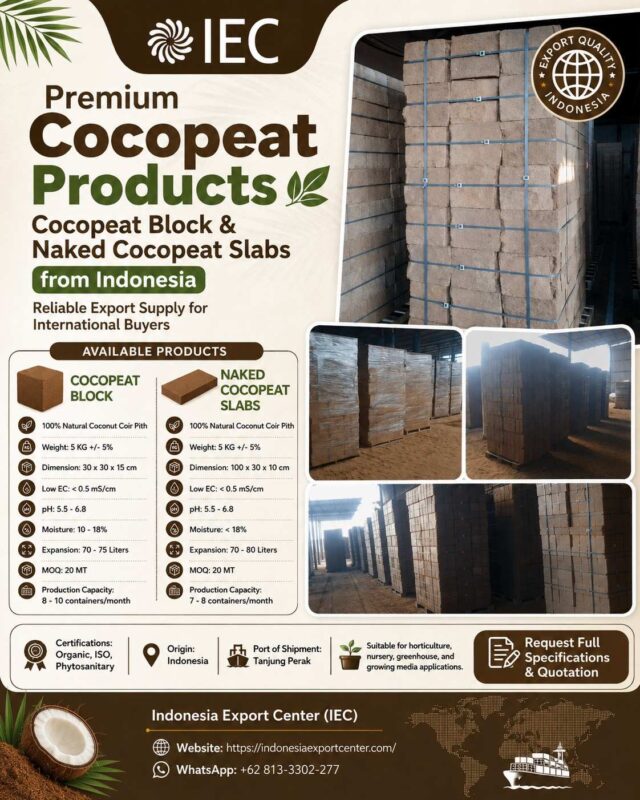
Cocopeat is widely used as a growing medium in hydroponics, commercial nurseries, propagation systems, container production, and potting mix manufacturing. However, not every cocopeat product is suitable for every application.
A cocopeat block that performs well in a commercial potting mix factory may not be suitable for direct use in a hydroponic greenhouse. Likewise, cocopeat intended for mature ornamental plants may be too saline or too coarse for seedling trays.
The correct choice depends on several factors, including:
- Electrical conductivity, or EC
- pH
- Washing and buffering treatment
- Particle-size distribution
- Fiber content
- Water-holding capacity
- Air-filled porosity
- Expansion volume
- Moisture content
- Crop sensitivity
- Irrigation and fertilization systems
Virginia Cooperative Extension recommends selecting hydroponic substrates based on crop suitability, drainage, water retention, durability, handling characteristics, nutrient-holding capacity, and chemical consistency. Cocopeat can meet these requirements, but only when its grade and processing method match the intended application.
What Makes Cocopeat Suitable as a Growing Medium?
Cocopeat, also called coir pith or coir dust, is produced from the material remaining after coconut husks are processed. It may be supplied loose or compressed into bricks, bales, slabs, discs, grow bags, or 5 kg blocks.
Research describes coir as a material that can be used either as a stand-alone substrate or as a component of horticultural growing media. Compressed coir can expand several times its original volume after hydration, making it efficient to transport and store.
Cocopeat is valued because it can provide:
- High water-holding capacity
- Relatively low bulk density
- Easy root penetration
- Moisture distribution throughout the container
- Nutrient-holding capacity
- A renewable organic component for soilless substrates
However, its physical performance depends strongly on particle size. Fine cocopeat generally holds more water, while coarser particles, fibers, and chips create larger pore spaces that improve drainage and root-zone aeration. Utah State University Extension reports that finer coir particles can retain substantially more water than coarse particles.
Therefore, buyers should not evaluate cocopeat by EC and pH alone. Particle-size distribution and the balance between water and air are equally important.
Understanding Low-EC and High-EC Cocopeat
Electrical conductivity indicates the concentration of dissolved ions or salts in a solution or substrate extract. A higher EC reading generally means a higher concentration of soluble salts. Excessively high salt concentrations can cause osmotic stress, ion toxicity, nutrient imbalance, and reduced plant growth.
In the cocopeat trade, products are commonly marketed as either low-EC or high-EC cocopeat.
Low-EC Cocopeat
Low-EC cocopeat has normally been washed with fresh water to reduce soluble salts. Depending on the product and buyer requirements, it may also be buffered with calcium- and magnesium-containing materials.
Low-EC cocopeat is generally the safer choice for:
- Direct hydroponic cultivation
- Seed germination
- Plug and tray production
- Rooting cuttings
- Salt-sensitive crops
- Controlled fertigation programs
- Premium commercial potting mixes
A specification such as EC below 0.5 mS/cm may be suitable for many horticultural applications, but the EC extraction method must always be stated in the contract and laboratory report.
High-EC Cocopeat
High-EC cocopeat is normally unwashed, partially washed, or supplied with a naturally higher concentration of soluble salts. It can be commercially useful, but it should not automatically be treated as ready-to-use growing media.
High-EC cocopeat is more appropriate for:
- Buyers operating their own washing facilities
- Substrate manufacturers with buffering systems
- Potting mix factories with controlled dilution and blending
- Industrial processors capable of monitoring sodium, chloride and potassium
- Applications where the material will be treated before contact with plant roots
Oklahoma State University Extension warns that cocopeat may have salinity problems when coconut husks are exposed to saline water and are not properly rinsed. The publication recommends washing and notes that calcium and magnesium treatment may be needed to facilitate sodium removal and improve nutrient conditions.
For this reason, high-EC cocopeat should be sold and purchased as a processing-grade raw material, unless laboratory analysis and crop trials demonstrate that it is suitable for direct horticultural use.
Why the EC Testing Method Must Be Specified
An EC number cannot be evaluated correctly without knowing how the sample was prepared and tested.
Common testing methods include:
- 1:1.5 water extraction
- 1:2 water-to-substrate extraction
- Saturated media extract
- Pour-through extraction
- Press or squeeze extraction
These methods can produce different EC values from the same material because they use different amounts of water and different extraction procedures. A USDA review found that pour-through testing can produce higher EC readings than saturated media extraction because the latter involves greater dilution.
Therefore, an international buyer should never accept a specification stating only:
EC: below 0.5 mS/cm
A complete specification should state:
EC: below 0.5 mS/cm, tested using the agreed water-to-cocopeat extraction method.
The buyer and supplier should also agree on:
- Water quality used for testing
- Sample preparation
- Extraction ratio
- Temperature
- Test equipment
- Number of samples per production lot
- Laboratory or inspection company
- Acceptance and rejection limits
Without an agreed test method, two laboratories may report different results even when testing cocopeat from the same shipment.
Choosing Cocopeat for Hydroponics
Hydroponic production requires close control of water quality, nutrient concentration, pH, and root-zone EC. Unlike mineral soil, a soilless system provides less natural buffering against sudden chemical changes. Oklahoma State University recommends testing source water for EC, pH, alkalinity, sodium, calcium, chloride, and other dissolved salts before preparing a hydroponic nutrient solution.
Recommended Grade: Washed Low-EC Cocopeat
For direct hydroponic use, washed low-EC cocopeat is normally preferred because the grower needs to control the nutrient program from the beginning.
Unwanted salts already present in the substrate may:
- Increase the starting root-zone EC
- Interfere with the nutrient formula
- Increase sodium or chloride exposure
- Make fertilizer calculations less predictable
- Require additional flushing
- Create variability between grow bags or containers
The risk is especially important in recirculating systems because salts released from the substrate may return to the nutrient reservoir.
For sensitive crops, the required substrate EC may be particularly low. Ohio State University’s controlled-environment strawberry guidance recommends low substrate EC and states that coconut coir generally needs to be washed with fresh water before planting. It also advises growers to test bio-based substrates on a small scale because physical and chemical properties can vary between sources.
Washed Versus Buffered Cocopeat
Washing and buffering are related but different processes.
Washing primarily removes water-soluble salts from the cocopeat.
Buffering conditions the exchange sites of the cocopeat, commonly using calcium and magnesium. This treatment helps reduce the risk that the substrate will interfere with the crop’s calcium, magnesium, potassium, and sodium balance.
For professional hydroponic production, buyers should ask whether the product is:
- Unwashed
- Washed only
- Washed and buffered
- Pre-fertilized
- Hydrated and ready to fill
- Compressed and intended for on-site preparation
A low-EC laboratory result does not automatically prove that the cocopeat has been properly buffered. EC measures the total concentration of soluble ions, but it does not identify every individual nutrient or exchange-related risk.
Selecting the Correct Cocopeat Structure
Pure fine cocopeat may hold too much water under certain container designs or irrigation schedules. Peer-reviewed research notes that although coir has strong water-retention properties, very fine substrates may have limited aeration, which is why coarse materials such as perlite are often added to improve the water-air balance.
For hydroponic production, buyers may consider:
- Fine cocopeat for high-frequency irrigation or small propagation cells
- Cocopeat mixed with perlite for improved aeration
- Cocopeat with short fiber for improved structure
- Cocopeat and coco chips for long-cycle fruiting crops
- Custom grow-bag blends based on crop and container height
The best blend depends on the crop, climate, irrigation frequency, drainage system, and container geometry. A formula suitable for tomatoes in grow bags may not be appropriate for strawberries, lettuce transplants, or ornamental plants.
Choosing Cocopeat for Nurseries and Seedling Production
Nurseries require different cocopeat structures for seed germination, plug production, rooting cuttings, young transplants, and larger container-grown plants.
Cocopeat for Seed Germination and Plug Trays
A seed-starting substrate should be:
- Fine and uniform
- Light and loose
- Low in soluble salts
- Low in initial fertility
- Able to retain moisture
- Able to drain excess water
- Free from weeds, insects, and major contaminants
University of Georgia Extension explains that seed-starting media should be fine, loose, and low in fertility because excessive fertilizer can damage young roots. Its example seed-starting formulation uses equal parts coconut coir or peat, vermiculite, and perlite.
Utah State University Extension similarly recommends peat- or coir-based seed-starting mixes for moisture retention and drainage while advising growers to avoid mixes containing large wood particles for small seedlings.
Recommended Grade for Seedlings
For seeds, plugs, vegetable transplants, and young nursery plants, buyers should generally choose:
- Washed low-EC cocopeat
- Fine and uniform particle distribution
- Low coarse-fiber content
- Minimal sand and foreign matter
- Stable pH
- Consistent moisture content
- Verified expansion volume
High-EC cocopeat is generally unsuitable for direct seedling use unless it has been washed, buffered, retested, and approved through germination trials.
Seeds contain stored energy and nutrients for the first stage of development. A high initial salt concentration does not provide a benefit and may make water uptake more difficult for sensitive young roots.
Cocopeat for Rooting Cuttings
Cocopeat may also be used as a rooting medium for cuttings under mist or high-humidity propagation systems. Oklahoma State University identifies coir as both a stand-alone growing medium and a component for vegetable, cut-flower, and cutting-propagation substrates.
For cuttings, the substrate must maintain moisture around the stem while providing enough air for new root formation. The preferred composition may include:
- Fine washed cocopeat
- Cocopeat and perlite
- Cocopeat and vermiculite
- Cocopeat with a controlled percentage of short fiber
The appropriate ratio should be confirmed with a small-scale propagation trial because crop species and mist schedules differ.
Cocopeat for Larger Nursery Containers
Larger nursery pots and long-cycle ornamental crops often require more drainage and structural stability than plug trays.
For these applications, cocopeat may be blended with:
- Coco chips
- Coir fiber
- Perlite
- Pine bark
- Rice hulls
- Compost or other approved organic components
The objective is not simply to maximize water retention. The mix should provide sufficient air space after repeated irrigation and should resist excessive shrinkage or compaction during the production cycle.
Choosing Cocopeat for Potting Mix Production
Commercial potting mix manufacturers generally have more flexibility than hydroponic growers because cocopeat is only one component in the final formulation.
The correct grade depends on:
- Percentage of cocopeat in the formula
- Other components in the blend
- Target crop
- Added fertilizers
- Limestone or pH-adjustment program
- Wetting agents
- Container size
- Required shelf life
- Manufacturing equipment
- Whether the factory can wash or buffer raw cocopeat
Using Low-EC Cocopeat in Potting Mixes
Low-EC cocopeat gives manufacturers greater control over the final nutrient and salt concentration. It is usually preferred for:
- Seed-starting mixes
- Premium retail potting mixes
- Professional greenhouse substrates
- Salt-sensitive ornamentals
- Vegetable transplant mixes
- Organic growing-media formulations
- Products sold as ready to use
Using low-EC material reduces the amount of corrective processing required after expansion.
Using High-EC Cocopeat in Potting Mix Manufacturing
High-EC cocopeat can be considered when the manufacturer has adequate processing and quality-control systems.
A potting mix producer may purchase high-EC material when it can:
- Expand the compressed cocopeat with tested fresh water.
- Wash or leach the material repeatedly.
- Apply a controlled buffering treatment.
- Measure EC, pH, sodium, chloride, potassium, calcium, and magnesium.
- Blend the treated material uniformly.
- Test the finished potting mix.
- Conduct crop trials before commercial production.
A government-supported Australian study found substantial differences in EC and sodium between treated and untreated coir products. In its protected-cropping trial, untreated and non-buffered coir produced fewer flowers than pre-treated coir, demonstrating that a lower purchase price can become a false economy when insufficient processing reduces crop performance.
High-EC cocopeat should therefore be purchased based on the buyer’s processing capacity—not simply because it is cheaper.
Low-EC or High-EC Cocopeat: Which Grade Fits Each Application?
| Application | Preferred Cocopeat Grade | Main Reason |
|---|---|---|
| Direct hydroponic cultivation | Washed low EC, preferably buffered | Allows precise control of nutrient solution and root-zone salinity |
| Recirculating hydroponics | Low EC with strict batch consistency | Reduces the risk of salts entering the nutrient reservoir |
| Hydroponic strawberries | Low EC and high-porosity blend | Strawberries are sensitive to root-zone salinity and poor aeration |
| Seed germination | Fine, washed low EC | Young roots require a low-salt, uniform medium |
| Plug and tray production | Fine low-EC cocopeat or formulated blend | Provides moisture while protecting sensitive seedlings |
| Rooting cuttings | Low EC with balanced air and water | Supports moisture retention and new root development |
| Large nursery pots | Low-EC or properly treated cocopeat in a coarse blend | Long production cycles need drainage and structural stability |
| Ready-to-use potting mixes | Low EC | Provides better control over the finished formulation |
| Potting mix factory with washing facilities | High EC may be acceptable | Buyer can wash, buffer, test, and reformulate the material |
| Buyer without treatment facilities | Low EC | Reduces technical and operational risk |
Important Specifications for a 5 kg Cocopeat Block
A compressed 5 kg block can be suitable for international shipment because it reduces transport and storage volume before hydration.
An export specification may include:
| Parameter | Example Buyer Requirement |
|---|---|
| Raw material | 100% natural coconut coir pith |
| Block weight | 5 kg ± 5% |
| Block dimensions | Approximately 30 × 30 × 15 cm |
| Low-EC grade | Below 0.5 mS/cm using the agreed method |
| pH | Approximately 5.5–6.8 |
| Moisture | Approximately 10–18% |
| Expansion volume | Approximately 70–75 liters |
| Compression ratio | Approximately 5:1 |
| Impurities | Below 3% |
| Fiber content | Based on buyer formulation requirements |
| Packing | Naked blocks, palletized blocks, or custom export packing |
| Inspection | Pre-shipment or third-party inspection when required |
These figures should be treated as contractual targets rather than universal values. The appropriate specification may change according to crop, market, testing method, and intended manufacturing process.
Additional Tests Buyers Should Request
EC and pH are important, but they do not provide a complete quality profile. Professional buyers may also request:
- Sodium content
- Chloride content
- Potassium content
- Calcium and magnesium
- Cation exchange characteristics
- Moisture content
- Expansion volume
- Bulk density
- Air-filled porosity
- Water-holding capacity
- Particle-size distribution
- Sand content
- Foreign matter
- Fiber percentage
- Weed-seed assessment
- Plant pathogen or microbiological tests
- Residue and heavy-metal testing where required
The required test package should match the destination market and final application.
Questions to Ask a Cocopeat Supplier
Before ordering commercial quantities, buyers should ask:
- Is the cocopeat washed, buffered, or untreated?
- What water source is used during washing?
- Which EC extraction method is used?
- Is the EC tested before or after block compression?
- Can the supplier provide a recent certificate of analysis?
- Are sodium, chloride, and potassium tested separately?
- What is the particle-size distribution?
- What percentage of fiber, sand, and foreign matter is present?
- What is the guaranteed expansion volume per 5 kg block?
- How much variation is allowed between production batches?
- Can the supplier prepare a custom blend?
- Is a pre-shipment sample available?
- Can an independent inspection company collect samples?
- What traceability system identifies each production lot?
- Has the material been tested for the buyer’s intended crop?
A small trial should be completed before placing a long-term contract or introducing a new cocopeat source into a large greenhouse. Ohio State University specifically recommends testing bio-based substrates on a limited scale because cocopeat properties can vary among suppliers and sources.
Choosing an Indonesian Cocopeat Supplier
Indonesia has access to substantial coconut raw materials and can supply compressed cocopeat blocks for international horticultural buyers. However, buyers should evaluate the supplier’s processing controls rather than selecting a product solely by country of origin or price.
A reliable Cocopeat Block 5 kg Supplier from Indonesia should be able to provide:
- Clearly defined low-EC and high-EC grades
- Agreed EC test methods
- Consistent block weight and dimensions
- Controlled washing-water quality
- Reliable expansion volume
- Batch-level quality records
- Export packing options
- Certificates of analysis
- Phytosanitary documentation where required
- Production and shipment planning
- Pre-shipment inspection support
Buyers requiring material for direct hydroponic or nursery use should review the specifications offered by a specialized Low EC Cocopeat Block Supplier.
Manufacturers with their own washing, buffering, and formulation facilities may instead evaluate a High EC Cocopeat Block Supplier, provided that the product is treated as processing-grade raw material and not assumed to be ready for direct planting.
Conclusion
Choosing cocopeat is not simply a decision between low price and premium price. The buyer must match the cocopeat’s chemical and physical characteristics with the crop, irrigation system, container, and manufacturing process.
For direct hydroponics, germination, plug production, and sensitive nursery plants, washed low-EC cocopeat is generally the safest option. It gives growers greater control over nutrient management and reduces the risk of unwanted salts entering the root zone.
For commercial potting mix factories, both low-EC and high-EC cocopeat may have a role. Low-EC material is easier to formulate into ready-to-use products, while high-EC cocopeat is more suitable for experienced manufacturers that can wash, buffer, test, and standardize the material before use.
Regardless of grade, international buyers should verify the EC testing method, washing process, particle-size distribution, expansion volume, moisture, impurities, and batch consistency before confirming a commercial shipment.
Read Also Our Product
https://indonesiaexportcenter.com/product/product-cocopeat-block-slabs-supplier-exporter-indonesia/
References
- Oklahoma State University Extension, Soilless Growing Mediums.
- Oklahoma State University Extension, Electrical Conductivity and pH Guide for Hydroponics.
- Virginia Cooperative Extension, Hydroponic Production of Edible Crops: Media Systems.
- Ohio Controlled Environment Agriculture Center, Production Systems—Substrate Systems.
- University of Georgia Extension, Cut Veggie Garden Costs by Making Your Own Seed Starting Mix.
- Utah State University Extension, Starting Vegetable Seeds Indoors: Materials.
- Londra et al., Hydrological Behavior of Peat- and Coir-Based Substrates and Their Effect on Begonia Growth.
- Altland, The Pour-Through Procedure for Monitoring Container Substrate Chemical Properties: A Review.
- Poulter and Bors, Quantifying Differences Between Treated and Untreated Coir Substrate.
- Gruda, Increasing Sustainability of Growing Media Constituents and Stand-Alone Substrates in Soilless Culture Systems.
