

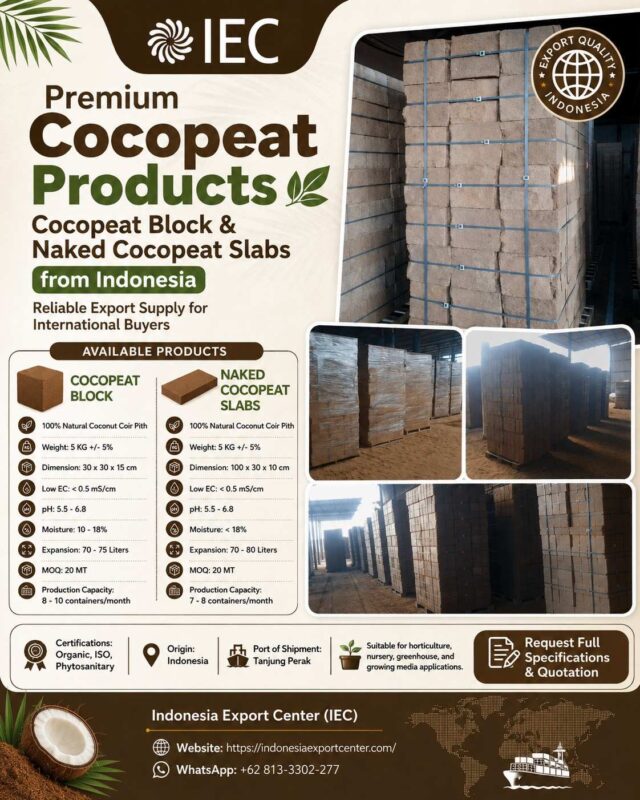
Cocopeat is widely used as a growing-medium component, soil conditioner, potting-mix ingredient, and substrate for commercial horticulture. For international buyers, however, selecting cocopeat involves more than checking block weight, expansion volume, moisture, and packaging.
One of the most important specifications is electrical conductivity, commonly abbreviated as EC.
In international cocopeat trading, products are frequently offered as either Low EC cocopeat or High EC cocopeat. These grades are not simply “good” and “bad” versions of the same product. They are processing and application categories intended for different buyers, crops, production systems, and budgets.
The correct choice depends on how the cocopeat will be used, whether the buyer has washing or blending facilities, the salt sensitivity of the crop, and how much control the grower requires over the nutrient solution.
What Does EC Mean in Cocopeat?
Electrical conductivity indicates the concentration of water-soluble ions in an extract prepared from the cocopeat. In practical terms, the EC result provides an indication of the soluble salt content of the material.
A higher concentration of dissolved ions produces a higher EC reading. These ions may include sodium, chloride, potassium, calcium, magnesium, nitrate, and other soluble nutrients or salts.
EC does not identify which individual ions are present. It only measures their combined effect on electrical conductivity. Buyers working with sensitive crops may therefore require separate sodium, chloride, and potassium results in addition to the general EC value.
Research examining coco coir dust from different origins found substantial variation in salinity, sodium, chloride, potassium, and other chemical properties. In one study of 13 coir-dust samples, salinity ranged from approximately 0.39 to 5.97 mS/cm when converted from the reported saturated-media-extract values. This variation demonstrates why cocopeat should be evaluated by batch rather than selected only according to its country of origin or general product name.
A higher EC generally means a higher total concentration of soluble salts, while a lower EC means a lower salt concentration. However, the result must always be interpreted together with the testing method, extraction ratio, water quality, temperature, and unit of measurement.
Understanding the EC Units
Cocopeat EC may be reported using several equivalent units:
- 1 mS/cm = 1 dS/m
- 0.5 mS/cm = 0.5 dS/m
- 0.5 mS/cm = 500 µS/cm
- 1.0 mS/cm = 1,000 µS/cm
International buyers should check the unit carefully. A quotation stating “EC 500” is incomplete unless the supplier confirms whether the figure means µS/cm, mS/cm, or another unit.
What Is Low EC Cocopeat?
Low EC cocopeat is coco coir pith that has normally undergone washing or another salt-reduction process to lower its concentration of water-soluble salts.
In the export market, EC below 0.5 mS/cm or 500 µS/cm is commonly offered as a Low EC specification. An Indonesian government-supported export portal, for example, lists Low EC cocopeat at below 500 µS/cm for horticultural and greenhouse applications. Nevertheless, buyers should treat this figure as a commercial specification rather than a universal definition applicable to every laboratory method.
Low EC cocopeat is generally preferred when the buyer needs a clean and controllable starting medium. It is especially relevant when cocopeat will be used directly in a professional cultivation system rather than being diluted with a large quantity of soil, compost, or other material.
Typical Applications for Low EC Cocopeat
Low EC cocopeat is generally the more appropriate choice for:
- Hydroponic and soilless cultivation
- Greenhouse vegetable production
- Seed germination
- Seedling trays and propagation media
- Commercial nurseries
- Potting-mix manufacturing
- High-value horticultural crops
- Salt-sensitive plants
- Controlled fertigation systems
- Grow bags, slabs, pots, and containers
Seeds, young seedlings, and newly established root systems are generally more vulnerable to excessive salts than established, salt-tolerant plants. High soluble-salt concentrations can interfere with water absorption and may cause poor germination, root damage, nutrient imbalance, or reduced growth.
For buyers using precise nutrient programs, Low EC cocopeat also provides more control. Growers can add nutrients according to crop requirements without beginning with an unnecessarily high or uncertain background salt concentration.
Professional growers and growing-media manufacturers can find the relevant export specification on the Low EC Cocopeat Block Supplier landing page.
What Is High EC Cocopeat?
High EC cocopeat generally refers to cocopeat that retains more soluble salts because it has received less washing, no washing, or a different level of processing compared with Low EC material.
There is no single globally accepted EC boundary for the term “High EC cocopeat.” Commercial listings use different thresholds. Some suppliers classify cocopeat above 0.8 mS/cm as High EC, while others use a value above 1.0 mS/cm. These differences show why buyers should request an actual numerical limit instead of accepting the words “High EC” without further specification.
High EC should not automatically be interpreted as defective cocopeat. It may be an economical and appropriate raw material when the buyer understands its chemical characteristics and plans to process, dilute, blend, or leach it before sensitive agricultural use.
Potential Applications for High EC Cocopeat
Depending on its actual test results and the buyer’s processing system, High EC cocopeat may be considered for:
- Soil conditioning
- Large-volume soil blending
- Landscaping substrates
- Compost or growing-media production
- Erosion-control applications
- Agricultural field incorporation
- Industrial absorbent applications
- Buyers operating their own washing facilities
- Applications involving salt-tolerant plants
- Markets where the material will be diluted with low-salt components
A buyer should not assume that all High EC cocopeat can be used directly around plant roots. Its suitability depends on the actual EC, sodium, chloride, potassium, application rate, crop tolerance, irrigation quality, drainage, and blending ratio.
For commercial applications that do not require a ready-to-use low-salt substrate, buyers can review the High EC Cocopeat Block Supplier landing page and request the current batch specification.
Low EC vs High EC Cocopeat: Main Differences
| Comparison Point | Low EC Cocopeat | High EC Cocopeat |
|---|---|---|
| Salt concentration | Lower soluble-salt concentration | Higher soluble-salt concentration |
| Common commercial EC | Frequently specified below 0.5 mS/cm | Boundary varies; actual maximum must be stated |
| Processing | Normally washed or salt-reduced | May be less washed or unwashed |
| Direct horticultural use | More suitable for controlled cultivation | Requires evaluation, dilution, washing, or crop-specific confirmation |
| Typical buyers | Hydroponic farms, greenhouse growers, nurseries and potting-mix manufacturers | Landscapers, soil blenders, processors and buyers with washing facilities |
| Crop sensitivity | Better starting point for sensitive crops and seedlings | More suitable where salts can be managed or tolerated |
| Nutrient control | Gives growers greater control over fertilizer formulation | Existing salts must be considered in nutrient management |
| Processing cost | Normally higher because additional treatment is required | Often more economical due to reduced processing |
| Buyer-side preparation | Usually lower, subject to product condition | Often higher |
| Main purchasing requirement | Confirm low EC by an agreed test method | Confirm exact EC and individual salt profile |
Treated coir normally costs more to produce because washing, calcium treatment, water use, handling, testing, and drying add processing steps. Research comparing treated and untreated coir also showed that selecting untreated material based only on initial price could become a false economy when plant productivity and quality were considered.
Washed Cocopeat and Buffered Cocopeat Are Not the Same
A common purchasing mistake is assuming that every Low EC cocopeat is automatically buffered.
Washing and buffering are related but different processes.
Washing
Washing uses suitable water to remove water-soluble salts from the cocopeat. It can lower EC by reducing readily soluble sodium, chloride, potassium, and other ions.
The final result depends on:
- Initial salt content
- Number of washing cycles
- Washing-water quality
- Water-to-cocopeat ratio
- Contact time
- Drainage efficiency
- Drying and storage conditions
Research has demonstrated that repeated washing can substantially reduce cocopeat EC. However, the result should still be confirmed through laboratory testing rather than inferred from the number of washes alone.
Buffering
Buffering normally involves treating the cocopeat with a calcium-containing solution and sometimes magnesium. Calcium can replace sodium and potassium held on exchange sites within the coir. The displaced ions can then be removed through drainage and washing.
A study on calcium-nitrate treatment found that an appropriate calcium treatment and soaking period reduced potassium and sodium in cocopeat while supplying calcium and nitrogen.
The treated-versus-untreated coir study published by the International Society for Horticultural Science similarly describes calcium treatment as a process that displaces sodium before the sodium is removed with suitable washing water.
Therefore:
- Low EC does not automatically mean buffered.
- Washed does not automatically mean buffered.
- Buffered does not eliminate the need to verify final EC.
Buyers should ask the supplier to state clearly whether the material is:
- Unwashed
- Washed
- Buffered
- Washed and buffered
Why the EC Testing Method Matters
An EC result cannot be evaluated properly without knowing how the sample was prepared.
Different laboratories may use:
- Water extracts with different cocopeat-to-water ratios
- Saturated-media extract methods
- Pour-through methods
- Rehydrated-block runoff
- Laboratory methods based on national or international standards
EN 13038 specifies an instrumental method for determining electrical conductivity in a water extract of soil improvers and growing media. Its purpose is to provide an indication of the concentration of water-soluble electrolytes.
A value obtained using one extraction method may not be directly comparable with a value obtained using another method. For this reason, a purchase contract should state:
- Maximum EC
- EC unit
- Extraction method
- Water-to-sample ratio
- Sample preparation
- Testing temperature, where relevant
- Laboratory or inspection party
- Acceptance and rejection procedure
The phrase “EC below 0.5” is not sufficiently precise without these details.
Which Grade Should Buyers Choose?
Choose Low EC Cocopeat When:
Low EC is generally the safer commercial choice when:
- Cocopeat will be used directly for hydroponics.
- The product is intended for greenhouse fertigation.
- The crop is sensitive to sodium or chloride.
- The buyer produces seedlings or propagation media.
- The buyer needs consistent nutrient management.
- No washing facility is available at the destination.
- The material will be used as the main growing substrate.
- The buyer supplies professional growers or premium retail markets.
- The purchase specification requires EC below 0.5 mS/cm.
- A current batch COA must demonstrate low soluble-salt content.
Low EC is particularly useful when consistency and reduced preparation are more important than obtaining the lowest initial raw-material price.
Choose High EC Cocopeat When:
High EC may be considered when:
- The buyer operates a washing or buffering facility.
- Cocopeat will be blended with large volumes of soil or low-salt materials.
- The product is intended for landscaping or soil-conditioning applications.
- Direct contact with sensitive seedlings is not planned.
- The crop and irrigation program can tolerate and manage the measured salts.
- The buyer will conduct additional treatment before commercial cultivation.
- The buyer needs a less-processed raw material for further manufacturing.
- The purchasing decision is based on a defined numerical EC range rather than the grade name alone.
High EC cocopeat should still be evaluated through a current COA and representative sample. A lower price does not compensate for unsuitable salinity, additional destination treatment, plant losses, wastewater handling, or inconsistent batches.
Indicative Cocopeat Block 5 kg Specification
International buyers evaluating an Indonesian Cocopeat Block 5 kg Supplier may use the following indicative product parameters as a starting point:
| Feature | Indicative Specification |
|---|---|
| Raw material | 100% natural coconut coir pith |
| Block weight | 5 kg ± 5% |
| Dimension | Approximately 30 × 30 × 15 cm |
| Low EC option | Below 0.5 mS/cm, subject to agreed test method |
| High EC option | Actual range must be confirmed by batch |
| pH | 5.5–6.8 |
| Moisture | 10–18% |
| Expansion | Approximately 70–75 liters |
| Compression ratio | Approximately 5:1 |
| Impurities | Below 3% |
| Fiber content | Below 2% |
| Origin | Indonesia |
| Port of shipment | Tanjung Perak, Surabaya |
| Final specification | Subject to sample, COA and contract confirmation |
Natural agricultural materials can vary between production batches. Dimensions, moisture, expansion, EC, pH, fiber, and impurity levels should therefore be confirmed before shipment.
Buyer’s Pre-Purchase Quality Checklist
Before placing a container order, buyers should request the following information.
1. Current Batch COA
The COA should represent the actual batch or production lot offered for shipment—not only a historical sample or general product specification.
2. Exact EC Test Method
Ask for the extraction procedure, dilution ratio, unit, testing temperature, and laboratory information.
3. Sodium, Chloride and Potassium
EC alone does not show which salts are responsible for the conductivity reading. Individual ion testing is particularly important for hydroponics, propagation, blueberries, strawberries, and other crops requiring strict nutrient control.
4. Washed or Unwashed Status
The quotation should clearly state the processing grade. Terms such as “premium,” “horticultural,” or “export quality” should not replace measurable specifications.
5. Buffered or Non-Buffered Status
A buyer requiring buffered material should request details of the buffering agent, process, final calcium and magnesium condition, and post-treatment testing.
6. pH, Moisture and Expansion
EC is only one part of cocopeat quality. Buyers should also verify pH, moisture, expansion volume, compression ratio, particle size, fiber percentage, and impurities.
7. Representative Sample
A sample block should be hydrated and tested under the same method planned for commercial acceptance.
8. Washing-Water Quality
Poor-quality washing water may reintroduce sodium, chloride, or other salts. Treated coir should be washed using water suitable for the intended quality standard. Concern about coir washed with saline water was one of the reasons behind comparative research on treated and untreated substrates.
9. Packaging and Container Loading
Confirm block arrangement, pallet requirements, wrapping, container type, net weight, gross weight, and estimated blocks per container.
10. Export Documents
Depending on the destination, buyers may require a commercial invoice, packing list, certificate of origin, phytosanitary certificate, fumigation certificate, bill of lading, inspection report, or other destination-specific documentation.
Frequently Asked Questions
Is Low EC cocopeat always better than High EC cocopeat?
Not for every application. Low EC is usually more suitable for direct horticultural use, hydroponics, seedlings, and sensitive crops. High EC can remain commercially useful for buyers who will wash, blend, dilute, compost, or process the material before use.
Is EC below 0.5 mS/cm an international standard?
It is a widely used commercial specification for Low EC cocopeat, but it is not a universal definition. The testing method and extraction procedure must be stated.
Does Low EC mean that cocopeat contains no salts?
No. Low EC means the concentration of soluble salts is relatively low under the specified testing method. It does not mean the material is completely salt-free.
Can High EC cocopeat be converted into Low EC cocopeat?
Its EC can often be reduced through suitable washing and treatment. However, the amount of water, processing time, wastewater management, initial salt composition, and final consistency must be considered. The resulting EC should be verified by laboratory analysis.
Does washing automatically buffer cocopeat?
No. Washing primarily removes soluble salts. Buffering uses calcium or calcium-and-magnesium treatment to modify the ions held on the cocopeat’s exchange sites.
Should buyers test every shipment?
For commercial cultivation and large-volume imports, batch-based testing is strongly recommended. Cocopeat is a natural product, and chemical characteristics can vary according to raw material, processing water, washing intensity, storage, and production lot.
Final Recommendation for International Buyers
Buyers should choose cocopeat according to its intended use rather than selecting a product only by price.
For hydroponics, professional greenhouses, seedling production, nurseries, high-value crops, and controlled potting-mix manufacturing, Low EC cocopeat is generally the preferred grade because it provides a cleaner and more predictable starting substrate.
For soil blending, landscaping, further processing, or buyers with their own washing and quality-control systems, High EC cocopeat may offer a practical and economical alternative, provided that its actual salt profile is understood and managed.
Regardless of grade, the purchase agreement should define the maximum EC, unit, testing method, washed or buffered status, pH, moisture, expansion, impurities, packaging, and batch-acceptance procedure.
Indonesia Export Center coordinates inquiries for Indonesian cocopeat products for international importers, distributors, growing-media manufacturers, nurseries, greenhouse growers, and agricultural trading companies.
To request a quotation, buyers should provide:
- Required grade: Low EC or High EC
- Maximum acceptable EC
- Testing method
- Required quantity
- Monthly purchasing volume
- Destination port
- Block weight and expansion requirement
- Packaging preference
- Required certificates and inspection documents
- Intended application
A clear technical inquiry allows the supplier to offer the correct Cocopeat Block 5 kg from Indonesia instead of quoting a generic grade that may not meet the buyer’s cultivation or processing requirements.
Read Also Our Product
https://indonesiaexportcenter.com/product/product-cocopeat-block-slabs-supplier-exporter-indonesia/
References
- Abad, M. et al. Physico-Chemical and Chemical Properties of Some Coconut Coir Dusts for Use as a Peat Substitute for Containerised Ornamental Plants. Bioresource Technology, 2002.
- Poulter, R. Quantifying Differences Between Treated and Untreated Coir Substrate. Acta Horticulturae 1018, International Society for Horticultural Science.
- Gbollie, S.N., Mwonga, S.M. and Kibe, A.M. Effects of Calcium Nitrate Levels and Soaking Durations on Cocopeat Nutrient Content.
- Oklahoma State University Extension. Electrical Conductivity and pH Guide for Hydroponics.
- EN 13038. Soil Improvers and Growing Media—Determination of Electrical Conductivity.
- University of Minnesota Extension. Information on soluble salts, plant water uptake, germination, and seedling sensitivity.
- Inaexport. Indonesian Low EC Cocopeat Block commercial specification.
