![Indonesia Export Center [IEC]](https://indonesiaexportcenter.com/wp-content/uploads/2023/07/logo-no-background.svg)
![Indonesia Export Center [IEC]](https://indonesiaexportcenter.com/wp-content/uploads/2023/07/svgviewer-output.svg)
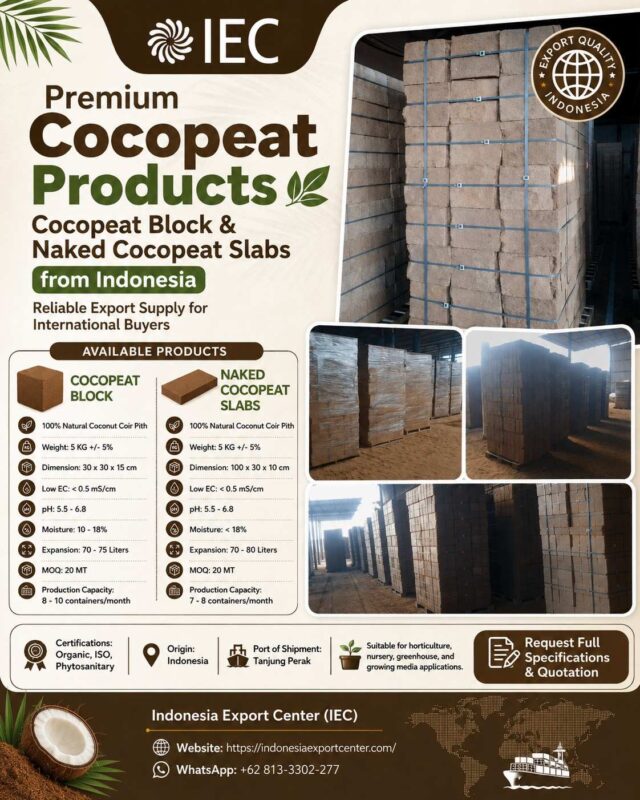
For international buyers, purchasing cocopeat is not only about comparing electrical conductivity, pH, moisture, and expansion volume. Packaging configuration, minimum order quantity, container loading, documentation, and shipment scheduling can have an equally significant effect on the total landed cost and reliability of supply.
A properly planned shipment helps protect the compressed blocks from moisture, contamination, deformation, and incorrect grade identification during storage and international transportation. It also reduces the risk of customs delays, unexpected freight charges, and discrepancies between ordered and delivered quantities.
This guide explains the key points buyers should evaluate when importing 5 kg cocopeat blocks from Indonesia, whether sourcing standard-grade, low-EC, or high-EC material.
Understanding the 5 kg Cocopeat Block Format
A 5 kg cocopeat block is produced by drying, screening, and compressing coconut coir pith into a compact format. The compression process allows a relatively large volume of growing medium to be transported and stored in a much smaller space.
For the Indonesian supplier program discussed in this article, the indicative specification is:
| Parameter | Indicative Specification |
|---|---|
| Raw material | 100% natural coconut coir pith |
| Nominal weight | 5 kg ± 5% |
| Block dimensions | Approximately 30 × 30 × 15 cm |
| Compression ratio | Approximately 5:1 |
| Expansion volume | Approximately 70–75 liters per block |
| pH | Approximately 5.5–6.8 |
| Moisture | Approximately 10–18% |
| Impurities | Below 3% |
| Fiber content | Below 2% |
| Standard packing | Naked blocks without individual wrapping |
| Indicative MOQ | 20 metric tons |
| Production lead time | Approximately 25–30 days |
| Origin | Indonesia |
| Port of shipment | Tanjung Perak, Surabaya, subject to final quotation |
Final values should always be confirmed in the sales contract, proforma invoice, product data sheet, and batch certificate of analysis.
The compact dimensions shown in the product specification refer to the compressed block. Buyers should not confuse these dimensions with the volume of hydrated cocopeat after expansion.
Why Packaging Matters in Cocopeat Shipments
Cocopeat is an absorbent organic material. Although compressed blocks are relatively stable, exposure to excessive humidity, rainwater, dirty warehouse floors, or container condensation can increase moisture content and affect the physical condition of the shipment.
The IMO/ILO/UNECE Code of Practice for Packing of Cargo Transport Units recommends protecting moisture-sensitive cargo against condensation from container roofs, walls, and floors. It also emphasizes proper cargo distribution, securing, and the use of suitable protective materials where required.
For this reason, buyers should not evaluate packaging only by asking whether each block is individually wrapped. A complete packaging assessment should consider:
- Protection during factory storage
- Handling between the factory and port
- Container cleanliness and dryness
- Block stabilization inside the container
- Protection from condensation
- Pallet and dunnage compliance
- Product identification and lot traceability
A low-priced packaging configuration may become expensive if blocks arrive wet, broken, contaminated, or mixed with another EC grade.
Naked Blocks Versus Individually Wrapped Blocks
Naked cocopeat blocks
Naked blocks are compressed blocks supplied without individual plastic wrapping. They may be strapped, bundled, palletized, covered with stretch film, or loaded directly into the container, depending on the agreed configuration.
The main advantages are:
- Lower packaging material consumption
- Lower packaging cost
- Faster loading and unloading
- Less plastic waste for the importer
- Potentially more efficient use of container space
However, naked blocks require better control of warehouse conditions, container cleanliness, cargo handling, and moisture protection.
The supplier specification used for this program is based on no individual wrapping. Buyers requiring additional protection should state this clearly in the request for quotation.
Individually wrapped blocks
Individual wrapping may offer additional protection against dust, handling damage, and temporary exposure to moisture. It can also support retail distribution where blocks are resold individually.
However, individual wrapping can:
- Increase packaging cost
- Increase plastic consumption
- Add labor requirements
- Reduce loading efficiency
- Change the final number of blocks that fit into a container
Buyers should therefore decide whether the blocks will be used as industrial raw material, distributed to commercial growers, or resold through retail channels.
Palletized Versus Floor-Loaded Shipments
International buyers normally choose between palletized loading and direct floor loading.
Palletized loading
Blocks are arranged on pallets and usually secured using straps and stretch film.
Palletized shipments offer:
- Faster unloading with forklifts
- Easier warehouse handling
- Better separation from the container floor
- Easier lot segregation
- Lower manual handling requirements
The disadvantages include the space and weight occupied by the pallets. As a result, fewer blocks may fit into one container.
When solid-wood pallets, timber supports, or wooden dunnage are used, they may be subject to ISPM 15 requirements. ISPM 15 establishes internationally recognized treatment and marking requirements for regulated wood packaging material used in international trade.
Buyers should request confirmation that any regulated wooden packaging or dunnage is appropriately treated and marked.
Floor-loaded containers
With floor loading, blocks are stacked directly inside the container without pallets.
The advantages are:
- Better use of container volume
- No pallet purchasing cost
- No pallet weight
- Potentially higher block quantity per container
The disadvantages are:
- Slower manual unloading
- Greater labor requirements at destination
- More contact with the container floor
- More difficult lot segregation
- Increased need for careful stacking and moisture protection
Floor loading is often suitable for industrial importers with adequate unloading labor and warehouse facilities. Palletized loading may be more suitable for distributors that prioritize faster unloading and easier stock handling.
Packaging Details Buyers Should Specify
A professional purchase order should define more than “5 kg cocopeat block.”
The packaging section should include:
1. Individual block packaging
Specify one of the following:
- Naked block without wrapping
- Individual plastic wrapping
- Shrink wrapping
- Buyer-branded wrapping
- Neutral export wrapping
2. Outer packing configuration
Confirm whether the blocks will be:
- Bundled using plastic straps
- Covered with stretch film
- Palletized
- Floor-loaded
- Protected with a container liner
- Separated from the floor using approved material
3. Labeling
Each pallet, bundle, or lot should ideally show:
- Product name
- Low-EC, high-EC, or agreed commercial grade
- Nominal block weight
- Batch or lot number
- Production date
- Country of origin
- Supplier or manufacturer identification
- Quantity of blocks
- Relevant handling instructions
Low-EC and high-EC products should be physically segregated and clearly labeled. Mixing grades inside a warehouse or container can create serious problems for growers whose irrigation and fertilizer programs depend on a specific substrate condition.
4. Private labeling
Buyers requesting private-label packaging should provide approved artwork, language requirements, barcode formats, label dimensions, and destination-market warnings before production begins.
Late artwork approval can delay packing and shipment.
EC Grade Must Be Confirmed Separately from Packaging
Low-EC and high-EC cocopeat blocks can look nearly identical after compression. Packaging appearance alone cannot confirm the chemical grade.
Electrical conductivity should therefore be controlled through:
- Approved product specification
- Defined testing method
- Batch identification
- Certificate of analysis
- Pre-shipment sampling
- Clear grade labels
Research on commercial coir substrates has identified variation in electrical conductivity, sodium content, and physical properties between different coir products.
Buyers should also state the EC testing method used in the specification. EC values can differ depending on the extraction method, water-to-substrate ratio, sample moisture, and testing procedure. Purdue Extension guidance explains that substrate EC results can be affected by sampling and dilution conditions.
Therefore, a purchase order stating only “EC below 0.5 mS/cm” may be incomplete unless both parties agree on the testing method.
This is particularly important when purchasing from a Low EC Cocopeat Block Supplier or comparing low-EC offers from several manufacturers.
Understanding the 20 MT Minimum Order Quantity
For this supplier program, the indicative minimum order quantity is 20 metric tons.
At a nominal block weight of 5 kg:
20,000 kg ÷ 5 kg = approximately 4,000 blocks
This is an indicative calculation. The final number of blocks can vary because:
- The block specification allows a weight tolerance
- The sales contract may be based on net weight
- Individual block weights may vary within the approved tolerance
- Palletization affects container utilization
- The maximum container payload may differ by container and shipping line
- Loading patterns create unavoidable empty spaces
- Additional packaging materials add gross weight
Buyers should clarify whether the commercial contract is based on:
- Total net product weight
- Number of blocks
- Number of containers
- A combination of block quantity and guaranteed minimum net weight
For bulk international orders, net weight is usually the more reliable commercial basis, while the packing list records the corresponding number of blocks.
Why Suppliers Set a Minimum Order Quantity
Cocopeat production involves several stages, including raw-material preparation, washing where required, drying, screening, quality segregation, compression, packing, and inland transportation.
A minimum order quantity allows the supplier to organize:
- A dedicated production batch
- Consistent washing or processing conditions
- Efficient machine operation
- Batch-specific quality control
- Container-scale inland transportation
- Export documentation
- Inspection and quarantine procedures
- Competitive freight allocation per metric ton
Smaller trial quantities may sometimes be available, but their unit price and logistics cost are normally higher. Less-than-container-load shipments can also expose organic products to cargo from other shippers, additional warehouse handling, and multiple consolidation points.
For established importers, a full-container or near-full-container purchasing strategy is generally easier to control than frequent small consolidated shipments.
Do Not Calculate Shipping Capacity from Expansion Volume
Expansion volume represents the approximate volume produced after a compressed block is hydrated. It is not the volume used to calculate container loading.
For example, approximately 4,000 blocks with an expansion of 70–75 liters per block could produce around 280,000–300,000 liters of expanded growing medium.
However, the blocks remain compressed during transportation.
Container capacity should be calculated from:
- Compressed block dimensions
- Actual block weight
- Stacking orientation
- Number of blocks per layer
- Pallet dimensions
- Packaging thickness
- Container internal dimensions
- Container payload limit
- Road weight restrictions
- Shipping-line requirements
The supplier should provide a proposed loading plan showing the expected number of blocks, net weight, gross weight, pallet quantity where applicable, and estimated container utilization.
Selecting the Appropriate Container
Cocopeat blocks are normally transported in dry freight containers. The specific container size should be selected after reviewing both volume and weight.
Common alternatives include:
- 20-foot dry container
- 40-foot dry container
- 40-foot high-cube container
A high-cube container provides additional internal volume, but it does not automatically allow unlimited cargo weight. The permitted payload shown on the container safety plate, road regulations, terminal restrictions, and shipping-line conditions must still be followed.
The buyer should request the following information before confirming the booking:
- Proposed container type
- Estimated blocks per container
- Estimated net product weight
- Packaging and pallet weight
- Expected gross cargo weight
- Loading method
- Number of pallets, if applicable
- Port weight restrictions
- Destination unloading requirements
Final loading figures should be based on an actual loading plan rather than a generic online container-capacity table.
Container Inspection and Moisture Control
Before stuffing, the container should be inspected to confirm that it is:
- Structurally suitable
- Clean and free from previous cargo residues
- Free from strong odors
- Dry inside
- Free from visible holes or water leakage
- Free from insects and plant contamination
- Equipped with properly functioning doors
- Suitable for the planned cargo weight
The CTU Code emphasizes the suitability of cargo transport units, appropriate packing, cargo distribution, and protection against moisture-related damage.
Depending on the route, season, product moisture, and packaging design, the supplier and forwarder may also consider:
- Moisture-absorbing materials
- Container desiccants
- Floor protection
- Sidewall protection
- Container liners
- Protective sheets above the cargo
- Ventilation strategy
Desiccants should not be treated as a substitute for properly dried products or a watertight container. Moisture control must begin during production and warehouse storage.
Verified Gross Mass Is Required Before Vessel Loading
The gross mass of a packed container must be verified before it can be loaded onto a vessel under the SOLAS container-weight requirements.
The International Maritime Organization states that the shipper is responsible for obtaining and documenting the verified gross mass of the packed container.
The shipment schedule should therefore allow time for:
- Container stuffing
- Sealing
- Weighing or weight calculation under an approved method
- VGM submission
- Customs processing
- Terminal gate-in
- Shipping-line documentation cut-off
Failure to submit the VGM before the carrier’s deadline may prevent the container from being loaded onto the planned vessel.
Documents Commonly Requested by International Buyers
The required documentation depends on the destination, contract, customs classification, and importing-country regulations.
A standard document package may include:
- Commercial invoice
- Packing list
- Bill of lading
- Certificate of origin
- Certificate of analysis
- Product specification sheet
- Phytosanitary certificate, when required
- Certificate for processed or non-regulated products, where applicable
- Fumigation or treatment certificate, if required
- ISPM 15 evidence for regulated wooden packaging
- Organic or quality-management certificates, when contractually applicable
- Insurance certificate under the relevant sales term
The Indonesian Quarantine Agency’s certificate-verification system recognizes documentation categories including phytosanitary certificates for export and certificates for processed or non-regulated plant products.
However, cocopeat should not automatically be assumed to require—or not require—a phytosanitary certificate in every country.
Under IPPC guidance, the importing country’s national plant protection organization evaluates the degree of processing, intended use, and remaining pest risk when determining phytosanitary requirements.
The importer should confirm the requirements with its customs broker and national plant protection authority before shipment.
Confirm the HS Code Before Signing the Contract
Cocopeat and coir products may be classified differently depending on the degree of processing, product form, intended use, and national tariff subdivisions.
The Harmonized System provides an internationally recognized six-digit classification structure, but individual countries can create additional tariff subdivisions beyond six digits.
The Indonesian supplier may propose an export HS code, but the buyer should confirm that classification with the customs broker in the destination country.
An HS-code discrepancy can affect:
- Import duty
- Value-added tax
- Plant quarantine requirements
- Import licensing
- Customs declarations
- Trade statistics
- Eligibility for preferential tariffs
The agreed HS code should appear consistently across the invoice, packing list, bill of lading instructions, certificate of origin, and customs documents.
Choosing the Right Incoterm
The quotation should state a named place or port and the applicable Incoterms® version.
Examples include:
- FOB Tanjung Perak, Surabaya, Incoterms® 2020
- CFR Jebel Ali Port, Incoterms® 2020
- CIF Rotterdam Port, Incoterms® 2020
- FCA named container terminal, Incoterms® 2020
Incoterms® rules allocate transportation responsibilities, costs, and risks between the seller and buyer. The chosen rule should therefore match the parties’ ability to arrange freight, insurance, export procedures, and destination handling.
Buyers should avoid requesting only “CIF price” without naming the destination port. A complete request should identify:
- Destination port
- Required container type
- Expected monthly volume
- Packaging configuration
- Target shipment date
- Insurance requirement
- Required documents
- Preferred payment terms
For containerized shipments, the parties may also discuss FCA with their freight forwarders, especially where delivery occurs at a terminal before the container is loaded aboard the vessel.
Practical Shipment Timeline
The following timeline is an example for planning purposes. Actual dates depend on raw-material availability, production queue, testing, vessel space, port congestion, and documentation requirements.
Stage 1: Specification confirmation
The buyer and supplier confirm:
- Low-EC or high-EC grade
- EC testing method
- pH range
- Moisture limit
- Expansion volume
- Block dimensions
- Packaging configuration
- Quantity and tolerance
- Required documents
Stage 2: Commercial confirmation
The parties agree on:
- Unit price
- MOQ
- Incoterm
- Port of shipment
- Destination
- Payment terms
- Inspection arrangement
- Claims procedure
- Production lead time
Stage 3: Production and quality control
For the current supplier program, production lead time is approximately 25–30 days after order and payment conditions are fulfilled.
Quality-control checks may include:
- Weight
- Dimensions
- Moisture
- pH
- EC
- Expansion
- Fiber content
- Impurities
- Visual condition
- Compression quality
Stage 4: Vessel booking
The supplier or buyer books the vessel according to the agreed Incoterm.
The booking should consider:
- Empty-container release
- Factory stuffing date
- Customs cut-off
- VGM cut-off
- Shipping-instruction cut-off
- Terminal closing time
- Estimated vessel departure
Stage 5: Stuffing and sealing
The container is inspected, loaded, photographed, sealed, and weighed.
Buyers may request:
- Empty-container photographs
- Loading photographs
- Block-count records
- Pallet-count records
- Seal-number photographs
- Final gross-weight evidence
Stage 6: Export and shipping documents
Draft documents should be checked before final issuance, particularly:
- Consignee name
- Notify party
- Product description
- HS code
- Net and gross weight
- Number of packages
- Container number
- Seal number
- Port of loading
- Port of discharge
- Certificate wording
Stage 7: Destination preparation
Before the cargo arrives, the buyer should arrange:
- Customs broker
- Import permit, when required
- Quarantine inspection, when applicable
- Duty and tax preparation
- Container transport
- Warehouse space
- Forklift or unloading labor
- Empty-container return
Buyer’s RFQ Checklist
To receive an accurate cocopeat quotation, international buyers should provide:
- Product: 5 kg cocopeat block
- Grade: low EC, high EC, washed, unwashed, or custom specification
- Required EC value and testing method
- Required pH range
- Moisture limit
- Minimum expansion volume
- Block-weight tolerance
- Naked or individually wrapped blocks
- Palletized or floor-loaded shipment
- Order quantity in metric tons or containers
- Destination port and country
- Preferred Incoterm
- Required certificates
- Private-label requirements
- Target shipment date
- Expected repeat-order frequency
A complete RFQ enables the supplier to calculate the correct production, packaging, inland transport, documentation, and ocean-freight costs.
Common Shipment-Planning Mistakes
International buyers should avoid the following mistakes:
Comparing prices without comparing packaging
A floor-loaded naked-block quotation should not be compared directly with a palletized, individually wrapped quotation.
Ordering by block count without confirming net weight
Nominal block weight and actual shipment net weight must both be clearly defined.
Ignoring the EC testing method
Two laboratories can report different values when different extraction methods are used.
Assuming every country has the same phytosanitary rules
Import requirements are determined by the destination authority and may change according to product processing and intended use.
Booking freight before production is confirmed
A missed vessel can create amendment, storage, demurrage, or rebooking costs.
Failing to inspect the container
A dirty or leaking container can damage an otherwise compliant batch.
Using untreated wooden pallets
Regulated wooden packaging may be rejected or treated at destination when it does not comply with ISPM 15.
Focusing only on the lowest FOB price
The lowest product price may not provide the lowest landed cost when loading quantity, packaging, documentation, quality consistency, and claims risk are considered.
How Packaging Differs Between Low-EC and High-EC Cocopeat
The physical packaging may be similar for low-EC and high-EC blocks, but quality identification should be more rigorous when both grades are produced or stored at the same facility.
Recommended controls include:
- Separate production lots
- Separate storage areas
- Different pallet labels
- Color-coded lot identification
- Separate COAs
- Container loading verification
- Retained reference samples
- Clear product descriptions on documents
A buyer purchasing from a High EC Cocopeat Block Supplier should still define the acceptable EC range and test method. “High EC” is a commercial description rather than a universal numerical standard.
Similarly, buyers purchasing from a Low EC Cocopeat Block Supplier should not rely only on the product name. The contract should contain the measurable EC limit, sampling method, test procedure, and acceptance criteria.
Final Recommendations for International Buyers
A successful cocopeat purchase requires coordination between the buyer, manufacturer, exporter, freight forwarder, shipping line, quarantine authority, customs broker, and destination warehouse.
Before placing an order, buyers should confirm four key areas:
- Product quality
Define EC, pH, moisture, expansion, impurities, fiber content, weight, and testing methods. - Packaging
Confirm naked or wrapped blocks, palletized or floor-loaded configuration, labeling, moisture protection, and pallet compliance. - Commercial quantity
Define the MOQ, net-weight basis, expected block count, container plan, and quantity tolerance. - Shipment execution
Agree on the Incoterm, production lead time, vessel booking, VGM, documentation, inspection, and destination requirements.
For buyers seeking a reliable Cocopeat Block 5 kg Supplier from Indonesia, the most effective approach is to request a quotation supported by a complete specification, proposed loading plan, packaging details, batch-testing arrangement, and document checklist.
This provides a stronger basis for evaluating suppliers than comparing price per metric ton alone.
Frequently Asked Questions
What is the MOQ for 5 kg cocopeat blocks?
The indicative MOQ for the supplier program described here is 20 metric tons. This is approximately 4,000 blocks based on a nominal weight of 5 kg per block, although the final quantity depends on weight tolerance and the agreed commercial basis.
Are the blocks individually wrapped?
The standard specification is based on naked blocks without individual wrapping. Individual wrapping, stretch film, palletization, and private labeling may be discussed as custom requirements.
Can low-EC and high-EC blocks be shipped together?
They can be shipped in the same container only when the grades are clearly segregated, labeled, documented, and approved by the buyer. Separate containers are preferable where the risk of grade mixing is commercially significant.
How many blocks fit into one container?
The exact quantity depends on block dimensions, actual weight, palletization, loading pattern, container type, packaging thickness, and payload restrictions. Buyers should request a container loading plan from the supplier.
Is a phytosanitary certificate required?
Requirements depend on the destination country, degree of product processing, intended use, and phytosanitary risk assessment. The importer should obtain written confirmation from the destination authority or customs broker before shipment.
Which Incoterm should buyers choose?
FOB, CFR, CIF, and FCA may all be used depending on who arranges the main transportation and insurance. The quotation should state the named port or place and “Incoterms® 2020.”
What documents should be requested?
Common documents include a commercial invoice, packing list, bill of lading, certificate of origin, certificate of analysis, and phytosanitary or processed-product certificate when required.
Read Also Our Product
https://indonesiaexportcenter.com/product/product-cocopeat-block-slabs-supplier-exporter-indonesia/
References and Standards Consulted
- International Maritime Organization: SOLAS requirements for verified gross mass of packed containers.
- IMO/ILO/UNECE: Code of Practice for Packing of Cargo Transport Units.
- International Chamber of Commerce: Incoterms® 2020 rules.
- International Plant Protection Convention: ISPM 15 on wood packaging material.
- International Plant Protection Convention: ISPM 20 and ISPM 32 concerning import regulation and processed commodities.
- Purdue Extension: pH and electrical conductivity measurements in soilless substrates.
- Queensland agricultural research: variation in treated and untreated coir substrate properties.
- World Customs Organization: Harmonized System nomenclature and classification structure.
- Indonesian Quarantine Agency: export quarantine certificate-verification categories.
