

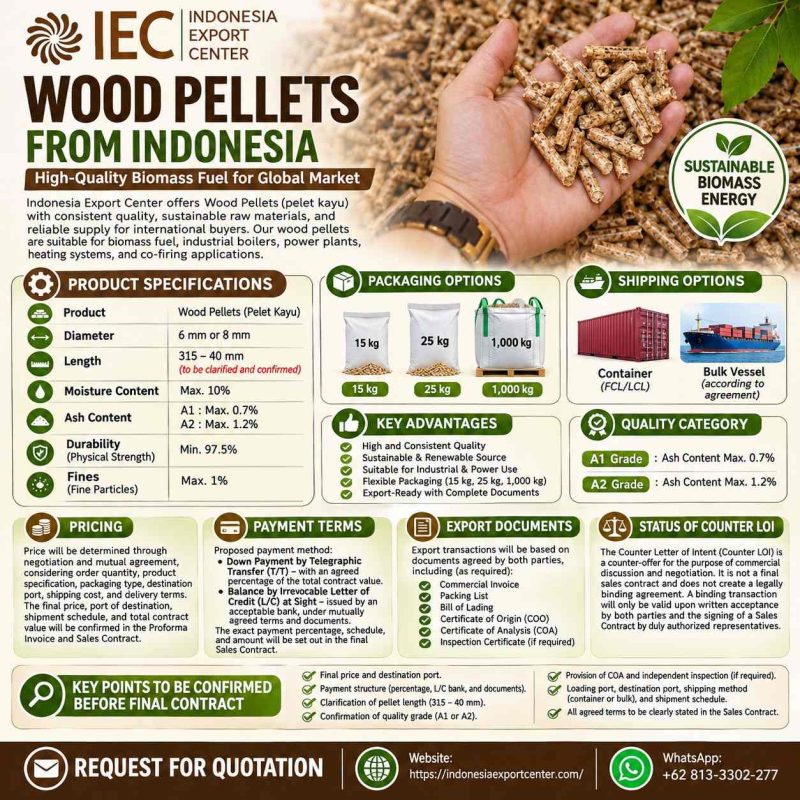
Wood Pellets Supplier Indonesia – High-Quality Biomass Fuel for Global Export Markets
Premium Indonesian Wood Pellets for Industrial Biomass Energy, Heating Systems, and International Buyers
As industries worldwide explore renewable energy alternatives and more diversified fuel supplies, wood pellets from Indonesia are becoming an important product for international biomass procurement. Manufactured from compressed wood-based raw materials, wood pellets offer a practical solid-fuel option for industrial boilers, biomass power plants, heating systems, and selected co-firing applications.
Indonesia Export Center (IEC) helps international buyers explore sourcing opportunities for Indonesian wood pellets, also known locally as pelet kayu. We support business-to-business inquiries involving product specifications, quality grades, packaging requirements, shipping arrangements, commercial documentation, and supplier coordination.
Whether you are a biomass fuel importer, energy distributor, industrial manufacturer, power generation company, or international trading business, IEC can assist with the initial sourcing and quotation process for Indonesian wood pellets.
Our wood pellet offering focuses on defined product specifications, A1 and A2 quality categories, flexible packaging options, and commercial arrangements that are confirmed before the final sales contract.
Product: Wood Pellets (Pelet Kayu)
Country of Origin: Indonesia
Available Diameter Options: 6 mm or 8 mm
Quality Categories: A1 and A2
Packaging Options: 15 kg, 25 kg, and 1,000 kg
Shipping Options: Container (FCL/LCL) and bulk vessel, subject to agreement
Website: https://indonesiaexportcenter.com/
WhatsApp: +62 813-3302-277
1. Why Source Wood Pellets from Indonesia?
Indonesia has significant wood-processing and biomass-related industries, creating opportunities for the development of solid biomass fuels. Wood pellets are produced by processing suitable woody materials into compressed cylindrical fuel particles.
For international buyers, Indonesia represents a potential sourcing destination for biomass fuel used in industrial and commercial energy applications.
However, successful wood pellet procurement requires more than simply identifying a supplier. Buyers should evaluate moisture content, ash content, pellet durability, particle dimensions, raw material origin, supply consistency, and shipping requirements.
IEC aims to help buyers approach these considerations systematically.
Potential Advantages of Indonesian Wood Pellets
Renewable biomass fuel option
Wood pellets can provide an alternative to certain fossil-fuel applications when the combustion equipment is designed for biomass and the feedstock is sourced responsibly.
Defined physical specifications
Pellet diameter, moisture, ash, fines, and durability can be included in commercial specifications and checked through appropriate testing.
Multiple industrial applications
Wood pellets can be used in compatible boilers, heating systems, biomass power plants, and selected co-firing operations.
Flexible packaging configurations
Smaller industrial users may prefer bagged pellets, while larger buyers may investigate jumbo bags, containerized shipments, or bulk transport.
International sourcing opportunities
Indonesian suppliers may serve overseas importers, energy distributors, biomass traders, and industrial fuel buyers, depending on actual capacity and contractual arrangements.
IEC encourages buyers to confirm the technical and commercial suitability of each proposed supply before making a purchase commitment.
2. Indonesian Wood Pellet Product Specifications
Wood pellet specifications are essential for determining fuel compatibility, combustion performance, transportation requirements, and acceptance criteria.
The following values are the product specifications presented in the IEC promotional material. They are reference requirements for commercial discussion and should be verified through supplier documentation, representative sampling, and testing where necessary.
| Parameter | Specification |
|---|---|
| Product Name | Wood Pellets (Pelet Kayu) |
| Country of Origin | Indonesia |
| Diameter | 6 mm or 8 mm |
| Length | 315–40 mm as printed; clarification required |
| Moisture Content | Maximum 10% |
| Ash Content – A1 | Maximum 0.7% |
| Ash Content – A2 | Maximum 1.2% |
| Durability (Physical Strength) | Minimum 97.5% |
| Fines (Fine Particles) | Maximum 1% |
Important technical clarification: The length shown in the source material is written as “315–40 mm,” which is ambiguous. The actual pellet-length range must be clarified and confirmed with the supplier before issuing a final technical specification or sales contract.
Pellet Diameter: 6 mm or 8 mm
The two indicated diameter options are 6 mm and 8 mm.
Diameter is relevant because fuel-feeding equipment, storage systems, and combustion installations may have specific pellet-size requirements.
Buyers should provide the preferred diameter during the quotation process.
Moisture Content: Maximum 10%
Moisture content influences the handling, storage, and combustion characteristics of biomass pellets.
Excessive moisture may reduce useful energy output, affect pellet stability, and create operational difficulties during storage or transport.
The IEC product reference specifies a maximum moisture content of 10%.
Ash Content: A1 and A2 Categories
Ash content represents the non-combustible residue remaining after fuel combustion.
Lower ash content can be beneficial in equipment where ash accumulation and maintenance requirements are important considerations.
The product information identifies two categories:
- A1 Grade: Maximum ash content of 0.7%.
- A2 Grade: Maximum ash content of 1.2%.
These are the grade labels used in the promotional material. Formal compliance with a recognized pellet standard, including ENplus or ISO-based classification, must not be assumed solely from these labels.
Mechanical Durability: Minimum 97.5%
Mechanical durability indicates the ability of pellets to resist breakage and abrasion during handling and transportation.
Durable pellets help reduce the formation of fine particles and support more predictable fuel-handling performance.
The specified minimum durability is 97.5%.
Fines Content: Maximum 1%
Fines are small particles generated during pellet production, storage, and handling.
Excessive fines may create dust, material losses, or operational challenges in certain feeding systems.
The IEC product reference specifies a maximum fines content of 1%.
For major shipments, buyers should agree on the sampling location, testing method, and acceptable fines level at the relevant delivery point.
3. A1 and A2 Wood Pellets: Understanding the Difference
Selecting the appropriate wood pellet grade is an important procurement decision.
IEC’s promotional material distinguishes A1 and A2 products primarily through their stated maximum ash content.
| Quality Category | Maximum Ash Content | Procurement Consideration |
|---|---|---|
| A1 Grade | 0.7% | Buyers seeking a lower-ash fuel specification |
| A2 Grade | 1.2% | Buyers whose equipment and operating requirements permit the stated ash level |
A1 Wood Pellets
A1 wood pellets are presented as a lower-ash option.
Buyers interested in this category should request additional information about calorific value, feedstock, pellet dimensions, moisture, durability, and ash-related combustion behavior.
A2 Wood Pellets
A2 wood pellets are presented with a higher permitted ash content than the A1 option.
They may be considered for compatible industrial biomass systems where the agreed ash specification is acceptable.
Which Grade Should International Buyers Choose?
The appropriate grade depends on several factors:
- Boiler or burner manufacturer requirements.
- Acceptable ash accumulation.
- Fuel-feeding system compatibility.
- Required energy output.
- Maintenance procedures.
- Environmental and emissions requirements.
- Delivered fuel cost.
The best choice is not determined by ash content alone. A complete purchasing specification should also address heating value, moisture, ash chemistry, contaminants, and other relevant parameters.
4. Industrial Applications of Wood Pellets from Indonesia
Wood pellets are used in several types of biomass energy systems.
Industrial Biomass Boilers
Industrial boilers can use biomass pellets to produce heat or steam when properly designed and configured for pellet combustion.
Potential users include food-processing facilities, textile operations, manufacturing plants, and other industries with substantial thermal energy requirements.
Before purchasing, buyers should confirm fuel compatibility with the boiler manufacturer or qualified engineering team.
Biomass Power Plants
Wood pellets may be used as fuel in suitable biomass power generation facilities.
Large-scale projects typically require substantial technical documentation and long-term supply planning.
Important considerations include fuel consumption, energy content, ash characteristics, receiving infrastructure, storage capacity, and delivery reliability.
Industrial Heating Systems
Compatible pellet-fired heating systems can use compressed wood fuel for controlled heat generation.
The suitability of a particular pellet depends on the design and operating conditions of the equipment.
Biomass Co-Firing
Co-firing involves using biomass alongside another fuel in a compatible energy installation.
Wood pellets may be evaluated for co-firing projects, subject to technical feasibility, combustion performance, regulatory requirements, and the operating characteristics of the facility.
Biomass Fuel Distribution
Importers and energy distributors may purchase wood pellets for resale to industrial or commercial customers.
Distributors should establish consistent product specifications, packaging formats, storage procedures, and quality verification requirements.
5. Wood Pellet Packaging Options for Export
Packaging affects product handling, transportation, storage, and distribution.
IEC’s promotional material presents three packaging options.
| Packaging Type | Nominal Weight | Potential Buyer Requirement |
|---|---|---|
| Small Bag | 15 kg | Bagged distribution and smaller-volume handling |
| Standard Bag | 25 kg | Commercial distribution and industrial users |
| Jumbo Bag | 1,000 kg | Larger-volume industrial handling |
15 kg Wood Pellet Bags
Fifteen-kilogram bags may be suitable for buyers requiring smaller handling units.
This option can be considered for distribution networks or operations where manual handling and smaller delivery quantities are important.
25 kg Wood Pellet Bags
Twenty-five-kilogram bags provide another packaging format for commercial and industrial distribution.
Buyers should confirm bag material, pallet configuration, labeling, and moisture protection.
1,000 kg Jumbo Bags
Jumbo bags may be suitable for larger industrial consumers with appropriate lifting and handling equipment.
The packaging design, safe working load, lifting loops, and transport configuration should be confirmed before shipment.
Custom Packaging Requirements
Buyers may request information about private labeling, palletization, bag dimensions, or other packaging requirements.
Any customization is subject to supplier confirmation and commercial agreement.
6. Wood Pellet Shipping from Indonesia
International biomass fuel logistics require coordination between the supplier, freight providers, buyer, and relevant authorities.
IEC identifies two general shipping arrangements.
Container Shipping: FCL and LCL
Containerized shipping may be considered for bagged or jumbo-bagged wood pellets.
FCL (Full Container Load) is typically considered when a buyer requires a dedicated container shipment.
LCL (Less than Container Load) may be investigated for smaller cargo quantities where appropriate freight services are available.
Actual cargo weight, stowage, container selection, and shipping feasibility depend on the shipment configuration and applicable transport requirements.
Bulk Vessel Shipping
Bulk vessel transport may be considered for large-volume biomass fuel procurement.
This arrangement requires further discussion about cargo volume, loading and unloading facilities, vessel suitability, port infrastructure, and commercial terms.
Bulk wood pellet cargoes also require appropriate safety planning for dust, carbon monoxide, oxygen depletion, and self-heating hazards.
Shipping Details to Confirm
Before finalizing a quotation, international buyers should specify the destination port, requested quantity, preferred packaging, expected shipping schedule, and proposed delivery terms.
Freight availability and shipping costs must be confirmed for each transaction.
7. Wood Pellet Quality Control and Inspection
Quality verification is particularly important in international biomass fuel trading.
A professional procurement process should establish measurable acceptance criteria and appropriate inspection procedures.
Recommended Quality Documentation
Depending on the transaction, buyers may request:
- A current Certificate of Analysis (COA).
- Product technical specifications.
- Representative laboratory test results.
- Feedstock and origin information.
- Moisture and ash analysis.
- Mechanical durability results.
- Fines content measurements.
- Calorific value information.
- Independent inspection reports where agreed.
The availability and scope of these documents must be confirmed with the relevant supplier.
Why Independent Inspection Matters
Independent inspection can help buyers assess whether the supplied cargo corresponds to the agreed specification.
The inspection scope may include sampling, laboratory testing, packaging verification, quantity checks, and loading supervision.
Inspection arrangements should be agreed upon before shipment, including the responsible party, sampling method, costs, and treatment of non-conforming goods.
8. Wood Pellet Price from Indonesia: How Quotations Are Determined
International buyers often search for wood pellet prices from Indonesia, Indonesian wood pellet price per metric ton, or bulk biomass pellet export quotations.
However, a reliable export quotation depends on the actual commercial requirements.
IEC does not present a fixed universal price in its promotional material.
Instead, pricing is determined through negotiation and mutual agreement.
Main Factors Affecting Wood Pellet Pricing
Product grade
A1 and A2 ash specifications may involve different sourcing and production considerations.
Technical specifications
Requirements for moisture, durability, fines, pellet dimensions, and other quality parameters can affect the quotation.
Order quantity
Shipment size influences production planning, packaging, handling, and freight arrangements.
Packaging
Fifteen-kilogram bags, twenty-five-kilogram bags, and jumbo bags may have different packaging and handling costs.
Destination port
Freight costs depend on the destination and available shipping services.
Delivery terms
The quotation should identify the agreed Incoterms rule and named place or port.
Payment structure
Payment conditions, banking costs, and commercial risk may influence the transaction.
Shipping schedule
The requested delivery period and confirmed supply availability are important pricing considerations.
Requesting an Accurate Price
For a meaningful quotation, buyers should provide complete purchasing details.
Once the supplier’s offer has been reviewed and commercial terms are agreed, the final price, quantity, specifications, and conditions should be documented in the Proforma Invoice and Sales Contract.
9. Payment Terms for International Wood Pellet Orders
IEC’s promotional material outlines proposed payment structures for international wood pellet transactions.
These are negotiation options, not automatically approved payment arrangements.
Telegraphic Transfer (T/T)
The proposed structure includes a down payment by Telegraphic Transfer (T/T).
The advance payment percentage is to be agreed upon by the buyer and seller.
The remaining balance may be payable by irrevocable Letter of Credit (L/C) or another mutually accepted bank arrangement, depending on the final contract.
Irrevocable Letter of Credit (L/C)
A Letter of Credit can establish documentary payment conditions through the banking system.
The L/C terms should clearly identify the required documents, shipment deadlines, presentation conditions, and other relevant requirements.
Final Payment Agreement
The final payment method, percentage, timing, and supporting documents must be recorded in the agreed Proforma Invoice and Sales Contract.
Buyers should independently verify beneficiary banking details and obtain appropriate financial or legal advice where needed.
10. Export Documents for Wood Pellets from Indonesia
International wood pellet transactions require accurate commercial and shipping documentation.
IEC’s promotional material identifies the following documents.
| Export Document | Purpose |
|---|---|
| Commercial Invoice | Records the commercial sale and transaction details |
| Packing List | Describes cargo quantities, packaging, and weights |
| Bill of Lading | Serves as a shipping document for sea freight |
| Certificate of Origin (COO) | Supports documentation of the product’s declared origin |
| Certificate of Analysis (COA) | Records tested product characteristics |
| Inspection Certificate | Documents agreed inspection findings, where required |
Additional documents may be necessary depending on the importing country, buyer requirements, product classification, and applicable regulations.
Import Compliance
Buyers should verify relevant customs classification, import permissions, phytosanitary or plant-product requirements where applicable, sustainability-related rules, and other destination-market obligations.
The existence of a commercial offer does not establish that a shipment automatically qualifies for entry into every importing market.
11. Responsible Biomass Sourcing and Sustainability Considerations
Wood pellets are often discussed as a renewable energy product, but responsible sourcing is essential.
The environmental performance of biomass depends on factors such as raw material origin, forest management, land-use effects, processing energy, transport, and the way the fuel is used.
International buyers may need evidence relating to:
- Legal and traceable raw material sourcing.
- Wood feedstock composition.
- Applicable forestry and timber legality requirements.
- Chain-of-custody arrangements.
- Relevant sustainability standards.
- Product carbon accounting where required.
- Compliance with destination-market regulations.
IEC encourages buyers to define sustainability requirements during the RFQ stage.
Any certification, traceability claim, or sustainability assessment should be supported by valid documentation specific to the proposed supplier and shipment.
12. International Markets for Indonesian Wood Pellets
Wood pellet procurement opportunities may arise in markets with industrial biomass demand, pellet-based heating infrastructure, or renewable energy projects.
Potential buyer regions include parts of East Asia, Southeast Asia, Europe, and other international markets.
Japan
Japanese biomass energy projects may require detailed fuel specifications, traceability information, and contract-based supply arrangements.
South Korea
South Korean buyers may evaluate imported biomass pellets for appropriate industrial and power-sector applications, subject to current regulations and project requirements.
European Markets
European buyers may focus on product classification, fuel quality, responsible sourcing, and relevant sustainability obligations.
Other International Markets
Biomass traders and industrial fuel users in other regions may also consider Indonesian wood pellets.
IEC welcomes inquiries from qualified international buyers, while product eligibility, import requirements, and supply feasibility must be assessed for each destination.
13. Why Contact Indonesia Export Center for Wood Pellet Sourcing?
International biomass transactions involve technical, commercial, and logistical coordination.
Indonesia Export Center provides a contact point for buyers seeking information about Indonesian export products and potential supplier arrangements.
Buyer-Focused Product Discussions
IEC can receive inquiries regarding pellet diameter, ash category, moisture requirements, packaging, and other technical preferences.
Commercial Coordination
Buyers can submit their requested order quantity, delivery terms, destination, and payment preferences for quotation discussions.
Documentation Planning
IEC can help clarify which documents should be discussed with the supplier before the transaction is finalized.
Export-Oriented Communication
International buyers can submit structured RFQs to support clearer discussions about quality, price, shipping, and contractual conditions.
Supplier availability, production capacity, product compliance, and final commercial terms remain subject to verification and agreement.
14. How to Import Wood Pellets from Indonesia
A structured procurement process helps reduce uncertainty and improve communication between the buyer and supplier.
Step 1: Define Your Wood Pellet Requirements
Determine the required diameter, preferred ash category, moisture limit, durability, fines content, and any additional specifications.
Step 2: Determine Your Purchase Quantity
Provide the estimated quantity in metric tons, along with expected repeat-order requirements if applicable.
Step 3: Select Packaging and Shipping Preferences
Specify whether the order requires 15 kg bags, 25 kg bags, jumbo bags, or another arrangement to be discussed.
Identify the destination port and preferred delivery terms.
Step 4: Submit Your Request for Quotation
Send the product requirements and company details to Indonesia Export Center.
Step 5: Review Supplier Information and Technical Documents
Request available specifications, quality documentation, samples, and relevant verification materials.
Step 6: Negotiate Commercial Terms
Discuss the product price, shipment schedule, inspection, payment structure, and contractual responsibilities.
Step 7: Finalize the Proforma Invoice and Sales Contract
Ensure that all agreed terms are recorded clearly before proceeding.
Step 8: Arrange Inspection and Shipment
Coordinate the agreed pre-shipment checks, documentation, cargo handling, and transportation arrangements.
Step 9: Complete Import Procedures
Work with the relevant customs broker, freight forwarder, and regulatory advisers to complete destination-country requirements.
15. Counter Letter of Intent (Counter LOI) and Contractual Process
IEC’s promotional material also refers to the use of a Counter Letter of Intent (Counter LOI) during preliminary commercial discussions.
A Counter LOI may be used to communicate proposed terms, demonstrate interest, or outline points requiring negotiation.
However, a Counter LOI should not automatically be treated as a completed purchase agreement.
Its legal effect depends on the wording, applicable law, and circumstances.
The parties should clearly distinguish preliminary expressions of interest from binding obligations.
A final transaction should be governed by appropriately reviewed contractual documents signed by authorized representatives.
16. Important Points to Confirm Before the Final Contract
Before concluding a wood pellet purchase, the buyer and seller should confirm the following matters.
| Contract Item | Required Confirmation |
|---|---|
| Final Price | Agreed price, currency, and destination |
| Payment Structure | Advance payment, L/C or other arrangement, bank details, and documents |
| Product Dimensions | Clarified and confirmed pellet length and diameter |
| Quality Grade | A1 or A2 and complete acceptance criteria |
| COA | Availability, sampling basis, and testing scope |
| Independent Inspection | Inspection agency, responsibilities, and costs |
| Loading Port | Agreed Indonesian loading location |
| Destination Port | Final receiving port |
| Shipping Method | Container or bulk vessel |
| Shipment Schedule | Agreed loading and delivery timetable |
| Sales Contract | Complete agreed terms and authorized signatures |
These confirmations are particularly important for international bulk commodity transactions.
17. Frequently Asked Questions About Indonesian Wood Pellets
What are wood pellets?
Wood pellets are compressed cylindrical fuel particles produced from suitable wood-based materials. They are used in compatible biomass combustion and energy systems.
Does Indonesia supply wood pellets for export?
Indonesia has biomass and wood-processing industries that can support wood pellet sourcing opportunities. Specific export availability must be confirmed with the proposed supplier.
What wood pellet diameters are listed by IEC?
The promotional material lists 6 mm and 8 mm diameter options.
What is the maximum moisture content?
The reference specification states a maximum moisture content of 10%.
What is the difference between A1 and A2 wood pellets?
The IEC material lists maximum ash contents of 0.7% for A1 and 1.2% for A2. Other quality requirements should be agreed separately.
Are IEC wood pellets ENplus certified?
Certification is not established by the promotional material. Buyers should request current, verifiable certification documents if ENplus or another recognized standard is required.
What is the specified mechanical durability?
The reference specification states a minimum durability of 97.5%.
What is the maximum fines content?
The listed maximum fines content is 1%.
What is the length of the pellets?
The source material contains an ambiguous length entry. Buyers should request the confirmed length specification before ordering.
Can I buy wood pellets in 15 kg bags?
The promotional material lists 15 kg bags as a packaging option. Availability for a particular order must be confirmed.
Are 25 kg bags available?
Twenty-five-kilogram bags are also included among the stated packaging options, subject to supplier confirmation.
Can I request 1,000 kg jumbo bags?
Yes, 1,000 kg jumbo bags are listed as a proposed packaging format. Packaging suitability and availability should be verified.
Can wood pellets be shipped in containers?
Container shipment using FCL or LCL is presented as an option, subject to logistical feasibility and agreement.
Is bulk vessel shipping possible?
Bulk vessel shipping is identified as a potential arrangement, subject to cargo volume, port facilities, vessel suitability, and contractual agreement.
What is the price per metric ton?
There is no fixed price stated in the promotional material. Buyers should request a quotation based on their specifications, volume, destination, and delivery terms.
What is the minimum order quantity?
A fixed minimum order quantity is not stated. The applicable MOQ must be confirmed during the quotation process.
What payment methods are proposed?
The material describes T/T down payment arrangements and possible irrevocable L/C or mutually agreed bank payment terms.
Can buyers request a Certificate of Analysis?
Buyers should request a COA as part of technical verification. The availability and scope of documentation must be confirmed.
Can wood pellets be used in power plants?
Wood pellets may be used in compatible biomass power generation facilities, subject to engineering requirements and fuel suitability.
How do I request a quotation from Indonesia Export Center?
Submit your company information, destination country, product grade, technical requirements, quantity, packaging, and shipping preferences through IEC’s contact channels.
18. Request for Quotation – Wood Pellets from Indonesia
Are you searching for a wood pellet supplier in Indonesia, bulk wood pellets for industrial boilers, A1 or A2 biomass pellets, or Indonesian wood pellet export opportunities?
Indonesia Export Center welcomes inquiries from international importers, biomass distributors, energy companies, industrial buyers, and trading businesses.
To help us understand your procurement requirements, please provide the following information.
| RFQ Information | Buyer Details |
|---|---|
| Company Name | |
| Contact Person | |
| Country | |
| Product | Wood Pellets |
| Required Diameter | 6 mm / 8 mm |
| Preferred Quality Category | A1 / A2 |
| Additional Technical Specifications | |
| Initial Order Quantity (MT) | |
| Estimated Monthly Quantity (MT) | |
| Preferred Packaging | 15 kg / 25 kg / 1,000 kg |
| Destination Port | |
| Preferred Incoterms | |
| Target Shipment Date | |
| Inspection Requirements | |
| Payment Preference |
Providing a complete RFQ allows the relevant parties to evaluate technical suitability, commercial conditions, and possible shipment arrangements more efficiently.
19. Contact Indonesia Export Center – Indonesian Wood Pellet Sourcing
Indonesia Export Center (IEC) is your point of contact for exploring wood pellet sourcing opportunities from Indonesia.
From industrial biomass fuel inquiries to export documentation discussions, our goal is to support clearer communication between international buyers and potential Indonesian suppliers.
We encourage buyers to submit detailed product specifications and commercial requirements so that each proposed transaction can be evaluated on an informed basis.
Looking for Wood Pellets from Indonesia? Request a Quotation Today.
Indonesia Export Center (IEC)
Product: Wood Pellets (Pelet Kayu)
Origin: Indonesia
Quality Categories: A1 and A2
Diameter: 6 mm or 8 mm
Packaging: 15 kg, 25 kg, and 1,000 kg
Shipping: Container or bulk vessel, subject to agreement
Website: https://indonesiaexportcenter.com/
WhatsApp: +62 813-3302-277
Send your wood pellet RFQ to Indonesia Export Center and begin discussing your international biomass fuel sourcing requirements.
Product information is based on IEC promotional material and remains subject to supplier verification. Product availability, quality certifications, technical compliance, pricing, minimum order quantity, shipping capacity, and commercial terms must be confirmed before any purchase commitment.
