

IEC | INDONESIA EXPORT CENTER
Vanilla Planifolia | Beverage Solubility | Clarity and Haze Control | pH Compatibility | Flavor Stability | Industrial Formulation
Water-Soluble Vanilla Extract Sourcing for Beverage Manufacturers
Beverage manufacturers need flavor ingredients that perform reliably in the finished drink, not simply ingredients that mix successfully in a laboratory beaker.
Vanilla flavoring can be used in coffee beverages, flavored milk, plant-based drinks, dessert beverages, and selected clear or lightly colored drinks.
However, compatibility varies significantly between formulations.
A flavoring that disperses in a milk-based beverage may create haze, sediment, or instability in an acidic clear beverage.
Companies seeking water soluble vanilla extract should therefore define measurable solubility, clarity, and stability requirements before approving an ingredient.
IEC | Indonesia Export Center facilitates B2B inquiries for Indonesian vanilla-derived ingredients and coordinates requests for technical information, samples, and supplier-approved quotations.
Water-soluble performance and commercial availability have not been verified for a particular product.
REQUEST WATER-SOLUBLE VANILLA SPECIFICATIONS
Product Overview
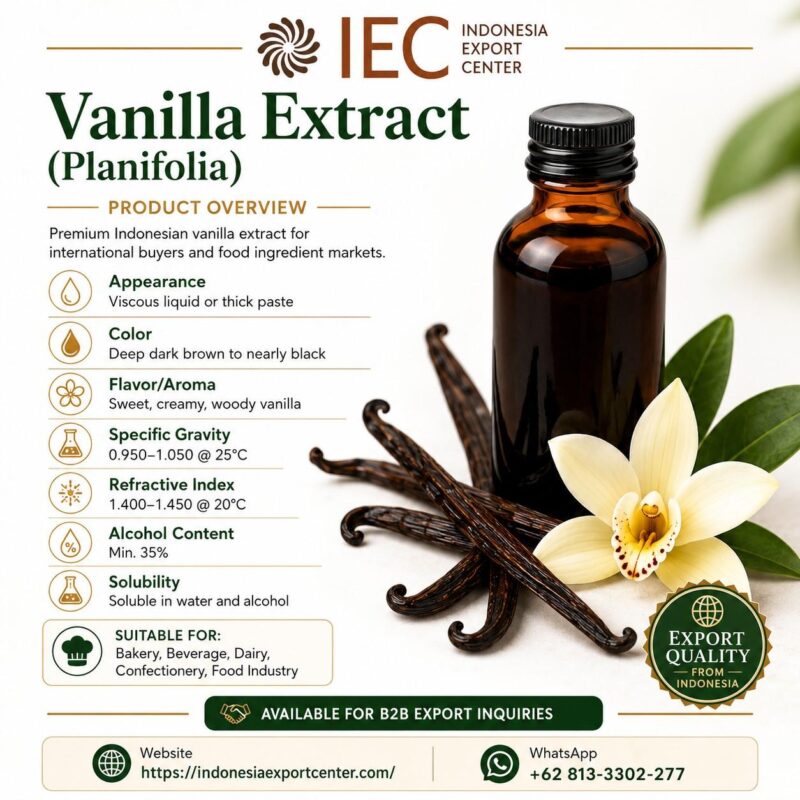
The preliminary IEC reference describes a vanilla extract associated with Vanilla planifolia.
| Parameter | Preliminary Reference or Status |
|---|---|
| Product | Vanilla Extract / Flavoring Inquiry |
| Botanical Source | Vanilla planifolia |
| Proposed Origin | Indonesia |
| Appearance | Viscous liquid or thick paste |
| Aroma | Sweet, creamy, woody vanilla |
| Specific Gravity | 0.950–1.050 at 25°C — unverified |
| Refractive Index | 1.400–1.450 at 20°C — unverified |
| Alcohol Content | Minimum 35% — unverified reference |
| Water Solubility | Claimed in preliminary reference; not independently verified |
| Beverage Clarity | Not verified |
| pH Stability | Not verified |
| Sedimentation | Not verified |
| Certifications | Not verified |
Water solubility should not be interpreted as a guarantee of haze-free performance in every beverage.
Solubility, Dispersibility, and Clarity
These terms describe different aspects of ingredient performance.
Solubility
A soluble ingredient dissolves in the relevant liquid under defined conditions.
Dispersibility
A dispersible ingredient can distribute through a liquid without necessarily dissolving completely.
Clarity
A clear beverage may require a flavoring that does not produce visible cloudiness.
Haze Formation
Haze may result from interactions involving flavor components, solvents, temperature, or other ingredients.
Sedimentation
Particles or precipitates may settle during storage.
Beverage manufacturers should establish acceptance criteria for each relevant characteristic.
Why pH Matters
Beverages may range from acidic fruit-based drinks to near-neutral dairy formulations.
An ingredient’s physical and sensory performance can change across this range.
Acidic Beverages
The manufacturer should evaluate clarity, flavor stability, and compatibility at the intended pH.
Milk-Based Drinks
Protein and fat interactions may influence appearance and flavor release.
Plant-Based Beverages
Protein, fiber, and stabilizer systems may affect ingredient dispersion.
Coffee Drinks
Coffee composition and processing conditions can influence aroma and haze formation.
Functional Beverages
Minerals, proteins, acids, and other ingredients may introduce additional compatibility challenges.
Solvent and Alcohol Disclosure
Vanilla extracts may contain ethanol or other solvent systems.
Beverage manufacturers should request the actual solvent composition and relevant analytical information.
Alcohol content may influence formulation decisions, product labeling, customer requirements, and market-specific compliance.
A preliminary reference of at least 35% alcohol should not be treated as a confirmed specification.
An extract that is water-soluble is not necessarily alcohol-free.
Recommended Beverage Compatibility Trials
A meaningful evaluation should reproduce the intended beverage formulation and manufacturing process.
- Review the ingredient’s complete composition.
- Establish the beverage’s target pH and appearance.
- Prepare samples at several dosage levels.
- Evaluate dissolution or dispersion.
- Measure or assess haze where relevant.
- Observe sedimentation.
- Apply the intended thermal process.
- Conduct sensory testing.
- Monitor stability during storage.
- Compare performance against an approved reference ingredient.
Manufacturers should define the test methods and acceptance criteria before final approval.
Heat Processing and Storage Stability
Commercial beverages may undergo pasteurization, hot filling, UHT processing, or other treatments.
These conditions can affect both aroma and physical compatibility.
A flavoring that remains clear before processing may behave differently afterward.
Storage temperature, packaging, light exposure, and product composition may also influence long-term performance.
IEC does not claim verified heat or pH stability for any particular vanilla ingredient.
Documentation for Beverage R&D Teams
| Document | Purpose |
|---|---|
| Technical Data Sheet | Product specifications |
| Certificate of Analysis | Batch quality |
| Ingredient Declaration | Formulation and labeling |
| Solvent Declaration | Alcohol and carrier assessment |
| Solubility Data | Physical compatibility |
| pH Stability Information | Beverage formulation |
| Heat-Stability Data | Processing assessment |
| Shelf-Life Information | Ingredient storage |
| Certification Evidence | Supplier qualification |
Documentation availability requires supplier confirmation.
IEC Sourcing Workflow
IEC can coordinate inquiries based on the buyer’s beverage category, target pH, clarity requirements, solvent restrictions, processing method, and estimated quantity.
Available samples and technical documents may be requested from potential suppliers.
The buyer should conduct formulation trials before confirming commercial approval.
MOQ, packaging, lead time, and quotation terms remain subject to supplier confirmation.
Frequently Asked Questions
Is water-soluble vanilla extract suitable for clear beverages?
Not automatically. Clarity and haze performance require testing.
Does water-soluble mean alcohol-free?
No. Solubility and alcohol content are different properties.
Can vanilla extract be used in acidic drinks?
Potentially, subject to pH compatibility and stability testing.
Can IEC guarantee no haze or sediment?
No. These characteristics have not been verified for a specific product.
What should beverage manufacturers include in an RFQ?
Target pH, clarity requirements, solvent restrictions, process conditions, quantity, and destination.
Request Water-Soluble Vanilla Flavor Ingredients
IEC welcomes inquiries from beverage R&D teams, coffee drink manufacturers, plant-based beverage brands, and international ingredient buyers.
REQUEST SPECS & SUPPLIER-APPROVED QUOTATION
Website: https://indonesiaexportcenter.com/
WhatsApp: +62 813-3302-277
Related page: Vanilla Extract for Beverage Manufacturing
Main sourcing page: Vanilla Extract Supplier in Indonesia
Reference: CBI — Vanilla Extract Market Entry
SEO METADATA
SEO Title: Water-Soluble Vanilla Extract for Beverages | IEC
Meta Description: Explore water-soluble vanilla extract sourcing for beverages. Review clarity, haze, pH compatibility, solvent disclosure, and technical samples.
Focus Keyword: water soluble vanilla extract
Secondary Keywords: water soluble vanilla flavoring, vanilla extract for clear beverages, beverage vanilla flavor supplier, vanilla extract solubility testing, vanilla flavor haze stability
URL Slug: water-soluble-vanilla-extract
Canonical URL: https://indonesiaexportcenter.com/water-soluble-vanilla-extract/
Search Intent: Commercial / Beverage Ingredient Procurement
Primary CTA: Request Specs & Supplier-Approved Quotation
