

IEC | INDONESIA EXPORT CENTER
CONNECTING INDONESIAN PRODUCTS TO THE WORLD
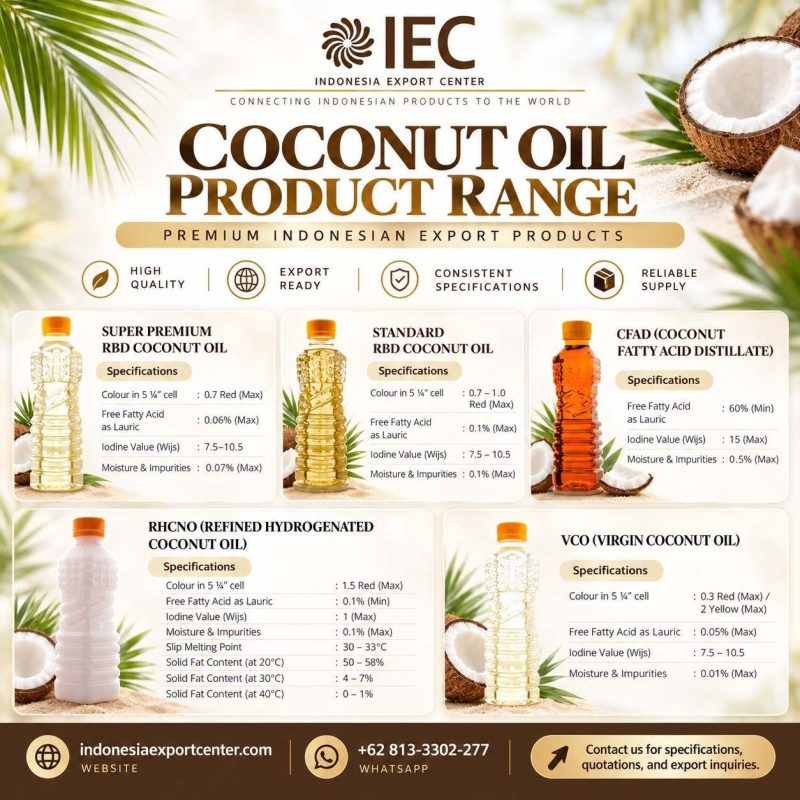
COCONUT OIL PRODUCT RANGE | PREMIUM INDONESIAN EXPORT PRODUCTS
Virgin Coconut Oil vs Refined Coconut Oil: Which Is Better for Your Product?
Understanding the virgin vs refined coconut oil difference is essential for food manufacturers, cosmetic formulators, ingredient distributors, and product development teams.
Both Virgin Coconut Oil (VCO) and Refined Coconut Oil are derived from coconuts, but they differ in their manufacturing processes, sensory characteristics, quality specifications, and suitability for different applications.
Virgin Coconut Oil is generally associated with less intensive processing and a more noticeable coconut aroma, while refined coconut oil is processed to produce a more neutral sensory profile.
However, neither type is automatically better for every application.
The appropriate choice depends on the product formulation, desired flavor, processing conditions, quality requirements, and commercial objectives.
IEC | Indonesia Export Center facilitates sourcing enquiries for Indonesian coconut oil products, including Virgin Coconut Oil and Refined, Bleached and Deodorized (RBD) Coconut Oil.
Need help evaluating coconut oil for your manufacturing requirements?
WhatsApp: +62 813-3302-277
Website: https://indonesiaexportcenter.com/
Quick Comparison: Virgin Coconut Oil vs Refined Coconut Oil
| Feature | Virgin Coconut Oil (VCO) | Refined Coconut Oil (RBD) |
|---|---|---|
| Raw Material | Fresh coconut kernel or suitable fresh-coconut-derived material | Commonly dried coconut kernel (copra) or crude coconut oil |
| Processing | Extraction and separation methods designed to retain virgin oil characteristics | Refining, bleaching and deodorization |
| Aroma | Usually noticeable coconut aroma | Generally neutral or mild |
| Flavor | Often retains coconut flavor | Generally neutral |
| Appearance | Typically clear when liquid, depending on temperature and quality | Typically clear when liquid, depending on temperature and quality |
| Processing Intensity | Generally less intensive | More intensive |
| Typical Product Positioning | Premium food, natural ingredient and specialty applications | General food manufacturing and applications requiring neutral sensory properties |
| Suitability for Cosmetics | Depends on formulation and quality requirements | Depends on formulation and quality requirements |
| Quality Documentation | Manufacturer specification and lot-specific COA | Manufacturer specification and lot-specific COA |
| Price | Depends on supplier, quality and market conditions | Depends on supplier, quality and market conditions |
| Best Choice | Applications where virgin characteristics are desired | Applications where a neutral profile is preferred |
Important: These are general distinctions. Actual sensory characteristics, processing methods, and technical performance must be confirmed for each product and supplier.
What Is Virgin Coconut Oil?
Virgin Coconut Oil is coconut oil produced using processes intended to preserve its characteristic properties without the conventional refining, bleaching, and deodorization steps associated with RBD oil.
VCO production methods can vary and may involve mechanical extraction, centrifugation, controlled drying, or other suitable processing techniques.
The term virgin does not automatically establish that an oil is cold pressed, certified organic, or suitable for every food or cosmetic application.
Common Characteristics of Virgin Coconut Oil
- Characteristic coconut aroma
- Coconut flavor, depending on processing
- Generally less intensive processing than RBD oil
- Potential suitability for premium or specialty ingredient positioning
- Technical quality that must be verified through actual testing
For manufacturers, VCO may be considered when coconut sensory characteristics are desirable in the finished product.
What Is Refined Coconut Oil?
Refined Coconut Oil is coconut oil that has undergone processing to reduce undesirable characteristics and achieve a specified quality profile.
A common commercial category is RBD Coconut Oil, meaning:
- Refined
- Bleached
- Deodorized
These processes are used to achieve particular quality and sensory characteristics.
RBD Coconut Oil is generally selected when manufacturers prefer a neutral or mild coconut flavor and aroma.
Common Characteristics of RBD Coconut Oil
- Neutral or mild aroma
- Generally neutral flavor
- Consistent sensory characteristics when manufactured to specification
- Suitability for applications where coconut flavor is not desired
- Technical performance that depends on grade and manufacturing controls
Refined coconut oil is not automatically inferior to virgin coconut oil. It serves different formulation and manufacturing requirements.
Main Difference 1: Manufacturing Process
The production method is one of the most important differences between VCO and refined coconut oil.
Virgin Coconut Oil Processing
VCO is commonly produced from fresh coconut material using methods designed to separate the oil while maintaining virgin oil characteristics.
Depending on the manufacturer, production may involve:
- Coconut raw material preparation
- Extraction or separation
- Moisture reduction
- Filtration
- Quality testing
- Packaging
Actual production conditions should be verified with the manufacturer.
Refined Coconut Oil Processing
RBD coconut oil commonly involves:
- Preparation of crude coconut oil
- Refining
- Bleaching
- Deodorization
- Filtration and quality control
- Packaging
The exact sequence and technology vary between manufacturers.
Which Processing Method Is Better?
Neither method is universally superior.
Virgin processing may be preferred when coconut aroma and a particular ingredient identity are important.
RBD processing may be preferred when neutral flavor, neutral aroma, and consistency are essential.
Main Difference 2: Coconut Flavor and Aroma
Sensory characteristics can strongly influence product formulation.
Virgin Coconut Oil Flavor
VCO generally retains a more noticeable coconut flavor and aroma.
This can be desirable in applications where coconut is part of the intended sensory experience.
Examples may include specialty coconut-based food products and certain natural personal care formulations.
Refined Coconut Oil Flavor
RBD Coconut Oil is generally more neutral.
This may be advantageous when the manufacturer does not want the oil to significantly influence the finished product’s flavor or aroma.
Product Development Consideration
Sensory performance should be assessed through actual product samples.
A technical specification alone does not fully describe flavor or aroma.
Main Difference 3: Technical Quality Specifications
Virgin and refined coconut oil can have different commercial specifications.
The following values are supplied reference specifications for potential product evaluation.
Virgin Coconut Oil (VCO) – Reference Specifications
| Specification | Reference Value |
|---|---|
| Colour in 5¼-inch Cell | 0.3 Red (Max) / 2 Yellow (Max) |
| Free Fatty Acid as Lauric | 0.05% (Max) |
| Iodine Value (Wijs) | 7.5–10.5 |
| Moisture & Impurities | 0.01% (Max) |
Super Premium RBD Coconut Oil – Reference Specifications
| Specification | Reference Value |
|---|---|
| Colour in 5¼-inch Cell | 0.7 Red (Max) |
| Free Fatty Acid as Lauric | 0.06% (Max) |
| Iodine Value (Wijs) | 7.5–10.5 |
| Moisture & Impurities | 0.07% (Max) |
Standard RBD Coconut Oil – Reference Specifications
| Specification | Reference Value |
|---|---|
| Colour in 5¼-inch Cell | 0.7–1.0 Red (Max) |
| Free Fatty Acid as Lauric | 0.1% (Max) |
| Iodine Value (Wijs) | 7.5–10.5 |
| Moisture & Impurities | 0.1% (Max) |
Important technical note: The Standard RBD colour entry is reproduced as supplied and requires confirmation of how the range and maximum limit should be interpreted.
All values above are reference specification limits, not verified lot-specific COA results.
Main Difference 4: Free Fatty Acid (FFA)
Free Fatty Acid is an important analytical parameter in coconut oil quality evaluation.
The supplied reference limits are:
- Virgin Coconut Oil: 0.05% maximum
- Super Premium RBD Coconut Oil: 0.06% maximum
- Standard RBD Coconut Oil: 0.1% maximum
All are expressed as FFA as Lauric.
Lower FFA limits may be part of a stricter commercial quality specification, but they do not independently establish overall superiority, freshness, or regulatory compliance.
FFA as Lauric must not be confused with total lauric acid content.
Buyers should review actual laboratory results and analytical methods before making comparisons.
Main Difference 5: Moisture and Impurities
Moisture and impurities are important for oil quality management.
The supplied reference limits are:
- Virgin Coconut Oil: 0.01% maximum
- Super Premium RBD Coconut Oil: 0.07% maximum
- Standard RBD Coconut Oil: 0.1% maximum
These values represent proposed reference limits.
The 0.01% maximum reference for VCO is particularly tight and should be confirmed with the manufacturer.
Actual test results should be compared using appropriate and consistent analytical methods.
Main Difference 6: Intended Applications
The most suitable oil depends on the intended product.
Virgin Coconut Oil for Food Products
VCO may be considered for food products where coconut flavor and ingredient positioning are desirable.
Manufacturers should verify food safety, sensory suitability, and relevant technical specifications.
Refined Coconut Oil for Food Manufacturing
RBD Coconut Oil may be preferred when a neutral flavor profile is important.
Actual suitability depends on processing conditions, product formulation, and supplier specifications.
Virgin Coconut Oil for Cosmetics
VCO may be evaluated for skincare, haircare, and other personal care formulations.
Manufacturers should verify ingredient quality, sensory characteristics, stability, and regulatory suitability.
Refined Coconut Oil for Cosmetics
Refined Coconut Oil may be considered when a more neutral sensory profile is preferred.
Its suitability should be established through formulation testing and quality assessment.
Virgin Coconut Oil for Soap Making
VCO can be evaluated for soap formulations, although formulators should consider the cost and performance requirements of the final product.
Refined Coconut Oil for Soap Making
RBD Coconut Oil may be considered as an alternative feedstock where its specifications and commercial characteristics suit the formulation.
Virgin vs Refined Coconut Oil for Cooking and Heat Processing
Both oils may be considered for suitable food applications, but their performance depends on the actual product quality and processing conditions.
Refined coconut oil is often selected for applications requiring a neutral flavor and may have a different smoke-point profile from virgin oil.
However, smoke point should not be assumed from the category name alone.
Buyers should request relevant technical information and evaluate:
- Actual smoke point, where required
- Oxidative stability
- Intended processing temperature
- Heating duration
- Product formulation
- Relevant food safety requirements
Neither oil should be described as universally healthier or more suitable for high-temperature cooking without appropriate evidence.
Is Virgin Coconut Oil Healthier Than Refined Coconut Oil?
Virgin and refined coconut oils are both coconut-derived fats, and their major fatty acid profiles are generally similar.
Differences in minor components may occur due to processing, but these differences should not be exaggerated into unsupported health claims.
Both oils are high in saturated fat.
For food product development, nutritional positioning should be based on reliable evidence, applicable regulations, and the overall dietary context.
No medical or therapeutic benefits are claimed for either product.
Which Coconut Oil Is Better for Your Manufacturing Business?
The answer depends on your product development objectives.
| Your Requirement | Product to Evaluate |
|---|---|
| Characteristic coconut aroma | Virgin Coconut Oil |
| More neutral flavor | RBD Coconut Oil |
| Virgin ingredient positioning | Virgin Coconut Oil |
| Neutral sensory profile for formulation | RBD Coconut Oil |
| Premium specialty food development | Virgin Coconut Oil, subject to testing |
| General food manufacturing | RBD or VCO, depending on formulation |
| Natural skincare formulations | VCO or RBD, depending on desired characteristics |
| Soap manufacturing | VCO or RBD, depending on formulation and cost |
| Consistent bulk supply | Verify actual manufacturer capacity for either oil |
| Organic-certified ingredient | Verify actual certification for the selected product |
A sample evaluation and supplier-specific technical review are recommended before making a final decision.
Virgin Coconut Oil vs RBD Coconut Oil: Buyer Evaluation Checklist
Before selecting either product, confirm:
-
Intended application
-
Desired flavor and aroma
-
Manufacturing process
-
Actual manufacturer identity
-
Product technical specification
-
Lot-specific Certificate of Analysis
-
FFA results
-
Moisture and impurities results
-
Iodine value
-
Colour measurement
-
Additional testing requirements
-
Relevant food or cosmetic regulations
-
Certification claims
-
Packaging suitability
-
Minimum order quantity
-
Available quantity
-
Price and payment terms
-
Production lead time
-
Shipment requirements
Bulk Sourcing Virgin and Refined Coconut Oil from Indonesia
IEC | Indonesia Export Center facilitates sourcing enquiries for Indonesian coconut oil products.
Buyers may enquire about:
- Virgin Coconut Oil (VCO)
- Super Premium RBD Coconut Oil
- Standard RBD Coconut Oil
The appropriate product should be selected according to the intended application and agreed specifications.
Packaging
Bulk packaging arrangements must be confirmed with the relevant supplier.
Minimum Order Quantity
No fixed MOQ has been verified.
Pricing
Current pricing must be requested through a formal quotation.
Product Availability
Available stock and production capacity must be confirmed.
Certification
Any organic, Halal, Kosher, food safety, or other certification claim must be verified.
Quality Documentation
Buyers should request a manufacturer-issued specification and lot-specific COA.
Request Virgin or Refined Coconut Oil Specifications and Quotation
Subject: RFQ – Virgin Coconut Oil vs RBD Coconut Oil
Dear IEC | Indonesia Export Center Team,
We are evaluating coconut oil options for our manufacturing or distribution requirements.
Please advise whether suitable Indonesian suppliers can provide the following products and supporting documentation.
BUYER INFORMATION
Company Name: [Company Name] Country: [Country] Business Type: [Food Manufacturer / Cosmetic Manufacturer / Distributor / Ingredient Trader] Contact Person: [Name] Email: [Email] WhatsApp: [Number]
PRODUCT REQUIREMENTS
Product of Interest: [Virgin Coconut Oil / Super Premium RBD / Standard RBD / Multiple Grades] Intended Application: [Specify] Required Quantity: [MT] Order Frequency: [Trial / One-Time / Recurring]
TECHNICAL REQUIREMENTS
Required FFA: [Specify] Required Moisture and Impurities: [Specify] Required Iodine Value: [Specify] Required Colour: [Specify] Flavor and Aroma Requirements: [Specify] Additional Testing: [Specify]
DOCUMENTATION REQUESTED
- Manufacturer-issued technical specification
- Lot-specific COA
- Processing method information
- Relevant quality and safety documentation
- Packaging specifications
- Certification documents, if claimed
- Sample availability
COMMERCIAL REQUIREMENTS
Preferred Packaging: [Specify] Required Quantity: [MT] Destination Port: [Port and Country] Requested Incoterm: [FCA / FOB / CFR / CIF / CIP / Other] Target Shipment Period: [Month / Year]
Please advise the available product grades, MOQ, quantity, pricing, lead time, and supporting documents.
Kind regards,
[Your Name] [Company Name]SEND YOUR COCONUT OIL ENQUIRY VIA WHATSAPP
Frequently Asked Questions: Virgin vs Refined Coconut Oil
1. What is the main difference between virgin and refined coconut oil?
Virgin Coconut Oil is generally less intensively processed and retains characteristic coconut sensory properties, while refined coconut oil undergoes refining, bleaching, and deodorization to achieve a more neutral profile.
2. Does Virgin Coconut Oil have a stronger coconut aroma?
Generally, yes, although the actual aroma depends on the manufacturer and processing method.
3. Is refined coconut oil flavorless?
RBD Coconut Oil is generally neutral or mild in flavor, but sensory characteristics should be verified through samples.
4. Is Virgin Coconut Oil always cold pressed?
No. VCO may be produced through different methods. Cold-pressed claims require verification.
5. Is Virgin Coconut Oil always organic?
No. Organic certification is a separate requirement.
6. Is refined coconut oil lower quality?
Not necessarily. Quality depends on the applicable grade, specifications, processing controls, and intended use.
7. Which oil is better for food manufacturing?
The appropriate choice depends on flavor requirements, processing conditions, product specifications, and regulatory suitability.
8. Which oil is better for cosmetics?
Both may be evaluated, depending on formulation and desired sensory properties.
9. Which coconut oil is better for soap making?
Either may be suitable depending on the formulation, performance requirements, and cost.
10. Is Virgin Coconut Oil healthier than refined coconut oil?
No broad health superiority should be assumed. Nutritional claims require reliable supporting evidence.
11. What is the supplied VCO FFA specification?
0.05% maximum, expressed as Lauric.
12. What is the supplied Super Premium RBD FFA specification?
0.06% maximum, expressed as Lauric.
13. What is the supplied Standard RBD FFA specification?
0.1% maximum, expressed as Lauric.
14. Can buyers request COAs for both products?
Yes. Actual availability and documentation must be confirmed.
15. Can IEC receive bulk sourcing enquiries for both VCO and RBD Coconut Oil?
Yes. IEC welcomes sourcing enquiries for both product categories, subject to supplier verification.
Find the Right Coconut Oil for Your Product
The virgin vs refined coconut oil difference is primarily about processing, sensory characteristics, technical specifications, and intended use.
Virgin Coconut Oil may be preferred when coconut aroma and virgin ingredient positioning are important.
Refined Coconut Oil may be preferred when a neutral flavor and aroma profile is required.
For industrial buyers, neither category should be selected solely on marketing descriptions.
Technical specifications, samples, COAs, supplier capabilities, regulatory requirements, and commercial terms should guide the decision.
IEC | INDONESIA EXPORT CENTER
CONNECTING INDONESIAN PRODUCTS TO THE WORLD
Products: Virgin Coconut Oil, Super Premium RBD Coconut Oil, Standard RBD Coconut Oil
Proposed Sourcing Country: Indonesia
Target Market: Global
Target Buyers: Ingredient Product Developers, Food Manufacturers, Cosmetic Manufacturers, and Distributors
Manufacturer: To Be Verified
Lot-Specific COA: To Be Requested and Verified
Certifications: To Be Verified
MOQ: To Be Confirmed
Available Quantity: To Be Confirmed
Packaging: To Be Confirmed
Price per MT: Request Quotation
Shipment Lead Time: To Be Confirmed
Request Coconut Oil Specifications and Bulk Quotation
Website: https://indonesiaexportcenter.com/
WhatsApp: +62 813-3302-277
CONTACT IEC FOR VIRGIN AND REFINED COCONUT OIL
Contact us for specifications, quotations, and export inquiries.
Technical and Commercial Disclaimer: This page provides general educational and sourcing information comparing Virgin Coconut Oil and Refined Coconut Oil. Product characteristics vary by manufacturer, grade, and production method. The numerical values shown are supplied reference specifications, not actual lot-specific laboratory results. No specific manufacturer, certification, COA, inventory, MOQ, packaging format, price, or shipment lead time has been independently verified. Buyers should evaluate the actual product and confirm applicable regulatory requirements before purchase. IEC facilitates sourcing and export enquiries; the actual manufacturer, contractual seller, and exporter of record must be confirmed for each transaction.
