

Source Indonesian Vannamei Shrimp for the United States Market
Are you looking for a reliable Indonesian vannamei shrimp supplier to support your seafood import, wholesale distribution, supermarket, restaurant supply, or frozen food manufacturing business in the United States?
Indonesia Export Center (IEC) assists American seafood importers with sourcing Indonesian vannamei shrimp according to their commercial requirements, technical specifications, processing preferences, packaging configurations, and international shipping needs.
Indonesia offers an established aquaculture and seafood processing industry, making it a potential sourcing destination for international buyers seeking farmed whiteleg shrimp.
Whether your company requires whole shrimp, peeled shrimp, individually quick frozen shrimp, foodservice packaging, or customized retail products, IEC welcomes business-to-business inquiries from qualified United States importers.
Our sourcing services focus on connecting buyers with potential Indonesian suppliers, coordinating product specifications, requesting supporting documentation, and facilitating commercial export discussions.
Indonesian Whiteleg Shrimp for American Seafood Businesses
Vannamei shrimp, scientifically known as Litopenaeus vannamei, is a widely cultivated shrimp species used throughout the international seafood industry.
Its relatively mild flavor and versatility make it suitable for evaluation across numerous commercial food applications.
American seafood buyers may consider Indonesian vannamei shrimp for:
- Frozen seafood wholesale distribution.
- Supermarket seafood departments.
- Private-label frozen seafood products.
- Restaurant and hotel supply.
- Commercial catering.
- Frozen ready-meal manufacturing.
- Breaded and value-added seafood.
- Seafood processing and repacking.
- Institutional foodservice.
- International seafood trading.
Product suitability must be evaluated according to the actual processing form, quality specification, and intended application.
Vannamei Shrimp Product Options for USA Importers
| Product Format | Potential Commercial Application |
|---|---|
| HOSO – Head-On Shell-On | Whole shrimp distribution and further processing |
| HLSO – Headless Shell-On | Seafood processors and foodservice |
| Peeled Deveined | Frozen meals and commercial kitchens |
| PDTO – Peeled Deveined Tail-On | Retail and restaurant presentation |
| Peeled Tail-Off | Prepared meals and ingredient manufacturing |
| Easy Peel | Retail seafood and foodservice |
| Cooked Frozen Shrimp | Selected prepared seafood applications |
| IQF Shrimp | Flexible portioning and frozen distribution |
| Breaded Shrimp | Value-added frozen food inquiries |
The exact availability of these formats must be confirmed with the responsible processing facility.
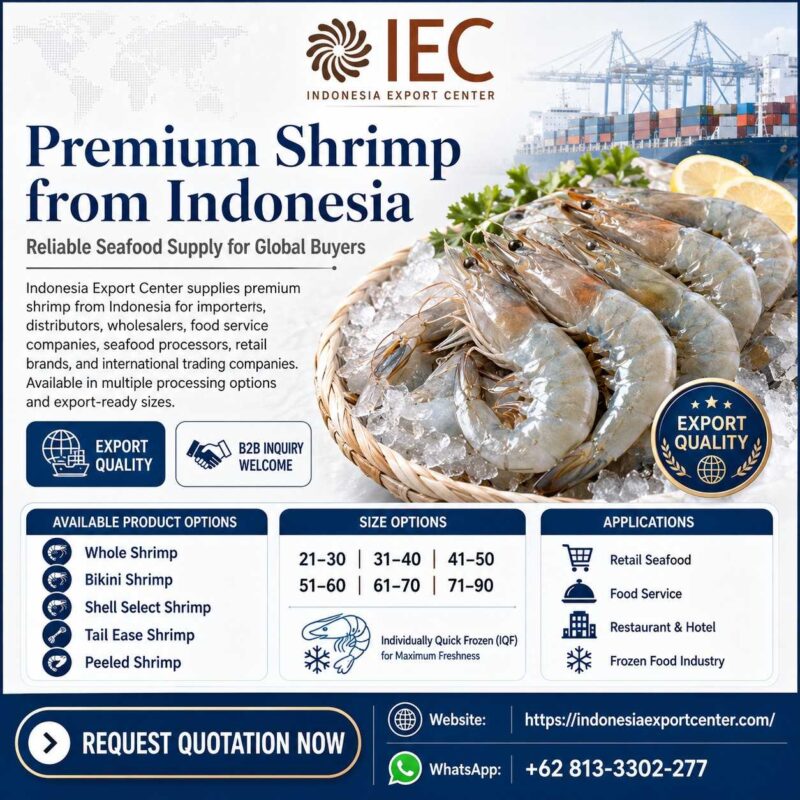
IEC’s preliminary product range also includes Whole Shrimp, Bikini Shrimp, Shell Select Shrimp, Tail Ease Shrimp, and Peeled Shrimp. The exact processing definitions of these commercial names should be confirmed before ordering.
Available Shrimp Size References
IEC’s preliminary product information includes the following size categories:
| Size Reference | Potential Application |
|---|---|
| 21–30 | Larger shrimp portions and presentation |
| 31–40 | Restaurant and retail applications |
| 41–50 | Foodservice and prepared foods |
| 51–60 | Industrial food manufacturing |
| 61–70 | Seafood ingredients and prepared meals |
| 71–90 | Smaller shrimp ingredient applications |
American shrimp buyers commonly communicate certain grades using pieces per pound.
However, international suppliers may use different counting systems depending on the processing form and market.
The counting unit, grading tolerance, product condition, and net weight basis must be confirmed before approving a commercial order.
Additional grades such as 16/20, 21/25, and 26/30 may be requested for supplier evaluation.
IQF Vannamei Shrimp for the United States
Individually Quick Frozen shrimp may support flexible portioning, convenient storage, and efficient commercial food preparation.
Unlike products frozen together in a block, IQF shrimp is intended to remain individually separated.
Actual separation depends on freezing performance, protective glazing, packaging, handling, and temperature management.
American buyers should evaluate representative samples for:
- Individual piece separation.
- Size consistency.
- Product appearance.
- Processing quality.
- Broken pieces.
- Remaining shell material.
- Glaze consistency.
- Declared net weight.
- Cooking performance.
IQF processing does not eliminate the need for appropriate food safety controls and frozen storage.
Frozen Shrimp for US Retail and Private-Label Brands
American supermarket suppliers and frozen seafood brands may require customized packaging designed for consumer distribution.
Potential packaging inquiries include 8 oz, 12 oz, 16 oz, 1 lb, 2 lb, and other buyer-defined configurations.
These are illustrative packaging requests rather than confirmed supplier offerings.
Private-label procurement may involve printed bags, branded pouches, approved product descriptions, master carton markings, lot codes, and destination-specific labeling.
Buyers should establish their packaging requirements before requesting a final quotation.
Artwork should be reviewed for regulatory compliance and accuracy before commercial production.
Shrimp for American Foodservice Distributors
Foodservice companies often require consistent shrimp sizes, predictable preparation requirements, reliable net weights, and suitable commercial packaging.
Potential customers include restaurant chains, seafood restaurants, hotels, catering businesses, institutional kitchens, and foodservice wholesalers.
Peeled and deveined shrimp may reduce certain preparation requirements compared with whole or shell-on shrimp.
However, actual processing yield, cooking performance, and labor savings should be evaluated using representative samples.
FDA and United States Seafood Import Requirements
Seafood imported into the United States is subject to applicable federal food safety and import requirements.
American importers should verify the specific obligations associated with the product, supplier, processing facility, and intended use.
Important areas for review may include:
| Compliance Area | Buyer Verification |
|---|---|
| Seafood HACCP | Applicable requirements under 21 CFR Part 123 |
| Foreign Facility Registration | FDA registration where required |
| Importer Verification | Applicable seafood importer responsibilities |
| Prior Notice | FDA notification requirements |
| Food Labeling | Applicable US food labeling rules |
| Allergen Declaration | Crustacean shellfish identification |
| Veterinary Drug Residues | Applicable US residue restrictions |
| Traceability | Relevant seafood and supply-chain records |
| Customs Classification | Correct HTS classification |
| Trade Measures | Applicable duties and trade remedies |
FDA facility registration does not constitute FDA approval of a supplier or its products.
Importers should also assess the relationship between seafood HACCP importer requirements and any applicable Foreign Supplier Verification Program exemptions or obligations.
IEC does not independently certify FDA compliance.
Seafood HACCP Documentation
Hazard Analysis and Critical Control Points is an important preventive food safety framework for seafood processing.
US buyers should request relevant supplier documentation and evaluate whether the actual processing facility maintains appropriate hazard controls.
The documentation may address raw material sourcing, sanitation, processing, temperature management, cooking where applicable, contamination prevention, monitoring, verification, and corrective actions.
A generic HACCP certificate should not be treated as proof of compliance for every product.
Seafood Import Monitoring and Traceability
American shrimp importers should evaluate applicable NOAA Seafood Import Monitoring Program requirements and other relevant traceability obligations.
Required records may include information about aquaculture production, harvesting, product movement, processing, and shipment.
The exact obligations should be verified according to the product and transaction.
Importers should confirm that their supplier can provide the necessary supporting information before shipment.
Veterinary Drug Residue and Food Safety Testing
Farmed shrimp buyers may require laboratory testing for relevant veterinary drug residues, microbiological hazards, and other regulated contaminants.
Testing requirements should be determined according to the actual product, destination regulations, and buyer-approved specification.
Potential documentation includes batch-specific Certificates of Analysis, laboratory reports, ingredient declarations, and additive information.
Claims such as antibiotic-free, chemical-free, or residue-free should not be made without appropriate supporting evidence.
United States Shrimp Labeling Requirements
Retail and foodservice products may require different labeling information.
Potential requirements include:
- Accurate product name.
- Species identification where applicable.
- Net quantity.
- Ingredient declaration.
- Crustacean shellfish allergen information.
- Country of origin.
- Responsible business information.
- Nutrition information where required.
- Storage and preparation instructions.
- Lot or batch identification.
The importer should confirm the current requirements for its specific product and sales channel.
Glazing and Net Weight Verification
Protective ice glaze may help maintain frozen shrimp quality during storage.
However, American buyers should clearly distinguish protective glaze from actual shrimp weight.
A commercial agreement should establish the required net weight, glaze percentage, calculation method, sampling procedure, and acceptance criteria.
Comparing supplier quotations without considering their weight basis can result in misleading cost comparisons.
Shipping Indonesian Shrimp to the United States
Frozen shrimp export inquiries may involve temperature-controlled ocean freight to buyer-selected US destinations.
Potential destination-port inquiries include Los Angeles, Long Beach, New York/New Jersey, Savannah, Houston, and other suitable ports.
These are possible destinations for quotation purposes, not confirmed shipping routes.
Actual freight availability, transit time, customs procedures, and reefer requirements must be confirmed.
Frozen storage at approximately -18°C or colder is a common reference, subject to the approved product specification and applicable requirements.
FOB and CIF Shrimp Export Quotations
IEC welcomes FOB and CIF quotation inquiries.
Under FOB Incoterms 2020, the seller delivers the goods on board the nominated vessel at the agreed loading port.
Under CIF, the seller arranges and pays for freight and the required minimum insurance to the named destination port, while risk generally transfers when the goods are on board at origin.
For containerized shipments, FCA or CIP may sometimes be more appropriate.
The parties should agree on the exact Incoterm, named location, insurance coverage, and contractual responsibilities.
Indonesian Vannamei Shrimp Price for USA Importers
Export prices may vary according to:
- Raw material availability.
- Shrimp size.
- Processing form.
- Raw or cooked condition.
- Processing yield.
- Freezing method.
- Glaze and net weight.
- Packaging configuration.
- Order quantity.
- Inspection requirements.
- International freight.
- Applicable import duties and trade measures.
IEC recommends requesting a current supplier quotation rather than relying on historical shrimp prices.
US importers should separately evaluate applicable antidumping or countervailing duty exposure and other trade measures for the actual exporter and product.
Bulk Orders and Recurring Supply
American seafood distributors may require trial orders followed by recurring monthly shipments.
IEC can facilitate inquiries covering initial quantities, container requirements, monthly procurement forecasts, and long-term supply arrangements.
MOQ, processing capacity, production schedules, and delivery commitments must be confirmed with the supplier.
Why Source Through Indonesia Export Center?
IEC provides independent B2B sourcing and export coordination assistance.
Our services may include supplier matching, product specification coordination, sample inquiries, documentation requests, packaging discussions, quotation coordination, and logistics inquiries.
IEC does not independently manufacture shrimp, issue regulatory approvals, or guarantee supplier compliance.
Frequently Asked Questions
Can I import Indonesian vannamei shrimp into the United States?
Importation may be possible when the product, supplier, and transaction meet applicable US requirements.
Can I request peeled IQF shrimp?
Yes. Buyers may submit peeled, deveined, tail-on, or tail-off IQF requirements for supplier evaluation.
Are all Indonesian suppliers FDA approved?
No. FDA registration is not equivalent to product or supplier approval.
Can I request private-label packaging?
Yes, subject to supplier capability, MOQ, and artwork approval.
Can IEC provide CIF quotations to US ports?
IEC can coordinate CIF inquiries subject to confirmed freight and supplier offers.
Can I request laboratory reports?
Yes. Buyers should specify the required tests and acceptance criteria.
Is a fixed monthly supply capacity guaranteed?
No. Capacity and production schedules require supplier confirmation.
Request a Vannamei Shrimp Quotation for the USA
Please provide the following information:
| RFQ Field | Buyer Requirement |
|---|---|
| Company Name | |
| US Destination | |
| Product Form | |
| Shrimp Size | |
| Count Basis | |
| Raw or Cooked | |
| Freezing Method | |
| Glaze Specification | |
| Net Weight | |
| Packaging | |
| Initial Quantity | |
| Monthly Requirement | |
| Destination Port | |
| Preferred Incoterms | |
| FDA-Related Documentation | |
| Traceability Requirements | |
| Laboratory Testing | |
| Shipment Schedule |
Contact Indonesia Export Center
INDONESIA EXPORT CENTER (IEC)
Global Trading & Export Solution
Website: https://indonesiaexportcenter.com/
WhatsApp: +62 813-3302-277
Direct inquiry: https://wa.me/628133302277
Request Your Indonesian Vannamei Shrimp Export Quotation for the United States Today.
Explore related sourcing pages:
- Vannamei Shrimp Supplier Indonesia
- IQF Vannamei Shrimp Supplier
- Peeled Deveined Vannamei Shrimp
- Food Safety Requirements for Indonesian Shrimp
- Vannamei Shrimp Export Quotation
Product availability, supplier eligibility, FDA-related requirements, trade measures, certifications, prices, and shipping arrangements must be verified before commercial transactions.
