

IEC | INDONESIA EXPORT CENTER
Turmeric Oleoresin | Customs Classification | Import Documentation | Product Composition | International Trade
Understanding Turmeric Paste HS Code Classification
Accurate customs classification is an important part of international ingredient procurement.
For buyers researching turmeric paste HS code and customs guide, the first step is to establish what the product actually contains and how it was manufactured.
The term “turmeric paste” can refer to different preparations, including culinary pastes and concentrated turmeric extracts.Turmeric oleoresin is not necessarily classified in the same way as dried ground turmeric or another turmeric-derived product.
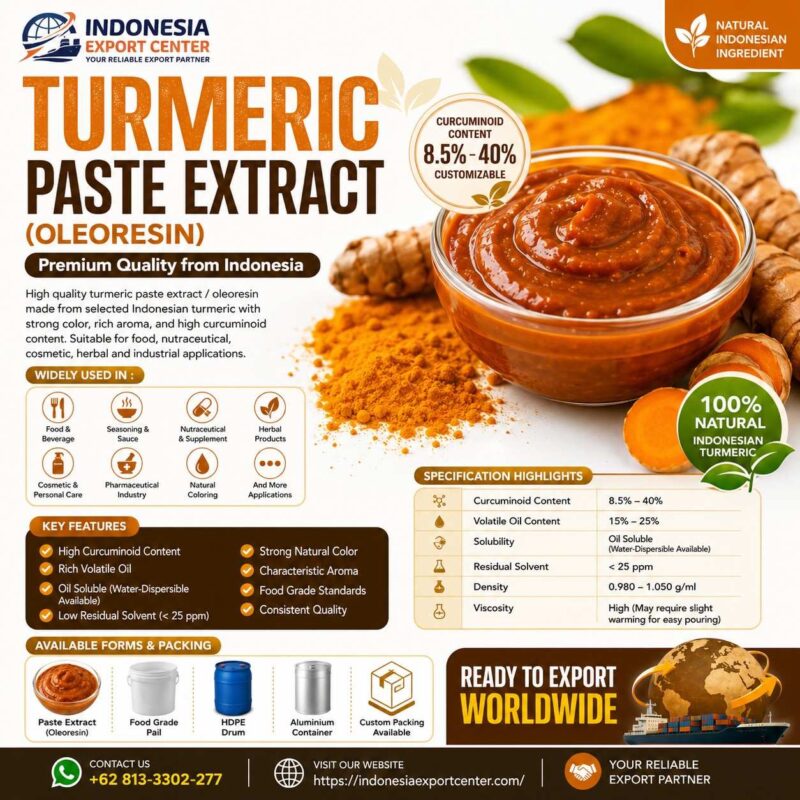
IEC | Indonesia Export Center facilitates sourcing inquiries for Indonesian turmeric paste extract and helps buyers request product information needed for customs and import review.
REQUEST TURMERIC PASTE PRODUCT DOCUMENTATION
Why the Product Definition Matters
Customs classification may depend on:
- Botanical source.
- Manufacturing process.
- Extraction method.
- Chemical and ingredient composition.
- Presence of carriers or additives.
- Physical form.
- Intended use.
- Applicable tariff schedule.
The commercial name alone is not sufficient to determine the correct HS code.
Turmeric Paste vs. Other Turmeric Products
| Product | General Description | Classification Consideration |
|---|---|---|
| Ground Turmeric | Dried and milled rhizome | Spice classification may be relevant |
| Turmeric Oleoresin | Concentrated extracted material | Extraction and composition matter |
| Culinary Turmeric Paste | Formulated paste | Added ingredients and preparation matter |
| Dried Turmeric Extract | Extract in powder form | Composition and processing matter |
| Formulated Color Ingredient | Turmeric-derived preparation | Function and composition matter |
This table does not assign a definitive tariff code.
Product Reference for Customs Review
| Parameter | Preliminary Information |
|---|---|
| Product | Turmeric Paste Extract / Oleoresin |
| Botanical Source | Curcuma longa L. |
| Proposed Origin | Indonesia |
| Curcuminoid Content | 8.5–40% reference range |
| Volatile Oil | 15–25% reference range |
| Solubility | Oil-soluble reference |
| Residual Solvent | Below 25 ppm stated; unverified |
| Physical Form | Viscous paste |
| Complete Composition | Not supplied |
| Extraction Method | Not supplied |
| Final HS Classification | Not determined |
The missing information should be obtained before making a classification decision.
Understanding HS Codes
The Harmonized System provides an international framework for classifying traded goods.
The first six digits are internationally harmonized, while countries may apply additional national tariff subdivisions.
A code used in one country should not automatically be copied into another country’s customs declaration without verification.
Information to Request from the Supplier
For customs review, buyers should request:
- Exact product name.
- Botanical identity.
- Manufacturing process.
- Extraction method.
- Full ingredient composition.
- Physical form.
- Curcuminoid and other relevant analytical data.
- Technical data sheet.
- Batch certificate of analysis.
- Intended application and packaging information.
Import Duties and Tariffs
Import duties depend on the destination country’s tariff schedule, classification, origin, and applicable trade arrangements.
Preferential tariffs may require specific origin criteria and supporting documents.
No duty rate or preferential eligibility is claimed for the referenced product.
Customs Documentation
| Document | Purpose |
|---|---|
| Commercial Invoice | Product and transaction details |
| Packing List | Shipment quantities and packaging |
| Transport Document | Shipment identification |
| Certificate of Origin | Origin evidence where applicable |
| TDS | Technical product description |
| COA | Batch quality information |
| Composition Statement | Classification support |
| Import Permits | Where required |
Customs Broker Review
Importers should consult a qualified customs broker or the responsible customs authority when classification is uncertain.
Where available, a formal advance or binding tariff ruling may provide greater certainty.
The applicable procedure varies by country.
Common Classification Mistakes
One mistake is using the HS code for ground turmeric without confirming whether the shipment is an extracted oleoresin.
Another is relying only on the product’s marketing name.
A third is assuming that the exporter and importer must always use identical national tariff extensions.
Frequently Asked Questions
What is the HS code for turmeric paste?
No definitive code can be assigned from the supplied information alone.
Is turmeric oleoresin classified as ground turmeric?
Not necessarily. Classification depends on the actual product.
Can IEC confirm import duty rates?
The responsible customs authority or qualified adviser should confirm classification and duties.
Does the country of origin affect tariffs?
Origin may affect applicable tariff treatment, subject to the relevant rules.
Can IEC request the documents needed for customs review?
Yes. IEC can facilitate technical documentation requests.
Request Turmeric Paste Customs Documentation
IEC welcomes inquiries from customs teams, logistics managers, ingredient importers, and international trading companies.
REQUEST PRODUCT COMPOSITION, TDS, COA & QUOTATION
INDONESIA EXPORT CENTER
Website: https://indonesiaexportcenter.com/
WhatsApp: +62 813-3302-277
Related pages:
SEO METADATA
SEO Title: Turmeric Paste HS Code and Customs Guide | IEC
Meta Description: Learn how turmeric paste HS code classification depends on composition, extraction, intended use, customs documentation, and destination-country tariff rules.
Focus Keyword: turmeric paste hs code and customs guide
URL Slug: turmeric-paste-hs-code-and-customs-guide
Canonical URL: https://indonesiaexportcenter.com/turmeric-paste-hs-code-and-customs-guide/
Search Intent: Informational
