

IEC | INDONESIA EXPORT CENTER
Turmeric Oleoresin | Industrial Seasoning Ingredients | Spice Blends | Sensory Consistency | Global B2B Procurement
Source Turmeric Paste Extract for Seasoning Manufacturing
Seasoning manufacturers rely on carefully balanced ingredient systems to maintain consistent flavor, aroma, and appearance across production batches.
When sourcing turmeric paste for seasoning manufacturers, the most important considerations include the extract’s sensory characteristics, curcuminoid concentration, physical form, compatibility with other ingredients, and batch-to-batch consistency.
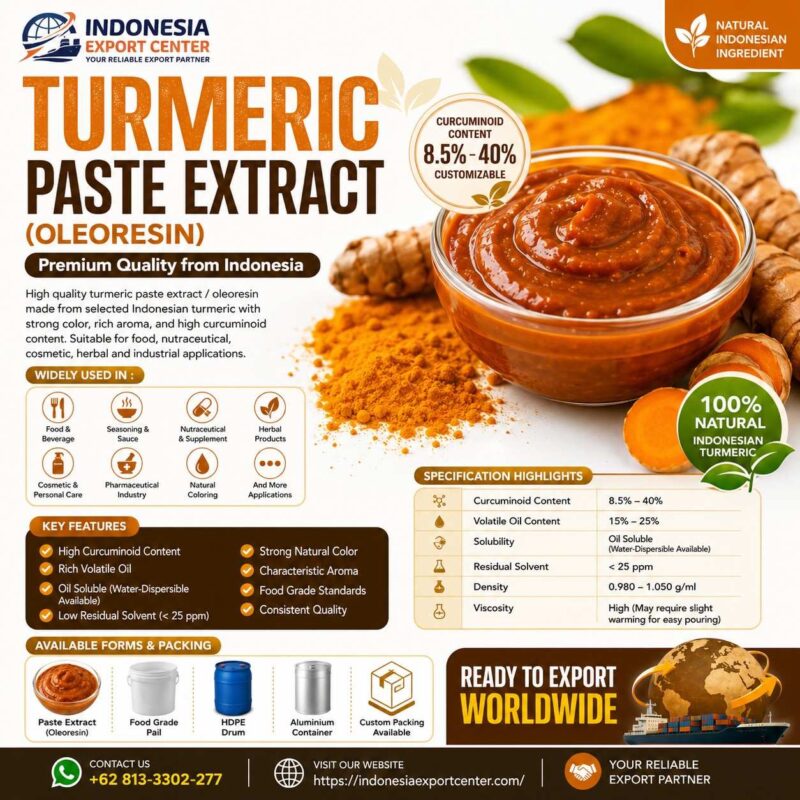
Turmeric paste extract, commonly referred to as turmeric oleoresin, may be evaluated as a concentrated turmeric-derived ingredient for suitable seasoning applications.
IEC | Indonesia Export Center facilitates sourcing inquiries for Indonesian turmeric paste extract, helping international seasoning manufacturers request specifications, samples, quality documentation, and supplier-approved quotations.
REQUEST TURMERIC PASTE FOR SEASONING PRODUCTION
Product Overview
| Parameter | Preliminary Information |
|---|---|
| Product | Turmeric Paste Extract / Oleoresin |
| Botanical Source | Curcuma longa L. |
| Proposed Origin | Indonesia |
| Curcuminoid Content | 8.5–40% reference range |
| Volatile Oil Content | 15–25% reference range |
| Color | Characteristic yellow-orange |
| Aroma | Characteristic turmeric |
| Physical Form | Viscous paste |
| Solubility | Oil-soluble reference |
| Water-Dispersible Option | Subject to supplier confirmation |
| Residual Solvent | Below 25 ppm stated; unverified |
| Packaging | Pails, HDPE drums, aluminium containers subject to confirmation |
| MOQ | Not verified |
Turmeric Oleoresin in Seasoning Formulations
Turmeric-derived ingredients are used in many culinary flavor systems.
For industrial manufacturers, however, choosing an extract requires an understanding of how its composition affects the finished seasoning.
The concentration of curcuminoids, volatile oil profile, and physical form may influence the ingredient’s behavior during blending and processing.
The extract should be evaluated as part of the complete seasoning formulation rather than as an isolated ingredient.
Potential Seasoning Applications
Liquid Seasoning Systems
Turmeric oleoresin may be evaluated in suitable liquid seasoning preparations where its dispersion and flavor characteristics meet the formulation requirements.
Oil-Based Seasoning Blends
An oil-soluble extract may be relevant to compatible oil-containing seasoning systems.
Savory Flavor Concentrates
Manufacturers may investigate turmeric paste as one component of a concentrated flavor preparation.
Curry and Spice Seasonings
Turmeric oleoresin may be considered in suitable curry-related seasoning systems after sensory and technical evaluation.
Dry Seasoning Production
A viscous oleoresin cannot automatically be used as a free-flowing powder. Incorporation into dry blends may require a suitable carrier or processing method, subject to formulation and supplier verification.
Sensory Profile and Consistency
Aroma
The product brief describes a rich characteristic turmeric aroma and volatile oil content of 15–25%.
Actual aroma performance and volatile oil results must be verified for the selected grade.
Color
The characteristic yellow-orange color may be relevant to the intended seasoning appearance.
Manufacturers should evaluate color intensity and stability within the finished product.
Flavor Balance
Turmeric-derived flavor should be evaluated alongside salt, spices, acids, oils, and other seasoning components.
Physical Distribution
The extract must be incorporated uniformly to avoid inconsistent ingredient distribution.
Batch-to-Batch Quality Control
A standardized ingredient specification helps manufacturers maintain production consistency.
Relevant acceptance criteria may include:
| Quality Parameter | Manufacturing Relevance |
|---|---|
| Curcuminoid Assay | Ingredient concentration |
| Volatile Oil Content | Aroma profile |
| Appearance | Visual consistency |
| Viscosity | Dosing and handling |
| Solubility | Blend compatibility |
| Residual Solvents | Quality and safety |
| Microbiology | Intended-use requirements |
| Heavy Metals | Contaminant control |
| Batch Identification | Traceability |
Formulation Testing
Before commercial approval, seasoning manufacturers should conduct representative trials.
These may include ingredient blending, sensory assessment, stability evaluation, dosing verification, and comparison with an approved reference formulation.
Where the extract is incorporated into a dry seasoning system, additional processing and flowability assessments may be necessary.
Food Safety and Regulatory Considerations
The intended use of turmeric oleoresin should be reviewed under applicable food regulations.
Buyers should request relevant supplier documents, including TDS, COA, ingredient declaration, residual solvent testing, and other quality evidence.
The product brief describes food-grade standards, but this claim requires verification for the actual ingredient.
Packaging and Industrial Supply
Potential packaging formats include food-grade pails, HDPE drums, and aluminium containers.
Exact container sizes, stock availability, MOQ, and production capacity require supplier confirmation.
IEC Supplier Matching Process
- Identify the seasoning application.
- Define the desired aroma and color characteristics.
- Clarify the required curcuminoid grade.
- Request technical and quality documentation.
- Coordinate sample inquiries.
- Conduct blending and sensory trials.
- Establish approved quality criteria.
- Confirm packaging and commercial volume.
- Review shipping requirements.
- Obtain a supplier-approved quotation.
IEC acts as a sourcing facilitator. The actual supplier must confirm product specifications, availability, and final commercial terms.
Frequently Asked Questions
Can turmeric paste be used in seasoning manufacturing?
It may be evaluated for suitable seasoning formulations, subject to technical and regulatory requirements.
Is turmeric oleoresin suitable for dry seasoning blends?
Not automatically. A suitable incorporation method or carrier system may be necessary.
Does turmeric paste contain volatile oil?
The product brief describes a 15–25% reference range, which requires supplier verification.
Can manufacturers request a specific curcuminoid grade?
Yes. The required grade can be submitted for supplier review.
Can IEC coordinate formulation samples?
IEC can facilitate sample inquiries, subject to supplier availability.
Is repeat industrial supply available?
Capacity and recurring supply arrangements must be confirmed with the supplier.
Request Turmeric Paste for Seasoning Manufacturing
IEC welcomes inquiries from seasoning manufacturers, spice blend producers, flavor ingredient companies, food processors, and international ingredient distributors.
Please provide your intended seasoning application, target curcuminoid grade, required quantity, packaging preferences, and destination country.
REQUEST COA, SAMPLE & SEASONING INGREDIENT QUOTATION
INDONESIA EXPORT CENTER
YOUR RELIABLE EXPORT SOURCING PARTNER
Website: https://indonesiaexportcenter.com/
WhatsApp: +62 813-3302-277
Related pages:
- Turmeric Paste for Curry Manufacturing
- Turmeric Paste for Food Manufacturers
- Turmeric Paste Sample Request
SEO METADATA
SEO Title: Turmeric Paste for Seasoning Manufacturers | IEC
Meta Description: Source turmeric paste for seasoning manufacturing. Explore oleoresin aroma, color, blending compatibility, batch consistency, samples, and B2B quotations.
Focus Keyword: turmeric paste for seasoning manufacturers
Secondary Keywords: turmeric oleoresin seasoning ingredient, turmeric paste spice blends, turmeric extract flavor concentrate, seasoning manufacturer turmeric supplier
URL Slug: turmeric-paste-for-seasoning-manufacturers
Canonical URL: https://indonesiaexportcenter.com/turmeric-paste-for-seasoning-manufacturers/
Search Intent: Commercial / Seasoning Ingredient Procurement
Primary CTA: Request COA, Sample & Supplier-Approved Quotation
