

IEC | INDONESIA EXPORT CENTER
CONNECTING INDONESIAN PRODUCTS TO THE WORLD
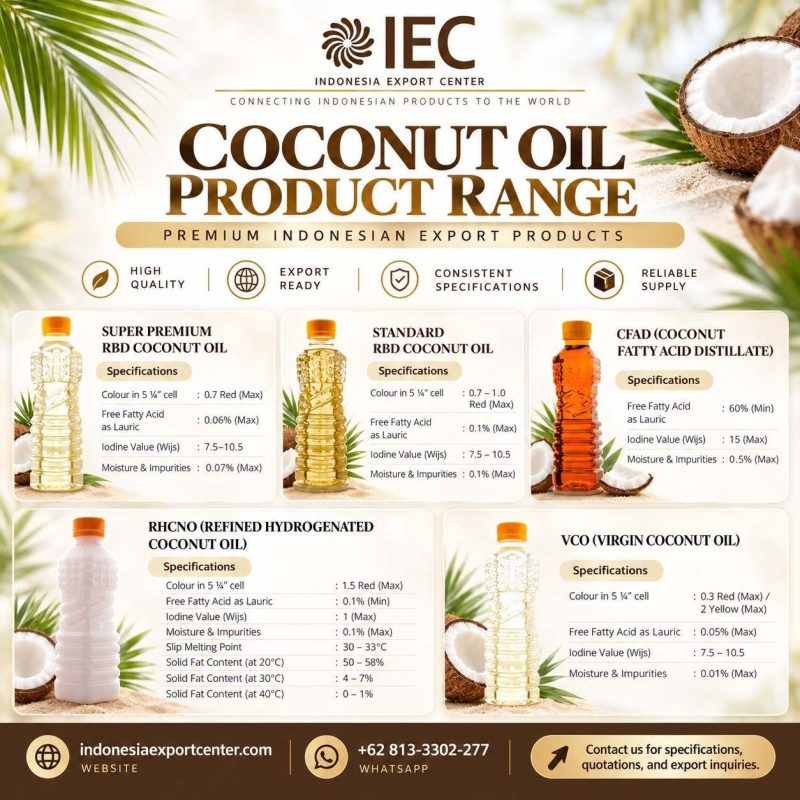
COCONUT OIL PRODUCT RANGE | PREMIUM INDONESIAN EXPORT PRODUCTS
Refined Hydrogenated Coconut Oil for Specialty Fat Blending
Looking for RHCNO specialty fat blends or evaluating hydrogenated coconut oil as a potential hardstock component in industrial fat formulations?
Refined Hydrogenated Coconut Oil (RHCNO) is a coconut-derived fat processed through refining and hydrogenation to modify its degree of unsaturation and physical characteristics.
For specialty fat blenders, the selection of a suitable fat component requires careful evaluation of solid fat content, melting behaviour, crystallization characteristics, compatibility with other fats, and final formulation requirements.
RHCNO may be evaluated as a potential structuring or hardstock component in selected fat blends where its actual properties meet the intended application.
However, suitability depends on the complete formulation, processing conditions, and verified product grade.
IEC | Indonesia Export Center facilitates sourcing and export enquiries for Indonesian coconut-derived products, including potential Refined Hydrogenated Coconut Oil supply.
International specialty fats manufacturers, blenders, and procurement teams can enquire about technical specifications, manufacturer availability, quality documentation, and bulk quotations.
Request RHCNO technical specifications and a bulk specialty fats quotation.
WhatsApp: +62 813-3302-277
Website: https://indonesiaexportcenter.com/
Actual manufacturer, food-grade status, COA, stock availability, MOQ, packaging, certifications, and export arrangements must be verified before purchase.
RHCNO Reference Technical Specifications
The following figures are supplied reference specifications for Refined Hydrogenated Coconut Oil.
| Technical Parameter | Reference Specification |
|---|---|
| Colour in 5¼” Cell | 1.5 Red (Max) |
| Free Fatty Acid as Lauric | 0.1% (Min) – Requires Verification |
| Iodine Value (Wijs) | 1 (Max) |
| Moisture & Impurities | 0.1% (Max) |
| Slip Melting Point | 30–33°C |
| Solid Fat Content at 20°C | 50–58% |
| Solid Fat Content at 30°C | 4–7% |
| Solid Fat Content at 40°C | 0–1% |
These values are reference specification limits and ranges, not actual lot-specific COA results.
Important technical clarification: The supplied FFA specification states 0.1% minimum. Because this is an unusual acceptance direction for refined oil, the correct limit must be confirmed with the manufacturer before contractual use.
What Is RHCNO in Specialty Fat Blending?
Refined Hydrogenated Coconut Oil is a coconut-derived fat that has undergone hydrogenation.
Hydrogenation reduces carbon-carbon double bonds in unsaturated fatty acid components.
This process can influence:
- Degree of unsaturation
- Melting behaviour
- Solid fat content
- Crystallization characteristics
- Oxidative behaviour
- Texture and firmness
In specialty fat blending, RHCNO may be evaluated as a component used to modify the physical characteristics of a fat system.
However, the final blend properties depend on all ingredients, blend ratios, processing conditions, and crystallization behaviour.
What Is a Hardstock in Fat Formulation?
A hardstock is a relatively high-melting or structurally firm fat component used to modify the physical characteristics of a fat blend.
Depending on the formulation, hardstocks may contribute to:
- Structure
- Firmness
- Solid fat content
- Crystallization behaviour
- Melting characteristics
- Texture
- Processing performance
Can RHCNO Function as a Hardstock?
RHCNO may be evaluated as a potential structuring component because of its hydrogenation characteristics and supplied SFC profile.
However, it should not automatically be assumed suitable as a hardstock for every application.
The actual suitability depends on the target blend and technical evaluation.
RHCNO Solid Fat Content for Hardstock Blends
Solid fat content is one of the most important parameters in specialty fat formulation.
Reference RHCNO SFC Profile
| Temperature | Solid Fat Content |
|---|---|
| 20°C | 50–58% |
| 30°C | 4–7% |
| 40°C | 0–1% |
These are supplied reference ranges, not actual lot-specific measurements.
SFC at 20°C
The reference indicates a substantial solid fraction at 20°C.
This may be relevant when evaluating the contribution of RHCNO to blend firmness and structure.
SFC at 30°C
The reference decreases to 4–7% at 30°C.
This indicates a considerable reduction in the solid fraction across the measured temperature interval.
SFC at 40°C
The reference indicates 0–1% solid fat at 40°C.
This may be relevant when evaluating melting behaviour.
Why This Profile Matters
Specialty fat blenders often target a particular SFC curve rather than a single melting point.
A suitable formulation may require:
- Adequate firmness at storage temperature
- Controlled melting characteristics
- Appropriate processing behaviour
- Acceptable texture
- Consistent crystallization
- Stable finished product performance
The final blend’s SFC curve must be measured rather than inferred solely from the component specifications.
RHCNO Slip Melting Point
The supplied reference specification is:
Slip Melting Point: 30–33°C
Slip melting point helps characterize the melting behaviour of a fat under standardized test conditions.
For specialty fat blenders, this parameter may support initial screening.
Why Slip Melting Point Matters
It may influence:
- Blend selection
- Processing temperature
- Melting behaviour
- Product handling
- Storage conditions
However, slip melting point alone does not determine the complete melting profile or crystallization characteristics.
RHCNO Iodine Value and Hydrogenation Degree
The supplied RHCNO iodine value specification is:
Iodine Value (Wijs): 1 Maximum
A low iodine value generally indicates a low degree of unsaturation.
For specialty fat blending, iodine value may help characterize the hydrogenated component.
However, iodine value alone does not establish:
- Complete fatty acid composition
- Triacylglycerol composition
- Crystal structure
- Solid fat content
- Melting profile
- Finished blend performance
Buyers should request additional analytical information where needed.
How RHCNO May Influence Specialty Fat Blends
The effects of adding RHCNO depend on the base fat, blend ratio, and processing conditions.
1. Solid Fat Content
RHCNO may change the blend’s SFC profile.
The actual result must be measured.
2. Firmness
RHCNO may influence firmness depending on its concentration and interaction with other fats.
3. Melting Behaviour
The melting profile may change when RHCNO is blended with other fat components.
4. Crystallization
RHCNO may affect crystal formation, polymorphism, and crystallization kinetics.
5. Texture
The final texture depends on the complete fat system and processing conditions.
6. Storage Performance
Storage stability must be evaluated through appropriate testing.
No specific blend performance, optimum inclusion level, or shelf-life improvement has been verified.
RHCNO Blending Compatibility
Compatibility is a critical consideration in specialty fat formulation.
Different fats may have different fatty acid compositions and triacylglycerol structures.
When combined, these differences may influence:
- Crystallization behaviour
- Melting characteristics
- Solid fat content
- Texture
- Storage stability
- Phase behaviour
Recommended Compatibility Evaluation
- Identify the base fat.
- Review fatty acid composition.
- Review triacylglycerol composition where relevant.
- Establish the target SFC profile.
- Prepare laboratory blends.
- Measure blend SFC.
- Evaluate crystallization behaviour.
- Conduct application testing.
- Review storage stability.
- Confirm regulatory suitability.
RHCNO and Lauric Fat Systems
Coconut-derived fats are associated with lauric-type fatty acid profiles.
However, actual fatty acid composition must be confirmed through analysis.
In specialty fat blending, compatibility may be influenced by whether the formulation contains:
- Lauric-type fats
- Non-lauric fats
- Cocoa butter
- Other specialty fat components
Why This Matters
Blending incompatible fat systems may cause undesirable changes in physical properties.
The actual effects depend on composition, blend ratio, and processing conditions.
RHCNO should not automatically be considered compatible with all specialty fat systems.
RHCNO and Cocoa Butter Compatibility
For formulations containing cocoa butter, compatibility requires particular attention.
Cocoa butter has distinctive crystallization behaviour.
Adding other fats can influence:
- Crystal formation
- Melting behaviour
- Texture
- Product stability
- Fat bloom risk
Before Using RHCNO in Cocoa-Containing Blends
Manufacturers should:
- Review the complete fat composition.
- Evaluate compatibility with cocoa butter.
- Conduct crystallization studies.
- Measure the finished blend’s SFC profile.
- Test texture and melting characteristics.
- Evaluate storage stability.
- Verify applicable product standards.
RHCNO should not automatically be classified as a cocoa butter equivalent, replacer, or substitute.
Potential Applications of RHCNO Specialty Fat Blends
Depending on the verified product grade and formulation requirements, RHCNO may be evaluated in selected specialty fat systems.
Confectionery Fat Blends
RHCNO may be evaluated where specific melting and solid fat characteristics are required.
Compound Coating Fat Systems
Specialty fat blenders may investigate RHCNO for suitable coating formulations.
Filling Fat Formulations
RHCNO may be evaluated as a component in fillings requiring particular texture and melting behaviour.
Industrial Fat-Based Formulations
RHCNO may be considered in other suitable industrial fat systems.
Important
These are potential evaluation areas, not verified approved applications for the referenced RHCNO.
Food-grade status and regulatory suitability must be confirmed before food use.
RHCNO vs Other Specialty Fat Components
| Comparison Factor | RHCNO | Other Specialty Fat Components |
|---|---|---|
| Raw Material Source | Coconut Oil | Depends on Product |
| Hydrogenation | Yes | Depends on Grade |
| Reference Iodine Value | 1 (Max) | Grade-Specific |
| Reference Slip Melting Point | 30–33°C | Grade-Specific |
| Reference SFC at 20°C | 50–58% | Grade-Specific |
| Reference SFC at 30°C | 4–7% | Grade-Specific |
| Reference SFC at 40°C | 0–1% | Grade-Specific |
| Fatty Acid Composition | To Be Verified | Grade-Specific |
| Blending Compatibility | Requires Testing | Requires Testing |
| Application Suitability | Requires Testing | Requires Testing |
RHCNO should be compared with other fats using actual analytical data and formulation trials.
Recommended RHCNO Blending Trial Procedure
Before commercial production, specialty fat blenders may conduct structured laboratory and pilot-scale evaluations.
Step 1: Define the Target Application
Establish the required texture, melting behaviour, SFC profile, and processing characteristics.
Step 2: Review the Raw Material
Verify the RHCNO specification and lot-specific COA.
Step 3: Select the Base Fat System
Identify the other fats used in the formulation.
Step 4: Prepare Trial Blends
Evaluate selected blend ratios appropriate to the intended application.
Step 5: Measure SFC
Test the finished blends at relevant temperatures.
Step 6: Evaluate Crystallization
Assess crystal formation and related physical behaviour.
Step 7: Conduct Application Testing
Evaluate the formulation under relevant processing conditions.
Step 8: Review Storage Stability
Assess changes during storage.
Step 9: Confirm Regulatory Requirements
Verify food-grade status and applicable regulations where relevant.
Step 10: Approve the Formulation
Proceed only after the required technical and quality criteria have been met.
RHCNO Quality Parameters for Specialty Fat Blenders
| Parameter | Relevance | Status |
|---|---|---|
| Iodine Value | Degree of unsaturation | Reference: 1 (Max) |
| Slip Melting Point | Melting characteristics | Reference: 30–33°C |
| SFC at 20°C | Solid fraction at 20°C | Reference: 50–58% |
| SFC at 30°C | Solid fraction at 30°C | Reference: 4–7% |
| SFC at 40°C | Solid fraction at 40°C | Reference: 0–1% |
| FFA as Lauric | Refined oil quality | Requires Clarification |
| Moisture & Impurities | Raw material quality | Reference: 0.1% (Max) |
| Colour | Appearance | Reference: 1.5 Red (Max) |
| Fatty Acid Composition | Blend compatibility | To Be Verified |
| Triacylglycerol Composition | Crystal and phase behaviour | To Be Verified if Required |
| Crystallization Behaviour | Blend performance | To Be Evaluated |
| Trans Fatty Acid Content | Food regulatory assessment | To Be Verified if Required |
| Food-Grade Status | Food application suitability | To Be Verified |
RHCNO Certificate of Analysis
A lot-specific Certificate of Analysis should be reviewed before commercial approval.
| Parameter | Reference Specification | Actual Lot Result |
|---|---|---|
| Colour in 5¼” Cell | 1.5 Red (Max) | To Be Verified |
| FFA as Lauric | 0.1% (Min) – Requires Clarification | To Be Verified |
| Iodine Value (Wijs) | 1 (Max) | To Be Verified |
| Moisture & Impurities | 0.1% (Max) | To Be Verified |
| Slip Melting Point | 30–33°C | To Be Verified |
| SFC at 20°C | 50–58% | To Be Verified |
| SFC at 30°C | 4–7% | To Be Verified |
| SFC at 40°C | 0–1% | To Be Verified |
| Fatty Acid Composition | Buyer-Defined | To Be Verified |
| Other Parameters | Buyer-Defined | To Be Verified |
COA Verification Checklist
-
Manufacturer or laboratory identity
-
Product name and grade
-
Lot or batch number
-
Sampling or testing date
-
Analytical methods
-
Actual numerical results
-
Units of measurement
-
Specification limits
-
Authorized approval
-
Traceability to the shipment lot
RHCNO Food-Grade and Regulatory Verification
For food-related specialty fat blends, food-grade suitability must be confirmed.
Recommended Verification
- Manufacturer identity
- Food-grade product specification
- Lot-specific COA
- Safety Data Sheet
- Fatty acid composition
- Trans fatty acid data
- Relevant contaminant information
- Food-contact packaging suitability
- Traceability documentation
- Applicable food regulations
- Certification documents where claimed
No specific food-grade approval, halal certification, kosher certification, ISO certification, HACCP certification, or other certification has been independently verified for the referenced RHCNO.
Bulk Packaging and Export Shipping
Packaging should be selected according to product characteristics and supplier capability.
Potential arrangements may include:
- Suitable industrial drums
- Compatible bulk containers
- Other supplier-approved packaging configurations
Shipping Information to Confirm
- Packaging type
- Net weight
- Gross weight
- Storage conditions
- Handling requirements
- Origin port
- Destination port
- Freight cost
- Insurance requirements
- Estimated transit time
No specific packaging configuration or shipment schedule has been verified.
RHCNO MOQ, Pricing and Commercial Terms
Minimum Order Quantity
No fixed MOQ has been verified.
Available Quantity
Current stock and production capacity must be confirmed.
Price per Metric Ton
Pricing depends on product grade, quantity, packaging, and commercial terms.
Export Incoterms
Depending on the transaction, buyers may request:
- FCA
- FOB
- CFR
- CIF
- CIP
The appropriate Incoterm should be selected according to the transport arrangement and named place.
For containerized cargo handed to a carrier before vessel loading, FCA is often more appropriate than FOB.
Specialty Fat Blending Procurement Checklist
Before placing an order, verify:
-
Manufacturer identity
-
Product identity as RHCNO
-
Intended blending application
-
Product specification
-
Iodine value
-
Slip melting point
-
SFC at 20°C
-
SFC at 30°C
-
SFC at 40°C
-
FFA specification direction
-
Moisture and impurities
-
Colour
-
Fatty acid composition
-
Triacylglycerol composition if required
-
Blending compatibility
-
Crystallization behaviour
-
Finished blend SFC profile
-
Application trial results
-
Storage stability
-
Food-grade status if required
-
Lot-specific COA
-
Safety Data Sheet
-
Packaging suitability
-
MOQ
-
Available quantity
-
Price per MT
-
Export terms
-
Destination-country regulatory requirements
Request for Quotation – RHCNO for Specialty Fat Blends
Subject: RFQ – Refined Hydrogenated Coconut Oil for Specialty Fat Blending
Dear IEC | Indonesia Export Center Team,
We are evaluating Refined Hydrogenated Coconut Oil as a potential component for specialty fat blends.
Please advise whether a suitable Indonesian manufacturer can provide RHCNO meeting our technical and commercial requirements.
BUYER INFORMATION
Company Name: [Company Name] Country: [Country] Business Type: [Specialty Fat Blender / Confectionery Fat Manufacturer / Industrial Fat Processor / Ingredient Importer / Distributor] Contact Person: [Name] Email: [Email] WhatsApp: [Number]
PRODUCT REQUIREMENTS
Product: Refined Hydrogenated Coconut Oil (RHCNO)
Intended Application: [Hardstock Blend / Confectionery Fat / Coating Fat / Filling Fat / Other]
Required Quantity: [MT]
Order Frequency: [Trial / One-Time / Monthly / Other]
REFERENCE SPECIFICATIONS
| Parameter | Required Value |
|---|---|
| Colour in 5¼” Cell | 1.5 Red (Max) |
| FFA as Lauric | Please Confirm Correct Limit and Direction |
| Iodine Value (Wijs) | 1 (Max) |
| Moisture & Impurities | 0.1% (Max) |
| Slip Melting Point | 30–33°C |
| SFC at 20°C | 50–58% |
| SFC at 30°C | 4–7% |
| SFC at 40°C | 0–1% |
| Fatty Acid Composition | Request Analysis |
| Triacylglycerol Composition | Request if Available |
| Food-Grade Status | Verify if Required |
| Additional Requirements | [Specify] |
DOCUMENTATION REQUESTED
Please provide, where available:
- Manufacturer legal name and facility location
- Current RHCNO technical specification
- Lot-specific COA
- Safety Data Sheet
- Confirmation of FFA specification
- Iodine value result
- Slip melting point result
- Solid fat content profile
- Fatty acid composition
- Triacylglycerol composition, if available
- Food-grade documentation, if applicable
- Packaging specifications
- Storage and handling recommendations
- Relevant certification documents, if claimed
- Sample availability
COMMERCIAL REQUIREMENTS
Preferred Packaging: [Specify] Required Quantity: [MT] Destination Country: [Country] Destination Port: [Port] Requested Incoterm: [FCA / FOB / CFR / CIF / CIP / Other] Target Shipment Period: [Month / Year]
Please advise:
- Minimum order quantity
- Available quantity
- Price per MT
- Currency
- Packaging options
- Indonesian origin port
- Production lead time
- Estimated shipment lead time
- Payment terms
- Quotation validity
- Recurring supply capability
We will review technical suitability, blending compatibility, and destination-country regulatory requirements before commercial approval.
Thank you. We look forward to your response.
Kind regards,
[Your Name] [Company Name] [Country]SEND YOUR RHCNO SPECIALTY FAT BLENDING ENQUIRY VIA WHATSAPP
Frequently Asked Questions – RHCNO Specialty Fat Blends
1. What is RHCNO?
RHCNO stands for Refined Hydrogenated Coconut Oil, a coconut-derived fat processed through refining and hydrogenation.
2. Can RHCNO be used in specialty fat blends?
Potentially, depending on the verified product grade, blend composition, and application requirements.
3. Can RHCNO function as a hardstock?
It may be evaluated as a potential structuring component, but suitability must be established through formulation testing.
4. Why is solid fat content important?
SFC influences firmness, melting behaviour, texture, and processing characteristics.
5. What is the supplied RHCNO SFC at 20°C?
50–58%.
6. What is the supplied RHCNO SFC at 30°C?
4–7%.
7. What is the supplied RHCNO SFC at 40°C?
0–1%.
8. What is the supplied slip melting point?
30–33°C.
9. What is the supplied iodine value?
1 maximum, using the Wijs method.
10. Is RHCNO compatible with all vegetable fats?
No. Compatibility depends on the actual fat composition and blend formulation.
11. Can RHCNO be blended with cocoa butter?
Potentially, but compatibility and crystallization behaviour must be evaluated.
12. Is RHCNO automatically food grade?
No. Food-grade status must be verified with the manufacturer.
13. Can buyers request a lot-specific COA?
Yes. Actual availability must be confirmed.
14. What is the minimum order quantity?
No fixed MOQ has been verified.
15. Does IEC have verified RHCNO stock for specialty fat blending?
No specific RHCNO stock or current supply availability has been independently verified for this page.
Request RHCNO for Specialty Fat Blending
Selecting RHCNO specialty fat blends requires careful evaluation of solid fat content, melting characteristics, crystallization behaviour, fat compatibility, and intended application.
For specialty fat blenders, the most important considerations include verified analytical results, laboratory trials, finished blend performance, and consistent quality.
IEC | Indonesia Export Center welcomes international enquiries for potential Indonesian Refined Hydrogenated Coconut Oil sourcing and export quotations.
IEC | INDONESIA EXPORT CENTER
CONNECTING INDONESIAN PRODUCTS TO THE WORLD
Product: Refined Hydrogenated Coconut Oil (RHCNO)
Product Category: Coconut-Derived Specialty Fat
Proposed Sourcing Country: Indonesia
Target Market: Global
Target Buyers: Specialty Fat Blenders, Confectionery Fat Manufacturers, Industrial Fat Processors, and Ingredient Importers
Reference Colour: 1.5 Red (Max), 5¼” Cell
Reference FFA as Lauric: 0.1% (Min) – Requires Verification
Reference Iodine Value: 1 (Max)
Reference Moisture & Impurities: 0.1% (Max)
Reference Slip Melting Point: 30–33°C
Reference SFC at 20°C: 50–58%
Reference SFC at 30°C: 4–7%
Reference SFC at 40°C: 0–1%
Fatty Acid Composition: To Be Verified
Triacylglycerol Composition: To Be Verified if Required
Blending Compatibility: Application Testing Required
Food-Grade Status: To Be Verified if Required
Manufacturer: To Be Verified
Lot-Specific COA: To Be Requested and Verified
Safety Data Sheet: To Be Requested and Verified
Certifications: To Be Verified
MOQ: To Be Confirmed
Available Quantity: To Be Confirmed
Packaging: To Be Confirmed
Price per MT: Request Quotation
Shipment Lead Time: To Be Confirmed
Request RHCNO Specialty Fat Blending Specifications and Bulk Quotation
Website: https://indonesiaexportcenter.com/
WhatsApp: +62 813-3302-277
REQUEST RHCNO SPECIALTY FAT BLENDING QUOTATION
Contact us for specifications, quotations, and export inquiries.
Technical and Commercial Disclaimer: This page provides general technical and sourcing information about potential Refined Hydrogenated Coconut Oil use in specialty fat blends. The numerical values shown are supplied reference specifications, not actual lot-specific COA results. The FFA value is reproduced as provided and requires manufacturer verification because its minimum-limit direction is unusual for refined oil. No specific manufacturer, food-grade approval, certification, COA, SDS, stock, MOQ, packaging configuration, price, production capacity, or shipment lead time has been independently verified. Hardstock performance, blending compatibility, crystallization behaviour, fatty acid composition, food safety requirements, and destination-country regulations must be assessed for the actual product and formulation. IEC facilitates sourcing and export enquiries; the actual manufacturer, contractual seller, and exporter of record must be confirmed for each order.
