

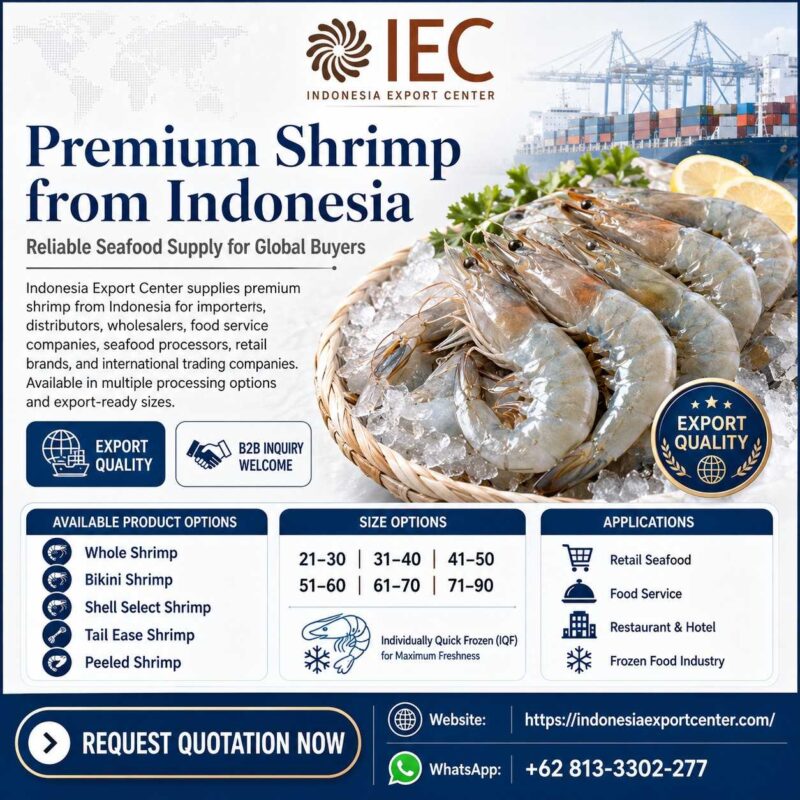
A Comprehensive Food Safety Guide for Indonesian Shrimp Importers
Food safety is a fundamental consideration when importing frozen shrimp from Indonesia.
International seafood importers, quality assurance managers, supermarket suppliers, food manufacturers, and wholesale distributors must evaluate the safety, quality, traceability, and regulatory status of products before entering into commercial purchase agreements.
Indonesia Export Center (IEC) assists international buyers with Indonesian vannamei shrimp sourcing inquiries, technical specification coordination, supplier documentation requests, and export procurement discussions.
This guide explains important food safety considerations for Indonesian shrimp, including HACCP-based controls, microbiological testing, veterinary drug residues, processing hygiene, allergens, traceability, cold-chain management, and destination-market requirements.
It is intended as a commercial procurement resource. Specific legal requirements and acceptance limits must be verified using current official regulations and supplier-specific documentation.
Understanding Food Safety in the Shrimp Supply Chain
Shrimp quality and safety can be influenced by activities throughout the supply chain.
Relevant stages include aquaculture production, harvesting, raw material transportation, receiving, processing, freezing, glazing, packaging, frozen storage, export transportation, and destination distribution.
Food safety management requires appropriate controls across these stages.
A finished-product laboratory report alone may not demonstrate that every relevant hazard has been adequately controlled.
Buyers should therefore evaluate both the product and the supplier’s food safety management practices.
Major Food Safety Considerations
| Risk Category | Potential Buyer Consideration |
|---|---|
| Biological Hazards | Relevant pathogenic microorganisms |
| Chemical Hazards | Veterinary drug residues and contaminants |
| Physical Hazards | Foreign materials |
| Allergens | Crustacean shellfish and additional ingredients |
| Processing Hygiene | Sanitation and cross-contamination controls |
| Cold Chain | Temperature management |
| Traceability | Source and production lot identification |
| Labeling | Accurate product and safety information |
| Regulatory Eligibility | Destination-specific facility and product requirements |
The applicable hazards depend on the actual product and intended use.
HACCP for Indonesian Shrimp Processing
HACCP stands for Hazard Analysis and Critical Control Points.
It is a preventive food safety management approach used to identify relevant hazards and establish appropriate controls.
For shrimp processing, a HACCP-based system may address hazards associated with raw material sourcing, processing, cooking where applicable, contamination, temperature management, and other relevant operations.
The seven commonly recognized HACCP principles include:
- Conduct a hazard analysis.
- Determine critical control points.
- Establish validated critical limits.
- Establish monitoring procedures.
- Establish corrective actions.
- Establish verification procedures.
- Establish documentation and recordkeeping.
The actual HACCP plan should be specific to the facility, product, and processing operation.
A generic certificate or document should not be treated as proof that all products from a supplier meet every import requirement.
Good Manufacturing Practices and Sanitation
Good Manufacturing Practices support appropriate production conditions and hygienic handling.
Relevant areas may include facility maintenance, personnel hygiene, cleaning, equipment sanitation, pest control, water quality, waste management, and prevention of cross-contamination.
Buyers may request information regarding the facility’s sanitation programs and verification procedures.
The appropriate documentation depends on the supplier and applicable requirements.
Raw Shrimp Versus Cooked Shrimp Food Safety
Raw frozen shrimp and cooked frozen shrimp have different processing characteristics and potential food safety considerations.
Raw shrimp may require appropriate preparation before consumption.
Cooked shrimp requires verification of its cooking process, intended use, and controls against post-process contamination.
A product described as cooked should not automatically be considered ready to eat.
The buyer should clearly identify whether the product is raw, partially cooked, fully cooked, ready to cook, or ready to eat.
Microbiological Testing for Frozen Shrimp
Microbiological testing may help assess whether a product meets applicable safety and hygiene criteria.
Potential testing parameters may include:
| Parameter | General Relevance |
|---|---|
| Aerobic Plate Count | General microbial quality assessment |
| Coliforms | Selected hygiene indicators |
| Escherichia coli | Relevant contamination indicator |
| Salmonella | Pathogen assessment where applicable |
| Listeria monocytogenes | Particularly relevant to certain ready-to-eat products |
| Vibrio species | Relevant to selected seafood hazard assessments |
| Staphylococcus aureus | Relevant to certain handling and processing conditions |
The required organisms, sampling plans, analytical methods, and acceptance limits depend on the product and destination-market requirements.
No universal numerical microbiological limits are presented here.
Buyers should request the specific criteria applicable to their products.
Veterinary Drug Residue Requirements
Farmed shrimp may be subject to regulatory controls concerning veterinary medicines and prohibited substances.
International importers should verify the supplier’s residue management procedures and applicable testing documentation.
Potential residue concerns may include substances such as chloramphenicol, nitrofuran metabolites, and other veterinary drugs regulated in the destination market.
The specific testing panel and acceptance criteria must follow applicable regulations and the buyer’s approved specification.
Claims such as antibiotic-free or residue-free should not be published without appropriate definitions and supporting evidence.
Chemical Contaminant Assessment
Depending on the sourcing environment and intended market, buyers may need to consider chemical contaminants.
Relevant assessments may include applicable heavy metals, environmental contaminants, processing chemicals, and other regulated substances.
Testing should be based on the actual risk assessment and applicable requirements.
A general statement that a product is laboratory tested does not identify which contaminants have been evaluated.
Sulfites and Processing Additives
Some shrimp products may involve processing additives used for specific technological purposes.
Buyers should request a complete ingredient and additive declaration.
If sulfites or other regulated additives are used, their use and labeling must comply with applicable destination-market requirements.
Products should not be described as additive-free without supplier confirmation and appropriate supporting evidence.
Allergen Management
Shrimp is a crustacean shellfish allergen.
Appropriate allergen management is important for seafood processors, retail brands, restaurants, and food manufacturers.
Further-processed products may contain additional allergens associated with coatings, seasonings, marinades, or other ingredients.
For example, breaded shrimp may contain wheat, egg, milk, soy, or other allergens depending on the actual formulation.
The supplier should provide an accurate ingredient list and allergen declaration.
Cross-contact risks should also be evaluated where relevant.
Water and Ice Quality
Water and ice used during shrimp processing may affect product safety.
The responsible processing facility should maintain appropriate water and ice quality controls according to its operations and applicable requirements.
Buyers may request relevant monitoring information or supplier declarations.
The presence of protective glaze does not establish that the water used meets applicable standards.
Physical Quality and Foreign Material Control
Physical quality inspection may evaluate broken shrimp, shell fragments, foreign material, discoloration, processing defects, and packaging integrity.
Physical hazards and commercial quality defects should be distinguished.
The supplier should establish appropriate controls for relevant foreign material risks.
Buyers should define acceptable defect levels in the commercial specification.
Traceability from Farm to Export Shipment
Traceability helps buyers identify the source and movement of shrimp products throughout the supply chain.
Relevant information may include:
- Farm or raw material source.
- Harvest or receiving date.
- Supplier identification.
- Processing facility.
- Production batch.
- Packaging lot.
- Frozen warehouse records.
- Export shipment identification.
- Customer distribution records.
The supplier should demonstrate how these records are maintained and retrieved.
Buyers may also request information regarding recall procedures and traceability testing.
Aquaculture Sourcing and Farm Controls
Farmed vannamei shrimp sourcing may involve multiple farms and raw material suppliers.
Importers should evaluate the available information concerning farm identity, feed, veterinary drug management, water conditions, harvest practices, and raw material traceability.
Sustainability and aquaculture certification claims require verification of the actual certificate, scope, and relevant supply-chain coverage.
No specific certification should be assumed from Indonesian origin alone.
Frozen Storage and Cold-Chain Management
Frozen shrimp requires appropriate temperature-controlled storage and transportation.
A temperature of approximately -18°C or colder is a common frozen storage reference, subject to the actual product specification and applicable rules.
The cold chain should be managed during storage, loading, transportation, customs handling, and destination distribution.
Relevant documentation may include warehouse temperature records, reefer settings, temperature logger records, and shipment inspection reports.
Freezing does not eliminate all food safety hazards.
Glazing and Net Weight Compliance
Protective glaze may help reduce exposure to air during frozen storage.
However, the glaze should be distinguished from the actual shrimp weight.
Buyers should establish the glaze calculation method, declared net weight, sampling procedure, and applicable deglazing standard.
Accurate weight declaration is important for both commercial procurement and regulatory compliance.
Understanding Certificates of Analysis
A Certificate of Analysis, or COA, reports the results of specified tests performed on a product or sample.
A buyer should review:
- Product identification.
- Batch or lot number.
- Sampling date.
- Laboratory identification.
- Tested parameters.
- Analytical methods.
- Results and units.
- Acceptance criteria.
- Reporting date.
- Relevant authorization or approval.
A COA should correspond to the relevant commercial batch where batch-specific testing is required.
A reference COA from an earlier production lot does not automatically establish the quality of a future shipment.
Food Safety Certifications and Facility Documentation
International buyers may request information concerning HACCP-based systems, BRCGS, FSSC 22000, ISO 22000, BAP, ASC, or other relevant schemes.
These programs have different purposes and scopes.
Some focus on food safety management, while others may address aquaculture or responsible sourcing.
The buyer should verify certificate validity, issuing body, facility address, product scope, and applicability to the transaction.
IEC does not claim that all potential suppliers hold these certifications.
Indonesian Shrimp Export Requirements for the United States
US seafood importers should verify applicable FDA requirements, seafood HACCP obligations, importer verification responsibilities, prior notice where required, labeling, customs classification, and relevant trade measures.
Depending on the transaction, additional seafood traceability and import requirements may apply.
Buyers should obtain current guidance from the relevant authorities and qualified import specialists.
Indonesian Shrimp Export Requirements for the European Union
EU importers should verify the eligibility of the country and responsible processing establishment, applicable official health certification, border-control procedures, traceability, residue requirements, and food labeling.
The exact requirements depend on the product, processing state, and destination.
Supplier claims should be supported by current official documentation.
Indonesian Shrimp Export Requirements for the United Kingdom
UK importers should confirm applicable seafood import procedures, establishment eligibility, official documentation, labeling, and food safety requirements.
Requirements may differ depending on the specific UK market and product.
Indonesian Shrimp Export Requirements for Japan
Japanese importers should verify applicable food sanitation requirements, import notifications, testing, additives, residues, labeling, and supporting documentation.
The responsible importer should establish the specific requirements before commercial shipment.
Indonesian Shrimp Export Requirements for China
Chinese seafood buyers should verify applicable overseas establishment registration, official documentation, customs procedures, labeling, and food safety requirements.
A supplier’s ability to export to another country does not automatically establish eligibility for China.
Indonesian Shrimp Export Requirements for South Korea
South Korean importers should verify applicable facility registration, food safety, inspection, customs, and labeling obligations.
The exact requirements must be established for the specific product.
Official Resources for Import Requirement Verification
International buyers may consult relevant official authorities, including:
- US Food and Drug Administration: https://www.fda.gov/
- European Commission Food Safety: https://food.ec.europa.eu/
- UK Food Standards Agency: https://www.food.gov.uk/
- Japan Ministry of Health, Labour and Welfare: https://www.mhlw.go.jp/english/
- General Administration of Customs of China: http://english.customs.gov.cn/
- South Korea Ministry of Food and Drug Safety: https://www.mfds.go.kr/eng/
These are general official authority websites. Buyers should locate and verify the current requirements applicable to their specific transaction.
Pre-Shipment Food Safety and Quality Inspection
Independent pre-shipment inspection may help buyers evaluate product conformity before export.
The inspection scope may include packaging, quantity, size grading, net weight, glaze, product temperature, physical quality, sampling, and laboratory testing.
The inspection provider should be qualified for the requested work.
The buyer and supplier should agree on sampling methods, acceptance criteria, reporting procedures, and responsibility for inspection costs.
Supplier Qualification Checklist
| Verification Area | Recommended Buyer Action |
|---|---|
| Legal Supplier Identity | Verify registration and contact information |
| Processing Facility | Identify actual production establishment |
| Export Eligibility | Check intended destination requirements |
| HACCP | Review relevant food safety controls |
| Product Specification | Approve technical requirements |
| Microbiology | Establish applicable test criteria |
| Residues | Verify required monitoring and results |
| Allergens | Review ingredients and declarations |
| Additives | Confirm permitted use and labeling |
| Traceability | Evaluate batch records |
| Certifications | Verify scope and validity |
| Cold Chain | Confirm storage and transport requirements |
| Packaging | Review materials and label accuracy |
| Inspection | Agree on methods and acceptance limits |
| Recall Procedures | Evaluate supplier arrangements |
Managing Non-Conforming Shrimp Shipments
A commercial agreement should establish procedures for handling products that do not meet the agreed specification.
Relevant arrangements may include shipment rejection criteria, additional testing, segregation, claims documentation, corrective action, and responsibilities for associated costs.
Products suspected of being unsafe should be managed according to applicable food safety procedures and regulatory obligations.
How Indonesia Export Center Supports Importer Quality Teams
IEC assists international buyers with supplier matching and technical documentation inquiries.
Our sourcing coordination may include requests for product specifications, COAs, HACCP-related documents, laboratory reports, traceability information, facility documents, packaging specifications, and commercial quotations.
IEC does not independently certify seafood products or guarantee regulatory approval.
Final supplier qualification and import compliance must be verified by the responsible transaction parties.
Frequently Asked Questions
Is HACCP important for frozen shrimp exports?
Yes. HACCP-based controls are important in seafood safety management, and specific legal obligations depend on the market.
Does every Indonesian shrimp supplier have the same certifications?
No. Certifications and facility approvals vary between suppliers.
Can I request microbiological testing?
Yes. Buyers may request relevant testing according to their product specification and destination requirements.
Is frozen shrimp automatically safe to eat without cooking?
No. The processing state and intended use must be verified.
Can I request antibiotic residue testing?
Yes. The applicable testing panel and acceptance criteria should be established.
Does a COA guarantee compliance with every regulation?
No. A COA reports specified test results and does not replace other applicable requirements.
Can IEC guarantee export approval?
No. Supplier eligibility and destination-market requirements must be verified.
Request Indonesian Shrimp Food Safety Documentation
Please provide:
Company Name:
Destination Country:
Product Form:
Raw or Cooked:
Intended Use:
Required Microbiological Criteria:
Required Residue Testing:
Additive Restrictions:
Allergen Requirements:
Required Certifications:
Traceability Requirements:
Facility Eligibility Requirements:
Inspection Requirements:
Initial Quantity:
Destination Port:
Shipment Schedule:
Contact Indonesia Export Center
INDONESIA EXPORT CENTER (IEC)
Global Trading & Export Solution
Website: https://indonesiaexportcenter.com/
WhatsApp: +62 813-3302-277
Direct inquiry: https://wa.me/628133302277
Request Indonesian Shrimp Supplier Documentation and Discuss Your Food Safety Requirements Today.
Related pages:
- Vannamei Shrimp Supplier Indonesia
- Indonesian Farmed Vannamei Shrimp
- Vannamei Shrimp Glazing and Net Weight Guide
- Vannamei Shrimp Export Quotation
This guide provides general procurement information. Food safety limits, testing requirements, official certifications, facility eligibility, and import regulations must be verified against current official requirements and supplier-specific documentation.
