

IEC | INDONESIA EXPORT CENTER
Botanical Supply Chain Traceability | Species Authentication | Origin Verification | Batch-Level Quality Assurance
Why Traceability Matters in Red Galangal Extract Sourcing
Traceability is a fundamental part of responsible botanical ingredient procurement. It enables buyers to understand where raw material originated, how it was processed, and how a finished ingredient batch can be linked to supporting quality records.
For companies evaluating red galangal extract traceability, the most important consideration is whether the supplier can demonstrate a credible chain of custody from the botanical source to the finished extract.
The proposed product is a powdered extract associated with Alpinia purpurata. The actual botanical species, plant part, origin, processing history, and supply chain must be verified.
Indonesia Export Center (IEC) facilitates sourcing inquiries with potential Indonesian suppliers, helping buyers request traceability information, technical documentation, and supplier-approved quotations.
IEC does not claim that a fully traceable commercial supply chain has already been verified for this ingredient.
REQUEST RED GALANGAL EXTRACT TRACEABILITY DOCUMENTATION
Understanding Botanical Ingredient Traceability
Botanical traceability refers to the ability to follow material through relevant stages of sourcing, processing, storage, and distribution.
A credible system should connect the declared ingredient identity with the actual material and its production records.
Traceability is particularly important when products are marketed using scientific names, geographic origin claims, or specific quality characteristics.
Botanical Identity
The proposed species is Alpinia purpurata, a member of the Zingiberaceae family.
Its taxonomic identity can be reviewed through Plants of the World Online.
However, a botanical database does not establish the identity of a supplier’s commercial batch.
The supplier should provide appropriate authentication records.
Preliminary Product Reference
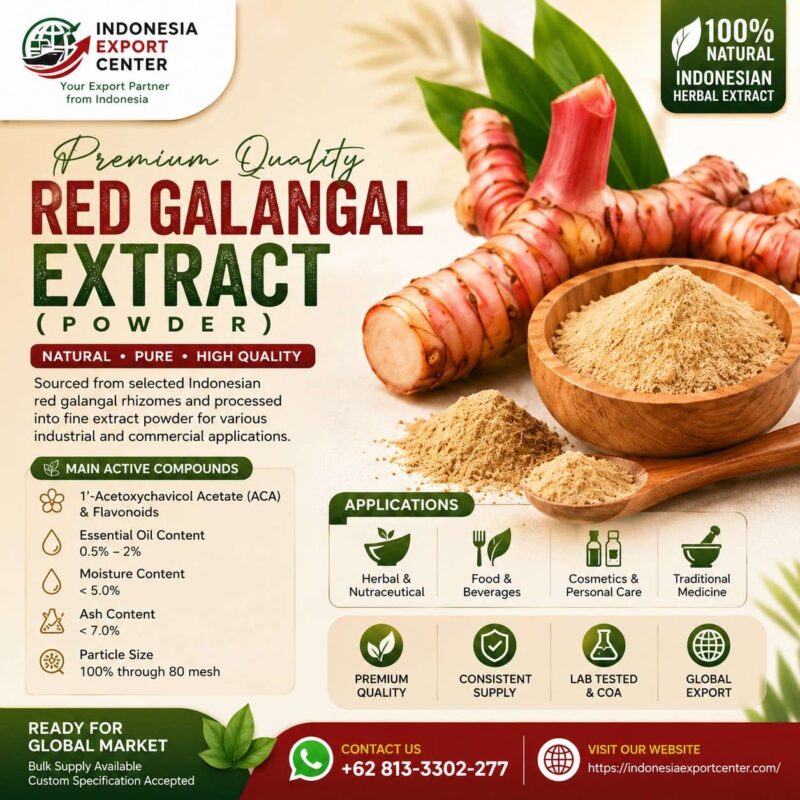
| Parameter | Proposed Information |
|---|---|
| Product | Red Galangal Extract Powder |
| Botanical Species | Alpinia purpurata |
| Proposed Origin | Indonesia |
| Plant Part | Rhizome; verification required |
| Physical Form | Fine extract powder |
| Moisture | Below 5% proposed |
| Ash | Below 7% proposed |
| Particle Size | 80 mesh proposed |
| Essential Oil | 0.5–2% proposed |
| Raw Material Source | Not established |
| Processor Identity | Not established |
| Batch Traceability | Not verified |
| Chain of Custody | Not verified |
Stage 1: Raw Material Origin
The first stage involves identifying where the botanical material was cultivated or collected.
Relevant records may include supplier identity, geographic source, harvest period, and raw material lot number.
The buyer should distinguish between the location of the seller, the raw material origin, and the processing facility.
These may not be the same.
Stage 2: Species and Plant-Part Authentication
The source material should be identified using suitable botanical evidence.
If the product is described as rhizome extract, the supplier should confirm that rhizomes are used.
This is essential because botanical common names and plant parts may be confused within complex supply chains.
Stage 3: Raw Material Receiving
A processor may maintain records of incoming botanical lots, including supplier details, quantities, inspection results, and acceptance decisions.
These records help establish a link between raw material and production.
Stage 4: Extraction and Processing
The manufacturing process should be documented sufficiently to establish how the raw material was transformed into the finished extract.
Relevant information may include extraction solvent, processing batch, concentration, drying, milling, and any carriers used.
The supplier should identify whether subcontractors perform any part of the process.
Stage 5: Batch Identification
Each finished batch should have a unique identifier that connects it to relevant manufacturing and quality records.
The batch number should appear consistently across applicable documents.
Stage 6: Quality Testing
The batch COA should correspond to the material being supplied.
Relevant tests may include identity, moisture, ash, particle size, chemical characterization, microbiology, contaminants, and residual solvents.
The appropriate testing program depends on the product and intended application.
Stage 7: Packaging and Warehousing
Packaging records should identify the finished product, batch number, quantity, and container configuration.
Storage conditions should follow supplier-approved requirements.
No verified storage conditions or shelf life have been provided.
Stage 8: Export and Shipment
Shipment records should connect the dispatched goods with the relevant commercial and quality documents.
Depending on the transaction, these may include the commercial invoice, packing list, transport document, and applicable origin documentation.
Chain-of-Custody Documentation
| Supply Chain Stage | Relevant Evidence |
|---|---|
| Botanical Source | Supplier and origin records |
| Species Authentication | Botanical identification |
| Plant-Part Verification | Raw material declaration |
| Receiving | Incoming lot records |
| Processing | Production batch records |
| Extraction | Method and solvent information |
| Quality Control | Batch COA and test reports |
| Packaging | Container and batch labels |
| Warehousing | Storage and inventory records |
| Shipment | Invoice, packing list, transport documents |
| Customer Delivery | Receiving and batch records |
Traceability vs Certificate of Origin
A certificate of origin may support a customs-related origin declaration.
It does not necessarily demonstrate the complete agricultural and manufacturing history of the botanical ingredient.
Buyers seeking detailed traceability should request supporting supply chain records.
Traceability vs Quality Testing
Traceability establishes links between materials, processes, and batches.
Quality testing evaluates selected characteristics of the material.
Both are important, but neither replaces the other.
A fully documented supply chain does not automatically establish that a batch meets every quality specification.
Traceability and Supplier Risk
Weak traceability may increase the risk of species substitution, plant-part misidentification, inconsistent quality, and difficulty investigating complaints.
Buyers should evaluate traceability controls in proportion to the product’s intended use and supply chain complexity.
Managing Changes in Botanical Supply
A supplier may change raw material sources, processing locations, extraction methods, or subcontractors.
Such changes can affect product characteristics.
Commercial buyers should establish procedures for supplier notification and technical review when relevant changes occur.
Traceability for International Distributors
Distributors may need to maintain links between incoming supplier batches and outgoing customer shipments.
This supports inventory control, customer complaints, quality investigations, and applicable recall procedures.
The exact recordkeeping requirements depend on the destination market and product category.
Traceability Verification Checklist
- Confirm the scientific botanical name.
- Verify the plant part.
- Request raw material origin information.
- Identify the actual processor.
- Review incoming lot records where available.
- Confirm the extraction method.
- Check finished batch numbering.
- Match COA results to the batch.
- Verify packaging labels.
- Review shipment documentation.
- Establish change notification requirements.
- Assess whether records support appropriate trace-back and trace-forward investigations.
Frequently Asked Questions
Is the proposed red galangal extract fully traceable?
No verified complete traceability records have been provided.
Does Indonesian origin guarantee Indonesian cultivation?
No. Raw material origin must be verified separately.
Can a COA prove the entire supply chain?
No. A COA reports analytical results and does not replace traceability records.
Can IEC request processor information?
IEC can facilitate supplier verification inquiries.
Are farm-level records available?
Availability has not been established.
Why is batch identification important?
It connects a specific material batch with manufacturing, quality, and shipment records.
Can traceability support supplier qualification?
Yes. It is an important component of broader supplier due diligence.
Request Red Galangal Extract Traceability Information
Indonesia Export Center welcomes inquiries from botanical ingredient importers, quality assurance managers, distributors, formulation companies, and international procurement teams.
Please provide your product specification, required traceability level, destination market, order quantity, and documentation requirements.
REQUEST ORIGIN RECORDS, BOTANICAL IDENTITY, BATCH COA & SUPPLIER QUOTATION
INDONESIA EXPORT CENTER
Your Export Sourcing Partner from Indonesia
Website: https://indonesiaexportcenter.com/
WhatsApp: +62 813-3302-277
Related pages:
- Alpinia Purpurata Extract for Botanical Research
- Alpinia Purpurata Extract Quality Testing
- Red Galangal Extract Manufacturer Sourcing
SEO METADATA
SEO Title: Red Galangal Extract Traceability | Indonesia Export Center
Meta Description: Explore red galangal extract traceability, including botanical species, plant-part verification, Indonesian origin, chain of custody, batch records, and COA.
Focus Keyword: red galangal extract traceability
URL Slug: red-galangal-extract-traceability
Canonical URL: https://indonesiaexportcenter.com/red-galangal-extract-traceability/
Search Intent: Commercial / Technical
Primary CTA: Request COA, Sample & Supplier-Approved Quotation
