

IEC | INDONESIA EXPORT CENTER
Supplier Verification • Factory Credentials • Botanical Traceability • Quality Assurance • International Procurement
Why Supplier Due Diligence Matters
International procurement of specialty botanical extracts involves several potential risks, including incorrect species identification, incomplete technical documentation, inconsistent manufacturing processes, unsupported quality claims, and unclear commercial responsibilities.
For buyers conducting red galangal extract supplier due diligence, a structured verification process can help establish whether a potential supplier is capable of providing the required material.
Indonesia Export Center (IEC) facilitates inquiries between international buyers and potential Indonesian botanical ingredient suppliers.
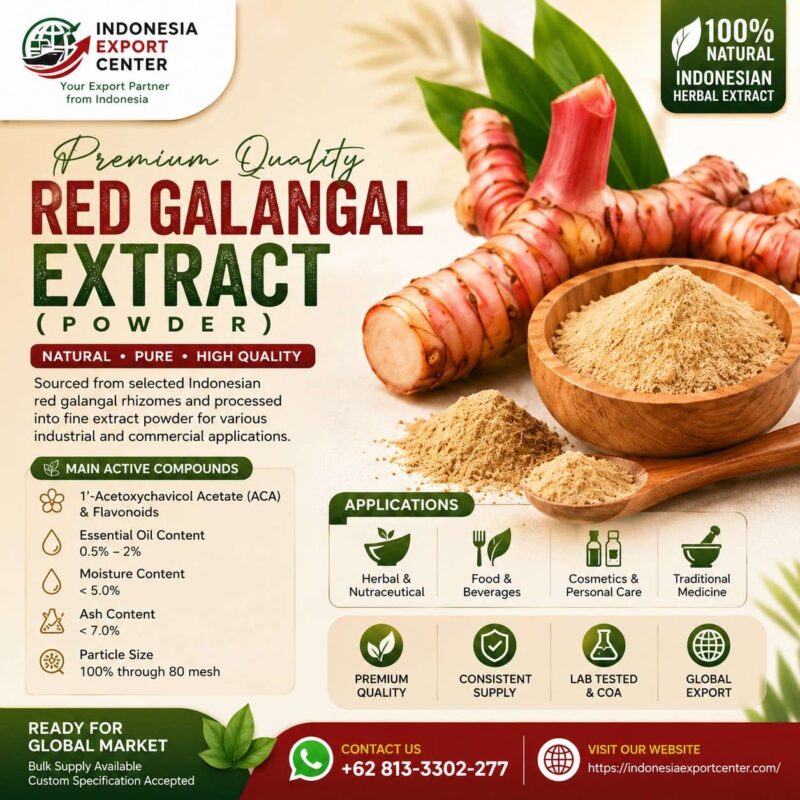
The proposed product is a powdered extract associated with Alpinia purpurata. No specific manufacturer, production capacity, inventory, or certification has been verified from the supplied information.
IEC supports sourcing inquiries and documentation requests, while final commercial offers require seller confirmation.
REQUEST SUPPLIER VERIFICATION SUPPORT
Step 1: Verify the Supplier’s Legal Identity
Buyers should establish the legal name, registered address, business registration details, and authorized commercial contacts of the potential seller.
The contracting entity should be clearly identified.
Step 2: Determine the Supplier’s Actual Role
A company may be a manufacturer, processor, trader, distributor, sourcing agent, or exporter.
These roles are not necessarily interchangeable.
Buyers should establish who manufactures the extract, who performs quality testing, and who will issue the final invoice.
Step 3: Verify Botanical Species
The proposed species is Alpinia purpurata.
Its taxonomic identity can be reviewed through Plants of the World Online.
However, the actual raw material must be authenticated.
Step 4: Confirm Plant-Part Identity
The initial product brief refers to rhizomes.
The actual plant part must be verified.
Species and plant-part information should be consistent across technical and commercial documents.
Step 5: Review Manufacturing Capability
Buyers should request relevant information about processing facilities, extraction technology, drying methods, quality controls, and production capacity.
Claims about manufacturing capability should be supported by suitable evidence.
Step 6: Review the Technical Specification
| Parameter | Proposed Reference |
|---|---|
| Product | Red Galangal Extract Powder |
| Species | Alpinia purpurata — unverified |
| Plant Part | Rhizome proposed |
| Origin | Indonesia proposed |
| Moisture | Below 5% proposed |
| Ash | Below 7% proposed |
| Particle Size | 80 mesh proposed |
| Essential Oil | 0.5–2% proposed |
| Chemical Markers | Not validated |
| Extraction Solvent | Unknown |
| MOQ | Not verified |
| Production Capacity | Not verified |
Step 7: Request Quality Documentation
| Document | Verification Purpose |
|---|---|
| Botanical Authentication | Species confirmation |
| Plant-Part Declaration | Source verification |
| TDS | Technical specification |
| Batch COA | Actual quality results |
| Composition Statement | Ingredient disclosure |
| Extraction Information | Process transparency |
| Microbiology Report | Microbial quality |
| Heavy Metal Report | Contaminant assessment |
| Residual Solvent Report | Extraction-related testing |
| Stability Data | Storage and shelf-life review |
| Traceability Records | Supply chain history |
| Relevant Certifications | Verify specific claims |
Step 8: Verify Certifications
Certification claims should be checked against actual documents, issuing organizations, scope, validity, and facility coverage.
No GMP, ISO, halal, organic, or other certification has been verified for the proposed supplier.
Step 9: Review Chain of Custody
Buyers should determine whether the supplier can connect raw material lots to production batches and finished shipments.
Step 10: Evaluate Representative Samples
A sample should be linked to appropriate batch information.
Buyers may conduct independent testing where justified.
Step 11: Review Commercial Capability
The seller should confirm MOQ, available capacity, packaging, lead time, and repeat-order conditions.
No guaranteed stock or continuous supply has been established.
Step 12: Evaluate Pricing and Payment Terms
Commercial due diligence should include clear pricing, payment instructions, seller identity, Incoterms, and quotation validity.
Payment instructions should be verified through trusted channels.
Step 13: Review Export Documentation
Buyers should determine which party is responsible for export documents, customs declarations, freight coordination, and destination-specific requirements.
Step 14: Assess Regulatory Suitability
The buyer should determine whether the actual material is suitable for the intended market and application.
No food, supplement, cosmetic, or medicinal authorization has been established.
Step 15: Establish Supplier Monitoring
Supplier qualification should not end after the first purchase.
Buyers may need ongoing review of batch consistency, changes in manufacturing, quality incidents, and commercial performance.
Common Supplier Red Flags
Potential warning signs include:
- Unclear scientific species.
- Missing plant-part information.
- Inconsistent technical documents.
- Unsupported certification claims.
- No identifiable manufacturer.
- Unverified inventory claims.
- Refusal to clarify extraction methods.
- Unclear batch traceability.
- Unexplained payment changes.
- Unrealistic commercial promises.
These issues should be investigated before proceeding.
IEC’s Role in Supplier Due Diligence
IEC can facilitate inquiries and help organize buyer requirements.
The actual supplier must substantiate technical claims and approve final commercial terms.
IEC does not guarantee that a supplier has passed a complete audit unless that assessment has actually been performed and documented.
Frequently Asked Questions
Is the proposed red galangal extract supplier verified?
No specific supplier has been verified in the provided information.
Can IEC identify the actual processor?
IEC can coordinate inquiries.
Are factory certifications available?
Availability and validity require confirmation.
Can buyers request independent laboratory testing?
Testing requirements may be discussed with potential suppliers.
Does a COA prove factory capability?
No. It provides analytical information about a sample or batch.
Can IEC guarantee commercial supply?
No. The actual seller must confirm capacity and terms.
Request Supplier Due Diligence Information
IEC welcomes inquiries from international procurement teams, ingredient distributors, quality managers, and industrial manufacturers.
REQUEST FACTORY DETAILS, BOTANICAL IDENTITY, COA & RFQ
INDONESIA EXPORT CENTER
Website: https://indonesiaexportcenter.com/
WhatsApp: +62 813-3302-277
Related pages:
- Red Galangal Extract Manufacturer Sourcing
- Red Galangal Extract Traceability
- How to Source Alpinia Purpurata Extract
SEO METADATA
SEO Title: Red Galangal Extract Supplier Due Diligence | IEC
Meta Description: Learn how to verify red galangal extract suppliers, including factory credentials, botanical identity, batch COA, traceability, production capability, and sourcing risks.
Focus Keyword: red galangal extract supplier due diligence
URL Slug: red-galangal-extract-supplier-due-diligence
Canonical URL: https://indonesiaexportcenter.com/red-galangal-extract-supplier-due-diligence/
Search Intent: Informational / Commercial
