

IEC | INDONESIA EXPORT CENTER
Extract Ratio Education • Botanical Concentration • Quality Specifications • B2B Ingredient Procurement
What Does an Extract Ratio Mean?
For botanical ingredient buyers, extract ratios such as 4:1 and 10:1 are commonly encountered in supplier catalogs and technical descriptions.
However, these numbers can be misunderstood.
For buyers researching red galangal extract ratio explained, the most important principle is that an extract ratio does not automatically establish active-compound concentration, biological potency, safety, or product quality.
Indonesia Export Center (IEC) facilitates inquiries for botanical extracts associated with Alpinia purpurata.
No verified extract ratio has been established for the proposed commercial material.
REQUEST EXTRACT RATIO AND TECHNICAL DOCUMENTATION
Understanding Drug-to-Extract Ratio
A drug-to-extract ratio, or DER, describes a relationship between the quantity of botanical starting material and the quantity of resulting extract under a defined calculation method.
The term “drug” in this technical context refers to the herbal starting material, not necessarily a pharmaceutical product.
The ratio should be interpreted according to the supplier’s documented method.
What Does 4:1 Mean?
A nominal 4:1 ratio may indicate that four parts of botanical starting material were used to produce one part of extract.
For example, a simplified theoretical calculation would be:
4 kg botanical starting material ÷ 1 kg extract = 4:1.
However, the actual meaning depends on whether the ratio refers to native extract, finished extract, or another manufacturing calculation.
What Does 10:1 Mean?
A nominal 10:1 ratio may indicate that ten parts of starting material were used to produce one part of extract.
For example:
10 kg botanical starting material ÷ 1 kg extract = 10:1.
This does not mean the extract is automatically ten times more effective than the starting material.
Extract Ratio Comparison
| Parameter | 4:1 Extract | 10:1 Extract |
|---|---|---|
| Nominal Starting Material | 4 parts | 10 parts |
| Nominal Extract Output | 1 part | 1 part |
| Active-Compound Content | Not determined by ratio alone | Not determined by ratio alone |
| Biological Potency | Not established | Not established |
| Safety | Requires evaluation | Requires evaluation |
| Quality | Requires testing | Requires testing |
| Interchangeability | Not automatic | Not automatic |
Native Extract vs Finished Extract
A native extract generally refers to the extracted material before certain added carriers or excipients, depending on the relevant technical definition.
A finished extract powder may contain carriers or processing aids.
The supplier should explain whether the stated ratio applies to the native extract or finished commercial powder.
Why Carriers Matter
Carriers can influence the finished product’s composition and the interpretation of its extract ratio.
A buyer should request a complete composition statement identifying any added materials.
Why a Higher Ratio Does Not Always Mean Better Quality
Extract quality depends on many factors, including botanical identity, plant part, raw material quality, extraction solvent, manufacturing process, chemical profile, contaminants, and stability.
A higher nominal ratio does not guarantee higher concentrations of every compound.
Extract Ratio vs Standardized Extract
A standardized extract is generally characterized by defined analytical criteria for selected constituents or markers.
An extract ratio describes a manufacturing relationship.
These are different concepts.
A 10:1 extract is not necessarily standardized, and a standardized extract is not necessarily described by a particular ratio.
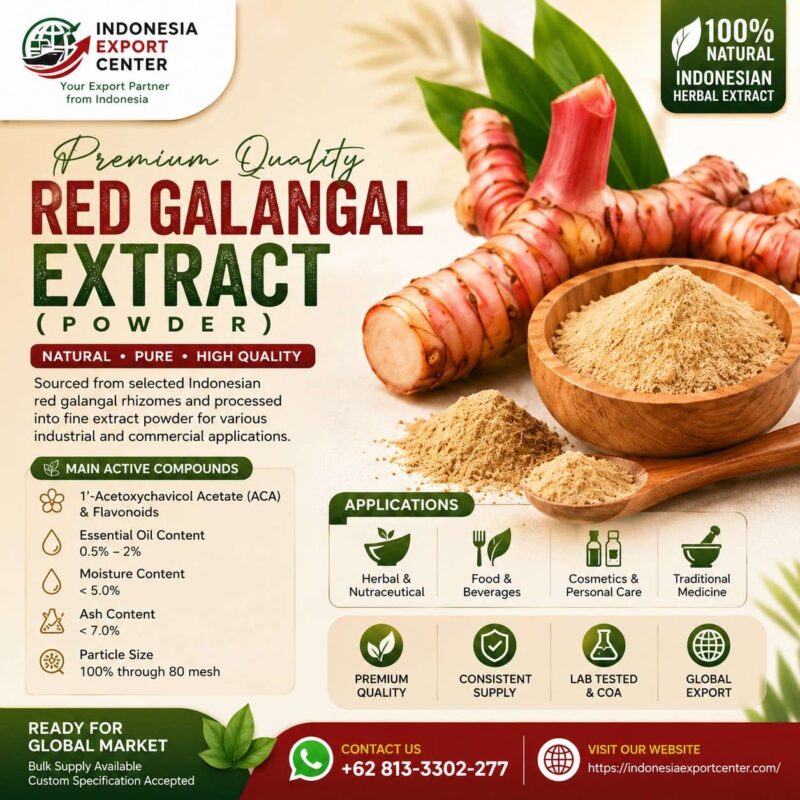
Proposed Red Galangal Extract Profile
| Parameter | Proposed Reference |
|---|---|
| Product | Red Galangal Extract Powder |
| Species | Alpinia purpurata — verification required |
| Plant Part | Rhizome proposed |
| Moisture | Below 5% proposed |
| Ash | Below 7% proposed |
| Particle Size | 80 mesh proposed |
| Essential Oil | 0.5–2% proposed |
| Extract Ratio | Not established |
| Carrier Composition | Not established |
| Marker Content | Not validated |
Chemical Marker Considerations
The initial brief mentions ACA and flavonoids.
However, their presence and concentration have not been established for the proposed extract.
A buyer should request appropriate analytical evidence rather than assuming that a nominal 10:1 ratio corresponds to a specific chemical marker level.
Questions to Ask About Extract Ratios
- What botanical species is used?
- Which plant part is extracted?
- Is the ratio based on dry starting material?
- Does it refer to native or finished extract?
- Which extraction solvent is used?
- Are carriers added?
- Is there a validated chemical marker?
- How is batch consistency controlled?
- What analytical methods are used?
- Is the ratio supported by manufacturing records?
Comparing Supplier Quotations
Two suppliers offering nominally identical extract ratios may provide different products.
Price comparisons should account for species, extraction process, composition, testing, and commercial terms.
Applications and Safety
An extract ratio does not establish eligibility for food, cosmetics, supplements, or medicinal products.
Any intended use requires appropriate technical, safety, and regulatory review.
Frequently Asked Questions
Is 10:1 stronger than 4:1?
Not necessarily. A higher nominal ratio does not establish biological potency.
Does 10:1 mean ten times the active compounds?
No.
Can extract ratios be compared across suppliers?
Only after confirming how the ratios are defined and calculated.
Is IEC’s proposed red galangal extract 10:1?
No verified extract ratio has been supplied.
Does a COA prove the extract ratio?
A COA may support selected quality parameters, but ratio claims may also require manufacturing records.
Can IEC request custom extract ratios?
IEC can forward technical requirements for supplier feasibility review.
Request Red Galangal Extract Specifications
IEC welcomes inquiries from procurement managers, botanical ingredient distributors, and formulation laboratories.
REQUEST EXTRACT RATIO, COMPOSITION, COA & QUOTATION
INDONESIA EXPORT CENTER
Website: https://indonesiaexportcenter.com/
WhatsApp: +62 813-3302-277
Related pages:
- Alpinia Purpurata Extract Specification
- Red Galangal Powder vs Extract
- Red Galangal Extract Phytochemical Profile
SEO METADATA
SEO Title: Red Galangal Extract Ratio Explained | Indonesia Export Center
Meta Description: Learn what red galangal extract ratios such as 4:1 and 10:1 mean, how native and finished extracts differ, and why ratio alone cannot prove potency or quality.
Focus Keyword: red galangal extract ratio explained
URL Slug: red-galangal-extract-ratio-explained
Canonical URL: https://indonesiaexportcenter.com/red-galangal-extract-ratio-explained/
Search Intent: Informational / Commercial
