

IEC | INDONESIA EXPORT CENTER
Botanical Ingredient Research | Nutraceutical Formulation | Analytical Qualification | Supplier Sourcing
Evaluating Red Galangal Extract for Nutraceutical Research and Development
Nutraceutical product development requires careful evaluation of ingredient identity, composition, safety, manufacturing quality, and regulatory status.
For research teams exploring red galangal extract for nutraceutical R&D, an important distinction must be made between a botanical material that is scientifically interesting and an ingredient that is suitable for commercial supplement production.
The proposed ingredient is associated with Alpinia purpurata, a species in the Zingiberaceae family. Its identity must be verified because the common name red galangal can be associated with different botanical materials.
Indonesia Export Center (IEC) facilitates sourcing inquiries for potential Indonesian botanical ingredients, helping international buyers request technical information, research samples, and supplier-approved quotations.
IEC does not claim that the proposed extract has established nutritional benefits, clinical efficacy, or approval for dietary supplement use.
REQUEST NUTRACEUTICAL RESEARCH INGREDIENT INFORMATION
Botanical Identity and Research Relevance
The proposed scientific name is Alpinia purpurata.
Reference: Plants of the World Online.
Researchers should distinguish this species from other plants in the Alpinia genus.
Scientific findings associated with another species should not automatically be attributed to Alpinia purpurata.
The proposed plant part is the rhizome, but this must be confirmed through supplier documentation.
Preliminary Ingredient Specification
| Parameter | Proposed Information |
|---|---|
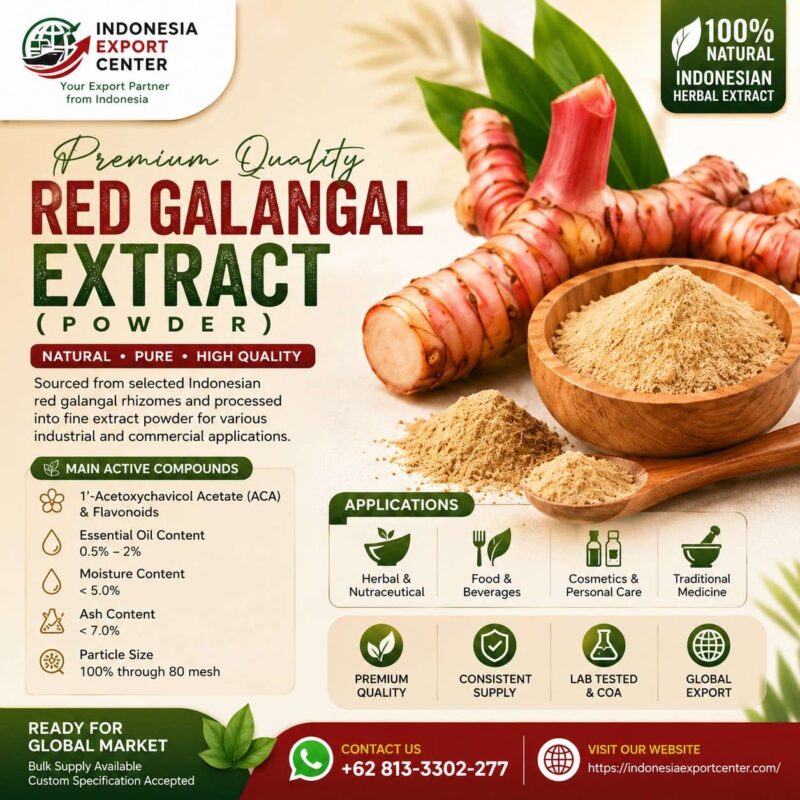
| Ingredient | Red Galangal Extract Powder |
| Botanical Species | Alpinia purpurata |
| Proposed Origin | Indonesia |
| Plant Part | Rhizome; unverified |
| Physical Form | Fine extract powder |
| Moisture | Below 5% proposed |
| Ash | Below 7% proposed |
| Particle Size | 80 mesh proposed |
| Essential Oil | 0.5–2% proposed |
| ACA and Flavonoids | Mentioned; relevance unverified |
| Extract Ratio | Not established |
| Standardization | Not established |
| Nutraceutical Suitability | Requires assessment |
| Commercial Availability | Not verified |
Research Objectives
Nutraceutical R&D teams may investigate botanical composition, analytical methods, formulation behavior, stability, and relevant biological properties.
Any research involving biological activity should use appropriately designed experiments and distinguish exploratory findings from established health benefits.
The supplied product information does not support claims of disease prevention, treatment, or clinical efficacy.
Ingredient Authentication
The first stage of research should establish the correct species and plant part.
Where appropriate, authentication may involve botanical records, voucher specimens, chemical fingerprinting, or molecular identification.
A supplier’s marketing description alone is not sufficient for rigorous research.
Phytochemical Characterization
Researchers may use suitable analytical techniques to characterize the extract.
Potential methods include HPLC, LC-MS, GC-MS, and other techniques selected according to the target compounds.
The source brief mentions ACA and flavonoids, but no validated assay or marker specification has been supplied for the proposed material.
Extract Ratio and Standardization
A declared extract ratio may help describe the manufacturing process, but it does not prove the concentration of any specific compound.
If a standardized ingredient is required, the buyer should define the marker, test method, units, and acceptance criteria.
No standardized commercial grade has been verified.
Formulation Research
Capsules
Research may consider powder flow, bulk density, moisture sensitivity, and compatibility with capsule materials.
Tablets
Tablet development may require compressibility testing, blend uniformity, and evaluation of excipient compatibility.
Powdered Formulations
Powder blends may require evaluation of particle size, segregation, and stability.
Liquid Systems
Liquid formulation feasibility depends on the extract’s actual solubility or dispersibility.
No water-soluble grade has been confirmed.
Stability and Shelf-Life Research
Researchers may investigate the stability of the ingredient under defined temperature, humidity, light, and packaging conditions.
Relevant parameters may include chemical marker retention, moisture, appearance, odor, and microbiological quality.
No validated shelf life is available.
Safety Assessment
Nutraceutical ingredient evaluation may require toxicological review, impurity testing, exposure assessment, and consideration of potential interactions.
The required evidence depends on the ingredient and intended market.
No safe intake level or recommended dosage can be established from the supplied information.
Regulatory Considerations
Dietary supplement and nutraceutical regulations vary across countries.
Buyers should verify whether the ingredient is permitted for the intended use and whether additional safety submissions, notifications, registrations, or manufacturing controls apply.
Botanical origin does not automatically establish regulatory acceptance.
Quality Documentation
| Document | Purpose |
|---|---|
| Botanical Identity | Species verification |
| Plant-Part Declaration | Raw material definition |
| TDS | Technical specification |
| Batch COA | Analytical results |
| Extract Ratio Statement | Processing characterization |
| Composition Statement | Ingredient disclosure |
| Chemical Fingerprint | Batch characterization |
| Microbiology | Quality assessment |
| Heavy Metals | Contaminant assessment |
| Residual Solvents | Extraction-related control |
| Stability Data | Storage and shelf-life planning |
| Safety Documentation | Toxicological review |
From R&D to Commercial Production
A successful research project should be followed by supplier qualification, commercial-batch testing, specification approval, regulatory review, and manufacturing feasibility assessment.
A laboratory sample does not guarantee commercial-scale availability.
IEC can coordinate sourcing inquiries during this process.
Frequently Asked Questions
Is red galangal extract a clinically proven nutraceutical ingredient?
No clinical efficacy evidence has been supplied for the proposed product.
Can the extract be used in dietary supplements?
Regulatory eligibility and safety must be established.
Is an ACA-standardized grade available?
No verified standardized grade has been confirmed.
Can IEC arrange laboratory samples?
IEC can facilitate sample requests, subject to supplier availability.
Is a recommended daily intake available?
No verified dosage information has been provided.
Can buyers request custom extract specifications?
Requirements can be submitted for supplier feasibility assessment.
Request Nutraceutical R&D Material
IEC welcomes inquiries from nutraceutical research teams, supplement formulators, contract manufacturers, and botanical ingredient distributors.
Please provide your research objective, required material, target specification, quantity, and destination.
REQUEST RESEARCH SAMPLE, TDS, COA, SAFETY INFORMATION & RFQ
INDONESIA EXPORT CENTER
Website: https://indonesiaexportcenter.com/
WhatsApp: +62 813-3302-277
Related pages:
- Red Galangal Extract for Herbal Formulations
- Red Galangal Extract Phytochemical Profile
- Alpinia Purpurata Extract Quality Testing
SEO METADATA
SEO Title: Red Galangal Extract for Nutraceutical R&D | IEC
Meta Description: Explore red galangal extract for nutraceutical R&D. Review botanical authentication, analytical characterization, formulation, safety, regulatory screening, and sourcing.
Focus Keyword: red galangal extract for nutraceutical r&d
URL Slug: red-galangal-extract-nutraceutical-rd
Canonical URL: https://indonesiaexportcenter.com/red-galangal-extract-nutraceutical-rd/
Search Intent: Commercial / Technical
