

IEC | INDONESIA EXPORT CENTER
Herbal Ingredient Research | Botanical Formulation Development | Quality Documentation | B2B Procurement
Evaluating Red Galangal Extract for Herbal Product Development
Herbal product manufacturers increasingly require botanical ingredients with clear identity, reproducible specifications, and appropriate safety documentation.
For companies investigating red galangal extract for herbal formulations, the first challenge is determining whether the proposed botanical material is suitable for the intended product category.
The supplied concept refers to Alpinia purpurata extract powder. Although the species belongs to the ginger family, it must not be assumed to have the same traditional uses, chemical composition, or safety profile as other galangal species.
Indonesia Export Center (IEC) facilitates inquiries with potential Indonesian botanical ingredient suppliers, helping buyers request technical documents, samples, and commercial information.
IEC does not claim that the proposed extract is approved for herbal medicinal products, dietary supplements, or any particular therapeutic application.
REQUEST HERBAL FORMULATION INGREDIENT INFORMATION
Botanical Identity and Product Definition
The proposed species is Alpinia purpurata.
Its botanical identity can be reviewed through Plants of the World Online.
However, the actual ingredient must be authenticated separately.
The plant part, extraction method, carrier ingredients, and chemical composition should be documented before formulation research begins.
Preliminary Ingredient Reference
| Parameter | Proposed Information |
|---|---|
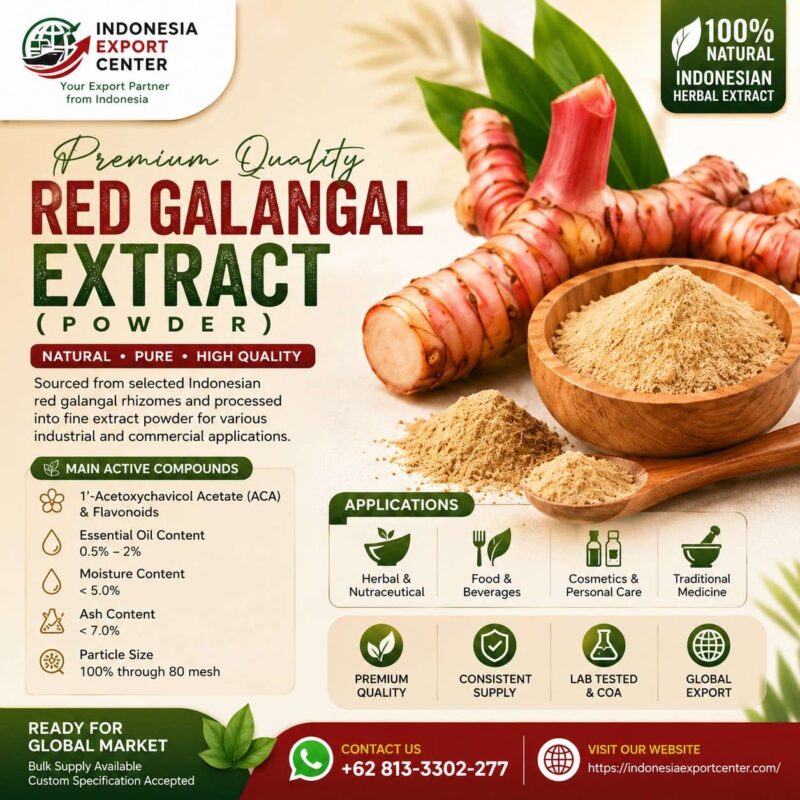
| Ingredient | Red Galangal Extract Powder |
| Proposed Species | Alpinia purpurata |
| Proposed Origin | Indonesia |
| Plant Part | Rhizome; unverified |
| Physical Form | Fine extract powder |
| Moisture | Below 5% target |
| Ash | Below 7% target |
| Particle Size | 80 mesh target |
| Essential Oil | 0.5–2% target |
| Marker Compounds | Not validated |
| Extract Ratio | Not established |
| Safety Status | Requires evaluation |
| Regulatory Status | Market-specific; unverified |
Defining the Intended Herbal Product
The regulatory requirements for an herbal ingredient depend heavily on how the finished product will be marketed.
A botanical material intended for research is not necessarily suitable for a food supplement or herbal medicinal product.
Similarly, a traditional-use claim does not automatically establish regulatory authorization.
Buyers should identify the destination country and intended product classification before selecting a supplier.
Potential Formulation Formats
Capsules
Capsule development may require evaluation of powder flow, bulk density, moisture, particle size, and compatibility with excipients.
No verified flowability or density information is available.
Tablets
Tablet formulations may require additional evaluation of compressibility, blending uniformity, and interactions with binders or disintegrants.
A botanical extract powder cannot be assumed suitable for direct compression.
Powder Blends
Powder blends require assessment of particle size distribution, segregation risk, stability, and ingredient compatibility.
Liquid Herbal Formulations
Liquid applications depend on the extract’s actual solubility or dispersibility.
No water-solubility claim has been verified.
Extract Standardization
An herbal formulation may require a defined extract ratio, chemical fingerprint, or validated marker assay.
The source brief mentions ACA and flavonoids, but their suitability as markers for the proposed Alpinia purpurata material remains unverified.
Buyers should request analytical evidence before establishing a standardization claim.
Safety and Toxicological Evaluation
A suitable safety assessment may consider:
- Correct species identification.
- Plant-part-specific composition.
- Extraction solvent and residues.
- Exposure level.
- Relevant toxicological evidence.
- Potential impurities.
- Microbiological quality.
- Heavy metals and pesticides.
- Intended consumer population.
- Potential interactions and contraindications where supported by evidence.
No safe dosage or therapeutic indication can be established from the current product brief.
Regulatory Screening
Herbal products may be regulated as supplements, traditional medicines, herbal medicinal products, or other categories depending on the market.
Requirements may involve ingredient eligibility, manufacturing standards, safety evidence, product registration, labeling, and restrictions on claims.
The manufacturer and importer should verify applicable rules before commercializing the formulation.
Quality Documentation
| Document | Purpose |
|---|---|
| Botanical Identity | Species verification |
| Plant-Part Declaration | Raw material identification |
| TDS | Ingredient specification |
| Batch COA | Analytical conformity |
| Extraction Process Description | Manufacturing characterization |
| Composition Statement | Ingredient disclosure |
| Safety Information | Risk assessment |
| Microbiological Results | Quality control |
| Heavy Metal Results | Contaminant evaluation |
| Residual Solvent Results | Extraction-related control |
| Stability Information | Shelf-life planning |
| Regulatory Documents | Market-specific assessment |
Formulation Development Workflow
A practical development process begins with botanical verification and technical documentation.
The next stages may involve sample testing, formulation trials, stability studies, safety assessment, and regulatory review.
Only after these steps should a manufacturer consider commercial purchasing.
The exact process depends on the product category and applicable requirements.
Supplier Qualification
Potential suppliers should be evaluated for raw material authentication, extraction capability, quality control, documentation, batch consistency, and traceability.
IEC can coordinate inquiries but does not guarantee that an appropriate manufacturer has already been identified.
Frequently Asked Questions
Is Alpinia purpurata extract approved for herbal supplements?
No market-specific approval has been established.
Can the extract be used in capsules?
Formulation feasibility and regulatory suitability require evaluation.
Is there a recommended dosage?
No verified dosage information is available.
Is the extract standardized for ACA?
No validated standardization has been provided.
Can IEC request samples for herbal R&D?
Yes, subject to supplier availability.
Does traditional botanical use prove safety?
No. Safety must be evaluated for the actual ingredient and intended use.
Request Herbal Ingredient Sourcing
Provide your intended product category, destination market, formulation format, technical specification, quantity, and documentation requirements.
REQUEST BOTANICAL IDENTITY, TDS, COA, SAMPLE & RFQ
INDONESIA EXPORT CENTER
Website: https://indonesiaexportcenter.com/
WhatsApp: +62 813-3302-277
Related pages:
- Red Galangal Extract for Nutraceutical R&D
- Alpinia Purpurata Extract Specification
- Red Galangal Extract COA Requirements
SEO METADATA
SEO Title: Red Galangal Extract for Herbal Formulations | IEC
Meta Description: Explore red galangal extract for herbal formulation R&D, including botanical identity, ingredient specifications, safety, regulatory screening, and B2B sourcing.
Focus Keyword: red galangal extract for herbal formulations
URL Slug: red-galangal-extract-herbal-formulations
Canonical URL: https://indonesiaexportcenter.com/red-galangal-extract-herbal-formulations/
Search Intent: Commercial / Technical
