

IEC | INDONESIA EXPORT CENTER
Certificate of Analysis | Botanical Authentication | Batch Testing | Quality Assurance
What Should a Red Galangal Extract COA Include?
A Certificate of Analysis is an important document for verifying whether a botanical ingredient batch meets an agreed quality specification.
For buyers reviewing red galangal extract COA requirements, the central question is whether the reported results establish the identity, composition, and quality of the actual material being purchased.
The proposed product is a powdered botanical extract associated with Alpinia purpurata. Since common galangal names can refer to different species, botanical identity should be established before relying on chemical or physical test results.
Indonesia Export Center facilitates supplier inquiries and helps international buyers request available quality documentation.
REQUEST RED GALANGAL EXTRACT COA
What Is a Batch Certificate of Analysis?
A COA reports analytical results for an identified batch or sample.
A useful document should include the product name, batch number, relevant tests, results, units, methods, acceptance limits, and responsible issuing party.
A generic marketing specification should not be presented as a batch-specific COA.
Recommended COA Review Table
| Parameter | What to Verify |
|---|---|
| Product Identity | Correct ingredient description |
| Botanical Name | Alpinia purpurata authentication |
| Plant Part | Rhizome or other declared part |
| Batch Number | Traceable identification |
| Appearance | Defined acceptance criteria |
| Moisture | Result against approved limit |
| Ash | Result against approved limit |
| Particle Size | Method and sieve result |
| Essential Oil | Method, units, and result |
| Marker Compounds | Validated marker and assay |
| Microbiology | Applicable results |
| Heavy Metals | Relevant contaminant results |
| Pesticide Residues | Applicable screening |
| Residual Solvents | Solvent-specific results where relevant |
| Test Date | Appropriate testing period |
| Issuing Party | Supplier or laboratory identity |
Preliminary Quality Targets
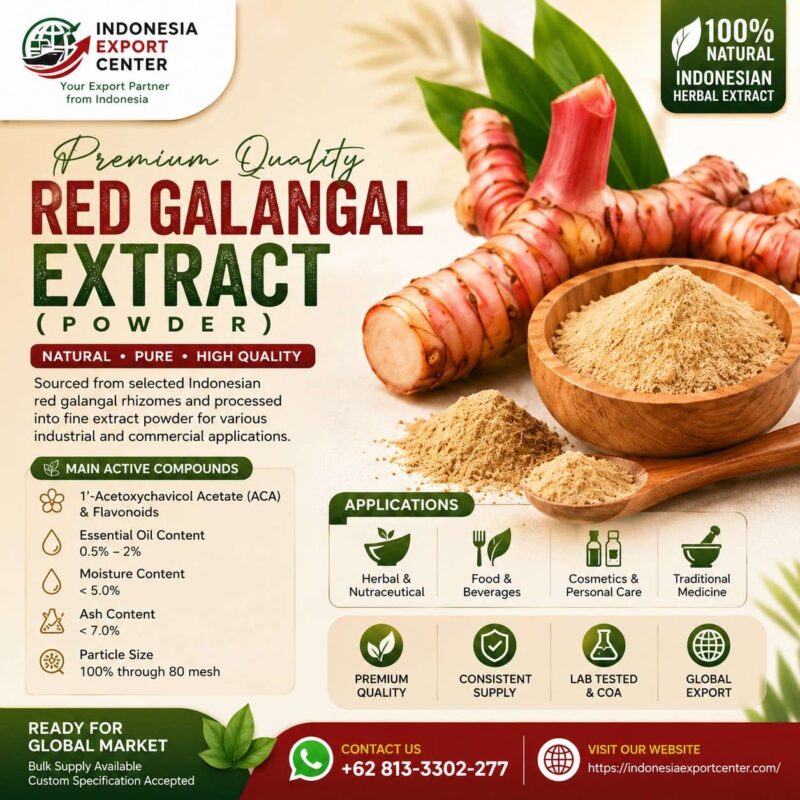
The source brief proposes moisture below 5%, ash below 7%, 100% passage through 80 mesh, and essential oil content of 0.5–2%.
These values are not confirmed batch results.
The brief also mentions ACA and flavonoids. Their analytical relevance to the requested species must be established before they are used as acceptance criteria.
Botanical Identity Testing
A COA should not rely solely on the common name “red galangal.”
The buyer should request supporting botanical identity documentation.
The accepted species name can be reviewed through Plants of the World Online, but the commercial material still requires authentication.
Reviewing Moisture and Ash
The COA should report actual results using identified methods.
If the agreed specification requires moisture below 5%, the reported result should be evaluated against that limit.
The same principle applies to ash and other physical parameters.
Chemical Markers and Essential Oil
A reported chemical marker is meaningful only when its identity, analytical method, reporting basis, and acceptance criteria are clear.
Buyers should not assume that ACA is a validated marker for the proposed extract without supporting evidence.
Essential oil content also requires a defined test method.
Microbiological and Contaminant Testing
Relevant microbiological, heavy metal, pesticide, and solvent tests should be selected according to the product and intended use.
A COA does not automatically establish that a material is approved for food, supplement, cosmetic, or pharmaceutical applications.
How to Verify a COA
- Match the product name to the purchase specification.
- Confirm the botanical species and plant part.
- Check the batch number.
- Review the test methods.
- Confirm units and reporting basis.
- Compare results with agreed limits.
- Verify the issuing laboratory or responsible party.
- Investigate missing or inconsistent results.
- Confirm that the tested batch corresponds to the shipment.
- Consider independent testing when appropriate.
COA vs TDS
The TDS describes the product’s intended specification.
The COA reports actual analytical results for a specific batch or sample.
A complete supplier qualification process may require both.
Frequently Asked Questions
Is a COA available for the proposed product?
No verified batch COA has been supplied.
Does a COA prove the botanical species?
Not necessarily. Supporting identity evidence may be required.
Can a COA confirm ACA content?
Only if a suitable analytical method and relevant test result are provided.
Should buyers request third-party testing?
Independent testing may be appropriate based on risk and procurement requirements.
Can IEC coordinate COA requests?
Yes, subject to supplier document availability.
Request Quality Documentation
IEC welcomes inquiries from quality assurance managers, importers, distributors, and industrial buyers.
REQUEST BATCH COA, TDS, TEST REPORTS & RFQ
INDONESIA EXPORT CENTER
Website: https://indonesiaexportcenter.com/
WhatsApp: +62 813-3302-277
Related pages:
SEO METADATA
SEO Title: Red Galangal Extract COA Requirements | IEC
Meta Description: Learn red galangal extract COA requirements, including botanical identity, batch traceability, moisture, ash, particle size, marker testing, and contaminants.
Focus Keyword: red galangal extract coa requirements
URL Slug: red-galangal-extract-coa-requirements
Canonical URL: https://indonesiaexportcenter.com/red-galangal-extract-coa-requirements/
Search Intent: Commercial / Transactional
