

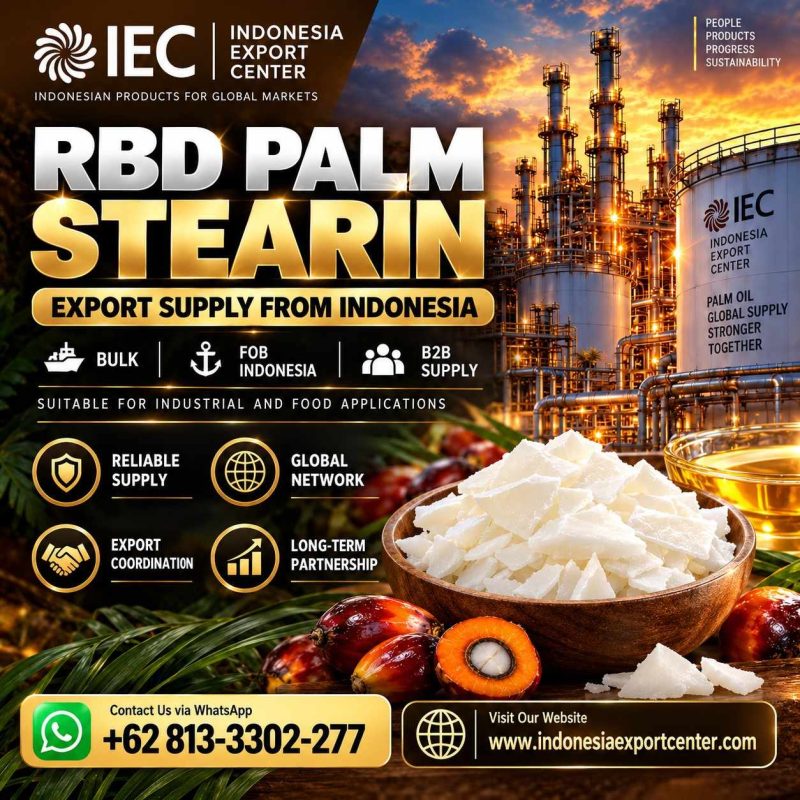
Palm Stearin for Industrial Fat Formulation
Manufacturers of margarine, shortening, bakery fats and specialty fat blends require ingredients with carefully controlled physical and chemical properties.
RBD Palm Stearin may be evaluated as a higher-melting component in selected fat formulations. Its potential contribution to firmness and fat structure makes it relevant to manufacturers developing products with specific melting and texture requirements.
Indonesia Export Center (IEC) facilitates B2B inquiries for Indonesian RBD Palm Stearin, including technical specification requests, supplier identification and export quotation coordination.
Food-grade suitability and application performance must be verified for the actual supplier grade.
What Is RBD Palm Stearin?
RBD Palm Stearin is a fraction of refined, bleached and deodorized palm oil.
During fractionation, palm oil is separated into fractions with different physical characteristics. Palm stearin is the relatively higher-melting fraction, while palm olein is the more liquid fraction.
The composition and melting behaviour of palm stearin depend on the fractionation process and grade.
This distinction matters for food manufacturers because fat functionality cannot be predicted from the product name alone.
Preliminary Product Information
| Parameter | Information |
|---|---|
| Product | RBD Palm Stearin |
| Origin | Indonesia |
| Product type | Higher-melting palm oil fraction |
| Indicative iodine value | Typically up to 48, depending on grade |
| FFA | Supplier specification required |
| Moisture and impurities | Supplier specification required |
| Slip melting point | Supplier data required |
| Solid fat content | Temperature-specific supplier data required |
| Fatty acid profile | Supplier data required |
| Food-grade status | Must be verified |
| MOQ and packaging | Subject to confirmation |
Application in Margarine Manufacturing
Margarine is a formulated product whose characteristics depend on the complete fat blend, water phase, emulsification process and manufacturing conditions.
Palm stearin may be evaluated as a structuring component.
Important formulation objectives can include:
- Desired firmness at refrigeration temperature.
- Suitable spreadability.
- Controlled melting characteristics.
- Stable texture during storage.
- Appropriate crystallization behaviour.
- Consistent processing performance.
A higher-melting ingredient does not automatically produce the desired margarine texture.
Manufacturers should examine the complete solid fat content curve and conduct controlled trials.
Application in Shortening Production
Shortening manufacturers may evaluate palm stearin when developing fats for bakery and food-processing applications.
Shortening functionality may depend on plasticity, crystal structure, melting behaviour and compatibility with other fats.
Potential applications include selected bakery shortenings, pastry fats and industrial fat blends.
However, the performance requirements for cookies, cakes, pastries and laminated doughs can differ substantially.
The appropriate grade should be selected according to the finished product.
Why Solid Fat Content Matters
Solid fat content, commonly abbreviated SFC, describes the proportion of solid fat at specified temperatures.
A single melting point does not describe the complete behaviour of a fat.
Manufacturers may need SFC results at several temperatures relevant to processing, storage and consumption.
The appropriate temperature points and test methods should be agreed with the supplier.
Crystallization and Texture
Fat crystallization influences the structure of many margarine and shortening products.
Important factors include cooling rate, mixing, formulation and the presence of other ingredients.
Palm stearin should be evaluated within the intended manufacturing process.
No specific crystal form, texture or shelf-life performance is guaranteed by the product description.
Technical Data to Request
| Technical Parameter | Why It Matters |
|---|---|
| Iodine value | Grade characterization |
| FFA | Quality control |
| Moisture and impurities | Raw material quality |
| Slip melting point | Melting behaviour |
| SFC curve | Formulation design |
| Fatty acid profile | Ingredient composition |
| Peroxide value | Oxidation assessment |
| Colour and odour | Finished-product considerations |
| Relevant contaminants | Food safety compliance |
| Batch COA | Shipment quality verification |
Food Safety and Regulatory Considerations
Food manufacturers should confirm the applicable food safety requirements in their destination market.
Depending on the buyer’s needs, documentation may include the supplier’s food safety management information, analytical test reports and relevant certifications.
No Halal, HACCP, RSPO or other certification should be assumed without current evidence covering the appropriate product and facility.
Supplier Qualification Process
A structured evaluation may involve:
- Confirming the actual supplier and producing facility.
- Reviewing the TDS.
- Requesting an available COA.
- Checking food-grade suitability.
- Reviewing SFC and melting data.
- Obtaining a representative sample where feasible.
- Conducting laboratory formulation trials.
- Evaluating finished-product texture.
- Checking storage performance.
- Confirming bulk supply and commercial terms.
Packaging and Shipping
Packaging and shipping arrangements should reflect the product’s physical characteristics.
Buyers may investigate suitable bulk arrangements or supplier-approved packaging.
Temperature management, pumping, cargo cleanliness and discharge requirements should be reviewed before contracting.
Food-Grade RFQ Template
Subject: RBD Palm Stearin for Margarine and Shortening – Technical Quotation
Company: [Company]
Country: [Country]
Application: [Margarine / Shortening / Specialty Fat]
Required iodine value: [Range]
Required slip melting point: [Range]
Required SFC data: [Temperatures]
Other quality requirements: [Details]
Quantity: [MT]
Packaging: [Preferred Format]
Destination port: [Port]
Incoterm: [FOB / CFR / CIF]
Please advise suitable grades, available technical documentation, sample feasibility, MOQ and current quotation.
Frequently Asked Questions
Is RBD Palm Stearin suitable for margarine?
Selected grades may be suitable as components of a formulated fat blend, subject to testing.
Can it be used for shortening?
It may be evaluated for suitable shortening formulations.
Is iodine value enough to select a grade?
No. Melting characteristics, SFC and other parameters may be essential.
Is every RBD Palm Stearin food-grade?
Food-grade suitability must be verified.
Can IEC guarantee specific formulation performance?
No. Manufacturers must conduct application trials.
Can buyers request a current COA?
IEC can facilitate the request, subject to supplier availability.
Request Food-Grade RBD Palm Stearin Quotation
Indonesia Export Center welcomes inquiries from margarine factories, shortening manufacturers, bakery ingredient suppliers and specialty fat processors.
Indonesia Export Center (IEC)
Website: https://indonesiaexportcenter.com/
Email: info@indonesiaexportcenter.com
WhatsApp: +62 813-3302-277
Food-grade status, technical properties, certification, packing, quantity and shipment terms require supplier confirmation.
Related Resources
RBD Palm Stearin Bulk Supplier Indonesia
RBD Palm Oil for Margarine Manufacturing
