

RBD Palm Olein CP8 vs CP10 Comparison – Technical Specifications, Differences & Buyer Guide
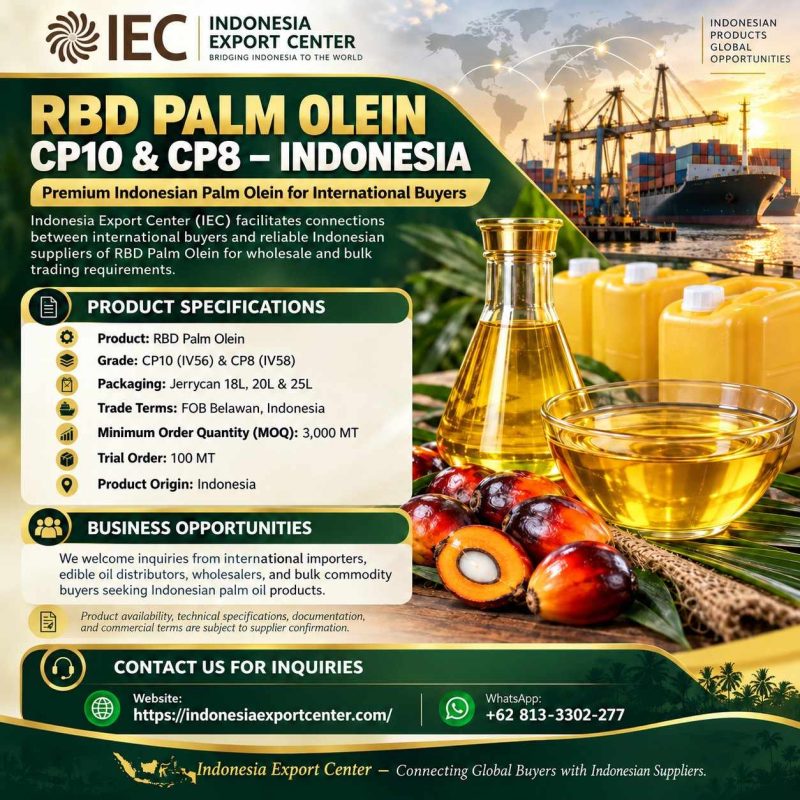
Premium Indonesian RBD Palm Olein CP8 (IV58) & CP10 (IV56) for International Buyers
Are you comparing RBD Palm Olein CP8 vs CP10 for cooking oil distribution, food manufacturing, or bulk import requirements?
Understanding the technical differences between CP8 and CP10 is essential for selecting the appropriate refined palm olein grade for your market, manufacturing process, and quality standards.
Indonesia Export Center (IEC) connects international buyers with Indonesian suppliers offering RBD Palm Olein CP8 (IV58) and CP10 (IV56) for wholesale and bulk trading requirements.
Our sourcing facilitation services support importers, procurement managers, edible oil distributors, and food manufacturers seeking Indonesian palm olein products.
What Is RBD Palm Olein?
RBD Palm Olein is the liquid fraction of palm oil produced through refining and fractionation.
RBD stands for:
- Refined: Processing to remove undesirable impurities and reduce free fatty acids.
- Bleached: Treatment to reduce pigments and certain impurities.
- Deodorized: Processing to remove unwanted odors and volatile substances.
RBD Palm Olein is widely used in cooking oil production, commercial frying, food processing, and edible oil distribution.
Two commonly traded commercial grades are CP8 and CP10.
The primary differences relate to cloud point, iodine value, and performance at lower temperatures.
RBD Palm Olein CP8 vs CP10 – Technical Comparison
The following comparison helps international buyers evaluate the two grades.
| Technical Parameter | RBD Palm Olein CP8 | RBD Palm Olein CP10 |
|---|---|---|
| Product Type | Refined Palm Olein | Refined Palm Olein |
| Cloud Point | Maximum 8°C | Maximum 10°C |
| Iodine Value (IV) | Target IV58 | Target IV56 |
| Free Fatty Acids (FFA) | Commonly max. 0.10% | Commonly max. 0.10% |
| Moisture & Impurities | Commonly max. 0.10% | Commonly max. 0.10% |
| Color (Lovibond 5¼”) | Commonly max. 3.0 Red | Commonly max. 3.0 Red |
| Low-Temperature Clarity | Better | Standard |
| Typical Applications | Premium liquid cooking oil, food processing | General cooking oil, frying, food processing |
| Relative Pricing | Often higher | Often more economical |
| Country of Origin | Indonesia | Indonesia |
Important: These are indicative market specifications, not a supplier-certified product specification. CP8 iodine value requirements can vary between suppliers, including minimum IV57 or IV58. Buyers requiring IV58 should specify that minimum explicitly in their purchase contract and request a supplier Certificate of Analysis (COA).
1. Cloud Point – The Main Difference Between CP8 and CP10
Cloud point is one of the most important technical parameters used to classify commercial RBD Palm Olein.
It represents the temperature at which visible cloudiness develops under a defined testing procedure as higher-melting components begin to crystallize.
RBD Palm Olein CP8
CP8 has a maximum cloud point of 8°C.
It is generally more suitable for applications requiring improved clarity at lower temperatures.
RBD Palm Olein CP10
CP10 has a maximum cloud point of 10°C.
It is widely used for general-purpose cooking oil and commercial frying applications, especially in markets where low-temperature clarity is less critical.
Buyer Recommendation: Choose CP8 when lower-temperature clarity is an important purchasing requirement. Choose CP10 when standard liquid cooking oil performance is sufficient.
A cloud point specification does not guarantee that oil will remain completely clear at every temperature above or below the stated value. Actual performance depends on composition, temperature history, and storage conditions.
2. Iodine Value (IV56 vs IV58)
Iodine Value measures the degree of unsaturation in oils and fats.
For the grades offered through IEC’s supplier network, the commercial references are:
- CP8: IV58
- CP10: IV56
CP8 generally has a higher iodine value, reflecting a greater degree of unsaturation.
CP10 has a slightly lower iodine value and is commonly selected for standard edible oil applications.
For procurement and quality control purposes, buyers should confirm whether the iodine value represents a minimum contractual limit or another agreed specification.
Iodine value alone should not be used to determine frying stability, shelf life, or overall product quality.
3. Free Fatty Acid (FFA) and Moisture Specifications
Both CP8 and CP10 are refined edible oil products.
Two important quality control parameters are free fatty acids and moisture and impurities.
Free Fatty Acids (FFA)
FFA indicates the level of free fatty acids present in the oil.
A common commercial specification for both grades is:
FFA: Maximum 0.10%, expressed as palmitic acid.
Moisture and Impurities
Moisture and impurities are monitored to support consistent product quality and handling.
A common specification is:
Moisture & Impurities: Maximum 0.10%.
Actual parameters must be confirmed through the supplier’s technical data sheet and shipment-specific documentation.
4. Which Is Better for Cooking Oil Manufacturing?
Both CP8 and CP10 can be suitable for cooking oil manufacturing, depending on the target market.
Advantages of CP8
- Improved low-temperature clarity
- Appropriate for markets with stricter cloud point requirements
- Suitable for selected bottled cooking oil applications
- Higher targeted iodine value for the IV58 grade
Advantages of CP10
- Suitable for general-purpose cooking oil
- Widely applicable to frying and food processing
- Often offers a more economical sourcing option
- Appropriate where a maximum 10°C cloud point satisfies product requirements
Conclusion: Neither grade is universally superior. The better choice depends on the technical specifications, intended application, destination-market requirements, and procurement budget.
5. Industrial Applications of RBD Palm Olein CP8 and CP10
Indonesian RBD Palm Olein is sourced for numerous commercial and industrial applications.
Cooking Oil Distribution
Suitable for importers and wholesalers supplying edible vegetable oil to commercial customers.
Food Manufacturing
Used in various food processing operations, subject to the specific formulation and production requirements.
Commercial Frying
Commonly used in frying applications for restaurants, catering operations, and food service businesses.
Snack and Instant Noodle Production
Palm olein can be used for frying operations in snack and instant noodle manufacturing.
Private Label Cooking Oil
Importers may evaluate appropriate grades for private-label cooking oil products, subject to supplier packing capabilities, labeling requirements, and regulatory compliance.
6. Indonesian RBD Palm Olein – Available Commercial Specifications
Indonesia Export Center facilitates sourcing inquiries for the following grades and supply conditions.
| Product Information | Specifications |
|---|---|
| Product | RBD Palm Olein |
| Available Grades | CP10 (IV56) & CP8 (IV58) |
| Product Origin | Indonesia |
| Packaging | Jerrycan 18L, 20L & 25L |
| Trade Terms | FOB Belawan, Indonesia |
| Minimum Order Quantity (MOQ) | 3,000 Metric Tons |
| Trial Order | 100 Metric Tons |
| Target Buyers | International Importers, Wholesalers, Distributors, Industrial Buyers |
| Availability | Subject to Supplier Confirmation |
Packaging arrangements, technical requirements, shipment schedules, and additional commercial conditions must be confirmed before concluding a transaction.
7. Packaging Options for International Buyers
Available packaging references include:
- 18 Liter Jerrycan: For wholesale edible oil distribution.
- 20 Liter Jerrycan: For food service and commercial distribution.
- 25 Liter Jerrycan: For larger-volume wholesale and institutional buyers.
Packaging materials, loading quantities, product labeling, and container configuration should be confirmed with the supplier.
International buyers should also verify destination-country requirements for food-contact packaging and labeling.
8. FOB Belawan – Export Supply from Indonesia
The stated commercial trade term for the referenced supply is FOB Belawan, Indonesia.
Under FOB terms, the seller is responsible for delivering the goods on board the vessel nominated by the buyer at the agreed port of shipment, in accordance with the applicable contractual Incoterms rules.
The buyer generally arranges and pays for the main ocean freight and cargo insurance.
For bulk orders, buyers should confirm:
- Shipment quantity and loading schedule
- Product grade and technical specifications
- Packaging configuration
- Port of discharge
- Inspection and documentation requirements
- Payment terms
- Export and import regulatory requirements
Specific shipment and commercial arrangements remain subject to supplier confirmation.
9. Quality Control Checklist for Technical Buyers
Before purchasing RBD Palm Olein CP8 or CP10, procurement and quality assurance teams should verify the following requirements.
Cloud Point: Confirm maximum 8°C for CP8 or maximum 10°C for CP10.
Iodine Value: Confirm the contractual iodine value requirement, including IV58 for the requested CP8 grade and IV56 for CP10.
FFA: Verify the agreed maximum free fatty acid specification.
Moisture & Impurities: Ensure laboratory results comply with the purchase contract.
Color: Review Lovibond color specifications and test results.
Product Documentation: Request applicable Technical Data Sheets, Certificates of Analysis, and other required quality documents.
Inspection: Agree whether pre-shipment inspection or independent testing is required.
Regulatory Compliance: Verify food safety, labeling, and import requirements in the destination country.
Additional testing for peroxide value, contaminants, and other relevant quality indicators may be necessary depending on the application and local regulations.
10. Why Source RBD Palm Olein from Indonesia?
Indonesia is a major global producer of palm oil and refined palm oil products.
International buyers source Indonesian RBD Palm Olein for its established production base, available commercial grades, and relevance to international edible oil supply chains.
Indonesia Export Center supports business connections between international buyers and Indonesian suppliers.
Our facilitation services focus on:
- Connecting buyers with potential Indonesian suppliers
- Communicating commercial sourcing requirements
- Supporting technical specification discussions
- Facilitating inquiries concerning volume and packaging
- Coordinating initial buyer–supplier communications
IEC acts as a B2B sourcing and business-matching facilitator, not as the direct manufacturer or exporter of the product.
Supplier selection, contractual obligations, certification, and product conformity remain subject to verification and agreement between the relevant trading parties.
11. Frequently Asked Questions – RBD Palm Olein CP8 vs CP10
What is the difference between RBD Palm Olein CP8 and CP10?
The primary distinction is cloud point. CP8 has a maximum cloud point of 8°C, while CP10 has a maximum cloud point of 10°C. They may also differ in iodine value and low-temperature clarity.
Is CP8 better than CP10?
CP8 is generally preferable when improved low-temperature clarity is needed. CP10 may be more suitable for standard cooking oil applications where the lower cloud point is not required.
What does IV58 mean in palm olein?
IV58 refers to an iodine value of 58, expressed as grams of iodine absorbed per 100 grams of oil. It indicates the degree of unsaturation.
Is CP10 suitable for commercial frying?
Yes. CP10 is commonly used for general-purpose edible oil and commercial frying, subject to the applicable product quality and operating requirements.
Which grade is more expensive, CP8 or CP10?
CP8 is often priced higher because achieving a lower cloud point may require additional fractionation. Actual prices depend on market conditions, shipment volume, supplier offers, and commercial terms.
What is the MOQ for Indonesian RBD Palm Olein?
The referenced commercial MOQ is 3,000 MT, with a stated trial-order option of 100 MT, subject to supplier approval.
Which packaging options are available?
The referenced packaging options are 18L, 20L, and 25L jerrycans. Final packaging availability must be confirmed with the supplier.
Can buyers request a Certificate of Analysis?
Buyers can request applicable quality documents, including a COA and technical specifications. Availability and issuance depend on the supplier and agreed transaction requirements.
Does Indonesia Export Center directly manufacture RBD Palm Olein?
No. Indonesia Export Center facilitates business connections between international buyers and Indonesian suppliers.
12. Request RBD Palm Olein CP8 & CP10 Specifications and Quotation
Are you looking for RBD Palm Olein CP8 (IV58) or CP10 (IV56) from Indonesia?
Indonesia Export Center welcomes inquiries from international importers, edible oil distributors, wholesale buyers, and industrial procurement companies.
Please provide the following information when submitting an inquiry:
- Required Grade: CP8 or CP10
- Required Quantity: 100 MT trial order or bulk purchase
- Preferred Packaging: 18L, 20L, or 25L jerrycan
- Destination Country and Port
- Required Technical Specifications
- Expected Shipment Schedule
- Company Name and Contact Information
Our team will facilitate communication with potential Indonesian suppliers based on your purchasing requirements.
CONTACT INDONESIA EXPORT CENTER
Website: https://indonesiaexportcenter.com/
WhatsApp: https://wa.me/628133302277
WhatsApp Number: +62 813-3302-277
Product Origin: Indonesia
Available Grades: CP8 (IV58) & CP10 (IV56)
Trade Terms: FOB Belawan, Indonesia
Minimum Order Quantity: 3,000 MT
Trial Order: 100 MT
All commercial offers, availability, technical specifications, certifications, shipment arrangements, and transaction terms are subject to supplier confirmation.
Indonesia Export Center – Connecting Global Buyers with Indonesian Suppliers.
