

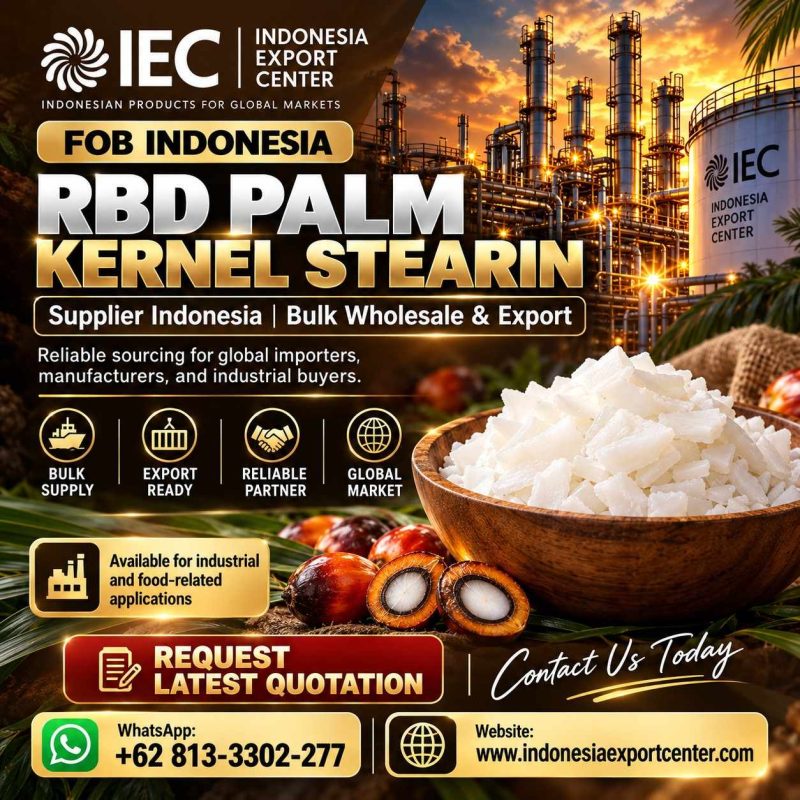
Understanding the Difference Between Palm Kernel Stearin and Palm Stearin
International buyers often encounter two similar product names: RBD Palm Kernel Stearin and RBD Palm Stearin. Although both are higher-melting fractions from oil palm-derived materials, they are fundamentally different products.
The distinction begins with the raw material.
Palm kernel stearin originates from palm kernel oil extracted from the kernel of the oil palm fruit. Conventional palm stearin originates from palm oil extracted from the fruit’s fleshy mesocarp.
This difference influences fatty acid composition, physical characteristics, industrial applications, and formulation suitability.
Indonesia Export Center (IEC) supports buyers seeking Indonesian suppliers of palm-derived oils and fats and encourages accurate product identification before purchasing.
What Is RBD Palm Kernel Stearin?
RBD Palm Kernel Stearin is a higher-melting fraction of palm kernel oil obtained through refining and fractionation.
It belongs to the lauric fat family and may be evaluated for selected confectionery fat systems, specialty fat manufacturing, and industrial processing applications.
Its exact specifications depend on the supplier and grade.
What Is RBD Palm Stearin?
RBD Palm Stearin is the higher-melting fraction obtained from palm oil derived from the mesocarp of the oil palm fruit.
It generally contains substantial palmitic fatty acid and has a different fatty acid profile from palm kernel stearin.
Depending on grade and processing, palm stearin may be evaluated for shortening, bakery fats, margarine-related formulations, soap production, and other industrial uses.
These applications remain grade- and formulation-dependent.
Product Comparison
| Characteristic | RBD Palm Kernel Stearin | RBD Palm Stearin |
|---|---|---|
| Raw Material | Palm kernel oil | Palm oil |
| Fruit Component | Kernel | Mesocarp |
| Main Oil Family | Lauric-rich | Palmitic-rich |
| Processing | Refining and fractionation | Refining and fractionation |
| Physical Form | Higher-melting fat fraction | Higher-melting fat fraction |
| Fatty Acid Profile | Kernel-derived composition | Mesocarp-derived composition |
| Potential Applications | Lauric specialty fats, CBS feedstock, selected industrial processing | Shortening, bakery fat systems, soap and other processing |
| Direct Interchangeability | Not assumed | Not assumed |
| Technical Verification | TDS, COA, application testing | TDS, COA, application testing |
Why Fatty Acid Composition Matters
Fatty acids influence the physical and chemical behavior of oils and fats.
Palm kernel stearin and palm stearin differ significantly in their characteristic fatty acid composition.
These differences may affect melting, crystallization, compatibility with other fats, and suitability for industrial processing.
A buyer should request the actual fatty acid profile instead of assuming that products with similar names perform similarly.
Melting Point Is Not the Only Difference
Both products are described as stearin fractions because they represent higher-melting portions of their parent oils.
However, the term “stearin” does not establish an identical melting point, chemical composition, or industrial function.
Two products can have similar reported melting points while behaving differently in a formulated fat system.
For specialty fat applications, buyers may need to review solid fat content and crystallization characteristics.
Application Differences
Confectionery Fat Manufacturing
Palm kernel stearin may be evaluated as a feedstock for certain lauric cocoa butter substitute systems.
Palm stearin may be used in different specialty fat formulations, depending on processing and target characteristics.
Neither should automatically be substituted for the other.
Bakery Fats
Certain palm stearin-based systems may be relevant to bakery fat manufacturing.
Palm kernel stearin may also be considered in specialized formulations, but technical approval is required.
Soap and Oleochemicals
Both palm-derived materials may be relevant to selected industrial processes.
However, their different fatty acid profiles can affect the properties of downstream products.
The appropriate feedstock depends on the process.
Procurement Decision Matrix
| Buyer Requirement | Recommended Action |
|---|---|
| Lauric specialty fat feedstock | Evaluate palm kernel stearin grades |
| Palmitic-rich fat fraction | Evaluate palm stearin grades |
| Cocoa butter substitute manufacturing | Request formulation-specific technical evaluation |
| Soap production | Compare fatty acid and saponification data |
| Bakery shortening | Evaluate complete fat-system requirements |
| Existing ingredient replacement | Conduct laboratory and pilot trials |
| Uncertain product identity | Request full product name, TDS and COA |
Quality Specifications to Compare
A technical buyer may evaluate FFA, iodine value, slip melting point, fatty acid composition, moisture and impurities, color, and solid fat content.
The appropriate test methods and numerical limits must be agreed with the supplier.
Avoiding Procurement Errors
A common purchasing mistake is omitting the word “kernel” from the product description.
An inquiry for “RBD Palm Stearin” may result in a quotation for a different material than “RBD Palm Kernel Stearin.”
The exact product name should appear consistently in the RFQ, contract, commercial invoice, and quality documents.
Export Sourcing from Indonesia
IEC can receive inquiries for either product category and facilitate discussions about supplier availability and technical specifications.
Buyers should provide their intended application and purchasing volume.
The relevant supplier must confirm the available grade, documentation, packaging, and commercial terms.
Frequently Asked Questions
Is palm kernel stearin the same as palm stearin?
No. They originate from different oils and have different fatty acid compositions.
Are both products solid fats?
They are higher-melting fractions, but their physical condition depends on temperature and grade.
Which product is suitable for CBS manufacturing?
Certain palm kernel stearin grades may be used as feedstock for lauric CBS systems, subject to processing and technical evaluation.
Can palm stearin replace palm kernel stearin?
Not without evaluating the intended application and formulation.
What is the most important specification?
There is no single universal parameter. Product identity, composition, and application requirements must be considered together.
Can IEC help compare the two products?
IEC can receive requests for supplier documentation and product sourcing discussions.
Request the Correct Indonesian Stearin Grade
Company Name:
Country:
Required Product:
Intended Application:
Technical Specifications:
Initial Quantity (MT):
Monthly Requirement (MT):
Packaging:
Destination Port:
Preferred Trade Terms:
Indonesia Export Center (IEC)
Website: https://indonesiaexportcenter.com/
WhatsApp: +62 813-3302-277
Contact IEC to compare RBD Palm Kernel Stearin and RBD Palm Stearin supplier options before placing a bulk order.
Technical specifications, applications, availability, and commercial terms require supplier verification.
