

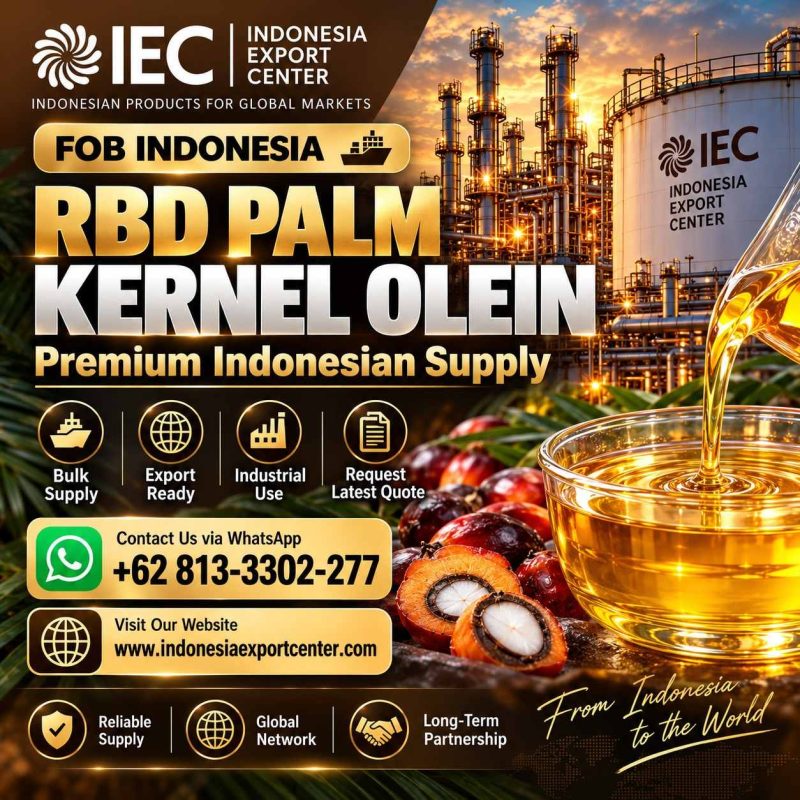
Source RBD Palm Kernel Olein for Industrial Food Ingredient Manufacturing
Food manufacturers and ingredient distributors require raw materials that meet defined technical, safety, regulatory, and commercial requirements.
RBD Palm Kernel Olein is a refined, fractionated palm kernel oil product that may be evaluated for selected food ingredient and specialty fat applications.
Indonesia Export Center (IEC) supports international buyers seeking supplier introductions, technical specifications, quality documentation, and export quotations for Indonesian RBD Palm Kernel Olein.
Our B2B sourcing approach emphasizes product identity, supplier verification, quality consistency, and appropriate documentation.
For food applications, buyers should not assume that every available grade is automatically suitable for food use. The intended application and destination-country requirements must be communicated clearly during the sourcing process.
What Is RBD Palm Kernel Olein?
RBD Palm Kernel Olein is the relatively liquid fraction of palm kernel oil that has undergone refining and fractionation.
The abbreviation RBD stands for Refined, Bleached and Deodorized.
Palm kernel oil is obtained from the kernel of the oil palm fruit.
Its fatty acid composition differs from conventional palm oil, which is extracted from the fruit’s fleshy portion.
Palm kernel oil is characterized by substantial lauric fatty acid content.
Fractionation produces fractions with different physical characteristics, allowing manufacturers to evaluate them for specific formulation requirements.
Why Food Ingredient Buyers Consider Palm Kernel Olein
Industrial food manufacturers often require ingredients with controlled characteristics.
These may include:
- Appropriate melting behavior.
- Consistent product quality.
- Compatibility with other ingredients.
- Suitable processing characteristics.
- Reliable quality documentation.
- Appropriate storage and handling requirements.
- Compliance with applicable food regulations.
Palm kernel olein may be considered where its properties are relevant to a particular formulation.
However, technical suitability must be established through testing.
Potential Food Ingredient Applications
Confectionery Ingredient Systems
Manufacturers of compound coatings, fillings, and related products may evaluate palm kernel olein as part of a specialty fat blend.
The formulation must be tested for melting behavior, compatibility, texture, and stability.
Bakery Ingredient Manufacturing
Palm kernel olein may be assessed in selected bakery filling or coating systems.
It should not automatically be considered interchangeable with all shortenings or margarines.
Specialty Vegetable Fat Blends
Ingredient producers may combine multiple oils and fats to achieve specific performance characteristics.
Palm kernel olein can be investigated as a potential blending component.
Industrial Food Processing
Food processors may consider suitable palm kernel olein grades for specific ingredient requirements.
Approval depends on the product’s specification, processing behavior, and regulatory status.
Food Ingredient Distribution
Distributors may source palm kernel olein for resale to qualified manufacturers.
They should establish clear product identification, traceability, and storage procedures.
Food-Grade Product Information
| Product Attribute | Requirement |
|---|---|
| Product | RBD Palm Kernel Olein |
| Origin | Indonesia |
| Intended Use | Buyer-defined food application |
| Grade | Supplier-confirmed food-suitable grade |
| Technical Specification | TDS and agreed quality limits |
| Batch Quality | COA or other appropriate test documentation |
| Food Safety Documentation | According to buyer and regulatory requirements |
| Packaging | Suitable for intended food use |
| Quantity | Supplier-confirmed |
| Price | Current quotation |
Essential Quality Parameters
Free Fatty Acid
FFA is relevant to oil quality assessment.
The acceptable level should be specified by the buyer and verified through appropriate analytical testing.
Moisture and Impurities
These parameters help assess product cleanliness and suitability for further processing.
Iodine Value
Iodine value helps characterize the degree of unsaturation.
It may support comparisons between different palm kernel fractions.
Color
Color may matter for applications where the oil influences finished-product appearance.
Melting Characteristics
Melting behavior can affect processing, texture, and product stability.
For some formulations, solid fat content measurements may be particularly useful.
Fatty Acid Composition
A fatty acid profile can support product identification and formulation analysis.
No numerical values should be treated as confirmed without supplier documentation.
Food Safety Documentation for International Buyers
Food-grade purchasing requires more than a statement that a product is edible.
Buyers should establish an appropriate supplier qualification program.
Depending on the application and importing country, documentation may include:
Technical Data Sheet: Describes product characteristics and quality requirements.
Certificate of Analysis: Reports analytical results for an identified batch or sample.
Food Safety Documentation: Supports evaluation of relevant manufacturing and handling controls.
Traceability Information: Helps identify the source and movement of the product.
Contaminant Testing: May be required to demonstrate compliance with relevant food regulations.
Certification Documents: May be requested where specific certifications are required.
The validity and scope of all documents should be verified.
Halal and Other Certification Requirements
Some food ingredient buyers require Halal certification or other third-party certification.
Other buyers may request specific food safety management or sustainability-related documentation.
IEC does not assume that a proposed supplier possesses any particular certification.
Buyers should specify their requirements in the RFQ and request current evidence.
A certificate should be checked for its issuing body, validity period, covered products, and manufacturing site.
Traceability in Food Ingredient Procurement
Traceability is important for quality management and potential product investigations.
A suitable system may connect the received material to supplier records, batch identifiers, shipping documents, and laboratory results.
Buyers should determine which traceability information is necessary for their business and regulatory obligations.
For repeat purchasing, consistent documentation can help support supplier performance monitoring.
Packaging for Food Ingredient Shipments
Packaging must be appropriate for the product and its intended use.
Potential packaging systems for edible oils and fats can include suitable drums, IBCs, flexitanks, ISO tanks, or other approved arrangements.
Actual availability depends on the supplier.
Buyers should confirm cleanliness, food-contact suitability, sealing, contamination controls, and unloading requirements.
If the product requires temperature management, the handling conditions should be established before shipment.
Evaluating Product Suitability
Food manufacturers should consider a staged qualification process.
Laboratory Evaluation
Review the technical specification and conduct relevant incoming-material tests.
Formulation Testing
Evaluate the ingredient in the actual product recipe.
Pilot Production
Confirm that processing performance is acceptable under representative manufacturing conditions.
Stability Assessment
Evaluate the finished product under relevant storage conditions.
Supplier Approval
Approve the material and supplier only after the required technical and compliance criteria have been satisfied.
Commercial Procurement from Indonesia
Once the technical requirements are defined, buyers can submit a bulk purchasing inquiry.
IEC can help coordinate discussions involving specifications, order volume, packaging, delivery terms, and documentation.
A quotation should identify the exact product grade and commercial conditions.
The final contract should establish the agreed quality requirements and treatment of non-conforming goods.
Frequently Asked Questions
Is RBD Palm Kernel Olein suitable for food manufacturing?
Certain grades may be suitable for particular food applications, subject to supplier verification, technical evaluation, and applicable regulations.
Can I request a food-grade COA?
Yes. Buyers should request relevant batch documentation and confirm its availability.
Is RBD Palm Kernel Olein the same as cooking palm olein?
No. Palm kernel olein and conventional palm olein have different origins and fatty acid compositions.
Can it be used in confectionery?
It may be evaluated in selected confectionery fat systems, but compatibility and performance testing are required.
Does IEC guarantee Halal certification?
No. Any certification must be verified with the actual supplier.
Can food ingredient distributors request wholesale quotations?
Yes. IEC welcomes inquiries from qualified distributors and manufacturers.
What details should I provide?
Include your intended application, required specification, quantity, packaging, destination port, and necessary certifications.
Request Food-Grade RBD Palm Kernel Olein Technical Specifications
Indonesia Export Center welcomes inquiries from food ingredient manufacturers, distributors, confectionery producers, bakery ingredient companies, and specialty fat formulators.
Please provide:
Company Name:
Country:
Food Application:
Required Specification:
Required Food Safety Documents:
Initial Order Quantity (MT):
Expected Monthly Volume (MT):
Packaging Preference:
Destination Port:
Target Shipment Date:
Indonesia Export Center (IEC)
Website: https://indonesiaexportcenter.com/
WhatsApp: +62 813-3302-277
Related product page: RBD Palm Olein CP8/CP10 Supplier Indonesia
Contact IEC to request supplier-confirmed food-grade specifications and discuss your RBD Palm Kernel Olein sourcing requirements.
Food suitability, certifications, specifications, regulatory compliance, and availability require verification for the specific supplier, grade, and destination market.
