

IEC | INDONESIA EXPORT CENTER
CONNECTING INDONESIAN PRODUCTS TO THE WORLD
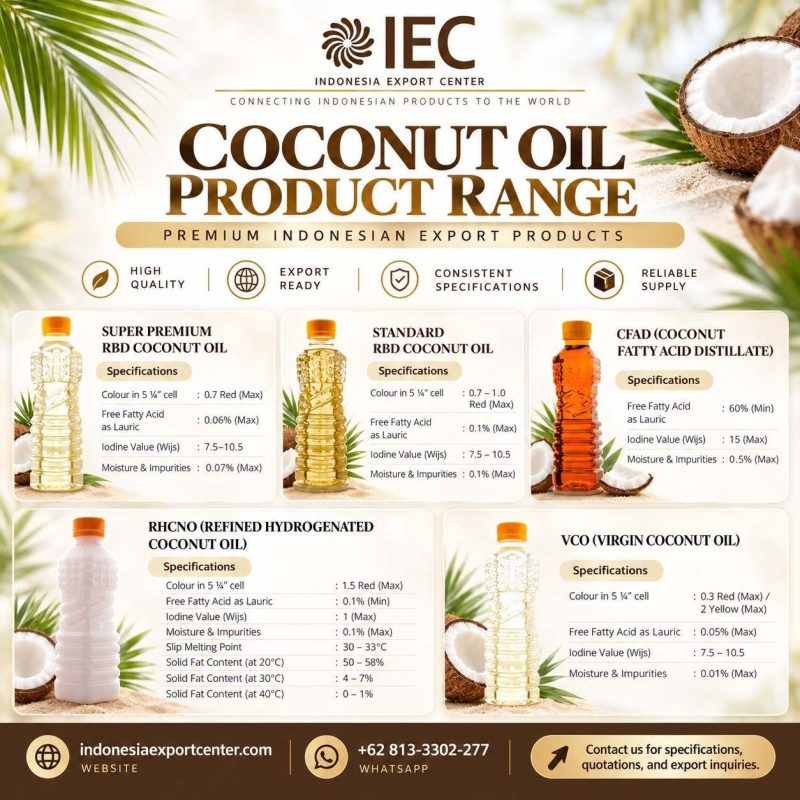
COCONUT OIL PRODUCT RANGE
PREMIUM INDONESIAN EXPORT PRODUCTS
HIGH QUALITY | EXPORT READY | CONSISTENT SPECIFICATIONS | RELIABLE SUPPLY
A Technical Comparison of Refined Coconut Oil and Virgin Coconut Oil for Global Ingredient Buyers
RBD Coconut Oil vs Virgin Coconut Oil: What Is the Difference?
The main difference between RBD coconut oil and virgin coconut oil is how the oil is produced and processed.
RBD Coconut Oil stands for Refined, Bleached and Deodorised Coconut Oil. It undergoes refining processes intended to reduce certain impurities, colour, odour and flavour components.
Virgin Coconut Oil (VCO) is generally produced from fresh coconut kernel through mechanical or other processes that avoid conventional chemical refining, bleaching and deodorisation. The exact production method varies by manufacturer.
These processing differences can influence sensory characteristics, product positioning, quality requirements, industrial suitability and purchasing decisions.
For global ingredient sourcing teams, neither product is automatically the better choice. The correct selection depends on the intended application, technical specifications, required documentation, regulatory requirements and total procurement cost.
Indonesia Export Center (IEC) facilitates sourcing and export enquiries for Indonesian coconut oil products, including Standard RBD Coconut Oil and Virgin Coconut Oil.
This guide explains the key differences between RBD Coconut Oil and VCO and how buyers can evaluate both products.
1. Quick Comparison: RBD Coconut Oil vs Virgin Coconut Oil
| Comparison Factor | RBD Coconut Oil | Virgin Coconut Oil (VCO) |
|---|---|---|
| Full Name | Refined, Bleached and Deodorised Coconut Oil | Virgin Coconut Oil |
| Primary Processing Approach | Refining, bleaching and deodorisation | Production without conventional RBD processing |
| Raw Material | Coconut-derived oil feedstock | Generally fresh coconut kernel |
| Odour | Typically neutral or relatively mild | Often retains characteristic coconut aroma |
| Flavour | Typically neutral or relatively mild | Often retains characteristic coconut flavour |
| Colour | Usually light in appearance | Usually clear to pale in appearance, depending on conditions |
| Processing Objective | Produce oil with defined refined characteristics | Preserve virgin-oil characteristics through controlled processing |
| Typical Buyer Considerations | Consistency, sensory neutrality, industrial suitability | Processing method, sensory profile, virgin product positioning |
| Potential Applications | Selected food, industrial, soap and oleochemical applications | Selected food, cosmetic and personal care applications |
| Food-Grade Status | Requires verification | Requires verification |
| Certifications | Supplier-specific verification required | Supplier-specific verification required |
| Price | Request supplier quotation | Request supplier quotation |
| Availability | To Be Confirmed | To Be Confirmed |
Important: These are general product-category differences. Actual characteristics depend on the manufacturer, production method and tested batch.
2. What Is RBD Coconut Oil?
RBD Coconut Oil is coconut oil that has undergone refining, bleaching and deodorisation.
These processes are intended to produce an oil with controlled quality characteristics.
RBD Coconut Oil may be considered for applications where buyers require a relatively neutral sensory profile and defined technical parameters.
The RBD designation alone does not establish food-grade compliance, a specific manufacturing standard or suitability for every industrial application.
3. What Is Virgin Coconut Oil?
Virgin Coconut Oil is coconut oil produced through processes intended to retain virgin-oil characteristics without conventional RBD refining.
Production methods may involve controlled preparation, separation, extraction and moisture management.
VCO is often selected for applications where the processing method, characteristic coconut aroma or virgin product positioning is important.
However, the actual sensory profile and quality must be verified for the specific product.
4. Why Processing Method Matters
Processing influences:
- Odour and flavour
- Colour
- Certain minor constituents
- Impurity levels
- Quality control requirements
- Product positioning
- Manufacturing suitability
Buyers should understand the production method before comparing commercial offers.
RBD Coconut Oil Processing Explained
5. Raw Material Preparation
RBD Coconut Oil production generally begins with coconut-derived oil feedstock.
The actual feedstock and manufacturing process should be confirmed with the supplier.
6. Refining
Refining involves processing steps intended to reduce unwanted constituents and improve specified oil characteristics.
The exact method varies by manufacturer.
7. Bleaching
Bleaching is intended to reduce certain colour-forming substances and other components.
It does not necessarily mean adding a bleaching chemical directly to the finished oil.
8. Deodorisation
Deodorisation is intended to reduce volatile components that contribute to odour and flavour.
This is an important reason RBD Coconut Oil is generally associated with a more neutral sensory profile.
9. Finished RBD Coconut Oil
The finished product should be evaluated against an agreed specification.
Batch-specific testing is needed to establish actual conformity.
Virgin Coconut Oil Processing Explained
10. Fresh Coconut Preparation
VCO production generally uses fresh coconut kernel.
Raw material handling can influence the final product.
11. Virgin Oil Extraction
Production may involve mechanical or other controlled separation methods.
The precise process should be confirmed with the manufacturer.
12. Moisture Management
Moisture control is important to finished oil quality.
Buyers should verify the applicable moisture specification and analytical results.
13. Filtration and Product Finishing
Filtration or other permitted finishing steps may be used depending on the production process.
The manufacturer should describe the actual process.
14. Finished Virgin Coconut Oil
VCO should be evaluated for:
- Identity
- Quality
- Sensory characteristics
- Moisture
- Free fatty acids
- Relevant contaminants
- Packaging suitability
Technical Specifications: RBD Coconut Oil vs VCO
15. IEC Reference Specification Comparison
The following values are supplied product references for IEC’s coconut oil range.
| Quality Parameter | Standard RBD Coconut Oil | Virgin Coconut Oil |
|---|---|---|
| Colour in 5¼-inch Cell | 0.7–1.0 Red (Max) | 0.3 Red (Max) / 2 Yellow (Max) |
| Free Fatty Acid as Lauric | 0.1% (Max) | 0.05% (Max) |
| Iodine Value (Wijs) | 7.5–10.5 | 7.5–10.5 |
| Moisture & Impurities | 0.1% (Max) | 0.01% (Max) |
Technical notes:
- These are reference specification values, not verified results from particular production batches.
- The Standard RBD colour entry combines a range and a maximum designation; the manufacturer should clarify the intended acceptance criterion.
- Different colour channels should not be treated as directly interchangeable without understanding the measurement method.
- Lower numerical limits in a supplier specification do not automatically establish that every batch of one product is superior to every batch of another.
16. Free Fatty Acid Comparison
The supplied reference limits are:
- Standard RBD Coconut Oil: 0.1% maximum FFA as lauric
- Virgin Coconut Oil: 0.05% maximum FFA as lauric
Free fatty acid content is one quality parameter used to evaluate fats and oils.
Actual results should be checked using an appropriate test method.
17. Moisture and Impurities Comparison
The supplied reference limits are:
- Standard RBD Coconut Oil: 0.1% maximum
- Virgin Coconut Oil: 0.01% maximum
These limits are product-specific references.
They do not establish the actual moisture content of an untested shipment.
18. Iodine Value Comparison
Both supplied references state:
Iodine Value (Wijs): 7.5–10.5
The identical reference range does not mean that both oils have identical sensory properties, processing histories or minor-component profiles.
19. Colour Comparison
The supplied references are:
Standard RBD Coconut Oil: 0.7–1.0 Red (Max) in a 5¼-inch cell.
Virgin Coconut Oil: 0.3 Red (Max) / 2 Yellow (Max) in a 5¼-inch cell.
Buyers should confirm the colour method, scale and acceptance criteria before comparing these values.
20. Are the Fatty Acid Profiles Identical?
Both products are coconut-derived oils and typically share broadly similar major fatty acid characteristics.
However, actual fatty acid composition may vary.
A verified fatty acid profile should be requested when composition is critical.
21. Lauric Acid Considerations
Coconut oil is commonly associated with lauric acid as a major fatty acid constituent.
However, the FFA-as-lauric specification is not the same as total lauric acid content.
Buyers should not interpret the FFA percentage as the oil’s total lauric acid composition.
22. Peroxide Value
Peroxide value may be relevant to oil quality evaluation.
No peroxide value is provided in the supplied reference specifications.
Buyers should request a result where required.
23. Saponification Value
Saponification value may be relevant to certain technical applications.
No numerical value is claimed for either product.
24. Additional Analytical Parameters
Depending on the application, buyers may request:
- Fatty acid composition
- Peroxide value
- Saponification value
- Unsaponifiable matter
- Relevant contaminants
- Additional identity and purity tests
25. Batch COA Verification
A Certificate of Analysis should identify the actual batch or sample and report relevant test results.
A generic specification sheet should not be presented as a batch-specific COA.
Sensory and Functional Differences
26. Odour: Neutral vs Coconut Aroma
RBD Coconut Oil is generally selected when a relatively neutral odour is desired.
VCO often retains a characteristic coconut aroma.
Actual sensory properties depend on the product and processing method.
27. Flavour Differences
RBD Coconut Oil generally has a milder flavour profile.
VCO may contribute a more noticeable coconut flavour.
Buyers should conduct product trials before making formulation decisions.
28. Appearance
Both products can appear light in colour.
Appearance alone is not sufficient to verify product identity or quality.
29. Physical State and Temperature
Coconut oil may change between liquid and solid states depending on temperature.
Neither product should be assigned an exact melting point without appropriate product-specific data.
30. Texture and Formulation
The finished formulation may behave differently depending on the oil, other ingredients and processing conditions.
Application testing is recommended.
31. Aroma Retention
For applications where coconut aroma is desired, VCO may be considered.
For applications requiring a relatively neutral sensory profile, RBD Coconut Oil may be considered.
32. Processing Consistency
Manufacturers should evaluate consistency using defined specifications and representative batch testing.
No specific consistency performance is guaranteed for either product.
RBD Coconut Oil vs VCO for Food Applications
33. Food Manufacturing Considerations
Food manufacturers should assess:
- Regulatory suitability
- Ingredient specifications
- Sensory requirements
- Product stability
- Processing conditions
- Packaging
- Traceability
- Cost
34. Bakery Applications
RBD Coconut Oil may be evaluated for selected bakery formulations where a relatively neutral coconut oil ingredient is desired.
Suitability depends on the recipe and processing conditions.
35. Confectionery Applications
RBD Coconut Oil may be considered for selected confectionery applications.
Compatibility should be established through formulation trials.
36. Non-Dairy Creamer Applications
RBD Coconut Oil may be evaluated as an ingredient for selected non-dairy creamer formulations.
Required physical and compositional characteristics should be confirmed.
37. Coconut-Flavoured Foods
VCO may be considered when the intended product benefits from characteristic coconut aroma or flavour.
38. Premium Ingredient Positioning
VCO may be used in product concepts emphasising virgin processing.
Marketing claims must be substantiated and comply with applicable regulations.
39. Cooking and Heating Applications
Suitability for a particular cooking or heating application depends on the actual oil quality, operating conditions and regulatory requirements.
No numerical smoke point or guaranteed thermal performance is claimed.
40. Food Safety Compliance
Neither RBD Coconut Oil nor VCO should be assumed food grade solely because of its product name.
The buyer should verify the actual product’s suitability for the intended market and use.
RBD Coconut Oil vs VCO for Industrial Applications
41. Soap Manufacturing
RBD Coconut Oil may be evaluated as a raw material for soap manufacturing.
Buyers should confirm the fatty acid profile and other relevant processing parameters.
42. Oleochemical Processing
RBD Coconut Oil may be evaluated as a feedstock for selected oleochemical applications.
The appropriate feedstock depends on the process and technical requirements.
43. Cosmetic Formulations
Both RBD Coconut Oil and VCO may be evaluated for suitable cosmetic formulations.
The choice depends on sensory, functional, regulatory and commercial requirements.
44. Personal Care Products
VCO may be considered for formulations where virgin processing and coconut sensory characteristics are important.
RBD Coconut Oil may be considered where a relatively neutral ingredient is preferred.
45. Industrial Raw Material Trading
Industrial traders should compare:
- Grade
- Specifications
- Application
- Packaging
- Price
- MOQ
- Documentation
- Supply arrangements
46. Are RBD Coconut Oil and VCO Interchangeable?
Not automatically.
Even when both are coconut-derived oils, processing differences may affect the finished product.
Substitution should be supported by technical testing and buyer approval.
How to Choose Between RBD Coconut Oil and Virgin Coconut Oil
47. Choose Based on Intended Application
Begin with the finished product’s requirements rather than the oil’s marketing description.
48. Choose Based on Sensory Profile
Consider whether the application requires:
- Neutral odour
- Mild flavour
- Characteristic coconut aroma
- Characteristic coconut flavour
49. Choose Based on Technical Specifications
Compare the actual parameters required by the manufacturing process.
50. Choose Based on Quality Assurance
Request appropriate quality documentation and batch test results.
51. Choose Based on Regulatory Requirements
Verify applicable requirements in the destination country.
52. Choose Based on Packaging
Packaging should match the product, shipping conditions and receiving facilities.
53. Choose Based on Commercial Cost
Compare actual quotations on equivalent terms.
54. Choose Based on Supply Planning
Evaluate:
- MOQ
- Available quantity
- Lead time
- Shipment frequency
- Inventory requirements
- Supplier qualification
55. Recommended Buyer Decision Matrix
| Buyer Requirement | Product to Evaluate First |
|---|---|
| Relatively neutral aroma | RBD Coconut Oil |
| Characteristic coconut aroma | VCO |
| Selected industrial processing | RBD Coconut Oil, subject to process requirements |
| Virgin processing positioning | VCO |
| Selected food ingredient use | Either, subject to application and compliance |
| Selected cosmetic use | Either, subject to formulation testing |
| Lowest total procurement cost | Compare verified quotations |
| Strict batch quality criteria | Compare verified COAs and agreed specifications |
This matrix is a screening guide, not a guarantee of suitability.
Indonesia Coconut Oil Sourcing Considerations
56. Why Consider Indonesia?
Indonesia is an established coconut-producing country.
Buyers may evaluate Indonesian coconut oil products as part of their international sourcing strategies.
57. Manufacturer Identification
The actual manufacturer should be identified and verified.
58. Manufacturer vs Trading Company
The manufacturer, contractual seller and exporter of record may be different entities.
Their roles should be clarified.
59. Supplier Qualification
Buyers may review:
- Company registration
- Facility information
- Product specifications
- Quality documentation
- Relevant certifications
- Commercial arrangements
60. Certification Verification
Buyers may request information about relevant certifications.
No Halal, HACCP, ISO, organic or other certification is claimed for a particular supplier.
61. Product Samples
Samples may be requested, subject to supplier availability and agreement.
62. Laboratory Testing
Independent testing may be requested where appropriate.
Sampling methods and chain of custody should be agreed.
63. Minimum Order Quantity
No MOQ has been independently verified for either product.
64. Available Quantity
No ready stock or available quantity has been verified.
65. Packaging Options
Potential enquiries may include:
- Steel drums
- IBC tanks
- Flexitank arrangements
- Other suitable packaging
Availability and suitability must be confirmed separately for each product.
66. Bulk Packaging Considerations
Buyers should review:
- Product compatibility
- Food-contact suitability where relevant
- Net fill
- Closure
- Handling
- Loading
- Storage
67. Shipping and Export Terms
Commercial quotations may be requested using suitable Incoterms® 2020 rules.
68. FOB Quotations
FOB may be suitable for certain sea shipments.
Risk generally transfers when goods are loaded on board at the named shipment port.
For certain containerised shipments, FCA may be more appropriate.
69. CFR and CIF Quotations
CFR and CIF may be considered for appropriate sea shipments.
Under both rules, risk generally transfers on board at the shipment port. CIF additionally requires the seller to obtain the insurance specified by the rule.
For certain containerised arrangements, CIP may be more appropriate.
70. Export Documentation
Depending on the transaction, documents may include:
- Commercial invoice
- Packing list
- Bill of lading
- Certificate of Origin
- Certificate of Analysis
- Insurance documents
- Other required certificates
71. Shipment Lead Time
Lead time depends on production, packaging, testing, documentation and logistics.
No fixed lead time is claimed.
72. Landed Cost Comparison
Buyers should compare the total landed cost rather than only the supplier’s unit price.
Potential costs include:
- Product price
- Freight
- Insurance
- Customs duties
- Taxes
- Port charges
- Inland transportation
- Storage
73. Purchase Contract
The contract should define:
- Product
- Grade
- Specifications
- Quantity
- Packaging
- Price
- Incoterm
- Named port
- Shipment period
- Payment terms
- Quality acceptance criteria
- Claims procedures
74. Receiving Inspection
Buyers should inspect packaging, quantity, lot identification and relevant quality documentation upon receipt.
75. Repeat Procurement
Repeat orders should be planned around verified supplier capability and agreed commercial terms.
No recurring supply commitment is confirmed.
RBD Coconut Oil vs Virgin Coconut Oil: Buyer Selection Checklist
Product Selection
-
Intended application identified
-
Sensory requirements defined
-
Technical specifications reviewed
-
Food or industrial use confirmed
-
Regulatory requirements identified
-
Product trials planned where needed
Quality Assurance
-
Manufacturer identified
-
Product specification obtained
-
Batch COA requested
-
Test methods reviewed
-
Additional analytical requirements defined
-
Traceability reviewed
-
Certifications verified where relevant
Commercial Procurement
-
MOQ confirmed
-
Available quantity confirmed
-
Packaging confirmed
-
Price per MT confirmed
-
Incoterm agreed
-
Shipment period confirmed
-
Payment terms agreed
-
Supplier bank details verified
Logistics
-
Origin port confirmed
-
Destination port confirmed
-
Freight reviewed
-
Insurance reviewed
-
Receiving arrangements planned
-
Import documentation checked
RFQ Template – Compare RBD Coconut Oil and Virgin Coconut Oil
Subject: RFQ – RBD Coconut Oil vs Virgin Coconut Oil from Indonesia
Dear Indonesia Export Center Team,
We are evaluating RBD Coconut Oil and Virgin Coconut Oil from Indonesia for our ingredient sourcing requirements.
Please provide available product specifications, manufacturer information, quality documentation, packaging options and separate commercial quotations for the requested products.
Buyer Information
Company Name: [Company Name]
Country: [Country]
Business Type: [Manufacturer / Ingredient Distributor / Importer / Industrial Trader / Other]
Contact Person: [Name]
Email: [Email]
Phone / WhatsApp: [Number]
Product Requirements
Products to Compare: [Standard RBD Coconut Oil / Virgin Coconut Oil / Both]
Required Quantity per Product: [MT]
Estimated Monthly Consumption: [MT]
Intended Application: [Food / Bakery / Confectionery / Cosmetics / Soap / Industrial / Other]
Required Sensory Profile: [Neutral / Characteristic Coconut Aroma / Other]
Additional Technical Requirements: [Details]
Reference Specification Comparison
| Parameter | Standard RBD | VCO |
|---|---|---|
| Colour in 5¼-inch Cell | 0.7–1.0 Red (Max), Clarification Required | 0.3 Red (Max) / 2 Yellow (Max) |
| FFA as Lauric | 0.1% (Max) | 0.05% (Max) |
| Iodine Value (Wijs) | 7.5–10.5 | 7.5–10.5 |
| Moisture & Impurities | 0.1% (Max) | 0.01% (Max) |
Documentation Requested
Please provide, separately for each product:
- Actual manufacturer name and address
- Contractual seller and exporter of record
- Current product specification
- Batch-specific COA availability
- Production method information
- Relevant analytical methods
- Traceability information
- Certification information, where available
- Product sample availability
- Additional testing options
Packaging Requirements
Preferred Packaging: [Steel Drums / IBC / Flexitank / Other]
Preferred Net Fill: [Specify]
Shipping Requirements
Destination Country: [Country]
Destination Port: [Port]
Preferred Incoterm: [FCA / FOB / CFR / CIF / CIP / Other]
Target Shipment Period: [Month / Year]
Commercial Information Requested
Please provide separate quotations showing:
- MOQ
- Available quantity
- Packaging options
- Price per MT
- Incoterm and named port
- Freight quotation if applicable
- Insurance information if applicable
- Production lead time
- Estimated shipment period
- Export documentation
- Payment terms
- Quotation validity
- Additional commercial conditions
We will review the product specifications, technical suitability and commercial terms before selecting the appropriate coconut oil grade.
Kind regards,
[Your Name] [Company Name] [Country]SEND YOUR COCONUT OIL COMPARISON ENQUIRY
WhatsApp: https://wa.me/628133302277
Frequently Asked Questions – RBD Coconut Oil vs Virgin Coconut Oil
What is the main difference between RBD Coconut Oil and Virgin Coconut Oil?
The main difference is processing. RBD Coconut Oil undergoes refining, bleaching and deodorisation, while VCO is produced without conventional RBD refining.
Is RBD Coconut Oil the same as VCO?
No. They are distinct coconut oil product categories.
Which oil has a stronger coconut aroma?
VCO often retains a more characteristic coconut aroma.
Which oil has a more neutral flavour?
RBD Coconut Oil generally has a milder or more neutral flavour profile.
Is RBD Coconut Oil chemically refined?
RBD processing involves refining stages, but the exact process should be confirmed with the manufacturer.
Is VCO always cold pressed?
No. VCO may be produced through different methods. The actual production process should be verified.
Is RBD Coconut Oil suitable for food manufacturing?
It may be suitable for selected food applications, subject to product-specific technical and regulatory verification.
Is VCO suitable for food manufacturing?
It may be suitable for selected food applications, subject to product-specific technical and regulatory verification.
Which oil is better for bakery applications?
The appropriate oil depends on the recipe, sensory requirements and processing conditions.
Which oil is better for coconut-flavoured products?
VCO may be considered where characteristic coconut flavour is desired.
Which oil is better for soap manufacturing?
RBD Coconut Oil may be evaluated, but suitability depends on the process and technical specifications.
Which oil is better for cosmetics?
Either may be evaluated depending on formulation requirements.
Does VCO always have lower FFA?
Not necessarily. The supplied VCO reference has a lower maximum FFA limit, but actual batches must be tested.
What is the FFA limit for Standard RBD Coconut Oil?
The supplied reference states 0.1% maximum FFA as lauric.
What is the FFA limit for VCO?
The supplied reference states 0.05% maximum FFA as lauric.
Do both products have the same iodine value?
The supplied references both state 7.5–10.5, but actual results must be verified.
Is VCO automatically healthier than RBD Coconut Oil?
No broad health superiority claim should be inferred from the product name alone. Nutritional considerations depend on the actual product, dietary context and supporting evidence.
Is RBD Coconut Oil more stable than VCO?
No general stability ranking is established by the supplied specifications. Stability should be assessed using appropriate testing and intended-use conditions.
Is VCO more expensive than RBD Coconut Oil?
Prices vary by supplier, grade, quantity, packaging and market conditions. Request comparable quotations.
Can RBD Coconut Oil replace VCO?
Not automatically. Substitution should be supported by formulation testing and buyer approval.
Can I request both products from IEC?
Yes. IEC welcomes enquiries for both product categories, subject to supplier confirmation.
Is a batch COA available?
A batch-specific COA should be requested and verified for each product.
Are certifications available?
Certification availability and validity must be verified with the actual supplier.
What is the MOQ?
No MOQ has been verified for either product.
Can I request 20 MT?
Yes, as a buyer enquiry. Availability and loading feasibility require confirmation.
Is bulk packaging available?
Packaging options should be confirmed for each product.
Can I request FOB or CIF quotations?
Yes. Quotations are subject to supplier, packaging, freight and commercial confirmation.
How do I choose between RBD Coconut Oil and VCO?
Compare processing method, sensory characteristics, technical specifications, regulatory suitability, quality documentation and total procurement cost.
Which Coconut Oil Should You Choose?
Choose the product that matches your manufacturing requirements—not simply the product with the more attractive label.
RBD Coconut Oil and Virgin Coconut Oil can serve different commercial and technical purposes.
For applications where a relatively neutral flavour and odour are important, RBD Coconut Oil may be an appropriate product to evaluate.
For applications where virgin processing and characteristic coconut sensory properties are important, VCO may be an appropriate product to evaluate.
In both cases, buyers should verify the actual manufacturer, product specifications, batch quality documentation, intended-use suitability, packaging and commercial arrangements.
Request RBD Coconut Oil and VCO Specifications from Indonesia
Indonesia Export Center (IEC) welcomes enquiries from global ingredient sourcing teams, manufacturers, distributors, importers and industrial buyers.
Standard RBD Coconut Oil
Reference FFA as Lauric: 0.1% Maximum
Reference Iodine Value (Wijs): 7.5–10.5
Reference Moisture & Impurities: 0.1% Maximum
Reference Colour: 0.7–1.0 Red (Max), Subject to Clarification
Virgin Coconut Oil
Reference FFA as Lauric: 0.05% Maximum
Reference Iodine Value (Wijs): 7.5–10.5
Reference Moisture & Impurities: 0.01% Maximum
Reference Colour: 0.3 Red (Max) / 2 Yellow (Max)
Manufacturer: To Be Verified
Batch COA: To Be Requested and Verified
MOQ: To Be Confirmed
Available Quantity: To Be Confirmed
Packaging: To Be Confirmed
Price per MT: Request Separate Quotations
Shipment Lead Time: To Be Confirmed
IEC | INDONESIA EXPORT CENTER
CONNECTING INDONESIAN PRODUCTS TO THE WORLD
Website: https://indonesiaexportcenter.com/
WhatsApp: +62 813-3302-277
REQUEST COCONUT OIL SPECIFICATIONS AND QUOTATIONS
Please include your company name, destination country, intended application, required quantity, preferred product grade, packaging requirements and target shipment period.
Product and Sourcing Disclaimer: This page provides general educational and procurement information, not medical, nutritional, technical, legal or regulatory advice. Processing descriptions represent general product-category characteristics; actual production methods and sensory properties depend on the manufacturer. The supplied technical values are reference specifications and not verified batch results. The Standard RBD colour specification requires clarification. No manufacturer, certification, food-grade approval, batch COA, stock, MOQ, packaging availability, price, production capacity, freight rate or lead time has been independently verified. Application suitability must be established through appropriate technical testing and regulatory review. IEC facilitates sourcing and export enquiries; the actual manufacturer, contractual seller and exporter of record must be confirmed for each transaction.
