

RBD Coconut Oil vs Virgin Coconut Oil: Differences, Specifications, and Industrial Applications
IEC | INDONESIA EXPORT CENTER
CONNECTING INDONESIAN PRODUCTS TO THE WORLD
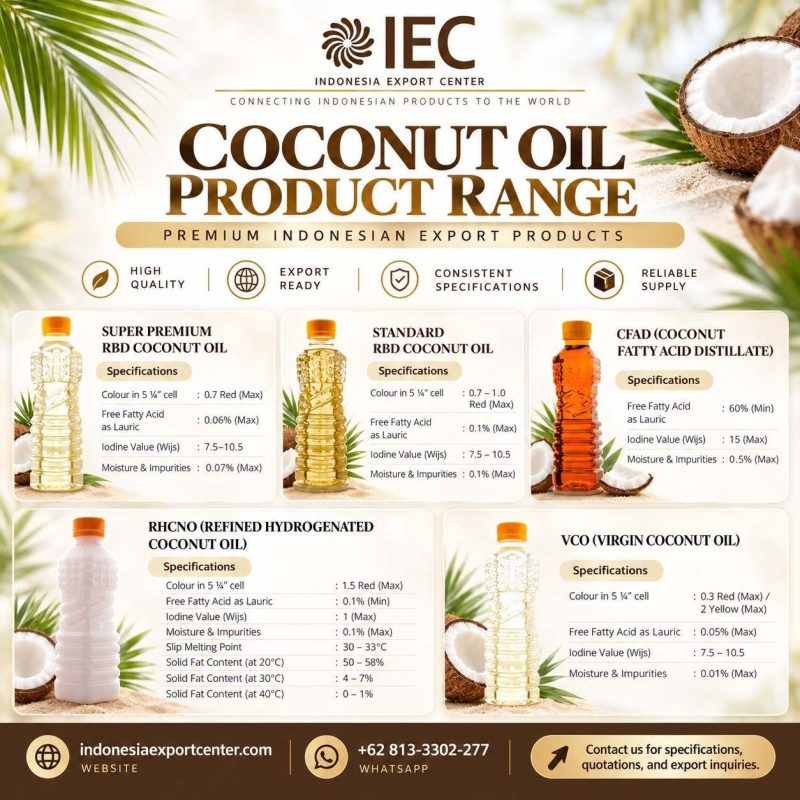
COCONUT OIL PRODUCT RANGE
PREMIUM INDONESIAN EXPORT PRODUCTS
HIGH QUALITY | EXPORT-ORIENTED SOURCING | CONSISTENT SPECIFICATIONS | RELIABLE SUPPLY COORDINATION
RBD Coconut Oil vs Virgin Coconut Oil: Which Is Better for Your Business?
Choosing between RBD Coconut Oil and Virgin Coconut Oil (VCO) is an important decision for international buyers, food manufacturers, cosmetic formulators, wholesalers, and industrial ingredient distributors.
Although both products are derived from coconuts (Cocos nucifera), their manufacturing processes, sensory characteristics, commercial applications, and procurement requirements differ significantly.
RBD Coconut Oil (Refined, Bleached, and Deodorized Coconut Oil) is commonly selected for applications requiring a neutral aroma, mild flavor, and standardized refined oil characteristics.
Virgin Coconut Oil (VCO) is produced using physical or natural extraction methods without chemical refining, bleaching, or deodorization. It typically retains more of the coconut’s characteristic aroma and flavor.
At Indonesia Export Center (IEC), we help international buyers connect with Indonesian coconut oil supply partners offering Standard RBD Coconut Oil, Super Premium RBD Coconut Oil, Virgin Coconut Oil, and other coconut-based industrial ingredients.
Whether your company requires coconut oil for food processing, cosmetics, personal care products, or industrial formulations, understanding the differences will help you select the appropriate product.
Request Coconut Oil Specifications and Export Quotations
WhatsApp: https://wa.me/628133302277
Website: https://indonesiaexportcenter.com/
1. What Is RBD Coconut Oil?
RBD Coconut Oil stands for Refined, Bleached, and Deodorized Coconut Oil.
It is produced by processing crude coconut oil through refining stages designed to reduce unwanted impurities, color compounds, free fatty acids, and undesirable odors.
RBD Coconut Oil Production Process
The typical manufacturing process involves:
- Crude Coconut Oil Extraction: Coconut oil is extracted from coconut kernels, commonly dried copra.
- Refining: Selected impurities and free fatty acids are reduced using an appropriate refining process.
- Bleaching: Adsorbent materials are used to reduce undesirable color compounds and certain impurities.
- Deodorization: Controlled high-temperature processing removes volatile substances responsible for unwanted odors and flavors.
- Quality Control: The finished oil is tested against the agreed product specifications.
The resulting product is a refined coconut oil suitable for various food and non-food applications, subject to product grade and regulatory requirements.
Common Applications of RBD Coconut Oil
- Food processing and manufacturing
- Bakery and confectionery products
- Industrial cooking and frying applications
- Margarine and specialty fat formulations
- Soap and detergent manufacturing
- Cosmetic and personal care formulations
- Oleochemical processing
- Industrial ingredient distribution
RBD Coconut Oil is particularly suitable when manufacturers require an oil with relatively neutral sensory characteristics that will not significantly influence the intended flavor or fragrance of the final product.
2. What Is Virgin Coconut Oil (VCO)?
Virgin Coconut Oil (VCO) is coconut oil obtained from fresh coconut kernels using physical or natural processing methods without chemical refining, bleaching, or deodorization.
Depending on the producer, extraction methods may involve mechanical pressing, centrifugation, controlled fermentation, or other suitable physical separation techniques.
Unlike RBD Coconut Oil, VCO generally retains more of its natural coconut aroma and flavor.
Virgin Coconut Oil Production Process
Typical production stages include:
- Selection of mature, fresh coconuts.
- Cleaning and preparation of coconut kernels.
- Extraction of coconut milk or oil through an approved physical process.
- Separation of oil from water and solids.
- Filtration and moisture reduction.
- Product testing and packaging.
The exact manufacturing method depends on the producer’s technology and target specification.
Common Applications of Virgin Coconut Oil
- Premium food ingredients
- Specialty food products
- Coconut-flavored culinary applications
- Cosmetic and skincare formulations
- Haircare and personal care products
- Natural product formulations
- Specialty retail and private-label products
- Food ingredient distribution
VCO is often preferred when the buyer requires recognizable coconut sensory characteristics and a minimally processed oil.
3. RBD Coconut Oil vs Virgin Coconut Oil: Comparison Table
| Comparison Factor | RBD Coconut Oil | Virgin Coconut Oil (VCO) |
|---|---|---|
| Raw material | Commonly dried coconut kernel or copra | Typically fresh mature coconut kernel |
| Manufacturing process | Refining, bleaching, and deodorization | Physical or natural extraction |
| Chemical refining | Yes, depending on refining technology | No |
| Deodorization | Yes | No |
| Aroma | Neutral or very mild | Characteristic coconut aroma |
| Flavor | Mild or relatively neutral | Characteristic coconut flavor |
| Appearance | Typically clear when liquid | Typically clear when liquid |
| Fatty acid profile | Predominantly saturated fatty acids | Predominantly saturated fatty acids |
| Industrial suitability | Broad range of food and industrial uses | Specialty food, cosmetic, and personal care uses |
| Main sourcing consideration | Standardized functional and analytical specifications | Extraction method, purity, aroma, and quality |
| Commercial positioning | Refined industrial and food ingredient | Virgin and specialty ingredient |
Important: Both RBD Coconut Oil and VCO contain substantial amounts of saturated fatty acids, including lauric acid. Their fatty acid compositions are broadly similar, so the main differences are primarily processing methods, sensory characteristics, and certain minor components.
Neither product is automatically healthier or superior for every application.
4. Standard RBD Coconut Oil Specifications
Our Indonesian sourcing network can assist buyers seeking Standard RBD Coconut Oil for food manufacturing, ingredient distribution, and suitable industrial applications.
Standard RBD Coconut Oil – Technical Specifications
| Specification | Value |
|---|---|
| Colour in 5 ¼” cell | 0.7–1.0 Red (Max) |
| Free Fatty Acid as Lauric | 0.1% (Max) |
| Iodine Value (Wijs) | 7.5–10.5 |
| Moisture & Impurities | 0.1% (Max) |
Advantages of Standard RBD Coconut Oil
Neutral Aroma and Flavor
Suitable for formulations where a strong coconut aroma is undesirable.
Versatile Applications
Used in food manufacturing, personal care, soap production, and other industrial sectors.
Defined Procurement Specifications
Buyers can evaluate free fatty acids, iodine value, moisture, impurities, and color against agreed requirements.
Commercial Bulk Sourcing
Suitable for buyers seeking repeated procurement volumes, subject to supplier availability and agreed commercial terms.
Industrial Processing Compatibility
Can be considered for formulations where refined coconut oil properties meet the manufacturer’s technical requirements.
For purchasing teams, the actual production batch should be evaluated using a current Certificate of Analysis (COA).
5. Super Premium RBD Coconut Oil Specifications
For buyers with stricter quality requirements, Super Premium RBD Coconut Oil provides an alternative specification profile.
Super Premium RBD Coconut Oil – Technical Specifications
| Specification | Value |
|---|---|
| Colour in 5 ¼” cell | 0.7 Red (Max) |
| Free Fatty Acid as Lauric | 0.06% (Max) |
| Iodine Value (Wijs) | 7.5–10.5 |
| Moisture & Impurities | 0.07% (Max) |
Standard vs Super Premium RBD Coconut Oil
| Quality Parameter | Standard RBD | Super Premium RBD |
|---|---|---|
| Colour in 5 ¼” cell | 0.7–1.0 Red (Max) | 0.7 Red (Max) |
| FFA as Lauric | 0.1% Max | 0.06% Max |
| Iodine Value | 7.5–10.5 | 7.5–10.5 |
| Moisture & Impurities | 0.1% Max | 0.07% Max |
Super Premium RBD Coconut Oil has tighter limits for selected parameters, including free fatty acids and moisture and impurities.
This may be important to manufacturers whose quality specifications require tighter analytical limits.
However, the correct grade should always be determined by the buyer’s complete formulation requirements, manufacturing process, regulatory obligations, and approved specifications.
6. Virgin Coconut Oil (VCO) Specifications
Indonesia also offers sourcing opportunities for Virgin Coconut Oil used by food manufacturers, cosmetics companies, personal care brands, and specialty ingredient distributors.
Virgin Coconut Oil – Technical Specifications
| Specification | Value |
|---|---|
| Colour in 5 ¼” cell | 0.3 Red (Max) / 2 Yellow (Max) |
| Free Fatty Acid as Lauric | 0.05% (Max) |
| Iodine Value (Wijs) | 7.5–10.5 |
| Moisture & Impurities | 0.01% (Max) |
These figures represent the proposed VCO product specification and should be confirmed against the selected supplier’s technical data sheet and lot-specific COA.
Why Buyers Choose Virgin Coconut Oil
Natural Coconut Characteristics
VCO generally retains the recognizable aroma and flavor associated with coconut.
Physical Extraction Methods
Produced without the chemical refining, bleaching, and deodorization used for RBD oil.
Specialty Formulation Applications
Suitable for selected premium food, cosmetic, and personal care products.
Product Differentiation
Manufacturers may choose VCO for products positioned around virgin extraction methods and characteristic coconut sensory qualities.
Private-Label Opportunities
Depending on supplier capabilities, VCO may be available for bulk supply or further packaging under buyers’ own brands.
VCO buyers should confirm the production process, product authenticity, moisture content, microbiological requirements where applicable, and other relevant analytical parameters.
7. Key Differences in Processing and Product Quality
Refining and Deodorization
RBD Coconut Oil undergoes refining processes to improve selected quality parameters and reduce unwanted odor and flavor.
VCO is manufactured without chemical refining, bleaching, or deodorization, preserving more of the original coconut sensory profile.
Free Fatty Acid Content
Free fatty acid content is an important quality parameter used in coconut oil procurement.
Based on the supplied product specifications:
- Standard RBD Coconut Oil: 0.1% maximum
- Super Premium RBD Coconut Oil: 0.06% maximum
- Virgin Coconut Oil: 0.05% maximum
These values are grade-specific commercial specifications rather than universal differences between all RBD and virgin coconut oils.
Moisture and Impurities
Excessive moisture and impurities may affect oil quality during storage and processing.
The listed product specifications establish separate maximum limits for each grade.
Fatty Acid Composition
Both RBD Coconut Oil and VCO contain similar major fatty acids, particularly lauric acid.
The refining process does not fundamentally transform coconut oil into a different major fatty acid composition.
Aroma and Flavor
RBD Coconut Oil is generally preferred for neutral-flavored formulations.
VCO is often selected when natural coconut flavor and aroma are desirable.
8. RBD Coconut Oil vs VCO for Food Manufacturing
Both products can be used in food manufacturing when supplied in an appropriate food-grade specification and when the intended application complies with applicable regulations.
When to Choose RBD Coconut Oil
RBD Coconut Oil is frequently selected for:
- Commercial bakery manufacturing
- Confectionery production
- Processed food ingredients
- Cooking oil applications
- Specialty fat formulations
- Food ingredient distribution
Its relatively neutral sensory profile makes it suitable for products where the manufacturer wants to control the final flavor.
When to Choose Virgin Coconut Oil
VCO can be suitable for:
- Specialty coconut-based foods
- Premium culinary products
- Coconut-flavored formulations
- Specialty retail products
- Selected food and beverage applications
VCO may be particularly relevant when coconut aroma and virgin processing are part of the finished product’s intended characteristics.
Procurement Recommendation: Food manufacturers should assess product specifications, sensory requirements, oxidative stability, processing temperatures, shelf-life performance, and regulatory compliance before choosing either grade.
9. RBD Coconut Oil vs VCO for Cosmetics and Personal Care
Both RBD Coconut Oil and VCO can serve as ingredients in cosmetic and personal care products.
However, their suitability depends on the formulation and desired sensory profile.
RBD Coconut Oil for Cosmetic Manufacturing
Potential applications include:
- Soap formulations
- Skin creams and lotions
- Hair conditioners
- Body care formulations
- Cosmetic oil blends
- Personal care ingredient manufacturing
Refined coconut oil is often preferred when fragrance neutrality and standardized ingredient characteristics are required.
Virgin Coconut Oil for Cosmetic Manufacturing
Potential applications include:
- Natural skincare products
- Hair oils
- Body oils
- Massage oil formulations
- Coconut-based beauty products
- Specialty personal care formulations
VCO may be chosen when the natural coconut aroma or virgin extraction method supports the intended product positioning.
For cosmetic applications, buyers should verify ingredient identity, oxidation parameters, contaminants, microbiological requirements where relevant, and compatibility with the intended formulation.
10. Which Coconut Oil Is Better for Industrial Buyers?
There is no single coconut oil grade that is best for every industrial application.
The appropriate choice depends on the manufacturer’s technical specifications, product positioning, operating requirements, and procurement budget.
| Buyer Requirement | Suggested Product |
|---|---|
| Neutral aroma | RBD Coconut Oil |
| Neutral flavor for food formulations | RBD Coconut Oil |
| Natural coconut aroma | Virgin Coconut Oil |
| Virgin extraction method | Virgin Coconut Oil |
| Standard refined oil procurement | Standard RBD Coconut Oil |
| Tighter selected refining specifications | Super Premium RBD Coconut Oil |
| Specialty coconut ingredient | Virgin Coconut Oil |
| Soap and industrial formulations | RBD Coconut Oil, subject to formulation |
| Premium coconut-based retail positioning | Virgin Coconut Oil |
Questions Buyers Should Ask
Before placing a commercial order, international buyers should confirm:
- What is the intended application?
- Is a neutral or natural coconut aroma required?
- What are the maximum acceptable FFA and moisture limits?
- Is the product required to meet a specific food-grade or cosmetic-grade standard?
- What packaging format is required?
- What is the expected monthly purchasing volume?
- What certifications are mandatory?
- Which destination-country import requirements apply?
- What delivery terms and lead times are acceptable?
These questions help buyers avoid choosing an unsuitable specification or packaging option.
11. Other Coconut Oil Products Available for Sourcing
Besides Standard RBD Coconut Oil, Super Premium RBD Coconut Oil, and VCO, Indonesia Export Center can assist with sourcing inquiries for related coconut-based industrial products.
CFAD – Coconut Fatty Acid Distillate
CFAD is a refining by-product containing a high concentration of free fatty acids.
Typical proposed specifications:
| Specification | Value |
|---|---|
| Free Fatty Acid as Lauric | 60% (Min) |
| Iodine Value (Wijs) | 15 (Max) |
| Moisture & Impurities | 0.5% (Max) |
CFAD is primarily relevant to suitable industrial and oleochemical applications rather than being a direct substitute for edible RBD Coconut Oil or VCO.
RHCNO – Refined Hydrogenated Coconut Oil
RHCNO is produced through hydrogenation and refining to achieve specific physical and functional characteristics.
Selected proposed specifications:
| Specification | Value |
|---|---|
| Colour in 5 ¼” cell | 1.5 Red (Max) |
| Iodine Value (Wijs) | 1 (Max) |
| Moisture & Impurities | 0.1% (Max) |
| Slip Melting Point | 30–33°C |
| Solid Fat Content at 20°C | 50–58% |
| Solid Fat Content at 30°C | 4–7% |
| Solid Fat Content at 40°C | 0–1% |
RHCNO is relevant to manufacturers requiring specific melting and solid-fat characteristics.
Final technical suitability and complete specifications must be verified before procurement.
12. Bulk Coconut Oil Sourcing from Indonesia
Indonesia is an established coconut-producing country with manufacturing capabilities across coconut oil and other coconut-derived products.
For overseas buyers, sourcing the appropriate coconut oil involves more than comparing product prices.
International procurement teams should also consider quality documentation, producer capability, packaging, shipment logistics, regulatory requirements, and commercial reliability.
Indonesia Export Center (IEC) operates as a B2B sourcing and business-matching facilitator, connecting international buyers with potential Indonesian producers, suppliers, traders, and export partners.
Our role is to support supplier identification, product inquiries, quotation coordination, and commercial communication.
Final supply capability, export arrangements, certifications, and delivery commitments depend on the selected supplier and agreed transaction structure.
Potential Packaging Options
Depending on product grade and supplier facilities, available options may include:
- Steel drums
- Food-grade plastic drums
- Intermediate Bulk Containers (IBC)
- Flexitanks for compatible bulk shipments
- Other industrial bulk packaging
- Retail or private-label packaging, where supported
Not every packaging option is suitable or available for every product.
Packaging materials, cleanliness, food-contact suitability, container compatibility, and shipment conditions should be verified before confirmation.
13. Export Documentation and Quality Assurance
International coconut oil buyers commonly require product documentation and commercial records before confirming procurement.
Depending on the supplier, product grade, destination country, and transaction, relevant documentation may include:
- Technical Data Sheet (TDS)
- Certificate of Analysis (COA)
- Commercial Invoice
- Packing List
- Bill of Lading
- Certificate of Origin
- Safety Data Sheet (SDS), where applicable
- Product-specific declarations
- Relevant food safety or manufacturing certifications
- Halal certification, where required
- Other destination-specific regulatory documents
Documents such as HACCP, ISO, GMP, or other certifications should only be represented as available after verification with the selected manufacturer.
Recommended Quality Parameters
In addition to the specifications listed on this page, buyers may request:
- Free fatty acid content
- Moisture and impurities
- Iodine value
- Peroxide value
- Color
- Odor and sensory characteristics
- Fatty acid composition
- Additional contaminants or quality parameters required by the importing country
Third-party inspection and laboratory testing can be discussed where needed.
14. Request an RBD Coconut Oil or VCO Export Quotation
If your company plans to source Indonesian RBD Coconut Oil or Virgin Coconut Oil, providing complete purchasing requirements will help us identify suitable potential suppliers.
Information Required for a Commercial Inquiry
Product Required:
Standard RBD Coconut Oil / Super Premium RBD Coconut Oil / Virgin Coconut Oil / CFAD / RHCNO
Application:
Food Manufacturing / Cosmetics / Personal Care / Industrial Processing / Wholesale Distribution
Order Quantity:
Metric tons per shipment or monthly purchasing volume
Preferred Packaging:
Drums / IBC / Flexitank / Other
Destination:
Country and port of destination
Preferred Incoterm:
FOB / CFR / CIF / Other
Required Documents:
COA / TDS / Certifications / Special Import Requirements
Delivery Schedule:
Expected shipment date or purchasing period
After receiving your requirements, IEC can help coordinate sourcing discussions and quotation requests with relevant supply partners.
Prices, minimum order quantities, payment terms, packaging, and shipment schedules are subject to supplier confirmation.
15. Frequently Asked Questions – RBD Coconut Oil vs Virgin Coconut Oil
What is the main difference between RBD Coconut Oil and Virgin Coconut Oil?
The primary difference is the processing method. RBD Coconut Oil undergoes refining, bleaching, and deodorization, while VCO is extracted without these refining stages. RBD is generally neutral in aroma and flavor, while VCO retains more coconut sensory characteristics.
Is RBD Coconut Oil the same as Virgin Coconut Oil?
No. Both originate from coconuts, but their processing methods and sensory characteristics differ.
Which is better for food manufacturing?
RBD Coconut Oil is commonly preferred when neutral flavor and consistent refined oil specifications are required. VCO may be more suitable when coconut aroma, flavor, or virgin extraction characteristics are important.
Which coconut oil is better for cosmetics?
Both can be used in suitable cosmetic formulations. The choice depends on fragrance requirements, product positioning, technical quality parameters, and formulation compatibility.
Is Virgin Coconut Oil always healthier than RBD Coconut Oil?
Not necessarily. Both contain high proportions of saturated fatty acids, and neither should automatically be considered healthier solely because of its processing method. Health-related assessments require consideration of diet, consumption patterns, and the available scientific evidence.
Is RBD Coconut Oil suitable for bulk export?
RBD Coconut Oil is commercially traded internationally. Actual shipment availability depends on the supplier, quantity, packaging, destination, and applicable export and import requirements.
What is the difference between Standard and Super Premium RBD Coconut Oil?
In the specifications presented here, Super Premium RBD Coconut Oil has tighter limits for selected parameters, including free fatty acids and moisture and impurities.
Is RBD Coconut Oil suitable for soap manufacturing?
Yes, refined coconut oil can be used as a raw material in appropriate soap formulations. Buyers should confirm its fatty acid profile, saponification characteristics, and suitability for their manufacturing process.
Can I request a Certificate of Analysis?
Yes. IEC can coordinate requests for available product specifications and lot-specific COA documents with relevant suppliers.
Does Indonesia Export Center manufacture coconut oil?
Indonesia Export Center operates as a sourcing and B2B business-matching facilitator. IEC connects buyers with relevant Indonesian supply partners rather than claiming to manufacture all listed products directly.
Can I request both RBD Coconut Oil and VCO quotations?
Yes. Buyers may submit their requirements for both products to compare supplier quotations, technical specifications, packaging, and commercial conditions.
16. Why Contact Indonesia Export Center?
CONNECTING INDONESIAN PRODUCTS TO THE WORLD
Indonesia Export Center supports international businesses seeking Indonesian commodities and industrial ingredients.
Our B2B Sourcing Support
Indonesian Supplier Connections
We help identify and introduce potential Indonesian coconut oil supply partners.
Multiple Coconut Oil Grades
Sourcing inquiries can cover Standard RBD Coconut Oil, Super Premium RBD Coconut Oil, VCO, CFAD, and RHCNO.
Technical Specification Coordination
We assist buyers in requesting and comparing supplier-provided specifications.
Commercial Quotation Support
We facilitate communication concerning volume, packaging, destination, and commercial requirements.
International Buyer Focus
Our sourcing services are designed for importers, distributors, manufacturers, wholesalers, and industrial purchasing teams.
Professional B2B Communication
We support efficient communication between qualified international buyers and Indonesian supply partners.
17. Contact Us – Indonesian Coconut Oil Sourcing
Looking for RBD Coconut Oil or Virgin Coconut Oil from Indonesia?
Whether your company needs Standard RBD Coconut Oil for industrial food manufacturing, Super Premium RBD Coconut Oil for stricter product specifications, or Virgin Coconut Oil for specialty applications, Indonesia Export Center is ready to assist with sourcing inquiries.
Send us your required specifications, quantity, destination, packaging preferences, and intended applications.
Our team can help coordinate product information and commercial discussions with relevant Indonesian suppliers.
IEC | INDONESIA EXPORT CENTER
CONNECTING INDONESIAN PRODUCTS TO THE WORLD
Website: https://indonesiaexportcenter.com/
WhatsApp: +62 813-3302-277
Direct WhatsApp Inquiry: https://wa.me/628133302277
Contact us for specifications, quotations, and export inquiries.
Find the Right Indonesian Coconut Oil for Your Business.
