

IEC | INDONESIA EXPORT CENTER
CONNECTING INDONESIAN PRODUCTS TO THE WORLD
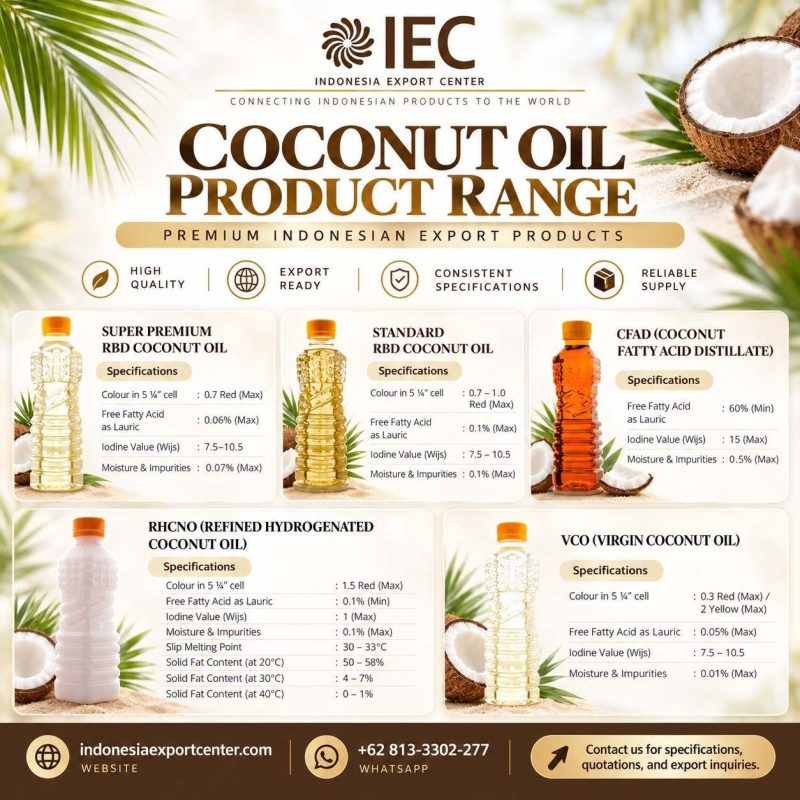
COCONUT OIL PRODUCT RANGE
PREMIUM INDONESIAN EXPORT PRODUCTS
Standard RBD Coconut Oil | Netherlands Import Enquiries | EU Edible Oil Procurement
Indonesian Coconut Oil Sourcing | EU Food Safety Considerations | Rotterdam Logistics | Bulk Export Quotations
Looking for an RBD Coconut Oil Supplier for the Netherlands?
Are you searching for an RBD coconut oil supplier Netherlands sourcing solution for your edible oil importing, ingredient distribution or manufacturing business?
Indonesia Export Center (IEC) facilitates sourcing and export enquiries for Indonesian coconut oil products, including Standard RBD Coconut Oil.
For Dutch importers and European Union food businesses, purchasing refined coconut oil involves evaluating product specifications, the actual manufacturer, quality documentation, EU food safety requirements, customs procedures and international shipping arrangements.
The Netherlands can serve as a European entry and distribution location, particularly for companies using Dutch ports and logistics infrastructure.
However, importing a product into the Netherlands does not automatically establish its compliance with every EU food regulation or its eligibility for distribution throughout the European Union.
IEC welcomes enquiries from Netherlands-based businesses seeking to evaluate Indonesian Standard RBD Coconut Oil for:
- Edible oil importing
- Food ingredient distribution
- Industrial food manufacturing
- Ingredient blending
- Selected bakery and confectionery applications, subject to technical suitability
- Other industrial uses
REQUEST RBD COCONUT OIL INFORMATION FOR NETHERLANDS IMPORTS
WhatsApp: https://wa.me/628133302277
Website: https://indonesiaexportcenter.com/
Product availability, food-grade suitability, certifications, MOQ, packaging, prices and shipment arrangements must be verified for each proposed order.
1. RBD Coconut Oil Netherlands Import Overview
| Procurement Item | Information |
|---|---|
| Product | Standard RBD Coconut Oil |
| Country of Sourcing | Indonesia |
| Target Market | Netherlands |
| Regional Market | European Union |
| Target Buyers | Dutch Edible Oil Importers, Ingredient Distributors |
| Manufacturer | To Be Verified |
| Contractual Seller | To Be Confirmed |
| Exporter of Record | To Be Confirmed |
| Product Specification | Supplied Reference Available |
| Batch COA | To Be Requested and Verified |
| EU Food Compliance | Buyer to Verify |
| Food Safety Documentation | To Be Requested and Verified |
| MOQ | To Be Confirmed |
| Available Quantity | To Be Confirmed |
| Packaging | To Be Confirmed |
| Indonesian Port of Shipment | To Be Confirmed |
| Dutch Destination Port | Buyer to Specify |
| FOB / CIF Pricing | Request Quotation |
| Shipment Lead Time | To Be Confirmed |
2. Why Netherlands Buyers Consider Indonesian RBD Coconut Oil
Dutch importers may evaluate Indonesian RBD Coconut Oil as part of international sourcing and supply diversification.
Supplier evaluation should consider:
- Technical quality
- Batch consistency
- Food safety documentation
- Commercial conditions
- Logistics feasibility
- Traceability
- Regulatory compliance
No historical IEC export volume to the Netherlands is claimed.
3. The Netherlands as a European Logistics Gateway
The Netherlands has established port, transport and distribution infrastructure.
Importers may use Dutch entry points as part of supply arrangements serving customers in the Netherlands or elsewhere in Europe.
The appropriate route depends on actual shipping availability, customs arrangements and destination requirements.
4. Rotterdam and European Port Logistics
Rotterdam is a major European port and may be considered by buyers planning imports into the Netherlands.
However, no confirmed IEC shipment route, carrier booking or freight quotation to Rotterdam is claimed.
Buyers should specify the actual destination port when requesting a quotation.
5. Rotterdam vs Other Destination Options
The preferred destination may depend on:
- Importer’s warehouse location
- Shipping route
- Port handling facilities
- Freight cost
- Customs arrangements
- Inland transportation
- Cargo packaging
6. RBD Coconut Oil Product Definition
RBD means Refined, Bleached and Deodorised.
The refining process is intended to reduce certain impurities, colour and odour.
The RBD designation alone does not establish compliance with EU food law.
7. Standard RBD Coconut Oil Technical Specifications
IEC’s supplied reference for Standard RBD Coconut Oil is:
| Quality Parameter | Reference Specification |
|---|---|
| Colour in 5¼-inch Cell | 0.7–1.0 Red (Max) |
| Free Fatty Acid as Lauric | 0.1% (Max) |
| Iodine Value (Wijs) | 7.5–10.5 |
| Moisture & Impurities | 0.1% (Max) |
Technical clarification: The colour entry combines a range and a maximum designation. The actual acceptance limit and analytical method must be confirmed with the manufacturer.
These are supplied reference specifications, not verified results for an identified shipment.
8. Standard vs Super Premium RBD Coconut Oil
| Parameter | Standard RBD | Super Premium RBD |
|---|---|---|
| Colour in 5¼-inch Cell | 0.7–1.0 Red (Max), Clarification Required | 0.7 Red (Max) |
| FFA as Lauric | 0.1% (Max) | 0.06% (Max) |
| Iodine Value (Wijs) | 7.5–10.5 | 7.5–10.5 |
| Moisture & Impurities | 0.1% (Max) | 0.07% (Max) |
The appropriate grade depends on the buyer’s technical requirements.
No grade-specific stock or pricing has been verified.
9. Confirm the Intended Food Application
Dutch buyers should identify whether the product is intended for:
- Food ingredient manufacturing
- Ingredient distribution
- Bakery formulations
- Confectionery formulations
- Other food applications
- Non-food industrial uses
Suitability must be established through product testing and relevant compliance verification.
10. EU Food Safety Requirements
Food products placed on the EU market must comply with applicable EU food legislation.
Importers should determine the requirements relevant to the product, processing history, intended use and distribution arrangements.
11. General Food Law
Regulation (EC) No 178/2002 establishes foundational principles of EU food law, including responsibilities relating to food safety and traceability.
Buyers should evaluate how the applicable obligations affect their importing business.
12. Food Business Operator Responsibilities
EU food business operators have responsibilities for ensuring that food under their control meets applicable requirements.
Importers should not rely solely on a supplier’s marketing description as evidence of compliance.
13. EU Food Hygiene Requirements
Applicable EU food hygiene rules may affect the handling, storage and distribution of imported edible oils.
Importers should review the requirements relevant to their operations.
14. HACCP-Based Procedures
Food business operators may be required to implement procedures based on HACCP principles, subject to the applicable rules and activities.
No HACCP certification is claimed for an IEC supplier.
15. EU Traceability Requirements
Traceability is an important part of EU food compliance.
Buyers should verify the ability to identify the relevant supplier, product lots and customers in accordance with applicable obligations.
16. EU Contaminant Requirements
Food products may be subject to maximum levels for specified contaminants.
The applicable requirements depend on the actual product category and intended use.
17. 3-MCPD Esters and Glycidyl Esters
Refined edible oils may require evaluation for process contaminants such as 3-MCPD esters and glycidyl esters, where relevant.
Buyers should determine the applicable EU limits and obtain appropriate test results.
No contaminant test result or compliance claim is provided.
18. Pesticide Residue Considerations
Where relevant, EU pesticide residue requirements should be reviewed for the actual product.
The importer should determine the applicable scope and documentation.
19. Other Relevant Contaminants
Depending on the product and application, buyers may assess additional contaminants.
Testing requirements should be based on the applicable legal and technical framework.
20. Food-Grade Verification
The term RBD does not automatically establish food-grade suitability.
Buyers should verify:
- Intended-use compliance
- Relevant contaminant results
- Food safety documentation
- Packaging suitability
- Traceability
- Applicable EU requirements
21. Certificate of Analysis
A batch-specific COA should be requested.
It may include:
- Manufacturer
- Product name
- Batch number
- Test methods
- Analytical results
- Testing date
- Document issuer
No verified batch COA has been supplied.
22. Specification Sheet vs COA
A specification sheet states the intended product requirements.
A COA reports analytical results for a particular batch or sample.
Both may be relevant to supplier approval.
23. Free Fatty Acid Specification
The supplied Standard RBD reference specifies:
FFA as Lauric: 0.1% Maximum
Buyers should verify the actual batch result.
24. Moisture and Impurities
The supplied reference specifies:
Moisture & Impurities: 0.1% Maximum
Additional testing may be needed depending on the application.
25. Iodine Value
The supplied reference specifies:
Iodine Value (Wijs): 7.5–10.5
26. Colour Specification
The supplied reference specifies:
Colour in 5¼-inch Cell: 0.7–1.0 Red (Max)
The manufacturer should clarify the intended limit and measurement method.
27. Peroxide Value
Peroxide value may be relevant to oxidation-related quality evaluation.
No peroxide value specification or batch result has been provided.
28. Fatty Acid Profile
Buyers may request a fatty acid profile for formulation or quality evaluation.
No numerical profile is claimed.
29. Supplier Identity Verification
Dutch importers should verify:
- Actual manufacturer
- Manufacturing address
- Contractual seller
- Exporter of record
- Business registration
- Relevant licences
- Authorised contact details
30. Manufacturer vs Trading Company
The manufacturer, trader and exporter may be different entities.
Their roles should be clarified before purchase.
31. Supplier Certification Verification
Buyers may request information about relevant certifications.
No ISO, HACCP, Halal, FSSC 22000 or other certification is claimed without verification.
32. Certification Scope
A certificate should be reviewed for:
- Legal entity
- Facility
- Product scope
- Issuing body
- Validity period
- Authenticity
33. Supplier Audit
An importer may request an onsite or remote supplier audit.
Audit availability and scope depend on supplier agreement.
34. Independent Laboratory Testing
Buyers may request independent testing, subject to sampling arrangements and laboratory availability.
35. Pre-Shipment Inspection
Independent inspection may cover:
- Product identification
- Packaging
- Quantity
- Loading
- Documentation
36. EORI Number for EU Importers
Economic Operators Registration and Identification (EORI) is used for customs identification in the EU.
Dutch importers should verify whether they need an EORI number and ensure their customs arrangements are appropriate.
37. EU Customs Classification
The correct Combined Nomenclature or TARIC classification should be determined for the actual product.
No specific tariff code is asserted.
38. EU Import Duties
Applicable duties depend on classification, origin, trade measures and any available preferential arrangements.
No tariff rate is claimed.
39. Preferential Origin and Trade Agreements
Buyers should verify whether any preferential tariff treatment is applicable at the time of import.
Preferential treatment should not be assumed without confirming the applicable agreement, origin rules and supporting evidence.
40. Dutch Import VAT
Import VAT treatment depends on the applicable Dutch tax rules and the importer’s circumstances.
Buyers should consult appropriate tax and customs advisers.
41. Article 23 Import VAT Arrangements
Certain qualifying businesses may be able to use Dutch import VAT deferment arrangements under Article 23, subject to the applicable conditions.
Eligibility should be verified with a qualified adviser.
42. Customs Clearance in the Netherlands
The importer should coordinate customs entry and clearance requirements with its customs representative or internal customs team.
43. Dutch Food Safety Oversight
The Netherlands Food and Consumer Product Safety Authority (NVWA) is among the authorities relevant to food safety oversight in the Netherlands.
The importer should verify which requirements and controls apply to the shipment.
44. Import Documentation
Depending on the transaction, documentation may include:
- Commercial invoice
- Packing list
- Bill of lading
- Certificate of Origin
- Certificate of Analysis
- Insurance documents
- Other relevant certificates
45. Commercial Invoice
The commercial invoice should accurately identify the product, parties, quantity, value, currency and commercial terms.
46. Packing List
The packing list should reflect the actual packaging, quantities and weights.
47. Bill of Lading
The transport document should correspond to the actual shipment and agreed documentary requirements.
48. Certificate of Origin
Origin documentation may be relevant to customs requirements or trade preferences.
The correct form and eligibility must be verified.
49. Packaging Options for Netherlands Buyers
Potential packaging enquiries may include:
- Steel drums
- IBC tanks
- Flexitank arrangements
- Other bulk packaging
Availability and suitability require confirmation.
50. Steel Drum Packaging
Buyers should confirm:
- Drum material
- Internal lining
- Net fill
- Closure
- Labelling
- Loading configuration
51. IBC Tank Packaging
Buyers should confirm:
- IBC material
- Product-contact suitability
- Capacity
- Net fill
- Valve specifications
- Handling arrangements
52. Flexitank Packaging
Flexitank use requires verification of:
- Product compatibility
- Carrier approval
- Filling procedures
- Discharge arrangements
- Container suitability
- Insurance conditions
53. EU Food-Contact Material Requirements
Where packaging contacts food, the applicable EU food-contact material requirements should be evaluated.
Packaging suitability should be supported by relevant supplier documentation.
54. Packaging Traceability
Buyers may require packaging identification and records supporting traceability and quality investigations.
55. Temperature and Handling Considerations
Coconut oil may change physical state with temperature.
Handling arrangements should be appropriate for the actual route, packaging and receiving facilities.
No specific heating or discharge temperature is claimed.
56. Minimum Order Quantity
MOQ depends on the actual supplier and packaging format.
No fixed MOQ has been verified.
57. Available Quantity
No ready stock or available quantity has been verified.
58. Production Lead Time
Production and preparation time depend on the supplier’s actual arrangements.
No fixed lead time is guaranteed.
59. FOB Quotations from Indonesia
FOB may be considered for suitable sea shipments.
The named Indonesian port of shipment should be agreed.
For certain containerised delivery arrangements, FCA may be more appropriate.
60. CIF Quotations to the Netherlands
Under CIF Incoterms® 2020, the seller contracts and pays for carriage to the named destination port and obtains the insurance required by the CIF rule.
Risk generally transfers when the goods are delivered on board at the shipment port.
For certain containerised arrangements, CIP may be more appropriate.
61. CIF Rotterdam Enquiries
Buyers may request a quotation naming Rotterdam as the destination port.
No confirmed CIF Rotterdam price, carrier service or shipment availability is claimed.
62. Freight and Insurance
Freight and insurance depend on the actual cargo, route, shipment period and agreed commercial terms.
No rate or premium has been verified.
63. Dutch Landed Cost
The buyer’s landed cost may include:
- Product value
- Ocean freight
- Cargo insurance
- Import duties
- Import VAT
- Port and terminal charges
- Customs brokerage
- Inland transportation
- Warehousing
64. Distribution Within the EU
After lawful importation and customs release, goods may be distributed under applicable EU and national requirements.
Buyers should verify food compliance, traceability, labelling and other obligations before onward distribution.
65. Distribution to Other EU Countries
A Dutch import arrangement may form part of a wider European supply chain.
However, compliance with applicable EU and destination-specific requirements must still be established.
66. Storage and Warehousing
Edible oil storage arrangements should account for:
- Product integrity
- Temperature
- Cleanliness
- Packaging
- Traceability
- Stock rotation
67. Product Shelf Life
Shelf life depends on the actual product, packaging and storage conditions.
No shelf-life period has been verified.
68. Payment Terms
Payment arrangements should be agreed with the contractual seller.
Buyers should independently verify banking details.
69. Purchase Contract
The contract should clearly identify:
- Buyer and seller
- Product grade
- Specifications
- Quantity
- Packaging
- Price
- Currency
- Incoterm
- Named port
- Shipment period
- Quality acceptance criteria
- Payment terms
- Claims procedures
70. Receiving Inspection
Upon arrival, buyers should check:
- Packaging condition
- Quantity
- Lot identification
- Document consistency
- Product quality under the receiving programme
71. Nonconforming Product
The contract should define procedures for quality disputes, shortages, damage, retesting and claims.
72. Repeat Supply Planning
Buyers planning repeat orders should evaluate supplier reliability, lead time, product consistency and inventory requirements.
No ongoing supply commitment is claimed.
73. Common Mistakes in EU Coconut Oil Imports
Common mistakes include:
- Assuming RBD automatically means EU food compliant
- Failing to verify contaminant limits
- Treating a specification sheet as a batch COA
- Assuming certifications without evidence
- Using an unverified tariff classification
- Ignoring food-contact packaging requirements
- Confusing port arrival with warehouse delivery
- Assuming Dutch customs clearance alone proves EU food compliance
- Overlooking traceability
- Treating indicative freight prices as confirmed offers
Netherlands and EU Import Due Diligence Checklist
Supplier Verification
-
Actual manufacturer identified
-
Contractual seller confirmed
-
Exporter of record confirmed
-
Company information verified
-
Manufacturing facility reviewed
-
Relevant certifications checked
Product and Food Safety
-
Standard RBD grade confirmed
-
Technical specification reviewed
-
Colour acceptance criterion clarified
-
Batch COA requested
-
Relevant contaminant testing reviewed
-
EU food compliance assessed
-
Traceability arrangements checked
-
Food-contact packaging suitability verified
Customs and Import
-
EORI requirements checked
-
Customs classification confirmed
-
Import duties reviewed
-
Import VAT treatment reviewed
-
Origin documentation requirements checked
-
Customs representative appointed if needed
-
Applicable NVWA requirements reviewed
Commercial
-
MOQ confirmed
-
Available quantity confirmed
-
Packaging confirmed
-
Price per MT confirmed
-
Incoterm agreed
-
Named port confirmed
-
Payment terms agreed
-
Bank details verified
-
Shipment period confirmed
Logistics
-
Port of shipment confirmed
-
Destination port confirmed
-
Freight arrangements reviewed
-
Cargo insurance reviewed
-
Container loading verified
-
Inland delivery planned
-
Receiving inspection arranged
RFQ Template – RBD Coconut Oil Supplier for Netherlands Buyers
Subject: RFQ – Standard RBD Coconut Oil Import to the Netherlands
Dear Indonesia Export Center Team,
We are evaluating Standard RBD Coconut Oil from Indonesia for import into the Netherlands and potential distribution within the European Union.
Please provide the available product specifications, manufacturer information, food safety documentation, packaging options and commercial quotation.
Buyer Information
Company Name: [Company Name]
Country: Netherlands
Business Type: [Edible Oil Importer / Ingredient Distributor / Manufacturer / Other]
Contact Person: [Name]
Email: [Email]
Phone / WhatsApp: [Number]
Product Requirements
Product: Standard RBD Coconut Oil
Required Quantity: [MT]
Intended Application: [Food Manufacturing / Ingredient Distribution / Other]
Additional Technical Requirements: [Details]
Reference Specifications
| Parameter | Reference |
|---|---|
| Colour in 5¼-inch Cell | 0.7–1.0 Red (Max), Please Clarify |
| FFA as Lauric | 0.1% (Max) |
| Iodine Value (Wijs) | 7.5–10.5 |
| Moisture & Impurities | 0.1% (Max) |
EU Food Safety Documentation Requested
Please provide available information regarding:
- Manufacturer and facility identification
- Current technical specification
- Batch-specific COA
- Relevant contaminant testing
- Traceability arrangements
- Food safety management documentation
- Relevant certifications
- Food-contact packaging suitability
- Additional laboratory testing availability
Packaging Requirements
Preferred Packaging: [Steel Drums / IBC / Flexitank / Other]
Preferred Net Fill: [Specify]
Special Requirements: [Details]
Shipping Requirements
Destination Country: Netherlands
Destination Port: [Rotterdam / Other Port]
Preferred Incoterm: [FCA / FOB / CFR / CIF / CIP / Other]
Target Shipment Period: [Month / Year]
Commercial Information Requested
Please provide:
- Actual manufacturer identity
- Contractual seller and exporter of record
- Current product specification
- Batch COA availability
- Relevant food safety documentation
- MOQ
- Available quantity
- Packaging options
- Price per MT
- Incoterm and named port
- Freight quotation if applicable
- Insurance information if applicable
- Production lead time
- Estimated shipment period
- Export documentation
- Payment terms
- Quotation validity
- Any additional conditions
We will review the technical documentation, supplier information and applicable EU import requirements before proceeding with a purchase order.
Kind regards,
[Your Name] [Company Name] NetherlandsSEND YOUR NETHERLANDS IMPORT ENQUIRY
WhatsApp: https://wa.me/628133302277
Frequently Asked Questions – RBD Coconut Oil Supplier Netherlands
Can Dutch companies import RBD coconut oil from Indonesia?
Dutch companies may evaluate importing RBD coconut oil, subject to supplier availability and applicable EU and Dutch import requirements.
Is Indonesian RBD coconut oil automatically EU food compliant?
No. Compliance must be established for the actual product and intended use.
Can Rotterdam be used as a destination port?
Buyers may request a Rotterdam quotation, subject to shipping feasibility and carrier availability.
Is Rotterdam the only possible destination?
No. The appropriate port depends on the buyer’s logistics requirements.
Is a batch COA available?
A batch-specific COA should be requested and verified.
What is the FFA specification?
The supplied Standard RBD reference states 0.1% maximum FFA as lauric.
What is the iodine value?
The supplied reference states 7.5–10.5 using the Wijs method.
What is the moisture and impurities specification?
The supplied reference states 0.1% maximum.
What is the peroxide value?
No peroxide value limit or batch result has been supplied.
Are 3-MCPD and glycidyl ester results available?
Availability of relevant contaminant testing must be confirmed.
Is the product food grade?
Food-grade suitability has not been verified for a specific supplier or batch.
Is HACCP certification available?
Certification availability and validity must be verified.
Is Halal certification available?
Certification availability and validity must be verified.
Do Dutch importers need an EORI number?
Importers should verify the applicable EORI requirements for their customs activities.
What is the EU import duty?
The duty depends on the applicable customs classification, origin and current tariff measures.
Is preferential tariff treatment available?
Eligibility must be verified under the applicable rules and agreements at the time of import.
Is import VAT payable?
Import VAT treatment depends on Dutch law and the importer’s circumstances.
Can imported oil be distributed to other EU countries?
Onward distribution is possible subject to applicable customs, food safety, traceability and other requirements.
What is the MOQ?
No MOQ has been verified.
Can I request a 20 MT quotation?
Yes, as a buyer enquiry. Availability and loading feasibility require confirmation.
Is steel drum packaging available?
Availability and specifications require confirmation.
Is IBC packaging available?
IBC availability requires confirmation.
Is flexitank packaging available?
Suitability, availability and carrier approval must be verified.
Can I request FOB pricing?
Yes. The named Indonesian port of shipment should be specified.
Can I request CIF Rotterdam pricing?
Yes. A formal quotation can be requested, subject to supplier and freight confirmation.
How long does shipment take?
No production or shipping lead time has been verified.
Can I request independent inspection?
Inspection may be requested, subject to agreement and availability.
How do I request a quotation?
Contact IEC with your quantity, intended application, destination port, packaging requirements and target shipment period.
Request Standard RBD Coconut Oil Information for Netherlands Imports
Explore Indonesian Standard RBD Coconut Oil Sourcing for Dutch and EU Procurement
Indonesia Export Center (IEC) welcomes enquiries from Netherlands-based edible oil importers, ingredient distributors, food manufacturers and procurement teams.
Product: Standard RBD Coconut Oil
Country of Sourcing: Indonesia
Target Market: Netherlands / European Union
Reference Colour: 0.7–1.0 Red (Max) in 5¼-inch Cell, Subject to Clarification
Reference FFA as Lauric: 0.1% Maximum
Reference Iodine Value (Wijs): 7.5–10.5
Reference Moisture & Impurities: 0.1% Maximum
Manufacturer: To Be Verified
Batch COA: To Be Requested and Verified
EU Food Compliance: Buyer to Verify
Relevant Contaminant Testing: To Be Requested and Verified
Food Safety Certifications: To Be Verified
MOQ: To Be Confirmed
Available Quantity: To Be Confirmed
Packaging: To Be Confirmed
Price per MT: Request Quotation
Shipment Lead Time: To Be Confirmed
Destination Port: Buyer to Specify
Contact IEC to request product information, supplier documentation and a commercial quotation for your proposed Netherlands import.
IEC | INDONESIA EXPORT CENTER
CONNECTING INDONESIAN PRODUCTS TO THE WORLD
Website: https://indonesiaexportcenter.com/
WhatsApp: +62 813-3302-277
REQUEST RBD COCONUT OIL INFORMATION FOR NETHERLANDS BUYERS
Please include your company name, required quantity in MT, intended application, Dutch destination port, packaging requirements and target shipment period.
EU Import and Product Disclaimer: This page provides general sourcing and import information, not legal, customs, tax or regulatory advice. EU and Dutch import requirements depend on the actual product, intended use, importer, shipment and current regulations. Buyers should verify requirements with relevant authorities, customs representatives and qualified advisers. No EU food compliance, certification, contaminant test result, batch COA, stock, MOQ, packaging availability, price, freight rate or lead time has been independently verified. The supplied Standard RBD colour specification requires clarification. The Netherlands and European Union are target markets and do not establish any verified previous IEC export shipment or import transaction. IEC facilitates sourcing and export enquiries; the actual manufacturer, contractual seller and exporter of record must be confirmed for each transaction.
