

IEC | INDONESIA EXPORT CENTER
CONNECTING INDONESIAN PRODUCTS TO THE WORLD
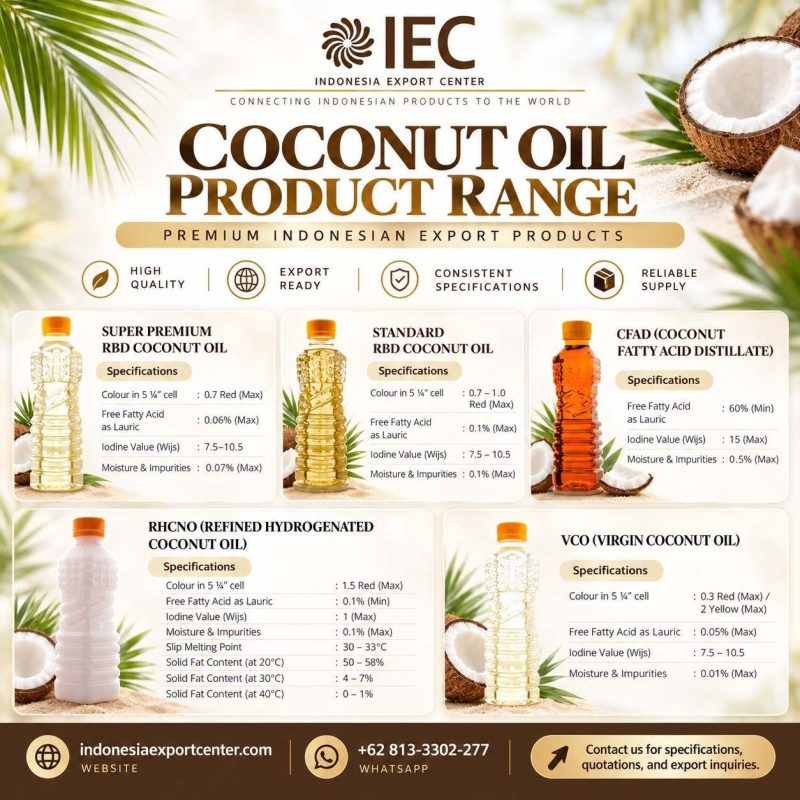
COCONUT OIL PRODUCT RANGE
PREMIUM INDONESIAN EXPORT PRODUCTS
HIGH QUALITY | EXPORT READY | CONSISTENT SPECIFICATIONS | RELIABLE SUPPLY
Standard RBD Coconut Oil | Monthly Bulk Supply Enquiries | Repeat-Order Planning | Contract Quantity Tolerance | Shipment Scheduling
Looking for an RBD Coconut Oil Monthly Supply Contract?
Are you searching for an RBD coconut oil monthly supply contract to support your manufacturing, distribution, ingredient trading or industrial procurement operations?
Indonesia Export Center (IEC) facilitates sourcing and export enquiries for Indonesian coconut oil products, including Standard RBD Coconut Oil.
For buyers with recurring requirements, a monthly supply arrangement may provide a structured framework for planning order quantities, delivery periods, product quality, pricing and documentation.
However, a monthly supply contract requires more than a supplier quotation. Buyers and sellers should agree on actual production capacity, quantity commitments, shipment schedules, acceptable tolerances, pricing mechanisms, quality acceptance criteria and remedies for non-performance.
IEC welcomes enquiries from international contract buyers, manufacturers, industrial distributors, procurement managers and raw material traders evaluating Indonesian Standard RBD Coconut Oil for recurring bulk purchases.
Important: No monthly supply capacity, fixed allocation, recurring shipment commitment or executed supply contract is currently verified. Any proposed arrangement is subject to supplier qualification, commercial negotiation and written agreement.
Request Information About:
- Standard RBD Coconut Oil specifications
- Actual manufacturer and contractual seller
- Batch Certificate of Analysis (COA)
- Monthly supply availability
- Minimum order quantity
- Proposed monthly contract volume
- Shipment frequency
- Quantity tolerance
- Contract duration
- Fixed or adjustable pricing mechanisms
- Packaging options
- FOB Indonesia or destination quotations
- Production lead time
- Contract documentation
REQUEST A MONTHLY RBD COCONUT OIL SUPPLY PROPOSAL
WhatsApp: https://wa.me/628133302277
Website: https://indonesiaexportcenter.com/
All monthly quantities, supply commitments, prices, packaging, documentation and shipment schedules require supplier verification and contractual agreement.
1. Monthly RBD Coconut Oil Procurement Overview
| Procurement Item | Information |
|---|---|
| Product | Standard RBD Coconut Oil |
| Country of Sourcing | Indonesia |
| Target Market | Global |
| Buyer Type | Contract Buyers, Manufacturers, Importers, Distributors |
| Procurement Model | Proposed Recurring Monthly Supply |
| Actual Manufacturer | To Be Verified |
| Contractual Seller | To Be Confirmed |
| Exporter of Record | To Be Confirmed |
| Technical Specification | Supplied Reference Available |
| Batch COA | To Be Requested and Verified |
| Monthly Supply Capacity | Not Verified |
| Minimum Order Quantity | To Be Confirmed |
| Contract Duration | To Be Negotiated |
| Monthly Contract Quantity | Buyer to Specify |
| Quantity Tolerance | To Be Negotiated |
| Shipment Frequency | To Be Agreed |
| Packaging | To Be Confirmed |
| Price per MT | Request Quotation |
| Pricing Mechanism | To Be Negotiated |
| Delivery Terms | To Be Agreed |
| Production Lead Time | To Be Confirmed |
| Payment Terms | To Be Agreed |
2. What Is a Monthly Coconut Oil Supply Contract?
A monthly supply contract is a commercial agreement under which a buyer and seller establish terms for supplying specified quantities of coconut oil over recurring monthly periods.
Depending on the agreement, the contract may define:
- Total contract quantity
- Monthly shipment quantity
- Shipment windows
- Product specifications
- Packaging
- Pricing
- Payment terms
- Quantity tolerance
- Quality acceptance
- Documentation
- Contract duration
- Remedies for non-performance
A recurring supply agreement should clearly distinguish binding purchase commitments from indicative forecasts.
3. Who Uses Monthly Supply Contracts?
Potential buyers include:
- Food ingredient manufacturers
- Industrial processors
- Soap manufacturers
- Oleochemical companies
- Ingredient distributors
- Wholesale traders
- Contract procurement teams
- Private label businesses sourcing bulk oil
The appropriate contract structure depends on each buyer’s consumption and commercial requirements.
4. Why Buyers Consider Recurring Supply Agreements
Monthly procurement agreements may help buyers organise:
- Production planning
- Inventory replenishment
- Procurement budgets
- Shipping schedules
- Supplier communication
- Quality assurance
- Documentation
- Working capital
These are potential planning benefits, not guarantees of uninterrupted supply or fixed pricing.
5. Spot Purchases vs Monthly Supply Contracts
| Factor | Spot Purchase | Monthly Supply Contract |
|---|---|---|
| Order Structure | Individual transaction | Recurring arrangement |
| Quantity | Per purchase order | Monthly and/or total contract quantity |
| Pricing | Agreed for one transaction | Fixed or adjustable under agreed terms |
| Delivery | Individual shipment | Planned shipment schedule |
| Quality | Shipment-specific acceptance | Ongoing specification plus batch acceptance |
| Supplier Capacity | Confirmed for the order | Must be evaluated across the contract period |
| Buyer Commitment | Individual order | Depends on contract terms |
| Commercial Flexibility | Transaction-specific | Defined by the agreement |
6. Monthly Supply Does Not Mean Guaranteed Availability
A supplier must demonstrate sufficient capability to support the proposed arrangement.
No guaranteed monthly allocation or production capacity is claimed.
Standard RBD Coconut Oil Specifications for Contract Buyers
7. What Is RBD Coconut Oil?
RBD stands for Refined, Bleached and Deodorised.
RBD Coconut Oil undergoes refining stages intended to reduce certain impurities, colour, odour and flavour components.
The RBD designation does not automatically establish food-grade compliance or suitability for every industrial application.
8. Standard RBD Coconut Oil Reference Specifications
| Quality Parameter | Reference Specification |
|---|---|
| Colour in 5¼-inch Cell | 0.7–1.0 Red (Max) |
| Free Fatty Acid as Lauric | 0.1% (Max) |
| Iodine Value (Wijs) | 7.5–10.5 |
| Moisture & Impurities | 0.1% (Max) |
Technical clarification: The supplied colour entry combines a range and a maximum designation. The actual manufacturer should clarify the intended acceptance limit and analytical method before contract execution.
These are reference specifications, not verified results for any specific production batch.
9. Super Premium RBD Coconut Oil Reference
An alternative grade in the supplied product range is Super Premium RBD Coconut Oil.
| Quality Parameter | Reference Specification |
|---|---|
| Colour in 5¼-inch Cell | 0.7 Red (Max) |
| Free Fatty Acid as Lauric | 0.06% (Max) |
| Iodine Value (Wijs) | 7.5–10.5 |
| Moisture & Impurities | 0.07% (Max) |
Availability must be verified separately.
10. Selecting the Correct Contract Grade
The purchase agreement should identify the exact product grade.
A seller should not substitute a different grade without the buyer’s approval.
11. Free Fatty Acid Acceptance
The supplied Standard RBD reference states:
FFA as Lauric: 0.1% Maximum
The contract should identify the relevant analytical method and acceptance process.
12. Moisture and Impurities
The supplied reference states:
Moisture & Impurities: 0.1% Maximum
13. Iodine Value
The supplied reference states:
Iodine Value (Wijs): 7.5–10.5
14. Colour Acceptance
The supplied reference states:
Colour in 5¼-inch Cell: 0.7–1.0 Red (Max)
The final acceptance limit must be clarified.
15. Additional Technical Requirements
Depending on the application, buyers may request:
- Peroxide value
- Fatty acid composition
- Saponification value
- Relevant contaminants
- Other application-specific tests
No additional numerical specifications are claimed.
16. Contract Specification Attachment
The final agreed specification should be attached to or clearly incorporated into the supply agreement.
17. Changes to Product Specifications
The contract should define how technical specification changes are proposed, reviewed and approved.
18. Product Substitution
Substitution should require appropriate buyer approval.
Monthly Quantity Planning
19. Define Monthly Consumption
The buyer should estimate actual monthly consumption rather than relying only on an annual purchasing target.
20. Monthly Contract Quantity
The buyer should specify the intended quantity in metric tons per month.
The supplier must confirm whether it can support the requested volume.
21. Total Contract Quantity
A contract may define both a monthly quantity and an aggregate quantity for the full contract period.
22. Illustrative Monthly Supply Schedule
The following is a hypothetical planning example, not an IEC supplier offer.
| Contract Month | Indicative Quantity |
|---|---|
| Month 1 | 20 MT |
| Month 2 | 20 MT |
| Month 3 | 20 MT |
| Month 4 | 20 MT |
| Month 5 | 20 MT |
| Month 6 | 20 MT |
| Illustrative Total | 120 MT |
The 20 MT figure is an example only. It is not a verified MOQ, container payload, supplier capacity or shipment commitment.
23. Monthly Quantity vs Shipment Quantity
A monthly requirement may be fulfilled through one or more shipments, depending on supplier capability, packaging and logistics.
24. Contract Quantity vs Forecast Quantity
A forecast may help production planning without creating a binding purchase obligation.
The contract should clearly state which quantities are binding.
25. Firm Orders
A firm order should identify the quantity, shipment period and other required transaction details.
26. Rolling Forecasts
A rolling forecast may be used to communicate expected requirements for future months.
The parties should define whether forecast updates are binding or indicative.
27. Forecast Revision Deadlines
The contract may establish deadlines for revising forecasts.
28. Order Confirmation
Each purchase order should be confirmed according to the agreed contract procedure.
29. Minimum Order Quantity
No fixed MOQ has been verified.
30. Minimum Monthly Commitment
Any minimum monthly purchase or supply commitment must be expressly negotiated.
31. Maximum Monthly Quantity
The supplier should confirm whether any maximum monthly volume applies.
32. Volume Increases
Requests for increased quantities should be subject to supplier acceptance and agreed terms.
33. Volume Reductions
The contract should define whether and when the buyer may reduce quantities.
34. Unused Monthly Allocation
The parties should agree whether unused quantities expire, carry forward or require a new agreement.
Quantity Tolerance and Shipment Variance
35. What Is Quantity Tolerance?
Quantity tolerance defines the permitted difference between an agreed quantity and the quantity actually delivered or invoiced.
36. Why Tolerance Matters
Quantity tolerance can affect:
- Production planning
- Container loading
- Freight
- Inventory
- Payment
- Contract compliance
37. Illustrative Quantity Tolerance
A hypothetical contract may allow a specified positive or negative tolerance.
For example, a 20 MT order with an agreed ±5% tolerance would permit a quantity range of 19 MT to 21 MT, if the parties explicitly adopt that term.
This is an illustration only. IEC does not claim a standard ±5% tolerance or that these quantities are physically loadable in any particular container.
38. Tolerance Is Not Automatically Included
No quantity tolerance applies unless established by the agreement or otherwise applicable contractual terms.
39. Tolerance Measurement Basis
The contract should define whether tolerance applies to:
- Each shipment
- Each purchase order
- Each month
- The total contract quantity
40. Quantity Measurement Method
The parties should define the measurement method and supporting documents.
41. Net Weight vs Gross Weight
The contract should distinguish net product weight from packaging and gross shipment weight.
42. Quantity Reconciliation
Delivered quantities should be reconciled against invoices, packing lists and other agreed records.
43. Under-Delivery
The contract should define how under-delivery is handled.
44. Over-Delivery
The contract should define whether over-delivery requires buyer approval.
45. Tolerance and Invoicing
The parties should agree whether invoicing is based on actual delivered quantity or another defined basis.
46. Contract Quantity Reconciliation
A reconciliation procedure may be useful for comparing scheduled, ordered, shipped and accepted quantities.
Monthly Shipment Scheduling
47. Shipment Frequency
Possible structures include:
- One shipment per month
- Multiple shipments per month
- Shipment against individual call-off orders
Availability and feasibility must be verified.
48. Shipment Windows
A shipment window defines the agreed period for shipment.
49. Shipment Date Confirmation
The parties should agree how shipment dates are proposed and confirmed.
50. Production Scheduling
The supplier should confirm production scheduling requirements.
51. Packaging Scheduling
Packaging availability may influence shipment timing.
52. Testing and Inspection Time
Quality testing and inspection should be included in the shipment planning process.
53. Export Documentation Time
Documentation preparation should be considered when planning shipment dates.
54. Vessel Booking
Vessel schedules and bookings depend on actual freight availability.
55. Shipping Delays
The contract should define notice requirements and consequences for delay.
56. Partial Shipments
The parties should state whether partial shipments are permitted.
57. Shipment Rescheduling
The contract should define how shipment dates may be revised.
58. Delivery Priority
No priority allocation or guaranteed delivery status is claimed.
Contract Pricing and Commercial Terms
59. Price per Metric Ton
The contract should identify the agreed price per MT or the method used to calculate it.
60. Fixed Price Contracts
A fixed-price arrangement may establish a price for a defined period.
Any fixed-price commitment requires explicit supplier agreement.
61. Adjustable Price Contracts
An adjustable-price arrangement may define a mechanism for revising prices.
62. Price Review Frequency
The parties should agree when prices may be reviewed.
63. Price Adjustment Formula
Any price adjustment formula should be clearly documented.
No particular index or pricing formula is claimed.
64. Currency
The contract should identify the transaction currency.
65. Quotation Validity
The supplier should confirm how long a quotation remains valid.
66. Packaging Costs
The parties should specify whether packaging is included in the unit price.
67. Freight Costs
Freight costs depend on route, packaging, carrier and shipment period.
68. Insurance Costs
Insurance obligations depend on the agreed commercial terms.
69. Duties and Taxes
Applicable duties and taxes depend on the destination and import arrangements.
70. Total Landed Cost
Buyers should compare the full landed cost rather than only the product price.
71. Payment Terms
Payment terms should be negotiated with the actual contractual seller.
72. Payment Security
Buyers should evaluate appropriate payment security arrangements and independently verify bank details.
73. Late Payment
The contract should define consequences for late payment.
74. Credit Terms
No supplier credit terms are claimed.
75. Price Changes Between Monthly Shipments
The agreement should clearly state whether price changes affect confirmed orders, future orders or both.
Quality Assurance for Repeat Orders
76. Supplier Qualification
Buyers should verify the actual manufacturer and relevant supply chain parties.
77. Manufacturer Verification
Relevant information may include:
- Legal manufacturer name
- Manufacturing address
- Company registration
- Facility information
- Product documentation
- Relevant licences
78. Contractual Seller
The legal seller responsible for contractual performance should be identified.
79. Exporter of Record
The exporter of record should be confirmed for each applicable shipment.
80. Product Specification Sheet
The product specification should define the agreed quality requirements.
81. Batch Certificate of Analysis
A batch-specific COA should identify:
- Product
- Manufacturer
- Batch number
- Sample identification
- Test methods
- Analytical results
- Testing date
- Document issuer
No verified batch COA has been supplied.
82. COA for Every Shipment
The parties should agree whether a batch-specific COA is required for each shipment and how multiple batches are documented.
83. Batch Traceability
Traceability should link the product batch to relevant packaging and shipment records.
84. Lot Identification
Lot identification should be consistent across applicable documents and packaging.
85. Quality Consistency
Consistency should be evaluated through agreed specifications and actual batch testing.
No consistency guarantee is claimed.
86. Independent Testing
Independent testing may be requested, subject to agreement and laboratory availability.
87. Pre-Shipment Inspection
Inspection may cover:
- Product identification
- Packaging
- Quantity
- Loading
- Documentation
88. Sampling Procedures
Sampling should follow an agreed method.
89. Sample Sealing and Chain of Custody
Appropriate sealing and chain-of-custody procedures may be relevant to independent testing.
90. Quality Acceptance Criteria
The contract should establish how product quality is accepted or rejected.
91. Quality Disputes
The parties should agree on procedures for retesting, independent determination and claims.
92. Nonconforming Shipments
The contract should define the remedies applicable to nonconforming goods.
93. Quality Changes During the Contract
Any proposed changes to specifications, manufacturing arrangements or relevant quality procedures should be handled under agreed change-control provisions.
Packaging and Logistics for Monthly Contracts
94. Bulk Packaging Options
Potential packaging enquiries may include:
- Steel drums
- IBC tanks
- Flexitank arrangements
- Other suitable bulk packaging
Availability and suitability require confirmation.
95. Steel Drum Supply
Buyers should verify drum material, lining, net fill, closure and loading configuration.
96. IBC Tank Supply
Buyers should verify material compatibility, capacity, valves and handling requirements.
97. Flexitank Supply
Flexitank arrangements require verification of carrier approval, container suitability, filling, discharge and insurance conditions.
98. Packaging Consistency
The parties should define whether packaging specifications must remain unchanged across shipments.
99. Packaging Changes
Packaging substitutions should be subject to agreed approval procedures.
100. Container Loading
Actual load quantity depends on container payload, packaging, cargo securing and carrier requirements.
101. Temperature and Handling
Coconut oil may change physical state with temperature.
Appropriate handling arrangements should be established for the actual product and packaging.
102. Storage Requirements
Storage conditions should be evaluated for the intended application and supply chain.
103. FOB Indonesia
Under Incoterms® 2020, FOB risk generally transfers when goods are placed on board at the named shipment port.
For certain containerised shipments, FCA may be more appropriate.
104. CFR Destination
Under CFR, the seller contracts and pays for carriage to the named destination port.
Risk generally transfers on board at origin.
105. CIF Destination
Under CIF, the seller contracts and pays for carriage and obtains the insurance required by the rule.
Risk generally transfers on board at the shipment port.
For certain containerised arrangements, CIP may be more appropriate.
106. Incoterms and Ownership
Incoterms define important delivery, cost and risk obligations but do not, by themselves, determine when legal ownership transfers.
Title transfer should be addressed separately where necessary.
107. Origin Port
The actual Indonesian shipment port must be confirmed.
108. Destination Port
The buyer should identify the intended destination port.
109. Ocean Freight
Freight rates and vessel availability require confirmation.
110. Transit Time
Transit time depends on route, vessel schedule and destination.
No fixed transit time is guaranteed.
111. Shipment Tracking
The parties should agree on appropriate shipment status updates and document-sharing procedures.
112. Export Documentation
Depending on the transaction, documents may include:
- Commercial invoice
- Packing list
- Bill of lading
- Certificate of Origin
- Certificate of Analysis
- Insurance documents
- Other required certificates
113. Import Compliance
The importer should verify customs, product and regulatory requirements in the destination country.
114. Customs Classification
No specific HS code is claimed.
The correct classification must be confirmed for the actual product.
Contract Administration and Risk Management
115. Master Supply Agreement
A master supply agreement may define the general terms governing recurring purchases.
116. Purchase Orders
Individual purchase orders may specify shipment-specific quantities, prices and dates.
117. Contract Duration
The parties should agree on the start date, end date and any extension provisions.
118. Contract Renewal
Renewal should be governed by clearly agreed terms.
119. Contract Amendments
Changes should be documented through an agreed amendment process.
120. Force Majeure
The parties should consider an appropriately drafted force majeure provision.
121. Supply Interruptions
The contract should address notification and remedies for supply interruptions.
122. Buyer Forecast Changes
The parties should define how changes in demand affect purchase commitments.
123. Supplier Capacity Changes
The seller should notify the buyer of material capacity issues according to agreed procedures.
124. Termination
Termination rights and consequences should be clearly defined.
125. Dispute Resolution
The parties should agree on governing law and an appropriate dispute resolution mechanism.
126. Contractual Remedies
The contract should define available remedies for relevant breaches.
127. Confidentiality
Confidentiality provisions may be appropriate for commercial and technical information.
128. Assignment and Subcontracting
The parties should address any restrictions or approval requirements concerning assignment or subcontracting.
129. Contract Review
International supply contracts should be reviewed by qualified legal and commercial advisers.
Monthly Supply Contract Checklist
Supplier Verification
-
Actual manufacturer identified
-
Contractual seller confirmed
-
Exporter of record confirmed
-
Company registration reviewed
-
Supply capability evaluated
-
Relevant certifications verified
Product and Quality
-
Product grade confirmed
-
Technical specification reviewed
-
Colour acceptance criterion clarified
-
Batch COA requirements agreed
-
Testing methods agreed
-
Traceability requirements established
-
Inspection procedures agreed
-
Quality dispute procedures established
Quantity and Scheduling
-
Monthly quantity agreed
-
Total contract quantity agreed
-
MOQ confirmed
-
Monthly capacity verified
-
Quantity tolerance agreed
-
Tolerance measurement basis defined
-
Forecast process agreed
-
Purchase order process established
-
Shipment windows agreed
-
Partial shipment rules defined
Commercial Terms
-
Price per MT agreed
-
Pricing mechanism documented
-
Currency agreed
-
Packaging costs confirmed
-
Incoterm agreed
-
Named port confirmed
-
Payment terms agreed
-
Bank details verified
-
Price review provisions agreed
Contract Risk
-
Delay procedures agreed
-
Under-delivery and over-delivery provisions agreed
-
Force majeure reviewed
-
Termination provisions reviewed
-
Governing law agreed
-
Dispute resolution mechanism agreed
-
Contract reviewed by qualified advisers
RFQ Template – RBD Coconut Oil Monthly Supply Contract
Subject: RFQ – Monthly Standard RBD Coconut Oil Supply Contract from Indonesia
Dear Indonesia Export Center Team,
We are evaluating a recurring monthly supply arrangement for Standard RBD Coconut Oil from Indonesia.
Please provide available manufacturer information, technical specifications, batch COA documentation, packaging options, commercial pricing and confirmation of whether the proposed monthly volume can be supported.
Buyer Information
Company Name: [Company Name]
Country: [Country]
Business Type: [Manufacturer / Importer / Distributor / Industrial Trader / Other]
Contact Person: [Name]
Email: [Email]
Phone / WhatsApp: [Number]
Product Requirements
Product: Standard RBD Coconut Oil
Intended Application: [Food / Industrial / Oleochemical / Soap / Other]
Monthly Required Quantity: [MT per Month]
Proposed Contract Duration: [Months]
Estimated Total Contract Quantity: [MT]
Preferred Shipment Frequency: [Monthly / Multiple Shipments per Month / Other]
Target First Shipment: [Month / Year]
Reference Specifications
| Parameter | Reference |
|---|---|
| Colour in 5¼-inch Cell | 0.7–1.0 Red (Max), Please Clarify |
| FFA as Lauric | 0.1% (Max) |
| Iodine Value (Wijs) | 7.5–10.5 |
| Moisture & Impurities | 0.1% (Max) |
Monthly Supply Requirements
Please confirm:
- Actual manufacturer
- Contractual seller
- Exporter of record
- Available monthly supply capacity
- MOQ
- Ability to support the proposed contract duration
- Production and shipment scheduling requirements
- Whether monthly quantities can be contractually committed
- Proposed quantity tolerance
- Whether partial shipments are possible
- Forecast and purchase order procedures
- Procedures for schedule changes
Quality Documentation Requested
Please provide:
- Current product specification
- Batch-specific COA availability
- Applicable analytical methods
- Traceability information
- Relevant certification information
- Product sample availability
- Independent inspection arrangements, if available
Packaging Requirements
Preferred Packaging: [Steel Drums / IBC / Flexitank / Other]
Preferred Net Fill: [Specify]
Special Requirements: [Details]
Shipping Requirements
Destination Country: [Country]
Destination Port: [Port]
Preferred Incoterm: [FCA / FOB / CFR / CIF / CIP / Other]
Preferred Shipment Window: [Details]
Commercial Terms Requested
Please provide:
- Price per MT
- Currency
- Proposed fixed or adjustable pricing structure
- Price review mechanism, if applicable
- Incoterm and named port
- Freight quotation if applicable
- Insurance information if applicable
- Payment terms
- Production lead time
- Shipment lead time
- Quotation validity
- Proposed contract conditions
We will review the supplier’s verified capabilities, technical documentation, proposed monthly quantity, tolerance, shipment schedule and contractual terms before making a purchasing commitment.
Kind regards,
[Your Name] [Company Name] [Country]SEND YOUR MONTHLY SUPPLY CONTRACT ENQUIRY
WhatsApp: https://wa.me/628133302277
Frequently Asked Questions – RBD Coconut Oil Monthly Supply Contracts
Can I request a monthly RBD Coconut Oil supply contract?
Yes. You may submit a proposed monthly supply enquiry. Actual supplier capacity and contractual availability require verification.
Does IEC guarantee monthly supply?
No. No monthly allocation or recurring shipment commitment has been verified.
Is IEC the manufacturer?
IEC facilitates sourcing and export enquiries. The actual manufacturer and contractual seller must be confirmed.
What is the minimum monthly order quantity?
No minimum monthly quantity has been verified.
Can I request 20 MT per month?
Yes, as a buyer enquiry. This is not a confirmed MOQ or supplier capacity.
Can I request 100 MT per month?
You may request that volume, but feasibility must be verified with the supplier.
Can I arrange a six-month contract?
A six-month arrangement may be proposed, subject to supplier acceptance and agreement.
Can I arrange a twelve-month contract?
A twelve-month arrangement may be proposed, subject to supplier acceptance and agreement.
Is the price fixed for the entire contract?
Not automatically. Pricing must be negotiated and documented.
Can prices change every month?
A price adjustment mechanism may be negotiated.
What is quantity tolerance?
Quantity tolerance is the agreed permissible difference between the ordered and actual quantity.
Is ±5% quantity tolerance standard?
No universal tolerance is claimed. Any tolerance must be agreed for the transaction.
Can monthly quantities change?
Changes depend on the agreed forecast, order and amendment provisions.
Are partial shipments allowed?
Only if permitted by the contract or separately agreed.
Is a batch COA provided for each shipment?
COA requirements should be agreed and verified.
What is the FFA specification?
The supplied Standard RBD reference states 0.1% maximum FFA as lauric.
What is the iodine value?
The supplied reference states 7.5–10.5.
What is the moisture and impurities specification?
The supplied reference states 0.1% maximum.
Can I request independent testing?
Independent testing may be requested, subject to agreement and availability.
Is steel drum packaging available?
Availability requires confirmation.
Is IBC packaging available?
Availability requires confirmation.
Is flexitank packaging available?
Suitability and availability require confirmation.
Can I request FOB Indonesia pricing?
Yes. The named shipment port should be agreed.
Can I request CIF destination pricing?
Yes, subject to supplier and freight confirmation.
What happens if a shipment is delayed?
Consequences depend on the agreed contract terms.
What happens if the delivered quantity is below the agreed tolerance?
The applicable remedy should be defined in the contract.
Can I cancel a monthly purchase order?
Cancellation rights depend on the contract and order terms.
Is production capacity verified?
No production or monthly supply capacity has been independently verified.
Can the supplier reserve monthly stock for my company?
Any reservation or allocation arrangement must be expressly confirmed.
How do I request a monthly supply proposal?
Contact IEC with the required monthly quantity, contract duration, application, packaging, destination and target first shipment date.
Plan Your Monthly RBD Coconut Oil Procurement from Indonesia
A recurring supply arrangement should be built around verified manufacturing capability, clear quality specifications, realistic shipment planning and enforceable commercial terms.
For international buyers evaluating an RBD coconut oil monthly supply contract, IEC welcomes enquiries regarding Indonesian Standard RBD Coconut Oil sourcing.
Request a Monthly Standard RBD Coconut Oil Supply Proposal
Product: Standard RBD Coconut Oil
Country of Sourcing: Indonesia
Procurement Model: Proposed Recurring Monthly Supply
Target Buyers: Global Contract Buyers, Manufacturers, Importers and Distributors
Reference Colour: 0.7–1.0 Red (Max) in 5¼-inch Cell, Subject to Clarification
Reference FFA as Lauric: 0.1% Maximum
Reference Iodine Value (Wijs): 7.5–10.5
Reference Moisture & Impurities: 0.1% Maximum
Actual Manufacturer: To Be Verified
Batch COA: To Be Requested and Verified
Monthly Supply Capacity: Not Verified
MOQ: To Be Confirmed
Monthly Quantity: Buyer to Specify
Contract Duration: To Be Negotiated
Quantity Tolerance: To Be Negotiated
Packaging: To Be Confirmed
Price per MT: Request Quotation
Pricing Mechanism: To Be Negotiated
Shipment Schedule: To Be Agreed
Payment Terms: To Be Agreed
Contact IEC to request supplier information, technical documentation and a commercial proposal for your intended monthly procurement requirements.
IEC | INDONESIA EXPORT CENTER
CONNECTING INDONESIAN PRODUCTS TO THE WORLD
Website: https://indonesiaexportcenter.com/
WhatsApp: +62 813-3302-277
REQUEST A MONTHLY RBD COCONUT OIL SUPPLY PROPOSAL
Please include your company name, destination country, intended application, required monthly quantity in MT, proposed contract duration, packaging requirements and target first shipment date.
Monthly Supply Contract Disclaimer: This page provides general procurement and commercial planning information, not legal, financial, technical or regulatory advice. No manufacturer, certification, food-grade approval, batch COA, stock, MOQ, monthly production capacity, reserved allocation, packaging availability, price, freight rate, lead time or recurring supply commitment has been independently verified. Any monthly supply contract, quantity tolerance, price mechanism, shipment schedule, payment arrangement or guarantee must be separately negotiated and documented with the actual contractual seller. The supplied Standard RBD colour specification requires clarification. Illustrative quantities and tolerances are hypothetical examples and do not represent IEC offers or confirmed supplier capabilities. IEC facilitates sourcing and export enquiries; the actual manufacturer, contractual seller and exporter of record must be confirmed for each transaction. Buyers should obtain qualified legal and commercial review before executing an international supply agreement.
