

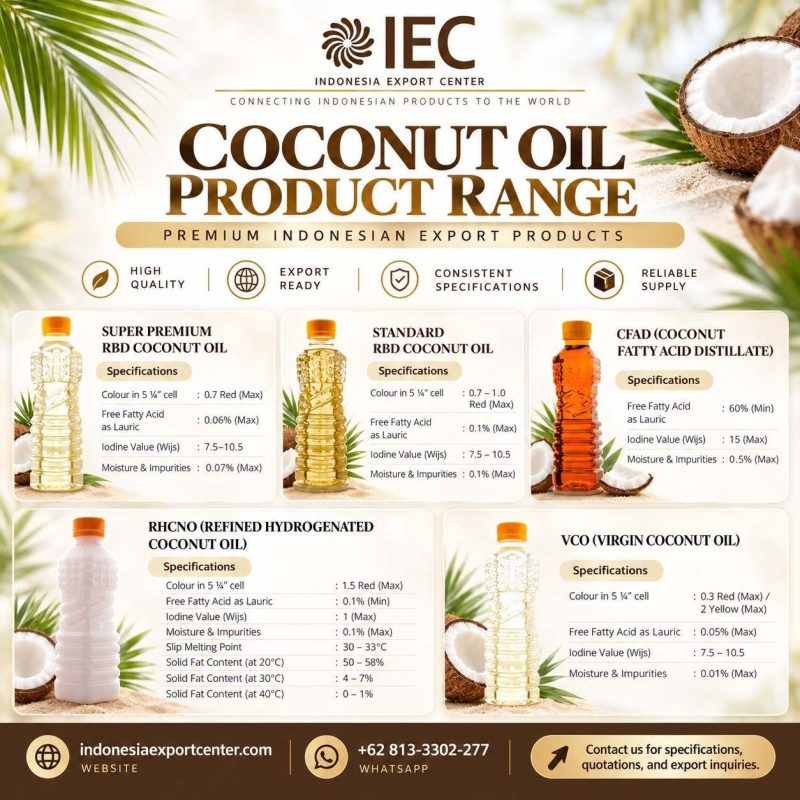
IEC | INDONESIA EXPORT CENTER
CONNECTING INDONESIAN PRODUCTS TO THE WORLD
COCONUT OIL PRODUCT RANGE
STANDARD RBD COCONUT OIL
IBC Packaging Enquiries for Industrial Ingredient Distributors and International Bulk Buyers
IBC Packaging Options | Product Compatibility | Net Weight | Filling and Discharge | Warehouse Handling | Bulk Export Quotations
Looking for an RBD Coconut Oil IBC Supplier?
Are you searching for an RBD coconut oil IBC supplier in Indonesia for industrial ingredient distribution, manufacturing or international procurement?
Indonesia Export Center (IEC) facilitates sourcing and export enquiries for Indonesian coconut oil products, including Standard RBD Coconut Oil.
Intermediate Bulk Containers, commonly called IBCs, are packaging systems that may be considered for the storage, handling and transportation of suitable liquid products.
For industrial ingredient distributors, IBC packaging may offer an alternative to smaller individual containers or bulk tank arrangements.
However, not every IBC is suitable for refined coconut oil, and not every supplier offers IBC filling.
Before confirming an order, buyers should verify:
- IBC packaging availability
- Container design and material
- Product compatibility
- Food-contact suitability if applicable
- Nominal volume
- Approved filling volume
- Net filling weight
- IBC tare weight
- Gross weight
- Outlet valve and closure specifications
- Pallet base and handling requirements
- Container loading configuration
- Batch COA
- MOQ and available quantity
- Pricing and shipment terms
IEC’s supplied Standard RBD Coconut Oil reference includes:
- Colour in 5¼-inch Cell: 0.7–1.0 Red (Max), subject to clarification
- Free Fatty Acid as Lauric: 0.1% Maximum
- Iodine Value (Wijs): 7.5–10.5
- Moisture & Impurities: 0.1% Maximum
These are supplied reference specifications, not independently verified batch results.
REQUEST RBD COCONUT OIL IBC PACKAGING INFORMATION
WhatsApp: https://wa.me/628133302277
Website: https://indonesiaexportcenter.com/
IBC availability, packaging compatibility, filling capacity, COA, MOQ, price and delivery require supplier confirmation.
1. Standard RBD Coconut Oil – IBC Supply Enquiry Overview
| Item | Details |
|---|---|
| Product | Standard RBD Coconut Oil |
| Country of Sourcing | Indonesia |
| Grade | Standard RBD |
| Requested Packaging | Intermediate Bulk Containers (IBCs) |
| Confirmed IBC Availability | Not Verified |
| IBC Type | To Be Confirmed |
| Nominal Capacity | To Be Confirmed |
| Approved Fill Volume | To Be Confirmed |
| Net Fill per IBC | To Be Confirmed |
| IBC Tare Weight | To Be Confirmed |
| Gross Weight per IBC | To Be Calculated |
| Product-Contact Material | To Be Confirmed |
| Food-Contact Suitability | To Be Verified if Required |
| Outlet Valve | To Be Confirmed |
| Pallet Base | To Be Confirmed |
| Container Loading Plan | To Be Confirmed |
| Batch COA | To Be Requested |
| MOQ | To Be Confirmed |
| Available Quantity | To Be Confirmed |
| Price per MT | Request Quotation |
| Price per IBC | Request Quotation |
| Lead Time | To Be Confirmed |
2. What Is an IBC Tank?
An Intermediate Bulk Container (IBC) is a packaging system designed for handling and transporting certain bulk liquid or other suitable products.
IBC designs vary by material, construction and intended use.
Buyers should select an IBC based on the actual product and operating requirements.
3. Why Industrial Ingredient Distributors Consider IBC Packaging
IBC packaging may be relevant to distributors that require:
- Intermediate-volume product units
- Warehouse handling
- Inventory allocation
- Industrial customer deliveries
- Batch traceability
- Controlled product transfer
The commercial suitability depends on the distributor’s operating model.
4. IBC Packaging vs Bulk Tank Supply
IBC packaging differs from direct bulk tank supply.
IBCs are individual transport or storage units, while bulk tanks may be integrated into larger liquid handling systems.
The appropriate arrangement depends on shipment quantity, handling facilities and cost.
5. IBC Packaging vs Steel Drums
| Consideration | IBCs | Steel Drums |
|---|---|---|
| Packaging Format | Intermediate bulk units | Individual metal drums |
| Unit Capacity | Depends on IBC specification | Depends on drum specification |
| Product Transfer | Depends on valve and outlet system | Depends on drum closure and handling |
| Warehouse Handling | IBC-compatible equipment | Drum or pallet equipment |
| Product Compatibility | Must Be Verified | Must Be Verified |
| Availability | To Be Confirmed | To Be Confirmed |
6. IBC Packaging vs Flexitank
Flexitanks are designed for selected bulk liquid container shipments.
IBCs are separate transport or storage units.
Selection depends on:
- Shipment quantity
- Destination facilities
- Loading and discharge requirements
- Product compatibility
- Freight and packaging costs
Neither format is automatically preferable.
7. IBC Construction Types
IBC systems may use different constructions.
Examples in the wider packaging market include composite and metal designs.
The actual type offered must be confirmed with the supplier.
8. Composite IBCs
Composite IBCs may combine a product-contact inner container with an external protective structure.
The material and design must be compatible with the intended cargo.
No composite IBC option has been verified.
9. Stainless Steel IBCs
Stainless steel IBCs may be used for selected industrial applications.
Availability, suitability and cost require confirmation.
No stainless steel IBC supply arrangement has been verified.
10. IBC Product-Contact Materials
The product-contact surface is important.
Buyers should verify:
- Material composition
- Compatibility
- Intended use
- Temperature limits
- Cleaning requirements
- Relevant documentation
11. Food-Contact IBC Requirements
For food applications, the actual IBC and associated contact components should meet applicable food-contact requirements.
Buyers should request suitable supporting documentation.
No food-contact certification has been supplied.
12. Industrial-Use IBC Requirements
Industrial applications may have different requirements.
Relevant factors include:
- Material compatibility
- Product cleanliness
- Chemical resistance
- Handling
- Storage
- Traceability
13. IBC Nominal Capacity
IBC nominal capacity is a design characteristic.
It does not necessarily equal the permitted filling volume for a particular product or transport arrangement.
No nominal IBC capacity has been confirmed.
14. Approved Filling Volume
Approved fill volume depends on the IBC specification and product characteristics.
Buyers should request the actual permitted filling limits.
15. Net Filling Weight per IBC
Net weight refers to the weight of the coconut oil inside the IBC.
It depends on the approved filling quantity and product characteristics.
No net filling weight has been verified.
16. Volume vs Weight
Liquid packaging may be specified in volume, while commodity orders may be priced by weight.
The relationship depends on density.
Formula:
Mass = Density × Volume
Actual density data at the relevant temperature should be used.
No verified density value has been supplied.
17. IBC Tare Weight
Tare weight is the weight of the empty IBC and relevant packaging components.
It is needed to calculate the gross weight.
18. Gross Weight per IBC
Formula:
Gross Weight per IBC = Net Product Weight + IBC Tare Weight
The final gross cargo weight may also include other relevant packaging or securing materials.
19. IBC Quantity Calculation
For a required net product quantity:
Formula:
Required IBC Count = Total Net Product Weight ÷ Net Fill per IBC
The final order must use whole IBC units and the supplier’s approved fill specification.
20. Illustrative IBC Count for 20 MT
The following figures are arithmetic examples only.
| Hypothetical Net Fill per IBC | Exact Division for 20,000 kg | Whole IBCs Needed to Meet or Exceed 20,000 kg |
|---|---|---|
| 800 kg | 25 | 25 |
| 900 kg | 22.22 | 23 |
| 1,000 kg | 20 | 20 |
| 1,100 kg | 18.18 | 19 |
These are not confirmed IBC filling weights or feasible shipment configurations.
The actual order quantity and tolerance should be agreed before filling.
21. IBC Dimensions
IBC dimensions influence:
- Warehouse storage
- Forklift handling
- Container loading
- Stacking
- Transport planning
No dimensions have been supplied.
22. IBC Pallet Base
Some IBC designs incorporate an integrated pallet base.
The material and load rating should be verified.
No pallet base specification has been confirmed.
23. IBC Outlet Valve
The outlet valve affects discharge and transfer operations.
Buyers should confirm:
- Valve type
- Outlet size
- Material compatibility
- Seal integrity
- Connection requirements
- Operating instructions
24. Filling Opening and Closure
The filling opening and closure system should be suitable for the product and filling method.
Specifications require confirmation.
25. Tamper-Evident Sealing
Depending on buyer requirements, IBCs may use tamper-evident arrangements.
Availability must be confirmed.
26. IBC Cleanliness
Before filling, the IBC should meet the applicable cleanliness requirements.
Potential concerns include:
- Foreign material
- Residues
- Moisture
- Odours
- Contamination
- Damage
27. New vs Reconditioned IBCs
Buyers should specify whether new IBCs are required.
Reconditioned IBCs may be subject to additional restrictions depending on the application and destination.
No new or reconditioned IBC arrangement has been verified.
28. Coconut Oil Temperature and IBC Handling
Coconut oil can change physical state with temperature.
This may affect:
- Filling
- Pumping
- Discharge
- Storage
- Product transfer
The manufacturer should provide appropriate handling instructions.
No verified temperature range has been supplied.
29. IBC Filling Procedures
Filling should follow the approved packaging and product requirements.
Relevant considerations include:
- Product identification
- Equipment cleanliness
- Temperature
- Fill limits
- Weight control
- Closure integrity
- Traceability
30. IBC Discharge Procedures
Discharge planning should consider:
- Outlet valve
- Hose connections
- Pumping equipment
- Product flow behaviour
- Receiving tank
- Temperature conditions
- Spill prevention
31. Heating and Temperature Management
Some liquid handling arrangements may involve temperature management.
However, heating must not be assumed suitable for every IBC.
Any heating method requires approval for the selected container and product.
32. IBC Stacking
Stacking depends on:
- IBC design
- Load rating
- Filled weight
- Storage conditions
- Transport requirements
- Manufacturer instructions
No stacking height is guaranteed.
33. Forklift Handling
IBC handling may require suitable forklift equipment.
Buyers should verify:
- Forklift capacity
- Fork pocket dimensions
- Load stability
- Operator training
- Site safety procedures
34. Warehouse Storage
Storage requirements should follow the product manufacturer’s recommendations.
Potential considerations include:
- Temperature
- Cleanliness
- Packaging integrity
- Contamination prevention
- Stock rotation
- Inspection
35. IBC Labelling
IBC labels may identify:
- Product name
- Grade
- Batch number
- Net weight
- Manufacturer
- Filling information
- Handling instructions
The final label should meet contractual and regulatory requirements.
36. Batch Traceability
Buyers should confirm how individual IBCs are linked to the applicable product batch and COA.
No traceability system has been independently verified.
37. Container Loading for IBCs
A container loading plan should consider:
- IBC dimensions
- Gross weight
- Container dimensions
- Payload limits
- Weight distribution
- Cargo securing
- Carrier requirements
No IBC count per container is guaranteed.
38. 20-Foot Container Loading
A 20-foot container may be evaluated for suitable IBC shipments.
The actual loading plan must be verified.
39. 40-Foot Container Loading
A 40-foot container may be considered depending on cargo and transport requirements.
A larger container does not automatically permit a higher cargo weight.
40. Container Payload Verification
Buyers should confirm:
- Container tare weight
- Maximum gross mass
- Permitted payload
- Road limits
- Carrier restrictions
- Cargo weight distribution
41. Cargo Securing
IBCs should be secured according to an appropriate loading plan.
Potential considerations include:
- Movement prevention
- Load distribution
- Protection from damage
- Container safety
42. Loading Inspection
A loading inspection may cover:
- IBC condition
- Labels
- Quantity
- Seals
- Loading arrangement
- Container condition
- Cargo securing
Inspection arrangements require agreement.
43. Leakage Prevention
Leakage prevention depends on suitable packaging, filling, closures and handling.
No zero-leakage guarantee is made.
44. Standard RBD Coconut Oil Technical Specifications
| Quality Parameter | Supplied Reference Value |
|---|---|
| Colour in 5¼-inch Cell | 0.7–1.0 Red (Max) |
| Free Fatty Acid as Lauric | 0.1% (Max) |
| Iodine Value (Wijs) | 7.5–10.5 |
| Moisture & Impurities | 0.1% (Max) |
Technical note: The colour entry combines a range and maximum designation. The actual acceptance limit, measurement scale and method require clarification.
These are supplied reference values, not independently verified batch results.
45. Certificate of Analysis
A batch-specific COA should be requested.
It should identify:
- Manufacturer
- Product grade
- Batch number
- Test methods
- Analytical results
- Test date
- Authorised issuer
No verified batch COA has been supplied.
46. IBC Packaging Specification Sheet
Industrial distributors should request a packaging specification covering:
- IBC type
- Material
- Nominal capacity
- Approved fill volume
- Net fill
- Tare weight
- Dimensions
- Outlet valve
- Closure
- Pallet base
- Handling instructions
No verified packaging specification sheet has been supplied.
47. Distributor Inventory Planning
IBC packaging may be relevant to distributors managing intermediate-volume inventory.
Buyers should consider:
- Unit weight
- Storage space
- Customer order sizes
- Handling equipment
- Batch rotation
- Packaging return or disposal
48. IBC Reuse and Return
IBC reuse or return depends on:
- Container type
- Product application
- Cleaning requirements
- Supplier arrangements
- Destination regulations
No returnable IBC programme is claimed.
49. IBC Packaging Cost
Packaging cost may depend on:
- IBC type
- Material
- Capacity
- Quantity
- Product-contact requirements
- Transport arrangement
No current packaging cost has been verified.
50. Price per IBC vs Price per Metric Ton
Buyers should compare quotations using consistent units.
Formula:
Price per MT = Total Product Price ÷ Total Net Product Weight in MT
Packaging charges should be identified separately or clearly included.
51. Wholesale Quantity and MOQ
The supplier should confirm:
- MOQ
- Minimum IBC quantity
- Available stock
- Filling schedule
- Repeat-order capability
No MOQ has been confirmed.
52. Production and Filling Lead Time
Lead time may depend on:
- Product stock
- IBC availability
- Filling schedule
- Inspection
- Documentation
- Freight arrangements
No fixed lead time is guaranteed.
53. Export Documentation
Depending on the transaction, documents may include:
- Commercial invoice
- Packing list
- Bill of lading or other transport document
- Certificate of Origin
- COA
- Applicable packaging or compliance documentation
54. Packing List for IBC Shipments
The packing list should accurately state:
- Number of IBCs
- Net weight
- Gross weight
- Packaging description
- Batch references
- Container information where applicable
55. Origin and Destination Ports
The origin port in Indonesia and destination port should be confirmed for the actual shipment.
No route is guaranteed.
56. FOB, CFR and CIF Quotations
Buyers may request appropriate Incoterm quotations.
The selected term should identify the named place or port and reflect the actual transport arrangement.
57. Total Landed Cost
Importers should evaluate:
- Product value
- Packaging cost
- Freight
- Insurance
- Duties
- Taxes
- Port charges
- Inland transport
- Warehouse handling
58. Import Regulations
Importers should verify:
- Product classification
- Customs requirements
- Packaging rules
- Labelling
- Food-contact requirements if applicable
- Required documentation
59. IBC Supplier Qualification Checklist
Product Quality
-
Standard RBD grade confirmed
-
Current specification obtained
-
Colour specification clarified
-
Batch COA reviewed
-
Intended-use suitability verified
IBC Packaging
-
IBC availability confirmed
-
IBC type confirmed
-
Nominal capacity confirmed
-
Approved fill volume confirmed
-
Net fill confirmed
-
Tare weight confirmed
-
Gross weight calculated
-
Product-contact material verified
-
Food-contact suitability verified if required
-
Outlet valve confirmed
-
Closure system confirmed
-
Pallet base confirmed
Logistics
-
IBC dimensions confirmed
-
Container loading plan approved
-
Payload limits checked
-
Cargo securing confirmed
-
Discharge requirements reviewed
-
Freight quotation obtained
Commercial
-
MOQ confirmed
-
Available quantity confirmed
-
Price per MT confirmed
-
Price per IBC confirmed if applicable
-
Incoterm agreed
-
Lead time confirmed
-
Export documents reviewed
RBD Coconut Oil IBC RFQ Template
Subject: RFQ – Standard RBD Coconut Oil in IBC Tanks from Indonesia
Dear Indonesia Export Center Team,
We are evaluating Standard RBD Coconut Oil from Indonesia for bulk purchase in IBC packaging.
Please confirm product availability, IBC specifications, loading arrangements and commercial terms.
Buyer Information
Company Name: [Company Name]
Country: [Country]
Business Type: [Industrial Ingredient Distributor / Manufacturer / Importer / Other]
Contact Person: [Name]
Email: [Email]
WhatsApp: [Number]
Product Requirements
Product: Standard RBD Coconut Oil
Required Quantity: [MT]
Intended Application: [Application]
Additional Technical Requirements: [Details]
Reference Specifications
Colour in 5¼-inch Cell: Please Confirm Acceptance Limit
FFA as Lauric: Maximum 0.1%
Iodine Value (Wijs): 7.5–10.5
Moisture & Impurities: Maximum 0.1%
IBC Packaging Requirements
Preferred Packaging: IBC Tanks
Please Confirm:
- IBC availability
- IBC type
- IBC material
- Nominal capacity
- Approved fill volume
- Net fill per IBC
- Tare weight
- Gross weight
- Product-contact material
- Food-contact suitability if required
- Outlet valve type
- Closure system
- IBC dimensions
- Pallet base
- Stacking limits
- Number of IBCs per shipment
- Container loading configuration
Quality Documentation
Current Technical Data Sheet: Required
Batch COA: Required
Manufacturer Information: Required
IBC Packaging Specification Sheet: Required
Additional Certificates: [Specify]
Shipping Information
Destination Country: [Country]
Destination Port: [Port]
Preferred Incoterm: [FCA / FOB / CFR / CIF / Other]
Target Shipment Period: [Month / Year]
Receiving Facility: [Factory / Warehouse / Other]
Discharge Equipment: [Details]
Commercial Information Requested
Please provide:
- Actual manufacturer information
- Current product specification
- Batch COA
- Confirmation of IBC availability
- IBC type and material
- Nominal capacity
- Approved fill volume
- Net fill per IBC
- Tare weight
- Gross weight
- Product-contact material information
- Food-contact documentation if applicable
- Outlet valve specification
- IBC dimensions
- Pallet base details
- Container loading plan
- MOQ
- Available quantity
- Price per MT
- Price per IBC if applicable
- Packaging-related charges
- Incoterm and named port
- Freight information
- Production lead time
- Payment terms
- Export documentation
- Quotation validity
We will review the technical, packaging and logistics information before confirming a purchase order.
Kind regards,
[Your Name] [Company Name] [Country]SEND YOUR IBC RBD COCONUT OIL ENQUIRY
WhatsApp: https://wa.me/628133302277
Frequently Asked Questions – RBD Coconut Oil in IBC Tanks
Is RBD coconut oil available in IBC tanks?
IBC packaging availability must be confirmed with the supplier.
What is an IBC?
An IBC is an Intermediate Bulk Container designed for suitable bulk product handling and transportation.
What is the capacity of an IBC?
No specific IBC capacity has been confirmed for this offer.
What is the net weight per IBC?
Net fill depends on the approved container and filling specification.
Are IBCs suitable for coconut oil?
Suitability depends on product compatibility, packaging material and operating conditions.
Are food-grade IBCs available?
Food-contact suitability and availability require verification.
Can I request new IBCs?
Buyers may request new IBCs, subject to supplier confirmation.
Can I request stainless steel IBCs?
Buyers may enquire about stainless steel IBCs, subject to availability.
What type of outlet valve is used?
No outlet valve specification has been confirmed.
Can coconut oil be discharged through an IBC valve?
Discharge feasibility depends on product condition, valve design and receiving equipment.
Is heating required for IBC discharge?
Temperature requirements depend on the actual product and handling arrangement.
Can IBCs be stacked?
Stacking must follow the approved IBC design and load limits.
How many IBCs are needed for 20 MT?
The number depends on the confirmed net filling weight per IBC.
How many IBCs fit in a container?
The number depends on dimensions, gross weight and loading limits.
Is a Certificate of Analysis available?
A current batch COA should be requested. Availability requires confirmation.
What is the FFA specification?
The supplied Standard RBD reference states 0.1% maximum FFA as lauric.
What is the iodine value?
The supplied reference states 7.5–10.5 using the Wijs method.
What is the moisture and impurities limit?
The supplied reference states 0.1% maximum.
What is the MOQ for IBC orders?
No IBC-specific MOQ has been confirmed.
Can I request price per IBC?
Buyers may request a price per IBC alongside a price per MT.
Can I request FOB or CIF pricing?
Buyers may request appropriate Incoterm quotations, subject to the actual shipping arrangement.
How can I request a quotation?
Contact IEC with your required quantity, IBC requirements, destination port and preferred Incoterm.
Request RBD Coconut Oil in IBC Tanks
Evaluate Indonesian Standard RBD Coconut Oil for IBC Packaging and International Distribution
Indonesia Export Center (IEC) welcomes enquiries from industrial ingredient distributors, bulk importers, manufacturers and international procurement teams.
Product: Standard RBD Coconut Oil
Country of Sourcing: Indonesia
Requested Packaging: IBC Tanks
IBC Availability: To Be Confirmed
IBC Type: To Be Confirmed
Nominal Capacity: To Be Confirmed
Approved Fill Volume: To Be Confirmed
Net Fill per IBC: To Be Confirmed
Product-Contact Material: To Be Confirmed
Outlet Valve: To Be Confirmed
Container Loading Plan: To Be Confirmed
Reference Colour: 0.7–1.0 Red (Max) in 5¼-inch Cell, Subject to Clarification
Reference FFA as Lauric: 0.1% Maximum
Reference Iodine Value (Wijs): 7.5–10.5
Reference Moisture & Impurities: 0.1% Maximum
Batch COA: To Be Requested and Verified
MOQ: To Be Confirmed
Available Quantity: To Be Confirmed
Price per MT: Request Quotation
Price per IBC: Request Quotation
Lead Time: To Be Confirmed
Contact IEC to discuss product specifications, IBC packaging requirements, container loading and bulk export quotations.
IEC | INDONESIA EXPORT CENTER
CONNECTING INDONESIAN PRODUCTS TO THE WORLD
Website: https://indonesiaexportcenter.com/
WhatsApp: +62 813-3302-277
REQUEST RBD COCONUT OIL IBC PACKAGING INFORMATION
Please include your company name, required quantity in MT, destination country, destination port, intended application and preferred IBC specifications.
Product and Packaging Disclaimer: IBC packaging is presented as a sourcing enquiry option and is not a confirmed available packaging format. The supplied Standard RBD specifications are reference values and not independently verified batch results. The colour specification requires clarification. No IBC type, nominal capacity, approved fill volume, net fill, product-contact material, food-contact suitability, outlet valve, stacking limit, container loading configuration, COA, MOQ, available quantity, price, certification or lead time has been independently verified. All arrangements are subject to supplier confirmation, packaging compatibility, transport feasibility and commercial agreement. IEC facilitates sourcing and export enquiries; the actual manufacturer, contractual seller and exporter of record must be confirmed for each transaction.
