

IEC | INDONESIA EXPORT CENTER
CONNECTING INDONESIAN PRODUCTS TO THE WORLD
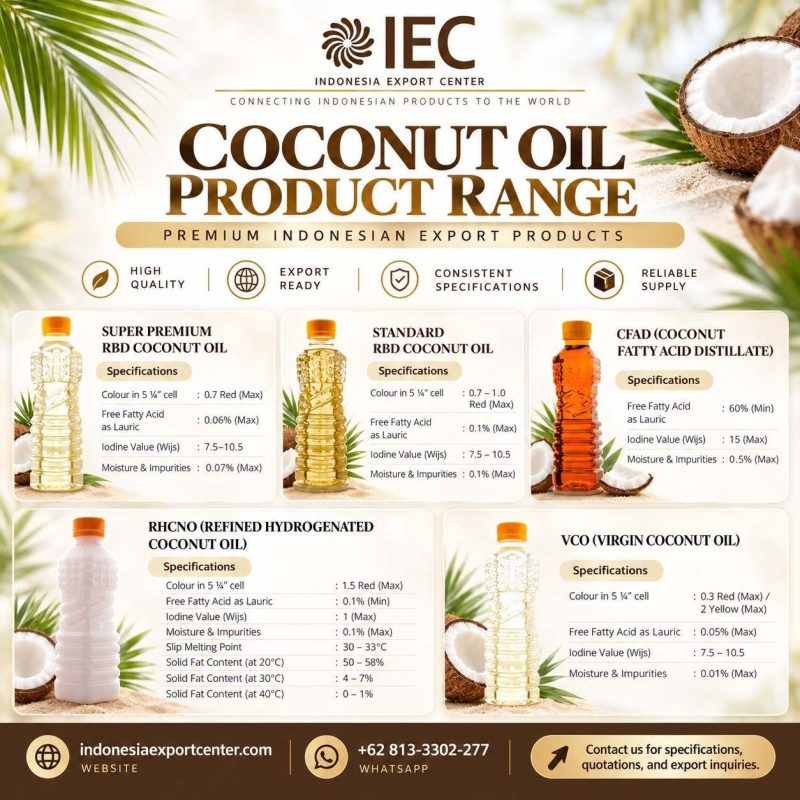
COCONUT OIL PRODUCT RANGE
STANDARD RBD COCONUT OIL
IBC Packaging Enquiries with Certificate of Analysis Verification, Product Sampling and Independent Inspection
Batch COA | Representative Sampling | Third-Party Laboratory Testing | Pre-Shipment Inspection | IBC Quality Control | Export Procurement
RBD Coconut Oil IBC Supplier – COA and Inspection Enquiries
Are you looking for an RBD coconut oil IBC supplier in Indonesia and need to verify product quality through sampling, laboratory analysis or independent inspection before placing a bulk order?
Indonesia Export Center (IEC) facilitates sourcing and export enquiries for Indonesian coconut oil products, including Standard RBD Coconut Oil.
For industrial ingredient distributors, product quality verification is an important part of international procurement.
A buyer may require more than a general product specification. Depending on the purchasing agreement, the buyer may request a batch-specific Certificate of Analysis (COA), an agreed sampling procedure or testing by an independent laboratory.
Where available and commercially agreed, independent inspection may also be considered before shipment.
Important verification requirements may include:
- Manufacturer identification
- Batch and lot traceability
- Current product specification
- Batch-specific COA
- Representative sampling
- Sample sealing and identification
- Chain of custody
- Independent laboratory testing
- Packaging inspection
- IBC filling verification
- Pre-shipment inspection
- Quantity verification
- Inspection reports
IEC’s supplied Standard RBD Coconut Oil reference includes:
| Quality Parameter | Supplied Reference Specification |
|---|---|
| Colour in 5¼-inch Cell | 0.7–1.0 Red (Max) |
| Free Fatty Acid as Lauric | 0.1% (Max) |
| Iodine Value (Wijs) | 7.5–10.5 |
| Moisture & Impurities | 0.1% (Max) |
These are supplied reference specifications, not independently verified analytical results for any particular production batch.
The colour specification requires clarification before it is used as a contractual acceptance criterion.
REQUEST IBC PACKAGING, COA AND INDEPENDENT INSPECTION INFORMATION
WhatsApp: https://wa.me/628133302277
Website: https://indonesiaexportcenter.com/
Batch COA availability, independent inspection arrangements, sampling access, IBC packaging, MOQ, quantity and pricing require supplier confirmation.
1. Standard RBD Coconut Oil – Product and Inspection Overview
| Item | Details |
|---|---|
| Product | Standard RBD Coconut Oil |
| Country of Sourcing | Indonesia |
| Product Category | Refined Coconut Oil |
| Requested Packaging | Intermediate Bulk Containers (IBCs) |
| Target Buyers | Industrial Ingredient Distributors, Importers and Manufacturers |
| Target Market | Global |
| Current Product Specification | To Be Requested |
| Batch-Specific COA | To Be Requested and Verified |
| Sampling Procedure | To Be Agreed |
| Independent Laboratory Testing | Subject to Availability and Agreement |
| Third-Party Inspection | Subject to Availability and Agreement |
| Inspection Agency | To Be Selected and Confirmed |
| IBC Packaging Availability | Not Verified |
| IBC Capacity | To Be Confirmed |
| Net Weight per IBC | To Be Confirmed |
| MOQ | To Be Confirmed |
| Available Quantity | To Be Confirmed |
| Price | Request Quotation |
| Lead Time | To Be Confirmed |
2. Why COA Verification Matters
A Certificate of Analysis helps buyers review reported quality results against the agreed product specification.
However, the usefulness of a COA depends on whether it is authentic, current and linked to the actual material being purchased.
Buyers should verify that the document corresponds to the relevant production batch.
3. Product Specification vs Certificate of Analysis
A product specification defines the agreed quality requirements.
A COA reports analytical results associated with identified material.
A product specification alone does not prove that a particular shipment meets those requirements.
4. What Should a Batch-Specific COA Include?
A suitable COA may identify:
- Manufacturer
- Product name
- Product grade
- Batch or lot number
- Analytical parameters
- Test methods
- Units
- Test results
- Test date
- Authorised issuer
The exact requirements should be agreed with the supplier.
5. Manufacturer Identification
Buyers should confirm the actual manufacturer of the offered product.
The manufacturer identified in the technical documentation should be consistent with the relevant batch records and transaction documents.
IEC facilitates sourcing enquiries and should not automatically be considered the physical manufacturer.
6. Batch and Lot Identification
Batch identification is essential for connecting analytical results to the supplied material.
Buyers should confirm how the manufacturer assigns and records batch numbers.
7. Single-Batch vs Multiple-Batch Shipments
A shipment may contain product from one or more batches.
For multiple-batch shipments, buyers should establish:
- Number of batches
- Batch identification
- Quantity per batch
- COA coverage
- Packaging traceability
- Sampling requirements
8. Why Representative Sampling Matters
A sample should be collected using a procedure appropriate to the material and the intended test.
Poor sampling practices may produce results that do not adequately represent the relevant lot.
The sampling plan should be agreed before collection.
9. Sampling Plan Development
A sampling plan may define:
- Material or lot to be sampled
- Sampling location
- Number of sampling points
- Sampling method
- Sample quantity
- Sampling equipment
- Sample containers
- Identification
- Sealing
- Storage
- Transportation
- Testing requirements
10. Sampling Before IBC Filling
Depending on the manufacturing process, sampling may occur before packaging.
The buyer should verify whether the sample represents the product subsequently filled into the IBCs.
11. Sampling During IBC Filling
Sampling during filling may be considered where appropriate.
The procedure should account for product handling, batch identification and contamination prevention.
12. Sampling After IBC Filling
Sampling from filled IBCs may be possible depending on container design and the agreed procedure.
Opening sealed packaging can create contamination and traceability risks.
The method should be approved before sampling.
13. Sampling from Multiple IBCs
If a shipment contains multiple IBCs, the sampling plan should establish which units are sampled and how the results will be interpreted.
Sampling one IBC does not automatically prove that all containers contain material of identical quality.
14. Sampling Equipment
Sampling equipment should be appropriate for the product and intended analysis.
Buyers may need to verify:
- Material compatibility
- Cleanliness
- Sampling method
- Contamination prevention
- Equipment condition
15. Sample Containers
Sample containers should be suitable for the intended analytical testing.
The laboratory may specify:
- Container material
- Required sample quantity
- Closure
- Labelling
- Storage conditions
16. Sample Sealing
Sealing can help preserve sample integrity and support traceability.
The sampling procedure should document the seal identification where applicable.
17. Sample Labelling
A sample label may include:
- Product name
- Grade
- Batch number
- Sampling date
- Sampling location
- Sample identification
- Sampler
- Seal reference
18. Chain of Custody
Chain of custody documents the handling and transfer of a sample from collection to analysis.
It may record:
- Sample identity
- Collection details
- Custodians
- Transfer dates
- Seal condition
- Laboratory receipt
19. Retained Samples
Buyers and suppliers may agree to retain samples for later investigation.
Retention periods, storage conditions and access should be defined in the quality agreement.
No retained-sample programme has been verified.
20. Independent Laboratory Testing
An independent laboratory may be requested to analyse product samples.
Laboratory selection should consider:
- Analytical capability
- Appropriate test methods
- Relevant accreditation scope
- Sample handling
- Reporting
- Turnaround time
- Cost
No laboratory appointment or testing arrangement has been confirmed.
21. Laboratory Accreditation
Buyers may prefer a laboratory with appropriate accreditation for the required testing.
Accreditation should be checked for the relevant methods and scope.
No specific laboratory accreditation or testing certification is claimed.
22. FFA Testing
The supplied Standard RBD Coconut Oil reference states:
Free Fatty Acid as Lauric: 0.1% Maximum
An independent laboratory may be asked to verify FFA using an appropriate method.
No actual test result has been supplied.
23. Moisture and Impurities Testing
The supplied reference states:
Moisture & Impurities: 0.1% Maximum
This is a combined reference value.
Buyers should confirm whether separate moisture and impurities results are required.
24. Colour Testing
The supplied reference states:
Colour in 5¼-inch Cell: 0.7–1.0 Red (Max)
The manufacturer should clarify the intended acceptance limit, measurement scale and method.
An independent test should use an agreed method and reporting basis.
25. Iodine Value Testing
The supplied reference states:
Iodine Value (Wijs): 7.5–10.5
Buyers may request an independent result using an appropriate method.
26. Peroxide Value Testing
Peroxide value may be relevant to the buyer’s quality assessment.
However, no peroxide value specification or actual result has been supplied.
If required, the buyer should establish an acceptance limit and request testing.
27. Additional Quality Parameters
Depending on the intended application, buyers may request additional tests.
Examples include:
- Separate moisture
- Insoluble impurities
- Peroxide value
- Fatty acid profile
- Unsaponifiable matter
- Relevant contaminants
- Other customer-specific parameters
No results are claimed for these additional tests.
28. Laboratory Test Methods
The buyer and supplier should agree on analytical methods before testing.
Differences in methods, reporting units or calculation bases may affect comparisons.
29. Comparing COA and Independent Test Results
If an independent test is performed, the buyer should compare:
- Sample identity
- Batch identity
- Test method
- Unit
- Result
- Acceptance criterion
- Measurement uncertainty where relevant
Any discrepancy should be investigated under the agreed quality procedure.
30. Handling Conflicting Test Results
The purchase agreement may define how conflicting results are addressed.
Potential steps include:
- Document review
- Sample identity verification
- Method comparison
- Additional testing
- Joint review
- Contractual resolution
31. Independent Inspection vs Laboratory Testing
Independent inspection and laboratory testing serve different purposes.
Inspection may examine packaging, quantity, loading and documentation.
Laboratory testing provides analytical results for selected product characteristics.
The scope of each service should be clearly defined.
32. Third-Party Inspection Agencies
A buyer may request an independent inspection agency.
The agency should be selected based on its capability, independence and the required inspection scope.
No agency has been appointed or endorsed for this offer.
33. Pre-Shipment Inspection
Pre-shipment inspection may be considered before the cargo leaves the loading facility.
The scope may include:
- Product identification
- Packaging condition
- Quantity
- Labelling
- Container condition
- Loading
- Sealing
- Documentation
34. Inspection Before IBC Filling
An inspection before filling may assess:
- IBC condition
- Packaging identification
- Cleanliness
- Filling equipment
- Product records
- Batch identification
35. IBC Packaging Inspection
The inspection may cover:
- IBC type
- Material
- Capacity
- Visible condition
- Product-contact suitability documentation
- Outlet valve
- Closure
- Seals
- Labels
36. IBC Cleanliness Verification
Before filling, buyers may request evidence that the packaging meets applicable cleanliness requirements.
Potential concerns include:
- Residues
- Foreign material
- Moisture
- Odours
- Packaging damage
37. New vs Reconditioned IBCs
Buyers should specify whether new packaging is required.
Reconditioned packaging may be subject to additional conditions depending on the application.
No new or reconditioned IBC arrangement has been confirmed.
38. IBC Material Compatibility
The IBC’s product-contact materials should be suitable for refined coconut oil.
Compatibility should be supported by appropriate packaging information.
No material compatibility approval has been verified.
39. Food-Contact IBC Verification
For food applications, buyers should verify the relevant food-contact requirements.
No food-contact certification has been supplied.
40. IBC Capacity Verification
IBC nominal capacity and approved filling volume may differ.
The supplier should provide the actual packaging specification.
No capacity has been confirmed.
41. Net Weight Verification
Net product weight should be determined using an agreed measurement procedure.
The final shipping documents should reflect the actual filled quantity.
42. Gross Weight Verification
Gross weight includes the product and relevant packaging components.
The loading plan should use the actual gross weight.
43. Quantity Inspection
An inspection may verify:
- Number of IBCs
- Net weight
- Gross weight
- Batch allocation
- Packaging description
- Shipping documents
44. IBC Filling Inspection
A filling inspection may cover:
- Product identity
- Filling equipment
- Fill quantity
- Batch traceability
- Closure integrity
- Labelling
- Packaging condition
45. IBC Sealing Inspection
The inspection may record:
- Seal presence
- Seal condition
- Seal identification
- Packaging closure
46. IBC Labelling Inspection
Labels may include:
- Product name
- Grade
- Batch number
- Net weight
- Manufacturer
- Handling information
The final requirements depend on the transaction and destination.
47. Container Inspection
A suitable shipping container should be inspected before loading.
Potential checks include:
- Structural condition
- Cleanliness
- Floor condition
- Door condition
- Signs of damage
- Cargo suitability
48. Container Loading Inspection
Loading inspection may assess:
- IBC arrangement
- Weight distribution
- Cargo securing
- Container payload
- Package condition
- Container sealing
49. Cargo Securing
IBCs should be secured according to an appropriate loading plan.
The final arrangement should reflect the container, cargo and transport requirements.
50. Container Seal Verification
Where applicable, container seal information should be recorded and checked against the shipping documents.
51. Photographic Inspection Records
Photographs may be useful as part of an inspection report.
They may document:
- Packaging condition
- Labels
- Container condition
- Loading arrangement
- Seals
Photographs do not replace analytical testing.
52. Inspection Report
An inspection report should identify:
- Inspection agency
- Date and location
- Scope
- Product
- Quantity
- Findings
- Limitations
- Supporting records
53. Inspection Scope Limitations
Buyers should understand what an inspection does and does not establish.
For example, a visual packaging inspection does not independently verify the chemical composition of the oil.
54. Inspection Cost
Inspection cost depends on:
- Scope
- Location
- Sampling requirements
- Laboratory testing
- Travel
- Reporting
- Timing
No inspection price has been verified.
55. Who Pays for Independent Inspection?
The buyer and seller should agree on inspection costs before the service is arranged.
The responsibility may be stated in the purchase agreement.
56. Inspection Timing
Inspection should be scheduled according to:
- Product availability
- Packaging readiness
- Sampling plan
- Laboratory turnaround
- Loading schedule
- Vessel schedule
57. Product Release Before Shipment
Buyers may establish a product release procedure requiring specified documents and inspection results before shipment.
The procedure should be agreed contractually.
58. Quality Acceptance Criteria
Acceptance criteria should be established before sampling and testing.
They may include:
- FFA
- Moisture
- Impurities
- Colour
- Iodine value
- Peroxide value if required
- Additional application-specific tests
59. Nonconforming Product
A quality agreement may define how nonconforming product is handled.
Potential procedures include:
- Investigation
- Segregation
- Retesting
- Rejection
- Corrective action
- Claims
60. Standard RBD Coconut Oil Technical Specifications
| Quality Parameter | Supplied Reference Value |
|---|---|
| Colour in 5¼-inch Cell | 0.7–1.0 Red (Max) |
| Free Fatty Acid as Lauric | 0.1% (Max) |
| Iodine Value (Wijs) | 7.5–10.5 |
| Moisture & Impurities | 0.1% (Max) |
Technical note: The colour entry requires clarification before it is used as a contractual acceptance criterion.
These values are supplied references, not independently verified batch results.
61. Standard RBD vs Super Premium RBD Coconut Oil
| Parameter | Standard RBD | Super Premium RBD |
|---|---|---|
| Colour in 5¼-inch Cell | 0.7–1.0 Red (Max), Clarification Required | 0.7 Red (Max) |
| FFA as Lauric | 0.1% (Max) | 0.06% (Max) |
| Iodine Value (Wijs) | 7.5–10.5 | 7.5–10.5 |
| Moisture & Impurities | 0.1% (Max) | 0.07% (Max) |
The appropriate grade depends on the buyer’s specifications and verified test results.
62. IBC Packaging vs Steel Drums
IBCs and steel drums are different packaging systems.
The selection depends on:
- Buyer handling facilities
- Storage
- Order quantity
- Product compatibility
- Packaging costs
- Distribution requirements
63. IBC Packaging vs Flexitank
Flexitanks may be considered for suitable bulk liquid shipments, subject to approval.
IBCs may be considered for intermediate-volume handling.
Availability and suitability must be verified.
64. Export Documentation
Depending on the transaction, documents may include:
- Commercial invoice
- Packing list
- Bill of lading or other transport document
- Certificate of Origin
- COA
- Inspection report if agreed
- Laboratory test report if agreed
65. Packing List and Lot Traceability
The packing list should accurately identify the shipment.
Buyers may request a record linking:
- IBC identification
- Product batch
- Quantity
- COA
- Shipping references
66. Origin and Destination Ports
The origin port in Indonesia and destination port must be confirmed for the actual shipment.
No specific route is guaranteed.
67. FOB, CFR and CIF Quotations
Buyers may request appropriate Incoterm quotations.
The selected term should reflect the actual transport arrangement and identify the named place or port.
68. MOQ and Availability
MOQ, stock availability and IBC packaging availability depend on the actual supplier.
No commercial quantities have been verified.
69. Lead Time
Lead time may depend on:
- Product availability
- IBC procurement
- Sampling
- Laboratory testing
- Inspection
- Documentation
- Shipping arrangements
No fixed lead time is guaranteed.
70. COA, Sampling and Inspection Checklist
Product Documentation
-
Manufacturer verified
-
Current product specification obtained
-
Colour specification clarified
-
Batch-specific COA obtained
-
Batch number confirmed
-
Test methods reviewed
-
Analytical results reviewed
Sampling
-
Sampling plan agreed
-
Sampling location confirmed
-
Sampling method agreed
-
Sample quantity confirmed
-
Sample containers approved
-
Sample labels prepared
-
Sealing procedure agreed
-
Chain of custody established
-
Retained sample requirements confirmed
Independent Testing
-
Laboratory selected
-
Relevant testing capability verified
-
FFA test requested
-
Moisture and impurities tests requested
-
Colour test requested
-
Iodine value test requested
-
Peroxide value test requested if required
-
Acceptance criteria agreed
-
Results reviewed
IBC Inspection
-
IBC availability confirmed
-
IBC type confirmed
-
Product-contact material verified
-
Food-contact suitability verified if required
-
IBC cleanliness checked
-
Filling quantity verified
-
Batch traceability checked
-
Closure and seals inspected
-
Labels inspected
Pre-Shipment
-
Inspection agency confirmed
-
Inspection scope agreed
-
Container condition checked
-
Loading plan approved
-
Cargo securing checked
-
Container seal recorded
-
Inspection report obtained
-
Shipping documents reviewed
RBD Coconut Oil IBC COA and Independent Inspection RFQ Template
Subject: RFQ – Standard RBD Coconut Oil in IBC Tanks with COA, Sampling and Independent Inspection
Dear Indonesia Export Center Team,
We are evaluating Standard RBD Coconut Oil from Indonesia for industrial ingredient distribution in IBC packaging.
Our procurement requirements include batch-specific quality documentation, representative sampling and the possibility of independent laboratory testing or pre-shipment inspection.
Please provide the available technical, packaging and commercial information.
Buyer Information
Company Name: [Company Name]
Country: [Country]
Business Type: [Industrial Ingredient Distributor / Importer / Manufacturer / Other]
Contact Person: [Name]
Email: [Email]
WhatsApp: [Number]
Product Requirements
Product: Standard RBD Coconut Oil
Required Quantity: [MT]
Intended Application: [Application]
Additional Technical Requirements: [Details]
Reference Specifications
Colour in 5¼-inch Cell: Please Confirm Acceptance Limit
FFA as Lauric: Maximum 0.1%
Iodine Value (Wijs): 7.5–10.5
Moisture & Impurities: Maximum 0.1%
Additional Tests: [Specify]
COA Requirements
Please provide:
- Current product specification
- Batch-specific COA
- Manufacturer information
- Batch identification
- Analytical methods
- Test results
- Test date
- COA issuer
Sampling Requirements
Please confirm:
- Whether buyer-requested sampling is possible
- Available sampling location
- Sampling method
- Sample quantity
- Sample container requirements
- Sample sealing
- Chain-of-custody arrangements
- Retained sample availability
Independent Laboratory Testing
Independent Testing Required: [Yes / No]
Preferred Laboratory: [Name / To Be Agreed]
Requested Parameters: [FFA / Moisture / Impurities / Colour / Iodine Value / Peroxide Value / Other]
Test Methods: [Specify]
Acceptance Criteria: [Specify]
Third-Party Inspection
Pre-Shipment Inspection Required: [Yes / No]
Preferred Inspection Agency: [Name / To Be Agreed]
Inspection Scope: [Packaging / Quantity / Loading / Sampling / Documentation / Other]
Inspection Cost Responsibility: [Buyer / Seller / To Be Agreed]
IBC Packaging Requirements
Preferred Packaging: IBC Tanks
Please confirm:
- IBC availability
- IBC type
- Product-contact material
- Food-contact suitability if applicable
- Nominal capacity
- Approved fill volume
- Net weight per IBC
- Tare weight
- Gross weight
- Outlet valve
- Closure and sealing
- Batch labels
- Container loading plan
Shipping Requirements
Destination Country: [Country]
Destination Port: [Port]
Preferred Incoterm: [FCA / FOB / CFR / CIF / Other]
Target Shipment Period: [Month / Year]
Commercial Information Requested
Please provide:
- Actual manufacturer information
- Current product specification
- Batch-specific COA
- Batch traceability information
- Sampling availability
- Sampling procedure
- Independent laboratory testing options
- Inspection agency options
- Inspection scope and cost
- IBC packaging availability
- IBC specifications
- Net fill per IBC
- Container loading plan
- MOQ
- Available quantity
- Price per MT
- Price per IBC if applicable
- Incoterm and named port
- Freight information
- Production lead time
- Testing and inspection lead time
- Payment terms
- Export documentation
- Quotation validity
We will review the technical documents, sampling arrangements and inspection requirements before confirming a purchase order.
Kind regards,
[Your Name] [Company Name] [Country]SEND YOUR COA AND INDEPENDENT INSPECTION ENQUIRY
WhatsApp: https://wa.me/628133302277
Frequently Asked Questions – RBD Coconut Oil IBC COA and Inspection
Is RBD coconut oil available in IBC tanks?
IBC packaging availability must be confirmed with the supplier.
Can I request a batch-specific COA?
Buyers may request one. Actual availability must be verified.
What is the difference between a specification and a COA?
A specification defines requirements, while a COA reports results for identified material.
Can I request independent laboratory testing?
Buyers may request testing, subject to supplier access, laboratory availability and agreement.
Can I appoint my own inspection agency?
This may be discussed with the supplier, subject to access and commercial agreement.
Can samples be collected before shipment?
Sampling may be requested, subject to an agreed procedure.
Can samples be taken from filled IBCs?
Possibly, depending on the IBC design and approved sampling procedure.
What is chain of custody?
It is documentation of sample handling and transfer from collection to testing.
Can I request sealed samples?
Sealed sampling arrangements may be requested, subject to agreement.
Can I request retained samples?
Availability and retention conditions require confirmation.
What is the FFA specification?
The supplied Standard RBD reference states 0.1% maximum FFA as lauric.
What is the moisture and impurities limit?
The supplied reference states 0.1% maximum.
What is the iodine value?
The supplied reference states 7.5–10.5 using the Wijs method.
What is the colour specification?
The supplied reference states 0.7–1.0 Red (Max) in a 5¼-inch cell. The acceptance limit and method require clarification.
Can peroxide value be tested?
Buyers may request testing, subject to laboratory capability. No PV result or acceptance limit has been supplied.
Does an independent inspection guarantee product quality?
No. Inspection provides findings within an agreed scope and does not guarantee every characteristic of the cargo.
Can an inspector verify IBC filling quantities?
Quantity verification may be included in the agreed inspection scope.
Can an inspector check container loading?
Loading inspection may be requested, subject to availability and agreement.
Who pays for independent inspection?
The buyer and seller should agree on the cost responsibility.
What is the MOQ?
No MOQ has been confirmed.
How can I request a quotation?
Contact IEC with your required quantity, destination, IBC specifications, COA requirements and inspection scope.
Request RBD Coconut Oil in IBC Tanks with COA and Independent Inspection
Evaluate Indonesian Standard RBD Coconut Oil with Documented Sampling and Quality Verification Requirements
Indonesia Export Center (IEC) welcomes enquiries from industrial ingredient distributors, importers, manufacturers and international procurement teams.
Product: Standard RBD Coconut Oil
Country of Sourcing: Indonesia
Requested Packaging: IBC Tanks
Reference Colour: 0.7–1.0 Red (Max) in 5¼-inch Cell, Subject to Clarification
Reference FFA as Lauric: 0.1% Maximum
Reference Iodine Value (Wijs): 7.5–10.5
Reference Moisture & Impurities: 0.1% Maximum
Batch-Specific COA: To Be Requested and Verified
Sampling: Subject to Agreement
Independent Laboratory Testing: Subject to Availability and Agreement
Third-Party Inspection: Subject to Availability and Agreement
IBC Availability: To Be Confirmed
IBC Capacity: To Be Confirmed
Net Fill per IBC: To Be Confirmed
MOQ: To Be Confirmed
Available Quantity: To Be Confirmed
Price: Request Quotation
Lead Time: To Be Confirmed
Contact IEC to discuss technical specifications, sampling procedures, inspection requirements, IBC packaging and bulk export quotations.
IEC | INDONESIA EXPORT CENTER
CONNECTING INDONESIAN PRODUCTS TO THE WORLD
Website: https://indonesiaexportcenter.com/
WhatsApp: +62 813-3302-277
REQUEST IBC PACKAGING, COA AND INDEPENDENT INSPECTION INFORMATION
Please include your company name, required quantity in MT, destination country, intended application, IBC requirements and requested sampling or inspection scope.
Product, Sampling and Inspection Disclaimer: The supplied Standard RBD specifications are reference values and not independently verified batch results. The colour specification requires clarification. No batch-specific COA, sampling programme, independent laboratory arrangement, inspection agency, IBC availability, packaging capacity, MOQ, available quantity, price, certification or lead time has been independently verified. Sampling, testing and inspection must be agreed with the actual supplier and relevant service providers. Independent inspection is limited to its agreed scope and does not guarantee all product characteristics. IEC facilitates sourcing and export enquiries; the actual manufacturer, contractual seller and exporter of record must be confirmed for each transaction.
