

RBD Coconut Oil IBC Supplier Indonesia – Bulk Refined Coconut Oil in IBC Tanks
IEC | INDONESIA EXPORT CENTER
CONNECTING INDONESIAN PRODUCTS TO THE WORLD
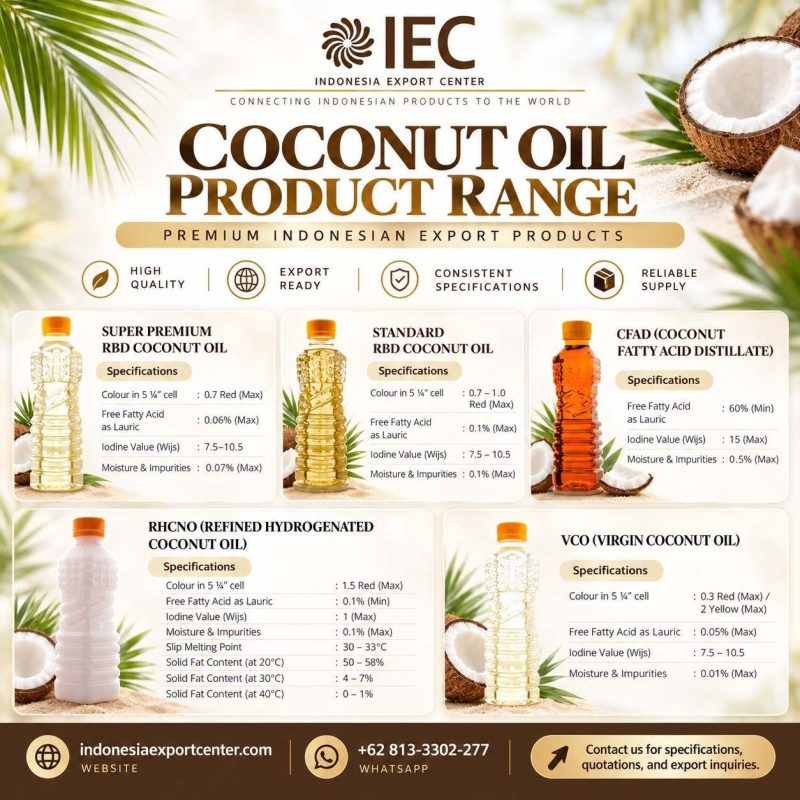
COCONUT OIL PRODUCT RANGE
PREMIUM INDONESIAN EXPORT PRODUCTS
HIGH QUALITY | EXPORT-ORIENTED SOURCING | CONSISTENT SPECIFICATION REQUIREMENTS | SUPPLY COORDINATION
Reliable RBD Coconut Oil in IBC Tanks from Indonesia
Looking for a reliable RBD coconut oil IBC supplier in Indonesia for industrial ingredient distribution, food manufacturing, or international wholesale?
Indonesia Export Center (IEC) helps international buyers connect with Indonesian suppliers and export-capable partners offering Refined, Bleached, and Deodorized (RBD) Coconut Oil for commercial and industrial applications.
For buyers seeking manageable bulk packaging, RBD Coconut Oil in Intermediate Bulk Containers (IBC Tanks) provides an alternative to smaller drums and large-volume flexitank shipments.
Our sourcing coordination focuses on product specifications, suitable packaging configurations, documentation, Certificate of Analysis (COA) verification, sampling arrangements, and independent inspection when requested.
Product: Standard RBD Coconut Oil
Country of Origin: Indonesia
Packaging: IBC Tanks, subject to supplier confirmation
Target Market: Global
Target Buyers: Industrial Ingredient Distributors, Food Manufacturers, Wholesale Importers, and Procurement Companies
Quality Control: COA Review, Sampling, and Optional Independent Inspection
Commercial Terms: Subject to supplier quotation and mutual agreement
REQUEST AN IBC COCONUT OIL QUOTATION
WhatsApp: +62 813-3302-277
Website: https://indonesiaexportcenter.com/
What Is RBD Coconut Oil in IBC Tanks?
RBD Coconut Oil is coconut oil processed through refining, bleaching, and deodorization to reduce unwanted impurities, pigments, free fatty acids, and characteristic odors.
The resulting oil is suitable for various industrial and food-processing applications, subject to the required product grade and regulatory requirements.
An Intermediate Bulk Container, commonly known as an IBC tank, is designed to store and transport liquid products in a containerized format.
IBC packaging can be especially useful for businesses that require bulk ingredient handling without purchasing an entire flexitank shipment.
Advantages of IBC Packaging
- Convenient handling using suitable forklifts or pallet-handling equipment.
- Individual packaging units suitable for controlled inventory management.
- Potentially easier separation of batches and traceability.
- Suitable for industrial distribution and batch-based production.
- Reduced dependence on numerous small packaging units.
- Flexible warehouse storage where applicable.
- Can facilitate controlled dispensing through compatible outlet equipment.
IBC suitability depends on tank construction, the oil’s physical state, filling temperature, food-contact requirements, and the receiving facility’s handling capabilities.
IEC can help buyers discuss appropriate IBC configurations with prospective suppliers before confirming an order.
Standard RBD Coconut Oil Specifications
Our primary product focus for IBC sourcing is Standard RBD Coconut Oil.
The following are the reference specifications supplied for this product range.
| Specification | Standard RBD Coconut Oil |
|---|---|
| Product Name | Refined, Bleached and Deodorized Coconut Oil |
| Colour in 5¼-inch Cell | 0.7–1.0 Red (Max), according to agreed grade |
| Free Fatty Acid as Lauric | 0.1% (Max) |
| Iodine Value (Wijs) | 7.5–10.5 |
| Moisture & Impurities | 0.1% (Max) |
| Origin | Indonesia |
| Packaging | IBC Tanks, subject to availability and technical suitability |
| Quality Documents | Supplier COA, subject to confirmation |
| Independent Inspection | Available by arrangement, subject to inspector and supplier agreement |
Important: These values are indicative procurement specifications and should be confirmed against the latest supplier-issued technical data sheet, actual production batch, and Certificate of Analysis before purchase.
IBC Packaging Options for Bulk Coconut Oil
IBC tanks are commonly used in industrial liquid logistics. However, packaging coconut oil requires additional consideration because coconut oil may become semi-solid or solid at ordinary ambient temperatures.
IBC Packaging Parameters
| Parameter | Procurement Consideration |
|---|---|
| Packaging Type | Intermediate Bulk Container |
| Nominal Capacity | Common options include 1,000 L; confirm actual availability |
| Container Material | Food-contact-compliant HDPE, stainless steel, or another approved configuration |
| Filling Quantity | Determined by density, temperature, allowable fill level, and container rating |
| Closure System | Sealed filling opening and compatible discharge outlet |
| Tank Condition | Clean, dry, suitable for the product, and inspected before filling |
| Labeling | Product, batch, net weight, and traceability details as required |
| Pallet Handling | Subject to IBC design and handling specifications |
| Heating and Discharge | Compatible temperature-control or warming arrangements where necessary |
| Shipping Compatibility | Subject to logistics and destination-country requirements |
Why Temperature Management Matters
Coconut oil has a relatively high solidification temperature compared with many other commonly traded vegetable oils.
During storage or international transportation, the oil may partially or fully solidify depending on ambient conditions.
Buyers should consider:
- Expected transportation temperatures.
- Product discharge procedures.
- Availability of compatible warming equipment.
- Maximum permissible heating temperature.
- IBC material temperature limits.
- Food safety and cleaning requirements.
Heating must remain within the supplier’s recommended conditions and the IBC manufacturer’s technical limits.
IEC recommends confirming filling, storage, transportation, and discharge requirements before selecting IBC packaging for RBD Coconut Oil.
Certificate of Analysis (COA) and Quality Verification
Quality documentation is important for industrial ingredient distributors, especially when importing coconut oil for further processing or redistribution.
IEC helps facilitate communication between buyers and suppliers regarding appropriate analytical documentation.
Certificate of Analysis
A supplier-issued COA may include the following parameters:
| Testing Parameter | Reference Requirement |
|---|---|
| Colour | According to agreed product grade |
| Free Fatty Acid | Maximum 0.1% as Lauric |
| Iodine Value | 7.5–10.5 |
| Moisture & Impurities | Maximum 0.1% |
| Batch Identification | Required for traceability |
| Production or Analysis Date | According to supplier documentation |
| Additional Testing | As agreed between buyer and supplier |
Additional tests may be requested depending on the intended industrial use, buyer requirements, and applicable market regulations.
COA issuance and testing scope must be confirmed with the supplying facility.
COA Sampling and Pre-Shipment Sample Verification
International buyers may require samples before placing large-volume orders.
IEC can help coordinate sampling requests with prospective suppliers to support preliminary product evaluation.
Recommended Sampling Procedure
Step 1 – Confirm Technical Specifications
The buyer provides the target product grade, required analytical parameters, intended application, and anticipated purchasing volume.
Step 2 – Request Product Documentation
The supplying company is asked to provide its available technical data sheet and representative COA.
Step 3 – Agree on Sampling Method
Buyer and supplier determine the appropriate sampling point, sample quantity, container type, labeling procedure, and responsible sampling party.
Step 4 – Laboratory Testing
Samples may be submitted to an agreed laboratory for relevant physical and chemical analysis.
Step 5 – Review Results
The buyer compares laboratory results with the agreed technical specifications before making a purchasing decision.
Step 6 – Confirm Commercial Order
Following satisfactory evaluation, the parties may proceed with a formal quotation, purchase order, and agreed quality-control requirements.
For additional protection, buyers may request independently collected and sealed samples from the actual shipment batch rather than relying solely on an earlier representative sample.
Independent Inspection for RBD Coconut Oil IBC Shipments
Independent inspection may provide additional verification of product condition, quantity, packaging, and shipment preparation.
IEC can help buyers discuss inspection arrangements with suppliers and qualified third-party service providers.
Potential Inspection Scope
- Verification of supplier and product identification.
- Review of applicable batch numbers.
- Sampling according to an agreed protocol.
- Examination of IBC cleanliness and physical condition.
- Verification of seals and packaging integrity.
- Review of declared filling quantities.
- Container loading observations.
- Documentation checks against contractual requirements.
Where appropriate, international inspection providers such as SGS, Bureau Veritas, or Intertek may be considered, subject to their service availability, commercial terms, and mutual agreement.
Independent inspection is not automatically included in a standard quotation. Its scope, cost, timing, and responsible party should be established before shipment.
Industrial Applications of Standard RBD Coconut Oil
Standard RBD Coconut Oil may be used across a wide range of manufacturing and distribution activities, depending on the applicable technical grade.
1. Food Ingredient Manufacturing
RBD Coconut Oil can be considered for selected food manufacturing and processing applications when supplied in an appropriate food-grade specification.
Manufacturers must confirm regulatory compliance, refining requirements, and application-specific suitability.
2. Bakery and Confectionery
Refined coconut oil may be used in certain fat formulations for bakery, confectionery, coatings, and processed-food production.
Formulation performance depends on melting properties and the required final-product characteristics.
3. Soap Manufacturing
Coconut oil is a recognized source of lauric fatty acids and can be used as a raw material in soap production.
Soap manufacturers should evaluate relevant fatty-acid characteristics and formulation requirements.
4. Oleochemical Processing
RBD Coconut Oil may serve as a feedstock for downstream fatty-acid and other oleochemical manufacturing processes.
5. Industrial Ingredient Distribution
IBC-packaged coconut oil may be particularly relevant for distributors supplying multiple factories, medium-volume industrial customers, and manufacturing facilities.
Why Industrial Distributors Consider IBC Packaging
Industrial ingredient distributors often require a balance between purchasing volume, warehouse handling, and customer-specific delivery requirements.
Compared with loose bulk oil transportation, individually packed IBC units can provide greater separation of inventory.
IBC packaging may support:
- Multiple customer delivery allocations.
- Controlled inventory movement.
- Individual batch identification.
- Warehouse stock rotation.
- Smaller-volume industrial distribution.
- Product traceability by packaging unit.
However, freight economics depend on filling efficiency, destination, packaging costs, unloading procedures, and the potential need for temperature-controlled handling.
For very large orders, flexitanks or bulk tank solutions may be more economical. Packaging selection should be based on a shipment-specific cost and technical evaluation.
Indonesia as a Source of Refined Coconut Oil
Indonesia is an established coconut-producing country with a domestic coconut processing industry.
The country provides sourcing opportunities for refined coconut oil and various coconut-derived products used in international manufacturing and distribution.
For international buyers, important supplier-selection considerations include:
- Product consistency.
- Available production capacity.
- Quality management.
- Suitable export documentation.
- Packaging compatibility.
- Shipment readiness.
- Supplier experience with international commercial requirements.
IEC supports buyer–supplier introductions and sourcing discussions involving Indonesian coconut oil products.
Additional Coconut Oil Products Available for Sourcing
In addition to Standard RBD Coconut Oil, IEC facilitates inquiries across several coconut oil product categories.
Super Premium RBD Coconut Oil
| Specification | Value |
|---|---|
| Colour in 5¼-inch Cell | 0.7 Red (Max) |
| Free Fatty Acid as Lauric | 0.06% (Max) |
| Iodine Value (Wijs) | 7.5–10.5 |
| Moisture & Impurities | 0.07% (Max) |
Super Premium RBD Coconut Oil offers tighter reference limits for certain quality parameters compared with the standard grade.
CFAD – Coconut Fatty Acid Distillate
| Specification | Value |
|---|---|
| Free Fatty Acid as Lauric | 60% (Min) |
| Iodine Value (Wijs) | 15 (Max) |
| Moisture & Impurities | 0.5% (Max) |
CFAD is a distinct coconut-derived industrial material and should not be treated as interchangeable with RBD Coconut Oil.
RHCNO – Refined Hydrogenated Coconut Oil
| Specification | Value |
|---|---|
| Colour in 5¼-inch Cell | 1.5 Red (Max) |
| Free Fatty Acid as Lauric | 0.1% (Min), subject to supplier clarification |
| Iodine Value (Wijs) | 1 (Max) |
| Moisture & Impurities | 0.1% (Max) |
| Slip Melting Point | 30–33°C |
| Solid Fat Content at 20°C | 50–58% |
| Solid Fat Content at 30°C | 4–7% |
| Solid Fat Content at 40°C | 0–1% |
RHCNO is processed to achieve different physical properties from standard RBD Coconut Oil. Buyers should request confirmation of its specification before contracting.
VCO – Virgin Coconut Oil
| Specification | Value |
|---|---|
| Colour in 5¼-inch Cell | 0.3 Red (Max) / 2 Yellow (Max) |
| Free Fatty Acid as Lauric | 0.05% (Max) |
| Iodine Value (Wijs) | 7.5–10.5 |
| Moisture & Impurities | 0.01% (Max) |
VCO differs from RBD Coconut Oil in processing methods, product characteristics, and intended market applications.
Note: Packaging availability and technical suitability must be confirmed separately for each coconut oil product grade.
International Shipping and Export Coordination
IEC helps facilitate discussions regarding international commercial arrangements between buyers and suitable Indonesian suppliers or exporters.
Potential shipment arrangements may include:
FOB – Free on Board
The seller arranges shipment according to the agreed FOB named port and contractual terms.
CFR – Cost and Freight
The seller arranges transportation to the named destination port, with risk allocation governed by the agreed Incoterms rules.
CIF – Cost, Insurance and Freight
The seller arranges freight and the required contractual insurance coverage to the named destination port.
Final quotations depend on the product specification, packaging type, confirmed order volume, freight conditions, documentation requirements, and commercial agreement.
Typical Export Documents
Depending on the shipment, buyers may request:
- Commercial Invoice.
- Packing List.
- Bill of Lading.
- Certificate of Origin.
- Supplier Certificate of Analysis.
- Relevant product or compliance certificates.
- Inspection Certificate, where contracted.
- Additional documents required by the importing country.
Documentation availability and regulatory requirements should be verified before finalizing a purchase order.
How to Request an RBD Coconut Oil IBC Quotation
International buyers are encouraged to submit a detailed procurement inquiry to improve the accuracy of supplier quotations.
Required Inquiry Information
- Product: Standard RBD Coconut Oil.
- Packaging: IBC Tanks.
- Required Quantity: Number of IBC units or total metric tons.
- Preferred Tank Specification: Capacity and material requirements.
- Destination: Country and port of discharge.
- Delivery Terms: FOB, CFR, or CIF.
- Required COA Parameters.
- Sampling and Third-Party Inspection Requirements.
- Target Delivery Schedule.
- Company Details and Intended Application.
IEC will use these details to support preliminary sourcing discussions and determine which requirements need confirmation from prospective suppliers.
Frequently Asked Questions – RBD Coconut Oil in IBC Tanks
1. Can RBD Coconut Oil be shipped in IBC tanks?
Yes, IBC transport can be technically feasible when the selected packaging is compatible with coconut oil, its temperature characteristics, and the applicable shipping requirements. Actual supplier availability must be confirmed.
2. What is the typical capacity of an IBC tank?
A common nominal IBC capacity is approximately 1,000 liters. However, actual filling quantity depends on the specific container, product density, filling conditions, and applicable weight limits.
3. Is Standard RBD Coconut Oil suitable for food manufacturing?
It may be suitable when supplied in an appropriate food-grade specification and supported by the necessary quality and regulatory documentation. Buyers should verify compliance for their intended use.
4. Can buyers request a Certificate of Analysis?
Yes. Buyers can request a supplier-issued COA for review. The exact analytical parameters and batch-specific documentation should be agreed before ordering.
5. Can independent inspectors collect shipment samples?
Independent sampling and testing may be arranged by agreement between the buyer, supplier, and selected inspection company.
6. Does IEC provide coconut oil directly from its own factory?
IEC primarily acts as a business sourcing and buyer–supplier connection platform. Product manufacture, sales contracts, and export execution depend on the supplying or exporting company involved.
7. What is the minimum order quantity for IBC coconut oil?
Minimum order quantities depend on supplier capabilities, IBC availability, and shipping arrangements. Buyers should submit their proposed order volume for confirmation.
8. Can IEC assist with recurring coconut oil orders?
IEC can help coordinate initial supplier discussions concerning recurring purchase schedules, specifications, packaging requirements, and expected shipment volumes. Actual commitments are subject to supplier agreement.
9. Is coconut oil always liquid inside the IBC?
No. Coconut oil can become semi-solid or solid under cooler conditions. Buyers must plan appropriate storage and discharge procedures that comply with product and container specifications.
10. How can an international buyer obtain an IBC quotation?
Send an inquiry with the desired quantity, product grade, packaging configuration, destination port, and quality-control requirements to IEC via WhatsApp or the official website.
Why Contact Indonesia Export Center?
Indonesia Export Center (IEC) connects international buyers with opportunities to source Indonesian products through supplier introductions and commercial coordination.
Our approach emphasizes:
- Clear buyer specification requirements.
- Communication with prospective Indonesian suppliers.
- Packaging and logistics requirement reviews.
- COA and quality-document coordination.
- Sampling and inspection discussions.
- Commercial quotation facilitation.
- International B2B sourcing support.
IEC operates as a sourcing and business connection facilitator and does not represent itself as the direct manufacturer of every product listed.
Request a Quotation – RBD Coconut Oil in IBC Tanks
SOURCE STANDARD RBD COCONUT OIL FROM INDONESIA
Looking for an RBD coconut oil IBC supplier for your ingredient distribution network, manufacturing operations, or international trading business?
Contact Indonesia Export Center to discuss available supplier options, technical specifications, IBC packaging feasibility, COA sampling, independent inspection, and export quotation requirements.
IEC | INDONESIA EXPORT CENTER
CONNECTING INDONESIAN PRODUCTS TO THE WORLD
Website: https://indonesiaexportcenter.com/
WhatsApp: +62 813-3302-277
WhatsApp Inquiry: https://wa.me/628133302277
REQUEST PRODUCT SPECIFICATIONS | ASK FOR COA | DISCUSS IBC PACKAGING | REQUEST EXPORT QUOTATION
All product specifications, IBC packaging availability, inspections, certificates, delivery arrangements, and commercial terms are subject to confirmation by the relevant supplier or exporter.
