

RBD Coconut Oil for Oleochemical Industry – Industrial Feedstock Supplier from Indonesia
IEC | INDONESIA EXPORT CENTER
CONNECTING INDONESIAN PRODUCTS TO THE WORLD
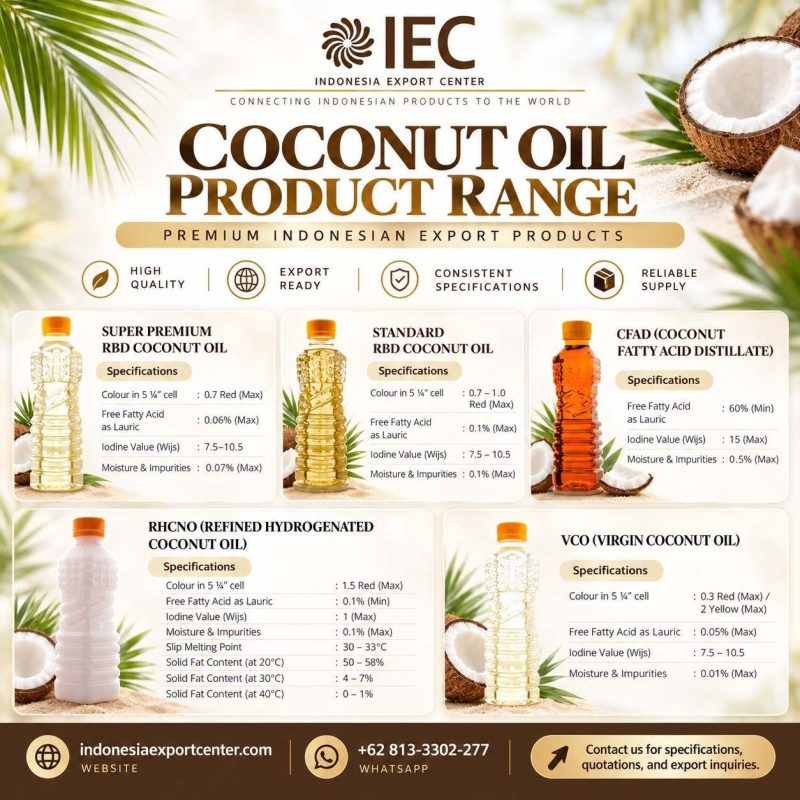
COCONUT OIL PRODUCT RANGE
PREMIUM INDONESIAN EXPORT PRODUCTS
HIGH QUALITY | EXPORT-READY SOURCING | CONSISTENT SPECIFICATIONS | RELIABLE SUPPLY CONNECTIONS
Industrial RBD Coconut Oil for Oleochemical Manufacturing
Indonesia Export Center (IEC) connects international manufacturers and industrial buyers with Indonesian suppliers of RBD Coconut Oil for the Oleochemical Industry, supporting sourcing requirements for fatty acid processing, fatty alcohol manufacturing, surfactant production, soap manufacturing, and other chemical processing applications.
Refined, Bleached, and Deodorized (RBD) Coconut Oil is a valuable lauric oil feedstock for oleochemical production. Its characteristic medium-chain fatty acid composition, particularly its naturally high lauric acid content, makes coconut oil suitable for producing a broad range of industrial chemical intermediates and downstream products.
Our sourcing network supports buyers seeking Standard RBD Coconut Oil, Super Premium RBD Coconut Oil, and selected coconut-derived industrial raw materials from Indonesia.
Whether your business requires bulk coconut oil for hydrolysis, fatty acid distillation, esterification, or other oleochemical processing operations, IEC helps facilitate supplier connections, product specification discussions, and international trade coordination.
Looking for bulk RBD Coconut Oil for your oleochemical production facility?
Contact Indonesia Export Center to discuss your industrial specifications, required quantity, destination port, and procurement schedule.
Website: https://indonesiaexportcenter.com/
WhatsApp: https://wa.me/628133302277
Why RBD Coconut Oil Is Important for the Oleochemical Industry
RBD Coconut Oil is widely recognized as an important renewable, plant-derived raw material for industrial oleochemical processing.
Coconut oil contains significant proportions of saturated medium-chain fatty acids, including lauric acid and myristic acid. These characteristics support its use as a feedstock for producing fatty acids, fatty alcohols, soaps, surfactants, and various chemical derivatives.
Key Advantages of RBD Coconut Oil
1. Lauric Acid-Rich Feedstock
Coconut oil typically contains approximately 45–53% lauric acid within its fatty acid composition, although the actual percentage depends on the source and individual production batch.
Lauric acid is an important building block for several oleochemical intermediates and downstream industrial formulations.
2. Refined Industrial Raw Material
RBD Coconut Oil undergoes refining, bleaching, and deodorization to reduce free fatty acids, color bodies, odor compounds, and other undesirable components.
This makes appropriately specified RBD Coconut Oil suitable for many industrial processing applications.
3. Suitable for Fatty Acid Manufacturing
Through industrial hydrolysis or fat-splitting processes, coconut oil triglycerides can be converted into free fatty acids and glycerol.
These fatty acids may subsequently be separated, purified, or processed into specialty chemical products.
4. Versatile Chemical Processing Applications
RBD Coconut Oil can serve as a raw material in oleochemical processes involving hydrolysis, esterification, transesterification, and other chemical conversion technologies.
5. Plant-Derived Feedstock
Coconut oil provides a renewable agricultural source of fatty acid chains for manufacturers developing plant-derived oleochemical ingredients.
6. Indonesian Supply Opportunities
Indonesia’s coconut production and processing industry provides sourcing opportunities for international oleochemical companies seeking coconut-based industrial oils.
IEC helps connect qualified buyers with potential Indonesian suppliers based on commercial requirements and product availability.
Standard RBD Coconut Oil Specifications
Primary Product: Standard RBD Coconut Oil
The following specifications represent the Standard RBD Coconut Oil product grade offered for sourcing discussions through IEC.
| Specification | Value |
|---|---|
| Product Name | Standard RBD Coconut Oil |
| Product Type | Refined, Bleached and Deodorized Coconut Oil |
| Country of Origin | Indonesia |
| Colour in 5¼” Cell | 0.7–1.0 Red (Max), depending on agreed grade |
| Free Fatty Acid as Lauric | 0.1% (Max) |
| Iodine Value (Wijs) | 7.5–10.5 |
| Moisture & Impurities | 0.1% (Max) |
| Intended Application | Oleochemical and Industrial Processing |
| Supply Format | Bulk or industrial packaging, subject to supplier confirmation |
| Documentation | Subject to supplier, shipment, and destination requirements |
Specifications are indicative procurement targets based on the supplied product information. Final contractual specifications should be confirmed through the supplier’s technical data sheet, batch-specific Certificate of Analysis, and mutually agreed purchase contract.
The relatively low free fatty acid and moisture specifications can be relevant for processors seeking controlled raw material quality.
However, buyers should evaluate other processing parameters, including fatty acid composition, saponification value, peroxide value, unsaponifiable matter, and applicable contaminant limits before approving the material for a particular oleochemical process.
Major Applications of RBD Coconut Oil in Oleochemical Manufacturing
1. Fatty Acid Production
RBD Coconut Oil for Fatty Acid Manufacturing
RBD Coconut Oil is an established triglyceride feedstock used in the production of coconut-derived fatty acids.
Industrial fat splitting converts coconut oil triglycerides into fatty acids and glycerol. The resulting fatty acids can undergo fractionation and further purification to produce commercially useful fatty acid products.
Potential downstream products include:
- Lauric acid
- Myristic acid
- Caprylic and capric fatty acid fractions
- Mixed coconut fatty acids
- Specialty fatty acid derivatives
The suitability and production yield of individual fatty acid fractions depend on the feedstock composition and processing technology.
2. Fatty Alcohol Manufacturing
Coconut Oil-Based Feedstock for Fatty Alcohol Production
Coconut-derived fatty acids and fatty acid methyl esters can be processed into fatty alcohols through suitable industrial conversion processes.
Fatty alcohols are important chemical intermediates for manufacturing surfactants, detergents, personal care ingredients, and other specialty products.
Typical downstream applications include fatty alcohol ethoxylates, fatty alcohol sulfates, and other industrial surfactant systems.
3. Surfactant Manufacturing
Lauric Oil Feedstock for Surfactant Production
Coconut-derived fatty acids and fatty alcohols are widely used in the surfactant industry.
These materials can be converted into ingredients used in:
- Household cleaning products
- Industrial detergents
- Liquid cleaning formulations
- Personal care products
- Emulsifying agents
- Specialty industrial surfactants
RBD Coconut Oil generally serves as an upstream raw material rather than a direct substitute for finished surfactants.
4. Soap Manufacturing
RBD Coconut Oil for Industrial Soap Production
RBD Coconut Oil can be used in soap manufacturing through saponification with an appropriate alkali.
Coconut-derived soap formulations are valued for their cleansing and foaming characteristics.
Industrial applications may include:
- Bar soap production
- Soap noodles manufacturing
- Laundry soap
- Specialty cleansing products
- Industrial cleaning formulations
Manufacturers should determine the appropriate coconut oil inclusion rate according to their formulation, processing equipment, and finished product requirements.
5. Fatty Acid Methyl Ester Production
RBD Coconut Oil for Esterification and Transesterification Processes
RBD Coconut Oil may be used as a triglyceride feedstock for producing fatty acid methyl esters through transesterification.
These esters can serve as intermediates for fatty alcohol production, specialty chemical synthesis, and other industrial applications.
The final ester distribution depends on the coconut oil’s fatty acid composition and the selected processing conditions.
6. Specialty Oleochemical Derivatives
Coconut-derived fatty acids may also be used to manufacture:
- Fatty acid esters
- Lubricant intermediates
- Emulsifier ingredients
- Cosmetic raw material intermediates
- Chemical processing additives
- Other specialty oleochemical derivatives
Application suitability must be assessed based on the required chemistry, purity, and technical performance standards.
Complete Coconut Oil Product Range from Indonesia
IEC supports sourcing discussions for several coconut oil products and related industrial feedstocks.
Super Premium RBD Coconut Oil
A refined coconut oil grade with tighter stated limits for free fatty acids and moisture-related impurities than the Standard RBD Coconut Oil grade.
| Specification | Value |
|---|---|
| Colour in 5¼” Cell | 0.7 Red (Max) |
| Free Fatty Acid as Lauric | 0.06% (Max) |
| Iodine Value (Wijs) | 7.5–10.5 |
| Moisture & Impurities | 0.07% (Max) |
Potential Applications: Food processing, cosmetics, and selected oleochemical manufacturing processes subject to technical requirements.
Standard RBD Coconut Oil
A refined coconut oil grade intended for manufacturers requiring commercially suitable coconut oil raw materials.
| Specification | Value |
|---|---|
| Colour in 5¼” Cell | 0.7–1.0 Red (Max), depending on agreed grade |
| Free Fatty Acid as Lauric | 0.1% (Max) |
| Iodine Value (Wijs) | 7.5–10.5 |
| Moisture & Impurities | 0.1% (Max) |
Potential Applications: Oleochemicals, soap manufacturing, fatty acid processing, and other suitable industrial applications.
CFAD – Coconut Fatty Acid Distillate
Coconut Fatty Acid Distillate is a coconut oil refining by-product containing a significant free fatty acid fraction.
| Specification | Value |
|---|---|
| Free Fatty Acid as Lauric | 60% (Min) |
| Iodine Value (Wijs) | 15 (Max) |
| Moisture & Impurities | 0.5% (Max) |
Potential Applications: Fatty acid recovery, soap manufacturing, and selected industrial oleochemical processes.
CFAD is chemically different from refined triglyceride coconut oil and should be evaluated separately when selecting industrial feedstocks.
RHCNO – Refined Hydrogenated Coconut Oil
RHCNO is hydrogenated coconut oil designed for applications requiring specific melting and solid fat characteristics.
| Specification | Value |
|---|---|
| Colour in 5¼” Cell | 1.5 Red (Max) |
| Free Fatty Acid as Lauric | To be confirmed against supplier COA |
| Iodine Value (Wijs) | 1 (Max) |
| Moisture & Impurities | 0.1% (Max) |
| Slip Melting Point | 30–33°C |
| Solid Fat Content at 20°C | 50–58% |
| Solid Fat Content at 30°C | 4–7% |
| Solid Fat Content at 40°C | 0–1% |
Potential Applications: Specialty fats and selected industrial formulations requiring hydrogenated coconut oil characteristics.
VCO – Virgin Coconut Oil
Virgin Coconut Oil is produced through processes intended to retain the characteristics of minimally refined coconut oil.
| Specification | Value |
|---|---|
| Colour in 5¼” Cell | 0.3 Red (Max) / 2 Yellow (Max) |
| Free Fatty Acid as Lauric | 0.05% (Max) |
| Iodine Value (Wijs) | 7.5–10.5 |
| Moisture & Impurities | 0.01% (Max) |
Potential Applications: Cosmetics, personal care, food processing, and specialty formulations.
VCO is generally a different sourcing category from commodity-grade industrial RBD Coconut Oil.
RBD Coconut Oil vs CFAD for Oleochemical Processing
Industrial buyers should understand the differences between refined coconut oil and coconut fatty acid distillate before selecting their preferred feedstock.
| Parameter | Standard RBD Coconut Oil | CFAD |
|---|---|---|
| Main Material Type | Refined triglyceride oil | Fatty acid-rich distillate |
| Free Fatty Acid | 0.1% Max | 60% Min |
| Primary Processing Consideration | Triglyceride conversion | Free fatty acid recovery or conversion |
| Typical Industrial Use | Fat splitting, soap production, ester processing | Soap production and selected fatty acid processing |
| Feedstock Selection | Based on triglyceride processing requirements | Based on free fatty acid processing requirements |
The appropriate feedstock depends on the manufacturer’s production process, conversion technology, product specifications, and overall economics.
IEC can help buyers communicate these requirements to prospective Indonesian suppliers.
Industrial Quality Considerations for Oleochemical Buyers
For oleochemical processing, purchasing decisions should consider more than price and basic commercial oil specifications.
Important technical parameters may include:
Fatty Acid Composition
The relative proportions of caprylic, capric, lauric, myristic, palmitic, oleic, and other fatty acids help determine the potential downstream product distribution.
Free Fatty Acid Content
FFA levels can influence refining requirements, storage stability, process chemistry, and raw material handling.
Moisture and Impurities
Excessive moisture or impurities may interfere with selected processing systems and affect production efficiency.
Iodine Value
Iodine value is an indication of the degree of unsaturation and may be relevant to industrial process control.
Saponification Value
Saponification value can help characterize the feedstock and support certain processing calculations.
Oxidative Quality
Peroxide value and other oxidative stability indicators may be relevant for selected downstream applications.
Traceability and Documentation
Buyers may request product origin records, production batch identification, technical data sheets, and independent inspection reports.
Final quality acceptance should always follow an agreed specification and appropriate testing procedures.
Bulk RBD Coconut Oil Supply for Asian Oleochemical Manufacturers
Indonesia Export Center focuses on connecting qualified industrial buyers with Indonesian supply partners capable of discussing commercial-scale coconut oil requirements.
Our target sourcing markets include:
China
Coconut-derived raw materials for fatty acid manufacturing, surfactant intermediates, and chemical processing industries.
India
Industrial coconut oil procurement for oleochemical, soap, detergent, and specialty chemical manufacturers.
Malaysia
Feedstock sourcing opportunities for established oleochemical processing and downstream chemical industries.
Thailand
Industrial oil requirements for fatty acid processors, soap manufacturers, and chemical ingredient companies.
Vietnam
Coconut-derived raw material sourcing for detergent, industrial chemical, and manufacturing applications.
South Korea
Coconut-based oleochemical feedstocks for specialty chemicals and downstream ingredient processing.
Japan
Refined coconut oil sourcing for manufacturers requiring defined product specifications, technical documentation, and quality management procedures.
IEC also welcomes inquiries from other markets seeking Indonesian coconut oil products.
Industrial Packaging and Export Arrangements
Packaging and logistics should be selected according to the order quantity, product handling requirements, destination, and supplier capabilities.
Potential arrangements may include:
- Industrial drums
- IBC containers
- Flexitanks suitable for the product and shipment
- ISO tank containers
- Other bulk shipment arrangements
All options are subject to supplier confirmation, packaging suitability, equipment availability, and applicable transportation requirements.
Commercial quotations may be discussed under agreed Incoterms, including FOB or CIF where supported by the contracting supplier.
Final delivery conditions, payment terms, insurance responsibilities, and inspection arrangements should be confirmed in the purchase contract.
Why Source RBD Coconut Oil Through Indonesia Export Center?
Access to Indonesian Supply Networks
IEC facilitates connections between international buyers and potential Indonesian manufacturers, processors, and trading partners.
Product Specification-Based Sourcing
We encourage buyers to define their required fatty acid profile, FFA content, moisture limits, processing applications, and other relevant industrial specifications.
Multiple Coconut Oil Product Categories
Our sourcing scope includes Standard RBD Coconut Oil, Super Premium RBD Coconut Oil, CFAD, RHCNO, and VCO, subject to supplier availability.
International B2B Communication
IEC supports initial communication between buyers and prospective suppliers to clarify commercial requirements, documentation, and purchasing expectations.
Industrial Procurement Support
We facilitate sourcing inquiries covering product grades, bulk quantities, shipment preferences, and supplier selection considerations.
Transparent Business Role
Indonesia Export Center operates as a B2B sourcing and trade facilitation platform, connecting buyers with Indonesian supply partners. Manufacturing, stock ownership, export execution, product warranties, and contractual obligations are determined by the actual participating supplier and agreed transaction structure.
How to Request an Industrial RBD Coconut Oil Quotation
International buyers can submit a Request for Quotation (RFQ) with the following information:
| Requirement | Buyer Information |
|---|---|
| Product | Standard RBD Coconut Oil |
| Application | Oleochemical Manufacturing |
| Required Quantity | Metric Tons (MT) |
| Technical Specifications | FFA, IV, Moisture, Fatty Acid Profile |
| Packaging | Drum / IBC / Flexitank / ISO Tank |
| Destination | Country and Discharge Port |
| Preferred Incoterm | FOB / CIF / Other |
| Delivery Schedule | Required Shipment Period |
| Documentation | COA / TDS / SDS / Other |
| Buyer Details | Company Name and Business Website |
Accurate RFQ information helps prospective suppliers assess technical compatibility and prepare relevant commercial offers.
Request an RBD Coconut Oil Quotation
WhatsApp: https://wa.me/628133302277
Website: https://indonesiaexportcenter.com/
Frequently Asked Questions About RBD Coconut Oil for the Oleochemical Industry
1. What is RBD Coconut Oil used for in the oleochemical industry?
RBD Coconut Oil is used as a raw material for producing fatty acids, soaps, fatty acid methyl esters, and other coconut-derived chemical intermediates. Through additional processing, these intermediates can be converted into fatty alcohols, surfactants, and specialty oleochemical products.
2. Why is coconut oil suitable for fatty acid manufacturing?
Coconut oil contains a significant proportion of lauric and other medium-chain fatty acids. Its triglycerides can be converted into free fatty acids through industrial fat-splitting processes.
3. What is the difference between Standard and Super Premium RBD Coconut Oil?
The stated Super Premium grade has tighter free fatty acid and moisture/impurity limits than the Standard grade. Selection should depend on the buyer’s actual manufacturing requirements rather than the grade name alone.
4. Can RBD Coconut Oil be used to produce fatty alcohols?
Yes. Coconut oil can serve as an upstream feedstock for producing fatty acids or fatty acid methyl esters that are subsequently converted into fatty alcohols using suitable processing technologies.
5. Is RBD Coconut Oil the same as Coconut Fatty Acid Distillate?
No. RBD Coconut Oil primarily consists of triglycerides, whereas CFAD contains a substantial proportion of free fatty acids and other refining-derived components. Their industrial processing requirements may differ significantly.
6. Can IEC arrange bulk RBD Coconut Oil sourcing from Indonesia?
IEC can facilitate sourcing inquiries and introductions to prospective Indonesian suppliers. Product availability, minimum order quantities, quotations, and export arrangements require confirmation from the relevant supply partner.
7. What documents should oleochemical buyers request?
Depending on the application and destination, buyers may request a Certificate of Analysis (COA), Technical Data Sheet (TDS), Safety Data Sheet (SDS), certificate of origin, inspection records, and relevant shipping documents.
8. Does IEC manufacture RBD Coconut Oil directly?
IEC operates as a sourcing and B2B trade facilitation platform. It connects international buyers with potential Indonesian supply partners rather than representing itself as the direct manufacturer.
9. What information is required for an accurate RBD Coconut Oil quotation?
Buyers should provide the quantity, product grade, target specifications, intended application, preferred packaging, destination port, Incoterm, and anticipated purchasing schedule.
10. Which Asian countries can inquire about Indonesian RBD Coconut Oil?
IEC welcomes inquiries from oleochemical manufacturers and industrial buyers in China, India, Malaysia, Thailand, Vietnam, Japan, South Korea, and other international markets.
Actual shipment feasibility depends on supplier capabilities and the applicable import and export requirements.
Source Indonesian RBD Coconut Oil for Your Oleochemical Production
INDONESIA EXPORT CENTER – CONNECTING INDONESIAN PRODUCTS TO THE WORLD
Are you looking for a reliable sourcing channel for RBD Coconut Oil for Oleochemical Industry applications?
Indonesia Export Center helps international industrial buyers identify potential Indonesian suppliers of refined coconut oil and selected coconut-derived chemical feedstocks.
Whether your company manufactures fatty acids, fatty alcohols, surfactants, soaps, esters, or specialty chemical intermediates, our platform can support your initial supplier sourcing and commercial inquiry process.
Our Coconut Oil Product Range:
- Super Premium RBD Coconut Oil
- Standard RBD Coconut Oil
- Coconut Fatty Acid Distillate (CFAD)
- Refined Hydrogenated Coconut Oil (RHCNO)
- Virgin Coconut Oil (VCO)
CONTACT INDONESIA EXPORT CENTER
Website: https://indonesiaexportcenter.com/
WhatsApp: +62 813-3302-277
Direct Inquiry: https://wa.me/628133302277
Send your product specifications, purchase quantity, and destination port to begin your sourcing inquiry.
Indonesia Export Center | Indonesian Coconut Oil Sourcing & International B2B Trade Facilitation
All specifications, prices, availability, certifications, and export arrangements are subject to supplier confirmation and mutually agreed commercial terms.
