

Premium vs Standard RBD Coconut Oil: Specifications, Quality Differences & Buyer Guide
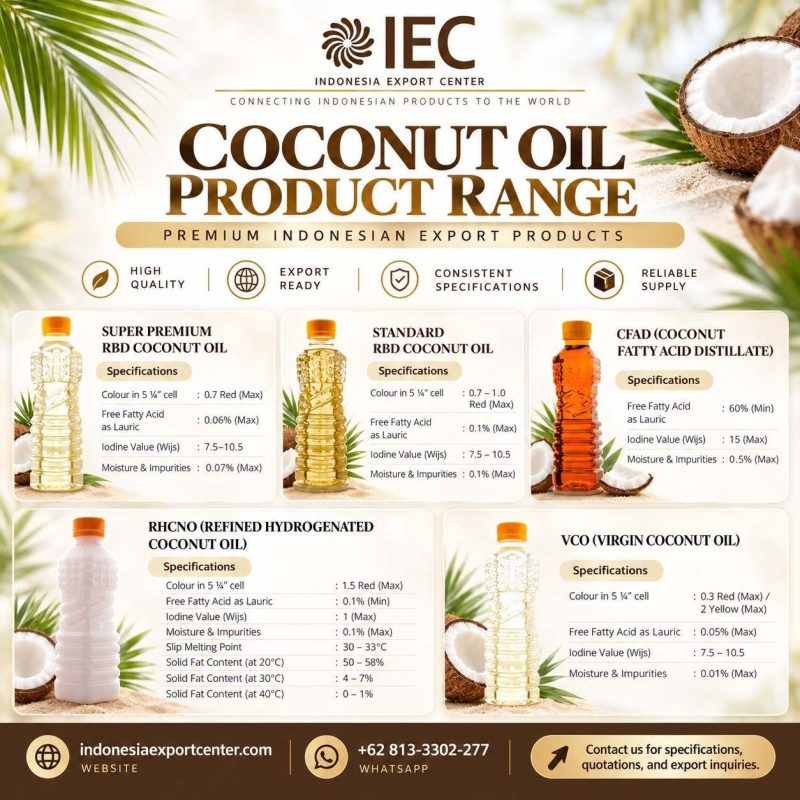
IEC | INDONESIA EXPORT CENTER
CONNECTING INDONESIAN PRODUCTS TO THE WORLD
COCONUT OIL PRODUCT RANGE
PREMIUM INDONESIAN EXPORT PRODUCTS
HIGH QUALITY | EXPORT-ORIENTED SOURCING | CONSISTENT SPECIFICATIONS | INTERNATIONAL B2B CONNECTIONS
Premium vs Standard RBD Coconut Oil – Understanding the Differences
Choosing between Premium RBD Coconut Oil and Standard RBD Coconut Oil is an important purchasing decision for international importers, food manufacturers, ingredient distributors, cosmetic producers, and industrial procurement managers.
Both products undergo refining, bleaching, and deodorization (RBD), producing refined coconut oil suitable for a range of industrial and manufacturing applications, subject to product-grade verification and intended-use requirements.
However, the two grades differ in their specified limits for free fatty acids (FFA), colour, and moisture and impurities.
These differences can influence purchasing specifications, incoming quality control, formulation requirements, and overall procurement costs.
At Indonesia Export Center (IEC), we help international buyers connect with Indonesian coconut oil suppliers and sourcing partners to evaluate suitable grades based on technical specifications, quantities, packaging requirements, and delivery destinations.
This guide provides a practical, specification-by-specification comparison to help procurement teams make informed sourcing decisions.
1. Premium vs Standard RBD Coconut Oil: Technical Comparison
The following table compares the supplied technical specifications for Super Premium RBD Coconut Oil and Standard RBD Coconut Oil.
| Specification | Super Premium RBD Coconut Oil | Standard RBD Coconut Oil |
|---|---|---|
| Colour in 5¼-inch Cell | 0.7 Red (Max) | 0.7–1.0 Red (Max), depending on supplier grade |
| Free Fatty Acid as Lauric | 0.06% (Max) | 0.10% (Max) |
| Iodine Value (Wijs) | 7.5–10.5 | 7.5–10.5 |
| Moisture & Impurities | 0.07% (Max) | 0.10% (Max) |
| Product Type | Refined, Bleached & Deodorized Coconut Oil | Refined, Bleached & Deodorized Coconut Oil |
| Principal Sourcing Consideration | Tighter specified quality limits | Broader specified quality tolerances |
| Potential Applications | Food, specialty ingredients, cosmetics and personal care, subject to suitability checks | Food manufacturing, ingredient processing and industrial applications, subject to suitability checks |
Important: These figures represent the supplied product-grade specifications and should not be interpreted as universal international standards. Actual production-lot values must be confirmed through supplier documentation and Certificates of Analysis (COA).
2. Key Differences Between Premium and Standard RBD Coconut Oil
A. Free Fatty Acid (FFA): 0.06% vs 0.10%
Free fatty acid content is an important quality parameter for refined edible oils.
The supplied specifications indicate:
- Super Premium RBD Coconut Oil: Maximum 0.06% FFA, expressed as lauric acid.
- Standard RBD Coconut Oil: Maximum 0.10% FFA, expressed as lauric acid.
The Super Premium grade therefore has a 40% lower maximum permitted FFA level compared with the Standard grade.
A lower FFA specification can be useful for manufacturers requiring tighter raw-material acceptance criteria and greater control over incoming ingredient specifications.
However, the maximum specification is not necessarily the actual FFA content of a shipment. A Standard-grade production lot may also test substantially below its maximum permitted level.
For purchasing decisions, buyers should compare actual COA results rather than relying on grade names alone.
B. Colour: Refined Oil Appearance and Quality Control
Colour is another important parameter when evaluating refined coconut oil for manufacturing applications.
The supplied specifications are:
- Super Premium RBD Coconut Oil: Maximum 0.7 Red.
- Standard RBD Coconut Oil: Maximum 0.7–1.0 Red, depending on the supplier’s specified grade.
Colour measurements are expressed for a 5¼-inch measurement cell.
The Super Premium grade offers a tighter maximum colour requirement where the Standard-grade supplier allows up to 1.0 Red.
This may be relevant for manufacturers of food ingredients, confectionery components, cosmetics, and personal care formulations where consistent oil appearance is important.
Buyers should confirm the colour testing instrument, method, measurement cell, and relevant acceptance criteria before approving shipments.
C. Moisture & Impurities: 0.07% vs 0.10%
Moisture and impurities are important parameters when assessing refined oil quality, cleanliness, and suitability for manufacturing processes.
The supplied specifications indicate:
- Super Premium RBD Coconut Oil: Maximum 0.07%.
- Standard RBD Coconut Oil: Maximum 0.10%.
The Super Premium grade has a 30% lower maximum permitted moisture-and-impurities level.
Lower specified moisture and impurities limits can be beneficial for manufacturers seeking tighter control of incoming ingredients.
Nevertheless, storage conditions, packaging integrity, handling procedures, oxidation characteristics, and other product quality parameters should also be evaluated.
D. Iodine Value: Similar Specifications for Both Grades
Both grades have the same stated iodine value range:
Iodine Value (Wijs): 7.5–10.5
Iodine value provides an indication of the degree of unsaturation in fats and oils.
Because both grades share the same specified range, iodine value does not distinguish Premium from Standard RBD Coconut Oil in this particular comparison.
Buyers should instead focus on the parameters where the specifications differ, while also evaluating any additional characteristics required by their formulations.
3. Which Grade Is Better for Your Business?
The appropriate grade depends on technical requirements, intended application, purchasing specifications, and overall supply economics.
Choose Super Premium RBD Coconut Oil When:
- Your purchasing specification requires FFA at or below 0.06%.
- Your formulation requires a maximum colour limit of 0.7 Red.
- Your quality assurance program specifies moisture and impurities at or below 0.07%.
- Your business requires tighter incoming material specifications.
- Your procurement team can justify a potential grade premium based on application needs.
Choose Standard RBD Coconut Oil When:
- Your approved raw-material specification allows FFA up to 0.10%.
- Your manufacturing process accepts the supplier’s Standard-grade colour specification.
- Your moisture-and-impurities acceptance limit is 0.10%.
- Your business prioritizes cost-effective sourcing while maintaining defined quality requirements.
- The supplier’s actual production-lot test results meet your technical requirements.
Procurement Recommendation: Choose the grade that meets the requirements of your final product, rather than selecting a more expensive grade solely because it is described as Premium.
4. Applications of Premium and Standard RBD Coconut Oil
Food Manufacturing
RBD Coconut Oil may be used as an ingredient in suitable food-processing applications, including selected bakery products, confectionery formulations, processed foods, and specialty fats.
Super Premium specifications may be preferable where buyers require tighter incoming oil-quality limits.
Standard RBD Coconut Oil may be an appropriate alternative when its specifications meet the manufacturer’s established requirements.
Food-use suitability must be confirmed against applicable regulations, supplier documentation, and the intended manufacturing application.
Cosmetics and Personal Care
Refined coconut oil may be evaluated for use in creams, lotions, soaps, balms, and other personal care formulations.
Premium-grade specifications can be relevant when formulators require tighter limits for colour, FFA, and moisture.
However, cosmetic suitability also depends on additional parameters, including odor, oxidation stability, microbiological considerations where applicable, traceability, and formulation compatibility.
Industrial Manufacturing
Standard and Super Premium RBD Coconut Oil may also be considered as feedstocks for selected industrial formulations.
The appropriate grade should be determined by the manufacturing process, required chemical and physical properties, and supplier documentation.
5. Does Premium RBD Coconut Oil Always Have Better Quality?
Not necessarily.
Super Premium RBD Coconut Oil has tighter limits for certain parameters in the supplied specifications, but this does not automatically mean that every Premium-grade batch performs better than every Standard-grade batch.
For example, a Standard-grade lot with actual FFA of 0.04% would meet the stated FFA maximum for both grades.
To establish a meaningful quality difference, purchasing teams should assess:
- Actual Certificate of Analysis results.
- Supplier product specifications.
- Testing methodologies.
- Production-lot consistency.
- Packaging and handling standards.
- Additional parameters relevant to the final application.
- Commercial terms and total landed cost.
The best purchasing decision combines verified technical compliance with reliable commercial supply arrangements.
6. What Should Importers Verify Before Purchasing?
Before purchasing Premium or Standard RBD Coconut Oil from Indonesia, international buyers should request documentation relevant to their intended application and importing jurisdiction.
Key purchasing considerations include:
Certificate of Analysis (COA)
Review actual test values against the agreed product specifications.
Technical Data Sheet (TDS)
Confirm the declared physical and chemical characteristics, application suitability, and testing methods.
Food Safety or Manufacturing Documentation
Request applicable certifications and manufacturer documentation where required. Certification availability must be verified for the specific producer and product.
Packing Specifications
Confirm the proposed packaging type, net weight, container loading plan, and handling requirements.
Country-Specific Import Requirements
Assess customs classifications, applicable food or cosmetic regulations, labeling requirements, and documentation obligations for the destination market.
Commercial and Shipment Terms
Confirm Incoterms, shipment origin, production lead time, payment terms, and inspection arrangements.
IEC can help facilitate discussions with potential suppliers regarding available documentation and buyer-specific requirements.
7. Premium vs Standard RBD Coconut Oil Pricing
The price difference between Premium and Standard RBD Coconut Oil depends on several commercial factors.
These may include:
- Product grade and technical acceptance criteria.
- Order volume and minimum order quantity.
- Coconut oil market conditions.
- Supplier production and inventory availability.
- Packaging configuration.
- Delivery destination and freight costs.
- Agreed Incoterms and payment arrangements.
Super Premium RBD Coconut Oil may command a higher quotation because of its tighter specified quality limits, although actual market prices vary.
International buyers should obtain quotations for both grades using identical order volumes, packaging assumptions, delivery terms, and quotation validity periods.
This provides a more reliable basis for comparing total landed cost.
8. Related Coconut Oil Products from Indonesia
Beyond Super Premium and Standard RBD Coconut Oil, IEC helps connect international buyers with sourcing opportunities across additional Indonesian coconut oil products.
CFAD – Coconut Fatty Acid Distillate
| Specification | Value |
|---|---|
| Free Fatty Acid as Lauric | 60% (Min) |
| Iodine Value (Wijs) | 15 (Max) |
| Moisture & Impurities | 0.5% (Max) |
CFAD is a distinct coconut oil refining by-product containing a high proportion of free fatty acids. It is used as an industrial feedstock for suitable downstream processing applications.
CFAD should not be treated as interchangeable with edible RBD Coconut Oil.
RHCNO – Refined Hydrogenated Coconut Oil
| Specification | Value |
|---|---|
| Colour in 5¼-inch Cell | 1.5 Red (Max) |
| Free Fatty Acid as Lauric | 0.1% (Min), as supplied — requires supplier confirmation |
| Iodine Value (Wijs) | 1 (Max) |
| Moisture & Impurities | 0.1% (Max) |
| Slip Melting Point | 30–33°C |
| Solid Fat Content at 20°C | 50–58% |
| Solid Fat Content at 30°C | 4–7% |
| Solid Fat Content at 40°C | 0–1% |
RHCNO is a hydrogenated coconut oil product with different physical characteristics from conventional RBD Coconut Oil.
It may be considered for applications requiring particular melting and solid-fat behavior.
Technical note: The supplied RHCNO FFA specification is written as a minimum. This should be clarified with the producer before publication as a confirmed quality limit or use in a purchasing contract.
VCO – Virgin Coconut Oil
| Specification | Value |
|---|---|
| Colour in 5¼-inch Cell | 0.3 Red (Max) / 2 Yellow (Max) |
| Free Fatty Acid as Lauric | 0.05% (Max) |
| Iodine Value (Wijs) | 7.5–10.5 |
| Moisture & Impurities | 0.01% (Max) |
Virgin Coconut Oil is produced through processes different from conventional refining, bleaching, and deodorization.
It serves distinct market segments, depending on extraction methods, quality characteristics, intended applications, and buyer requirements.
9. Why Source RBD Coconut Oil Through Indonesia Export Center?
Indonesia Export Center (IEC) is a B2B sourcing and business-matching platform connecting international buyers with Indonesian product suppliers and business partners.
Our role is to facilitate sourcing discussions, supplier introductions, and commercial communication rather than represent ourselves as the direct manufacturer of every listed product.
Through IEC, international buyers can explore:
- Product Grade Matching: Identify suppliers offering specifications aligned with purchasing requirements.
- Supplier Connections: Connect with potential Indonesian coconut oil producers and trading partners.
- Technical Discussions: Request available specifications and supporting documents.
- Bulk Procurement Inquiries: Discuss quantities, packaging, shipment destinations, and commercial requirements.
- Export Coordination: Facilitate discussions between buyers and suitable supply partners.
Final product availability, compliance documentation, quotations, export capability, and contractual obligations must be confirmed with the selected supplier.
10. Request Premium or Standard RBD Coconut Oil from Indonesia
Are you looking for Premium RBD Coconut Oil or Standard RBD Coconut Oil for international distribution, food manufacturing, cosmetic production, or industrial processing?
IEC welcomes inquiries from global procurement managers, importers, ingredient distributors, manufacturers, and wholesale buyers.
To receive a more relevant sourcing response, please provide:
- Required product: Super Premium or Standard RBD Coconut Oil.
- Intended application: Food, cosmetics, personal care, or industrial use.
- Required technical specifications.
- Estimated purchasing quantity in metric tons.
- Preferred packaging type.
- Destination country and discharge port.
- Preferred Incoterms, such as FOB, CFR, or CIF.
- Required technical or compliance documentation.
- Expected purchasing schedule.
Our team can help communicate these requirements to potential Indonesian supply partners.
INDONESIA EXPORT CENTER (IEC)
Connecting Indonesian Products to the World
Website: https://indonesiaexportcenter.com/
WhatsApp: +62 813-3302-277
WhatsApp Inquiry: https://wa.me/628133302277
Request Product Specifications | Ask for a Quotation | Discuss Bulk Sourcing
Frequently Asked Questions (FAQ)
1. What is the main difference between Premium and Standard RBD Coconut Oil?
The main differences in the supplied specifications are their maximum permitted levels for free fatty acids, colour, and moisture and impurities. Super Premium RBD Coconut Oil has tighter quality limits for these parameters.
2. What is the FFA limit for Premium RBD Coconut Oil?
The supplied Super Premium grade specifies a maximum free fatty acid content of 0.06%, expressed as lauric acid.
3. What is the FFA limit for Standard RBD Coconut Oil?
The supplied Standard grade specifies a maximum free fatty acid content of 0.10%, expressed as lauric acid.
4. Do Premium and Standard RBD Coconut Oil have the same iodine value?
Yes. Both supplied grades have an iodine value range of 7.5–10.5 using the Wijs method.
5. Is Premium RBD Coconut Oil better for cosmetic manufacturing?
It may be preferable for some formulations because of its tighter specified quality limits. However, actual suitability depends on formulation requirements, testing results, and applicable cosmetic regulations.
6. Can Standard RBD Coconut Oil be used in food manufacturing?
Yes, provided that the specific product is suitable for food use, meets relevant food safety requirements, and complies with the buyer’s technical specifications and destination-market regulations.
7. Is Super Premium RBD Coconut Oil more expensive?
It may be priced higher due to tighter specification requirements. Actual pricing depends on supplier quotations, market conditions, order quantity, packaging, and delivery terms.
8. Can buyers request a Certificate of Analysis?
Buyers should request a COA or appropriate product testing documentation from the supplier. Availability of lot-specific COAs should be confirmed before purchasing.
9. Does IEC manufacture or export coconut oil directly?
IEC operates as a B2B sourcing and business-matching platform. Manufacturing, sales, shipment, and export responsibilities depend on the selected supplier and agreed commercial arrangement.
10. How can I request Premium or Standard RBD Coconut Oil from Indonesia?
Contact IEC through WhatsApp at +62 813-3302-277 with your required grade, quantity, destination country, packaging preference, and technical specifications.
Final Conclusion: Premium vs Standard RBD Coconut Oil
Both Super Premium and Standard RBD Coconut Oil can serve international manufacturing and distribution markets when they meet the intended application’s requirements.
The principal differences in the supplied specifications are:
Super Premium RBD Coconut Oil
- FFA as Lauric: 0.06% Max.
- Colour: 0.7 Red Max.
- Moisture & Impurities: 0.07% Max.
- Iodine Value: 7.5–10.5.
Standard RBD Coconut Oil
- FFA as Lauric: 0.10% Max.
- Colour: 0.7–1.0 Red Max., depending on supplier specification.
- Moisture & Impurities: 0.10% Max.
- Iodine Value: 7.5–10.5.
For international procurement teams, the best grade is the one that consistently meets required quality specifications at an acceptable total procurement cost.
Looking for a reliable Indonesian RBD Coconut Oil sourcing connection?
Contact Indonesia Export Center to discuss technical requirements, supplier matching, available documentation, and commercial inquiries.
Website: https://indonesiaexportcenter.com/
WhatsApp: https://wa.me/628133302277
INDONESIA EXPORT CENTER – CONNECTING INDONESIAN PRODUCTS TO THE WORLD
