

IEC | INDONESIA EXPORT CENTER
CONNECTING INDONESIAN PRODUCTS TO THE WORLD
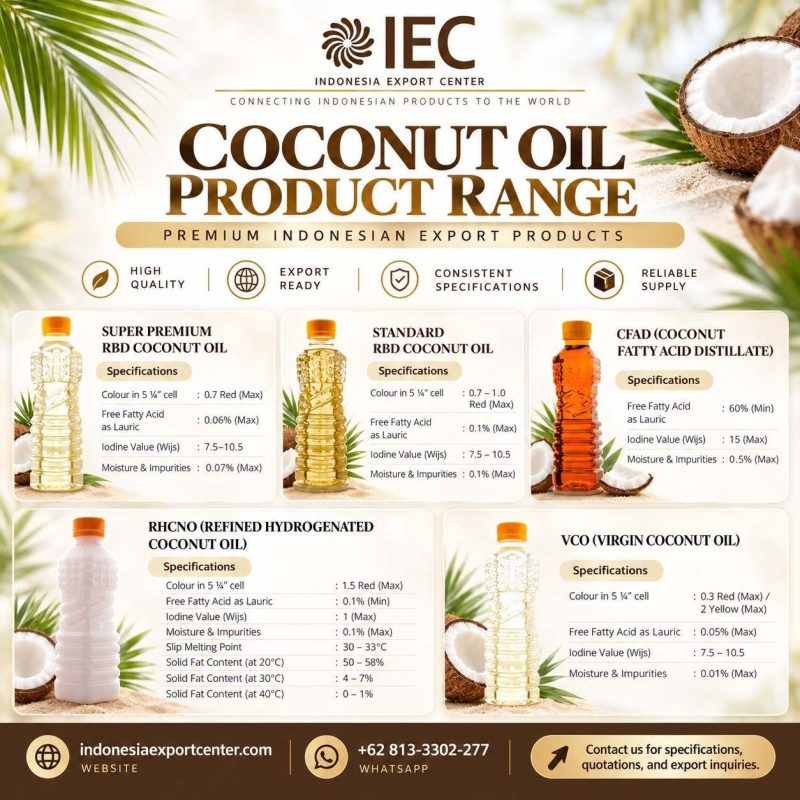
COCONUT OIL PRODUCT RANGE
PREMIUM INDONESIAN EXPORT PRODUCTS
Super Premium RBD Coconut Oil | Standard RBD Coconut Oil | Technical Comparison | Quality Specifications | Bulk Procurement
Premium vs Standard RBD Coconut Oil: What Is the Difference?
Understanding the difference between premium vs standard RBD coconut oil is essential for procurement managers evaluating refined coconut oil for food manufacturing, cosmetic production, personal care formulations and industrial applications.
Although both grades belong to the refined, bleached and deodorised coconut oil category, their stated quality specifications may differ.
Based on the supplied reference specifications, Super Premium RBD Coconut Oil has lower maximum limits for free fatty acid content and moisture and impurities than Standard RBD Coconut Oil.
Both grades share the same stated iodine value range.
The supplied color specifications also differ, although the Standard RBD color entry requires clarification from the manufacturer.
For buyers, the important question is not simply which grade has the more attractive name.
It is:
Which grade meets the technical, regulatory, operational and commercial requirements of the intended application?
This guide compares the two grades parameter by parameter and explains how procurement teams can make a documented purchasing decision.
Quick Comparison: Super Premium vs Standard RBD Coconut Oil
| Quality Parameter | Super Premium RBD Coconut Oil | Standard RBD Coconut Oil |
|---|---|---|
| Colour in 5¼-inch Cell | 0.7 Red (Max) | 0.7–1.0 Red (Max) |
| Free Fatty Acid as Lauric | 0.06% (Max) | 0.1% (Max) |
| Iodine Value (Wijs) | 7.5–10.5 | 7.5–10.5 |
| Moisture & Impurities | 0.07% (Max) | 0.1% (Max) |
Key takeaway: Super Premium has tighter supplied maximum limits for FFA and moisture and impurities. The iodine value ranges are identical. The Standard RBD color notation must be clarified before treating it as a definitive acceptance limit.
These are supplied reference specifications, not independently verified manufacturer specifications or actual batch COA results.
Need to compare available grades for your business?
Contact IEC | Indonesia Export Center to enquire about specifications, documentation and bulk quotations.
WhatsApp: https://wa.me/628133302277
Website: https://indonesiaexportcenter.com/
1. Understanding RBD Coconut Oil Grades
What Is RBD Coconut Oil?
RBD stands for Refined, Bleached and Deodorised.
RBD coconut oil is produced by refining crude coconut oil to modify certain characteristics, including appearance, odor and free fatty acid content.
It may be evaluated for various food, cosmetic, personal care and industrial applications, depending on the actual material and its suitability.
What Does Super Premium RBD Coconut Oil Mean?
Super Premium RBD Coconut Oil is a commercial grade designation used to distinguish a product specification from other offered grades.
In the supplied reference, this grade has:
- Color: 0.7 Red maximum in a 5¼-inch cell
- FFA as Lauric: 0.06% maximum
- Iodine Value (Wijs): 7.5–10.5
- Moisture & Impurities: 0.07% maximum
The designation Super Premium is not a universal regulatory certification.
What Does Standard RBD Coconut Oil Mean?
Standard RBD Coconut Oil is another commercial grade designation.
In the supplied reference, it has:
- Color: 0.7–1.0 Red (Max), subject to clarification
- FFA as Lauric: 0.1% maximum
- Iodine Value (Wijs): 7.5–10.5
- Moisture & Impurities: 0.1% maximum
The designation Standard does not automatically mean the product is unsuitable for food or cosmetic manufacturing.
Actual suitability depends on the complete specification, test results and application requirements.
2. Detailed Specification-by-Specification Comparison
Colour: Super Premium vs Standard RBD Coconut Oil
| Grade | Supplied Color Specification |
|---|---|
| Super Premium RBD | 0.7 Red (Max) |
| Standard RBD | 0.7–1.0 Red (Max) |
Why Color Matters
Color may be relevant to manufacturers requiring consistent raw material appearance.
For certain products, changes in oil color may influence the appearance of the finished formulation.
What the Difference Means
The Super Premium reference specifies a maximum of 0.7 Red.
The Standard RBD entry states 0.7–1.0 Red (Max).
However, this notation combines a range with a maximum designation. It is unclear whether the intended Standard acceptance criterion is a maximum of 1.0 Red or another specified requirement.
Procurement recommendation: Ask the manufacturer to clarify the Standard RBD color specification, confirm the measurement method and provide actual COA results.
Is Lower Color Always Better?
Not necessarily.
The appropriate color limit depends on the intended application and the buyer’s specification.
A lower numerical color result does not by itself establish better overall product quality.
3. Free Fatty Acid Comparison
| Grade | Maximum FFA as Lauric |
|---|---|
| Super Premium RBD | 0.06% |
| Standard RBD | 0.10% |
What Is Free Fatty Acid?
Free fatty acid content is a commonly measured quality parameter in fats and oils.
It is frequently included in purchasing specifications and batch quality assessments.
How Much Lower Is the Super Premium FFA Limit?
The supplied Super Premium maximum is 0.06%, compared with 0.10% for Standard RBD.
That represents a 40% lower maximum FFA limit.
Calculation:
(0.10 − 0.06) ÷ 0.10 × 100 = 40%
This compares the specification limits, not actual batch results.
Why This Difference Matters
A tighter FFA limit may be useful where a manufacturer has established strict raw material acceptance criteria.
However, it does not automatically demonstrate superior sensory quality, shelf life or finished product performance.
Those characteristics require separate evaluation.
Important Technical Clarification
FFA as Lauric is not the same as total lauric acid content.
FFA expressed as Lauric describes the reporting basis for free fatty acids.
A complete fatty acid profile is a separate analytical measurement.
4. Iodine Value Comparison
| Grade | Iodine Value (Wijs) |
|---|---|
| Super Premium RBD | 7.5–10.5 |
| Standard RBD | 7.5–10.5 |
What Is Iodine Value?
Iodine value is a measure associated with the degree of unsaturation in an oil.
It is used as one parameter in characterizing fats and oils.
Is There a Difference Between the Grades?
No difference is stated in the supplied iodine value specifications.
Both grades have the same reference range of 7.5–10.5.
Procurement Implication
Buyers should not claim that Super Premium RBD has a better iodine value specification based on these reference figures.
Actual lot results may vary within the agreed range.
The manufacturer should confirm the Wijs method and the reported results.
5. Moisture and Impurities Comparison
| Grade | Maximum Moisture & Impurities |
|---|---|
| Super Premium RBD | 0.07% |
| Standard RBD | 0.10% |
Why Moisture and Impurities Matter
Moisture and impurities are relevant to raw material quality evaluation.
Buyers may include them in specifications to help manage material consistency and suitability for processing.
How Much Lower Is the Super Premium Limit?
The supplied Super Premium maximum is 0.07%, compared with 0.10% for Standard RBD.
That represents a 30% lower maximum limit.
Calculation:
(0.10 − 0.07) ÷ 0.10 × 100 = 30%
This is a comparison of stated limits, not proof that any actual batch contains less moisture or fewer impurities.
Procurement Implication
A manufacturer with a maximum acceptance limit of 0.07% may find the Super Premium reference better aligned with its purchasing requirements.
However, actual COA results and analytical methods still require verification.
6. Summary of Measurable Grade Differences
| Comparison | Result |
|---|---|
| Super Premium FFA maximum vs Standard | 40% lower limit |
| Super Premium moisture & impurities maximum vs Standard | 30% lower limit |
| Iodine value range | Identical |
| Color specification | Different wording; Standard requires clarification |
| Actual batch quality | Cannot be determined from reference limits alone |
| Food or cosmetic suitability | Requires separate evaluation |
| Certification status | Not established by grade designation |
| Price difference | Not supplied or verified |
Does Super Premium Automatically Mean Higher Quality?
Super Premium has tighter limits for two of the four supplied parameters.
That is a meaningful technical distinction.
However, a tighter specification is not the same as verified superior performance in every application.
A purchasing decision should consider all relevant requirements, including parameters not shown in the reference table.
7. How to Compare Actual COAs Between Grades
A Certificate of Analysis should identify a specific production lot and report actual test results.
A specification describes the acceptable limits.
A COA provides analytical results for the tested material.
These documents serve different purposes.
Illustrative COA Comparison
The following example is hypothetical. It does not represent an actual supplier, product lot or verified COA.
| Parameter | Super Premium Limit | Hypothetical Super Premium Result | Standard Limit | Hypothetical Standard Result |
|---|---|---|---|---|
| Colour | 0.7 Red (Max) | 0.5 Red | Clarification required | 0.8 Red |
| FFA as Lauric | 0.06% (Max) | 0.04% | 0.10% (Max) | 0.07% |
| Iodine Value | 7.5–10.5 | 8.8 | 7.5–10.5 | 8.9 |
| Moisture & Impurities | 0.07% (Max) | 0.05% | 0.10% (Max) | 0.08% |
This example illustrates how results may be compared against different acceptance limits.
It does not establish overall food safety, cosmetic suitability or lot approval.
COA Verification Checklist
Before accepting a COA, check:
- Product name
- Grade designation
- Manufacturer or issuing laboratory
- Lot or batch number
- Sampling information
- Testing date
- Actual results
- Specification limits
- Test methods
- Units of measurement
- Authorized issuer
Where results are unclear or inconsistent, request clarification before approval.
8. Which Grade Is Better for Food Manufacturing?
The answer depends on the manufacturer’s approved raw material specification.
Super Premium RBD may be preferable when the buyer requires the tighter FFA and moisture and impurities limits shown in the reference data.
Standard RBD may be suitable where its actual quality results satisfy all applicable requirements.
Potential food applications may include:
- Bakery manufacturing
- Confectionery production
- Food ingredient blends
- Selected processed food formulations
Neither commercial grade name automatically establishes food-grade approval or regulatory compliance.
For food use, manufacturers should also evaluate applicable food safety requirements, contaminants, traceability, packaging and any additional quality parameters.
9. Which Grade Is Better for Cosmetic Manufacturing?
Cosmetic manufacturers should consider the complete ingredient profile.
Potential applications include:
- Body creams
- Lotions
- Balms
- Soap formulations
- Hair care products
- Cosmetic oil blends
Relevant criteria may include:
- Ingredient identity
- Odor
- Appearance
- FFA
- Peroxide value
- Fatty acid composition
- Formulation compatibility
- Stability
- Safety documentation
A Super Premium specification may align with a stricter purchasing requirement, but the actual material must still be evaluated.
Neither grade designation establishes cosmetic-grade certification.
10. Which Grade Is Better for Industrial Applications?
Industrial buyers may prioritize different characteristics depending on the process.
For example, one buyer may focus on a specific analytical limit, while another may prioritize process compatibility, delivery reliability or overall cost.
The preferred grade should be determined by the technical requirements of the application.
A product with tighter specifications is not automatically the most economical or technically necessary option.
11. Premium vs Standard RBD Coconut Oil: Cost Considerations
Does Super Premium RBD Coconut Oil Cost More?
A price difference cannot be established from the supplied technical specifications.
Actual pricing depends on the supplier’s quotation and transaction conditions.
Compare More Than Price per Metric Ton
Procurement managers should evaluate:
- Price per MT
- Available quantity
- Packaging costs
- Freight costs
- Insurance
- Import duties and taxes
- Inspection and testing costs
- Payment terms
- Lead time
- Risk of nonconforming material
Consider Total Cost of Ownership
The lowest quoted price is not always the lowest overall procurement cost.
A suitable purchasing decision should consider whether the grade meets the manufacturer’s requirements without unnecessary specification costs.
Avoid Paying for Unneeded Specifications
If a Standard RBD lot meets the buyer’s approved technical requirements, paying more for tighter limits may not provide a measurable benefit.
Conversely, if the buyer requires the Super Premium limits, choosing a material that does not meet them may create quality or operational risks.
12. How Procurement Managers Should Select a Grade
Step 1: Define the Intended Application
Identify whether the material is intended for food, cosmetics, personal care or industrial use.
Step 2: Establish Mandatory Specifications
Separate mandatory acceptance criteria from preferred characteristics.
Step 3: Compare the Four Reference Parameters
Review color, FFA, iodine value, and moisture and impurities.
Step 4: Identify Missing Data
Determine whether additional testing is needed.
Step 5: Request Manufacturer Specifications
Obtain current documents for both grades.
Step 6: Request Actual COAs
Compare lot-specific results rather than relying only on grade names.
Step 7: Confirm Analytical Methods
Make sure the results can be meaningfully compared.
Step 8: Evaluate Samples
Conduct relevant application or formulation testing.
Step 9: Review Supplier Qualification
Verify the actual manufacturer, traceability and quality procedures.
Step 10: Compare Commercial Quotations
Assess the full cost and contractual conditions.
Step 11: Approve the Appropriate Grade
Select the material that meets the agreed requirements.
13. Questions to Ask Before Ordering
Procurement managers should ask:
- Who is the actual manufacturer?
- What is the current specification for each grade?
- Can the supplier provide a lot-specific COA?
- What methods are used to measure color?
- Is the Standard RBD color limit 1.0 Red maximum?
- How is FFA measured and reported?
- How are moisture and impurities measured?
- Are additional analytical parameters available?
- Can representative samples be provided?
- What certifications are held, if any?
- What packaging options are available?
- What is the MOQ?
- What quantity is available?
- What is the price per MT for each grade?
- What are the shipment and payment terms?
14. Packaging and Bulk Procurement
Packaging should be selected according to the material, intended application and handling requirements.
Buyers may enquire about:
Steel Drums
Suitable drum options may be considered for certain bulk supply arrangements.
Actual availability and specifications must be confirmed.
Intermediate Bulk Containers
IBC packaging may be evaluated where appropriate.
Availability must be confirmed.
Flexitank
Flexitank arrangements may be considered for suitable bulk shipments.
Suitability and availability must be confirmed.
Packaging Comparison
When comparing grade quotations, ensure that packaging specifications are equivalent.
Differences in net fill, container utilization and handling requirements can affect the effective cost per MT.
15. Export and Shipping Considerations
IEC facilitates enquiries for Indonesian coconut oil sourcing and export arrangements.
Buyers should confirm:
- Actual manufacturer
- Contractual seller
- Exporter of record
- Origin port
- Destination port
- Packaging configuration
- Shipment quantity
- Freight and insurance arrangements
- Export documentation
- Import requirements
- Applicable Incoterm
No specific shipment route, export history or lead time is independently verified on this page.
16. Related Coconut Oil Products: Not Direct Grade Equivalents
Super Premium and Standard RBD Coconut Oil are two grades within the RBD coconut oil category.
Other coconut-derived products should be evaluated separately.
Coconut Fatty Acid Distillate (CFAD)
| Parameter | Supplied Reference |
|---|---|
| FFA as Lauric | 60% (Min) |
| Iodine Value (Wijs) | 15 (Max) |
| Moisture & Impurities | 0.5% (Max) |
CFAD is a distinct product category and should not be treated as another grade of RBD coconut oil.
Refined Hydrogenated Coconut Oil (RHCNO)
| Parameter | Supplied Reference |
|---|---|
| Colour in 5¼-inch Cell | 1.5 Red (Max) |
| FFA as Lauric | 0.1% (Min) |
| Iodine Value (Wijs) | 1 (Max) |
| Moisture & Impurities | 0.1% (Max) |
| Slip Melting Point | 30–33°C |
| Solid Fat Content at 20°C | 50–58% |
| Solid Fat Content at 30°C | 4–7% |
| Solid Fat Content at 40°C | 0–1% |
RHCNO is hydrogenated coconut oil and has different supplied technical characteristics.
Verification required: The supplied RHCNO FFA specification states 0.1% (Min), an unusual minimum designation that should be clarified with the manufacturer.
Virgin Coconut Oil (VCO)
| Parameter | Supplied Reference |
|---|---|
| Colour in 5¼-inch Cell | 0.3 Red (Max) / 2 Yellow (Max) |
| FFA as Lauric | 0.05% (Max) |
| Iodine Value (Wijs) | 7.5–10.5 |
| Moisture & Impurities | 0.01% (Max) |
VCO is a distinct product category with different processing characteristics.
It should not be considered interchangeable with RBD coconut oil without technical evaluation.
17. Request a Premium vs Standard RBD Coconut Oil Quotation
Buyers evaluating both grades can submit a single enquiry requesting comparable technical and commercial information.
Recommended RFQ Information
Product: Super Premium RBD Coconut Oil and/or Standard RBD Coconut Oil
Company Name: [Company Name]
Country: [Country]
Intended Application: [Food / Cosmetic / Industrial / Other]
Required Quantity: [MT]
Preferred Grade: [Super Premium / Standard / Both]
Required Technical Parameters: [Specify]
Preferred Packaging: [Specify]
Destination Port: [Port]
Preferred Incoterm: [FCA / FOB / CFR / CIF / CIP / Other]
Target Shipment Period: [Month / Year]
Documentation Requested
Please provide:
- Manufacturer identity
- Current specification for each grade
- Available lot-specific COAs
- Analytical test methods
- Clarification of Standard RBD color specification
- Relevant safety and regulatory documentation
- Available certifications, if any
- Packaging specifications
- MOQ for each grade
- Available quantity
- Price per MT for each grade
- Production and shipment lead time
- Payment terms
- Quotation validity
REQUEST A COMPARATIVE RBD COCONUT OIL QUOTATION
WhatsApp: https://wa.me/628133302277
Website: https://indonesiaexportcenter.com/
Frequently Asked Questions: Premium vs Standard RBD Coconut Oil
What is the main difference between premium and standard RBD coconut oil?
In the supplied reference, Super Premium RBD has tighter maximum limits for FFA and moisture and impurities. Both grades have the same iodine value range.
Is Super Premium RBD Coconut Oil always better?
Not for every application. The appropriate grade depends on the buyer’s technical and commercial requirements.
Is the Super Premium FFA limit lower?
Yes. The supplied maximum is 0.06%, compared with 0.10% for Standard RBD.
How much lower is the Super Premium FFA limit?
It is 40% lower than the Standard RBD maximum.
Is the Super Premium moisture and impurities limit lower?
Yes. The supplied maximum is 0.07%, compared with 0.10% for Standard RBD.
How much lower is the moisture and impurities limit?
It is 30% lower than the Standard RBD maximum.
Is the iodine value different?
No. Both supplied references state 7.5–10.5.
Is the color specification different?
The entries differ, but the Standard RBD notation requires manufacturer clarification.
Does a lower FFA limit guarantee longer shelf life?
No. Shelf life depends on additional factors, including actual oil quality, packaging, storage and oxidation.
Is Super Premium automatically food grade?
No. Food suitability and regulatory compliance must be evaluated separately.
Is Super Premium automatically cosmetic grade?
No. Cosmetic suitability requires separate technical and safety assessment.
Can Standard RBD be used in food manufacturing?
It may be evaluated for food manufacturing if it meets the applicable specifications and requirements.
Can Standard RBD be used in cosmetics?
It may be evaluated for cosmetic formulations, subject to ingredient and finished product assessments.
Is Super Premium more expensive?
No price comparison has been verified.
Can I request both grades in one quotation?
Yes. Buyers may request comparable quotations for both grades.
Can I request a COA for each grade?
Yes. Availability must be confirmed.
Can I request samples?
Yes, subject to availability.
What is the MOQ?
No fixed MOQ has been verified for either grade.
Are bulk drums available?
Packaging availability must be confirmed.
Can IEC arrange international export enquiries?
IEC facilitates Indonesian sourcing and export enquiries. Actual supplier and shipment arrangements require confirmation.
Final Comparison: Which RBD Coconut Oil Grade Should You Choose?
The choice between premium vs standard RBD coconut oil should be based on documented technical requirements rather than marketing terminology alone.
The supplied reference specifications show three important conclusions.
First, Super Premium RBD has a tighter FFA limit.
Its maximum of 0.06% is 40% lower than the Standard RBD maximum of 0.10%.
Second, Super Premium RBD has a tighter moisture and impurities limit.
Its maximum of 0.07% is 30% lower than the Standard RBD maximum of 0.10%.
Third, both grades share the same iodine value range.
Both references state 7.5–10.5.
The color specifications require additional clarification before a definitive numerical comparison can be made.
For procurement managers, the next step is to request authentic manufacturer documentation, compare actual lot-specific COA results and evaluate both grades against the intended application.
Compare Super Premium and Standard RBD Coconut Oil from Indonesia
IEC | INDONESIA EXPORT CENTER
CONNECTING INDONESIAN PRODUCTS TO THE WORLD
Product Range: Indonesian Coconut Oil Products
Grades for Comparison: Super Premium RBD and Standard RBD
Sourcing Country: Indonesia
Target Buyers: Global Procurement Managers, Ingredient Distributors, Food Manufacturers, Cosmetic Manufacturers and Industrial Buyers
Manufacturer: To Be Verified
Manufacturer Specifications: To Be Requested
Lot-Specific COAs: To Be Requested and Verified
Certifications: To Be Verified
MOQ: To Be Confirmed
Available Quantity: To Be Confirmed
Packaging: To Be Confirmed
Price per MT: Request Quotation
Shipment Lead Time: To Be Confirmed
Request Technical Specifications and Comparative Bulk Pricing
Website: https://indonesiaexportcenter.com/
WhatsApp: +62 813-3302-277
CONTACT IEC FOR PREMIUM AND STANDARD RBD COCONUT OIL ENQUIRIES
Please include your company name, intended application, required quantity, destination country, preferred packaging, required technical specifications and requested delivery terms.
Technical and Commercial Disclaimer: This comparison uses supplied reference specifications. The figures have not been independently verified against current manufacturer documents or actual production lots. The commercial terms Super Premium and Standard do not establish universal regulatory grades or certifications. No actual COA, food-grade approval, cosmetic-grade approval, certification, manufacturer, stock, MOQ, packaging, production capacity, price or shipment lead time has been verified. Buyers should confirm all specifications and requirements with the actual manufacturer and obtain appropriate documentation before purchasing. IEC facilitates sourcing and export enquiries; the manufacturer, contractual seller and exporter of record must be confirmed for each transaction.
