

IEC | INDONESIA EXPORT CENTER
CONNECTING INDONESIAN PRODUCTS TO THE WORLD
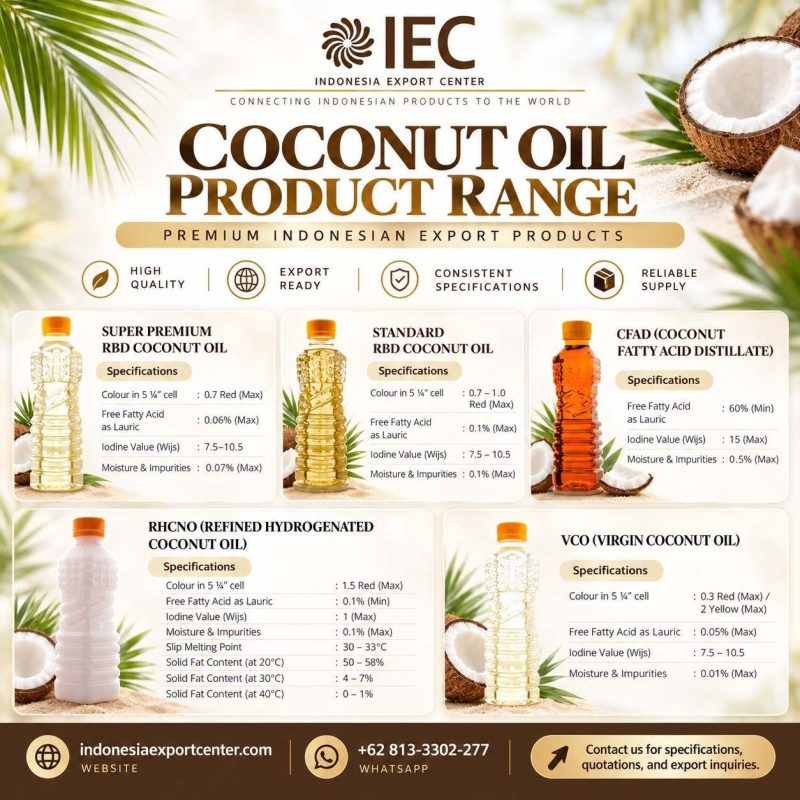
COCONUT OIL PRODUCT RANGE
PREMIUM INDONESIAN EXPORT PRODUCTS
HIGH QUALITY | EXPORT READY | CONSISTENT SPECIFICATIONS | RELIABLE SUPPLY
Super Premium RBD Coconut Oil | Food Ingredient Sourcing | Batch Consistency | Sensory Quality Standards | Bulk Procurement
Premium RBD Coconut Oil for Food Brands and Manufacturers
Are you sourcing a premium coconut oil food ingredient for commercial food production?
For established food brands, ingredient selection involves more than finding a product that meets a basic specification.
Food manufacturers must consider how the ingredient affects finished product quality, manufacturing performance, sensory characteristics and consistency across production batches.
Important purchasing considerations include:
- Consistent color
- Defined odor characteristics
- Appropriate flavor profile
- Lot-to-lot quality consistency
- Free fatty acid levels
- Moisture and impurities
- Oxidative stability
- Manufacturing compatibility
- Food safety documentation
- Supplier qualification
- Traceability
- Reliable commercial planning
IEC | Indonesia Export Center facilitates sourcing and export enquiries for Indonesian coconut oil products, including Super Premium Refined, Bleached and Deodorised (RBD) Coconut Oil.
The supplied Super Premium RBD Coconut Oil reference specifies:
- Colour in 5¼-inch Cell: 0.7 Red (Max)
- Free Fatty Acid as Lauric: 0.06% (Max)
- Iodine Value (Wijs): 7.5–10.5
- Moisture & Impurities: 0.07% (Max)
These reference values provide a starting point for technical evaluation.
However, food brands should also verify actual batch results, sensory characteristics, food safety requirements and suitability for the intended application.
The Super Premium designation and reference specifications do not independently establish food-grade certification, regulatory approval or guaranteed sensory consistency.
Request Premium Coconut Oil Food Ingredient Specifications and Bulk Pricing
WhatsApp: https://wa.me/628133302277
Website: https://indonesiaexportcenter.com/
Manufacturer identity, food-grade suitability, lot-specific COA, certifications, availability, MOQ, packaging and commercial terms require verification.
1. Premium Coconut Oil Food Ingredient – Product Overview
| Procurement Item | Information |
|---|---|
| Product | Super Premium RBD Coconut Oil |
| Product Description | Refined, Bleached and Deodorised Coconut Oil |
| Product Category | Coconut-Derived Food Ingredient Candidate |
| Proposed Sourcing Country | Indonesia |
| Target Market | Global |
| Primary Buyers | Food Brands and Food Manufacturers |
| Additional Buyers | Food Ingredient Importers, Contract Manufacturers, Procurement Teams |
| Product Grade | Super Premium RBD |
| Intended Application | Food Manufacturing Evaluation |
| Food-Grade Suitability | To Be Verified |
| Reference Colour | 0.7 Red (Max), 5¼-inch Cell |
| Reference FFA as Lauric | 0.06% (Max) |
| Reference Iodine Value | 7.5–10.5 |
| Reference Moisture & Impurities | 0.07% (Max) |
| Odor Specification | To Be Confirmed |
| Flavor Specification | To Be Confirmed |
| Oxidation Parameters | To Be Confirmed |
| Manufacturer | To Be Verified |
| Contractual Seller | To Be Confirmed |
| Exporter of Record | To Be Confirmed |
| Manufacturer Specification | To Be Requested |
| Lot-Specific COA | To Be Requested and Verified |
| Food Safety Documentation | To Be Requested and Verified |
| Certifications | To Be Verified |
| MOQ | To Be Confirmed |
| Available Quantity | To Be Confirmed |
| Packaging | To Be Confirmed |
| Price per MT | Request Quotation |
| Lead Time | To Be Confirmed |
2. What Is Premium RBD Coconut Oil?
RBD Coconut Oil is coconut oil that has undergone refining, bleaching and deodorisation.
These processes are intended to modify characteristics such as color, odor and certain impurities.
3. Why Food Brands Evaluate Refined Coconut Oil
Food brands may evaluate refined coconut oil as a potential ingredient where its composition, processing characteristics and sensory profile meet the intended product requirements.
4. What Does Super Premium Mean?
Super Premium is the supplied commercial grade designation.
It is not a universal food-grade certification.
5. Is RBD Coconut Oil Automatically Food Grade?
No.
Food-grade suitability requires appropriate verification.
6. Why Food Ingredient Consistency Matters
Consistent raw materials can support predictable manufacturing and finished product characteristics.
7. Why Sensory Standards Matter
Color, odor and flavor may influence the sensory characteristics of the finished food product.
8. Why Batch Verification Matters
Reference specifications do not establish the actual results of every production lot.
Super Premium RBD Coconut Oil Reference Specifications
9. Technical Specification Table
| Quality Parameter | Super Premium Reference |
|---|---|
| Colour in 5¼-inch Cell | 0.7 Red (Max) |
| Free Fatty Acid as Lauric | 0.06% (Max) |
| Iodine Value (Wijs) | 7.5–10.5 |
| Moisture & Impurities | 0.07% (Max) |
These are supplied reference specifications, not verified batch COA results.
10. Color: 0.7 Red Maximum
The supplied reference specifies:
Colour in 5¼-inch Cell: 0.7 Red (Max)
The measurement method should be confirmed.
11. FFA: 0.06% Maximum
The supplied reference specifies:
FFA as Lauric: 0.06% (Max)
FFA is one parameter relevant to fats and oils quality.
12. Iodine Value: 7.5–10.5
Iodine value is associated with the degree of unsaturation.
13. Moisture and Impurities: 0.07% Maximum
Moisture and impurities are relevant quality parameters.
14. Do These Specifications Prove Food Safety?
No.
Food safety requires a broader assessment.
15. Do These Specifications Prove Neutral Flavor?
No.
Flavor must be evaluated separately.
16. Do These Specifications Prove Low Odor?
No.
Odor requires sensory assessment.
17. Do These Specifications Guarantee Batch Consistency?
No.
Batch consistency requires actual lot data and appropriate controls.
Sensory Quality Standards for Food Brands
18. Why Sensory Evaluation Matters
Sensory evaluation can help determine whether an ingredient meets the finished product’s requirements.
19. Color Standards
Food brands may define acceptable color limits.
20. Odor Standards
Odor characteristics should be evaluated under defined conditions.
21. Flavor Standards
Flavor characteristics should be evaluated where relevant.
22. Neutral Sensory Profile
A relatively neutral sensory profile may be desirable for certain applications.
Actual neutrality must be verified.
23. Sensory Reference Samples
Approved reference samples may support consistent evaluation.
24. Sensory Panel Procedures
A defined panel procedure may improve consistency.
25. Sample Temperature
Sensory evaluation conditions should be controlled.
26. Sample Preparation
Sample preparation should follow an agreed procedure.
27. Sensory Acceptance Criteria
Acceptance criteria should be documented.
28. Sensory Defect Identification
Potential defects should be defined.
29. Off-Odor Monitoring
Off-odor characteristics should be monitored where relevant.
30. Off-Flavor Monitoring
Off-flavor characteristics should be monitored where relevant.
31. Sensory Changes During Storage
Sensory changes may occur during storage and should be evaluated.
32. Sensory Changes During Processing
Processing conditions may influence sensory characteristics.
33. Sensory Consistency Across Lots
Consistency should be assessed through representative lot comparisons.
34. Finished Product Sensory Testing
The ingredient should be evaluated in the finished food formulation.
Batch-to-Batch Quality Consistency
35. Why Lot Consistency Matters
Food brands often require predictable raw material performance.
36. Manufacturer Specification
Request the current manufacturer-issued specification.
37. Lot-Specific COA
Request a COA linked to the relevant lot.
38. COA Parameters
The COA should include the agreed analytical parameters.
39. Actual Test Results
Actual results should be reviewed against the approved specification.
40. Analytical Methods
Test methods should be identified where relevant.
41. Sampling Procedures
Sampling procedures should be appropriate for the product.
42. Retained Samples
Retained samples may support investigations where agreed.
43. Trend Monitoring
Trend monitoring may help identify changes in quality characteristics.
44. Supplier Change Control
Relevant manufacturing or product changes should be communicated.
45. Lot Traceability
The supplier should support appropriate lot traceability.
46. Incoming Inspection
Buyers should establish suitable receiving procedures.
47. Nonconforming Lots
A procedure should exist for nonconforming material.
48. Corrective Actions
Relevant quality issues should be addressed through agreed corrective action procedures.
49. Supplier Performance Review
Supplier performance may be evaluated over time.
50. Repeat-Order Consistency
Repeat orders should be evaluated against the approved specification.
Food Manufacturing Applications
51. Bakery Manufacturing
RBD Coconut Oil may be evaluated for suitable bakery applications.
52. Confectionery Manufacturing
It may be considered for selected confectionery formulations.
53. Biscuit and Cookie Production
The oil may be evaluated for appropriate biscuit and cookie formulations.
54. Wafer Manufacturing
It may be considered for suitable wafer applications.
55. Snack Manufacturing
The oil may be evaluated for selected snack applications.
56. Non-Dairy Creamer Manufacturing
It may be considered for suitable non-dairy creamer formulations.
57. Food Ingredient Blends
The oil may be evaluated as part of suitable ingredient blends.
58. Specialty Food Formulations
The oil may be considered for specialty formulations where its characteristics meet the technical requirements.
59. Private Label Food Brands
Private label manufacturers may evaluate the ingredient against their approved specifications.
60. Contract Food Manufacturing
Contract manufacturers may evaluate the oil against client requirements.
61. Application-Specific Testing
Every application requires appropriate technical evaluation.
62. Finished Product Validation
The finished product should be evaluated before commercial approval.
Manufacturing Compatibility
63. Processing Temperature
Processing conditions should be suitable for the ingredient.
64. Melting Behavior
Coconut oil may change physical state depending on temperature.
No melting-point specification has been supplied for Super Premium RBD Coconut Oil.
65. Mixing Compatibility
Compatibility with the formulation should be evaluated.
66. Ingredient Interactions
Interactions with other ingredients should be assessed.
67. Texture
Texture should be evaluated in the finished product.
68. Mouthfeel
Mouthfeel should be assessed where relevant.
69. Flavor Interaction
Flavor interactions should be evaluated.
70. Oxidative Stability
Oxidative stability should be assessed through appropriate testing.
71. Processing Losses
Relevant processing losses should be monitored.
72. Finished Product Stability
Finished product stability requires testing.
73. Packaging Compatibility
Packaging compatibility should be evaluated.
74. Pilot Production
Pilot trials may help confirm suitability.
75. Commercial Scale-Up
Scale-up should follow successful technical evaluation.
Food Safety and Regulatory Documentation
76. Food-Grade Suitability
Food-grade suitability must be verified.
77. Manufacturer Identity
Confirm the actual manufacturer.
78. Manufacturer Specification
Request the current specification.
79. Lot-Specific COA
Request actual batch-specific results.
80. Food Safety Management Information
Request relevant food safety management documentation.
81. Hazard Analysis
Relevant hazards should be identified and evaluated.
82. Contaminant Requirements
Applicable contaminant requirements should be reviewed.
83. Relevant Residue Requirements
Residue requirements should be reviewed where applicable.
84. Allergen Information
Request appropriate allergen information where relevant.
85. Traceability
The supplier should support appropriate traceability.
86. Storage Conditions
Storage conditions should be established.
87. Shelf-Life Information
Shelf-life information should be supported by evidence.
88. Certification Verification
Verify claimed certifications, issuing bodies, scope and validity.
89. Destination-Market Regulations
Requirements should be reviewed for each destination market.
90. Labeling Requirements
Finished product labeling should comply with applicable requirements.
91. Food Claims
Claims should be appropriately substantiated.
92. Regulatory Responsibility
The responsible manufacturer, importer or other relevant party should verify compliance.
Super Premium vs Standard RBD Coconut Oil
93. Reference Grade Comparison
| Quality Parameter | Super Premium RBD | Standard RBD |
|---|---|---|
| Colour in 5¼-inch Cell | 0.7 Red (Max) | 0.7–1.0 Red (Max) |
| FFA as Lauric | 0.06% (Max) | 0.1% (Max) |
| Iodine Value (Wijs) | 7.5–10.5 | 7.5–10.5 |
| Moisture & Impurities | 0.07% (Max) | 0.1% (Max) |
Technical clarification: The Standard RBD color reference combines a range and maximum designation. The manufacturer should clarify the intended acceptance limit.
94. Does Super Premium Guarantee Better Taste?
No.
Taste must be evaluated.
95. Does Super Premium Guarantee Better Manufacturing Performance?
No.
Manufacturing performance requires testing.
96. Does Lower FFA Guarantee Longer Shelf Life?
No.
Shelf life depends on multiple factors.
97. Can Standard RBD Be Used for Food Manufacturing?
It may be evaluated if it meets the relevant technical, safety and regulatory requirements.
98. How Should Food Brands Compare Grades?
Compare actual lot data, sensory characteristics, application performance and documentation.
Bulk Food Ingredient Procurement
99. Required Quantity
Specify the required quantity in metric tons.
100. Minimum Order Quantity
No fixed MOQ has been verified.
101. Available Quantity
Availability must be confirmed.
102. Steel Drum Packaging
Buyers may request steel drum packaging information.
Availability requires confirmation.
103. IBC Tank Packaging
Buyers may request IBC packaging information.
Availability requires confirmation.
104. Flexitank Arrangements
Buyers may request flexitank arrangements.
Suitability and availability require verification.
105. Food-Contact Packaging
Packaging suitability for food-contact applications should be verified.
106. Packaging Cleanliness
Packaging should protect the material from contamination.
107. Packaging Integrity
Packaging condition should be checked.
108. Lot Identification
Packaging should support lot identification.
109. Storage Conditions
Appropriate storage conditions should be established.
110. Temperature Management
Temperature conditions may influence the oil’s physical state.
111. Repeat-Order Planning
Repeat-order schedules should be agreed based on verified capability.
Export Quotation and Delivery Terms
112. Price per MT
Request a current quotation.
113. Currency
Confirm the quotation currency.
114. FOB Indonesia
Under Incoterms® 2020, FOB risk generally transfers when goods are loaded on board at the named shipment port.
For certain containerised shipments, FCA may be more appropriate.
115. CFR Destination
Under CFR, the seller contracts and pays for carriage to the named destination port.
Risk generally transfers on board at origin.
116. CIF Destination
Under CIF, the seller contracts and pays for carriage and obtains the insurance required by the rule.
Risk generally transfers on board at origin.
For certain containerised shipments, CIP may be more appropriate.
117. Origin Port
The actual Indonesian shipment port must be confirmed.
118. Destination Port
The buyer should specify the destination port.
119. Freight and Insurance
Actual freight and insurance costs require confirmation.
120. Payment Terms
Payment terms should be agreed with the contractual seller.
121. Lead Time
No fixed lead time has been verified.
122. Export Documentation
Depending on the transaction, documents may include:
- Commercial invoice
- Packing list
- Bill of lading
- Certificate of Origin
- Certificate of Analysis
- Insurance documents
- Other applicable certificates
123. Import Compliance
The importer should verify destination-market requirements.
Food Brand Ingredient Procurement Checklist
Product and Technical Requirements
-
Product grade confirmed
-
Manufacturer identified
-
Intended food application defined
-
Manufacturer specification obtained
-
Color requirement confirmed
-
FFA requirement confirmed
-
Iodine value confirmed
-
Moisture and impurities confirmed
-
Additional technical parameters identified
Sensory Standards
-
Color acceptance criteria defined
-
Odor acceptance criteria defined
-
Flavor acceptance criteria defined
-
Sensory evaluation method established
-
Reference sample approved where relevant
-
Finished product sensory testing completed
-
Storage-related sensory changes evaluated
Batch Consistency
-
Lot-specific COA obtained
-
Test methods reviewed
-
Sampling requirements defined
-
Lot traceability confirmed
-
Incoming inspection established
-
Nonconforming material procedure defined
-
Change control requirements agreed
Food Safety and Regulatory Review
-
Food-grade suitability verified
-
Relevant food safety documentation obtained
-
Applicable contaminant requirements reviewed
-
Destination-market requirements reviewed
-
Certification claims verified
-
Storage conditions confirmed
-
Shelf-life information reviewed
Commercial Procurement
-
MOQ confirmed
-
Available quantity confirmed
-
Packaging confirmed
-
Price per MT obtained
-
Currency confirmed
-
Incoterm agreed
-
Named port confirmed
-
Payment terms agreed
-
Lead time confirmed
-
Export documentation reviewed
RFQ Template – Premium Coconut Oil Food Ingredient
Subject: RFQ – Super Premium RBD Coconut Oil for Food Manufacturing
Dear Indonesia Export Center Team,
We are evaluating Super Premium RBD Coconut Oil from Indonesia for food manufacturing.
Please provide the current manufacturer-issued specification, lot-specific COA information, relevant food safety documentation, sensory characteristics, packaging options and commercial quotation.
Buyer Information
Company Name: [Company Name]
Country: [Country]
Business Type: [Food Brand / Food Manufacturer / Contract Manufacturer / Ingredient Distributor / Other]
Contact Person: [Name]
Email: [Email]
Phone / WhatsApp: [Number]
Product Requirements
Product: Super Premium RBD Coconut Oil
Intended Application: [Bakery / Confectionery / Snacks / Non-Dairy Creamer / Other]
Required Quantity: [MT]
Expected Order Frequency: [One-Time / Monthly / Repeat Orders]
Reference Technical Specifications
| Parameter | Reference |
|---|---|
| Colour in 5¼-inch Cell | 0.7 Red (Max) |
| FFA as Lauric | 0.06% (Max) |
| Iodine Value (Wijs) | 7.5–10.5 |
| Moisture & Impurities | 0.07% (Max) |
Sensory Requirements
Color Requirement: [Specify]
Odor Requirement: [Specify]
Flavor Requirement: [Specify]
Sensory Evaluation Method: [Specify]
Reference Sample Requirement: [Specify]
Quality Documentation Requested
Please provide:
- Actual manufacturer name and address
- Contractual seller and exporter of record
- Current manufacturer-issued specification
- Lot-specific COA availability
- Relevant food safety documentation
- Relevant contaminant information
- Applicable certification documents
- Sensory specification information
- Sampling and traceability information
- Storage and shelf-life information
- Sample availability
- Independent testing options, if available
Packaging Requirements
Preferred Packaging: [Steel Drums / IBC / Flexitank / Other]
Preferred Net Fill: [Specify]
Food-Contact Packaging Requirements: [Specify]
Shipping Requirements
Destination Country: [Country]
Destination Port: [Port]
Preferred Incoterm: [FCA / FOB / CFR / CIF / CIP / Other]
Target Shipment Period: [Month / Year]
Commercial Information Requested
Please provide:
- MOQ
- Available quantity
- Price per MT
- Currency
- Packaging specifications
- Incoterm and named port
- Freight quotation if applicable
- Insurance information if applicable
- Production lead time
- Estimated shipment period
- Payment terms
- Quotation validity
- Export documentation
- Repeat-order capability, if available
- Additional commercial conditions
We will evaluate the ingredient’s technical quality, sensory characteristics, food safety documentation, batch consistency and commercial terms before making a purchasing decision.
Kind regards,
[Your Name] [Company Name] [Country]SEND YOUR PREMIUM COCONUT OIL FOOD INGREDIENT ENQUIRY
WhatsApp: https://wa.me/628133302277
Frequently Asked Questions – Premium Coconut Oil Food Ingredient
What is premium coconut oil for food manufacturing?
It is coconut oil evaluated against defined technical, sensory, safety and application requirements for food manufacturing.
What is Super Premium RBD Coconut Oil?
It is the supplied commercial grade of refined, bleached and deodorised coconut oil.
Is Super Premium RBD Coconut Oil automatically food grade?
No. Food-grade suitability requires verification.
Is Super Premium a food safety certification?
No. The grade name does not establish certification.
Can RBD Coconut Oil be used in bakery manufacturing?
It may be evaluated for suitable bakery applications.
Can it be used in confectionery?
It may be evaluated for suitable confectionery formulations.
Can it be used in biscuits and cookies?
It may be evaluated for appropriate biscuit and cookie formulations.
Can it be used in snack manufacturing?
It may be evaluated for selected snack applications.
Can it be used in non-dairy creamer?
It may be evaluated for suitable non-dairy creamer formulations.
Is RBD Coconut Oil flavorless?
Not necessarily. Actual flavor characteristics require verification.
Is RBD Coconut Oil odorless?
Not necessarily. Actual odor characteristics require verification.
Does Super Premium guarantee better sensory quality?
No. Sensory quality must be evaluated.
What is the color specification?
The supplied reference states 0.7 Red maximum in a 5¼-inch cell.
What is the FFA specification?
The supplied reference states 0.06% maximum FFA as Lauric.
What is the iodine value?
The supplied reference states 7.5–10.5.
What is the moisture and impurities specification?
The supplied reference states 0.07% maximum.
Does low FFA guarantee longer shelf life?
No. Shelf life depends on multiple factors.
Does Super Premium guarantee batch consistency?
No. Consistency requires actual lot data and appropriate controls.
Can I request a lot-specific COA?
Yes. Availability must be confirmed.
Can I request sensory specifications?
Yes. Availability must be confirmed.
Can I request food safety documentation?
Yes. Availability must be confirmed.
Are food safety certifications available?
Certification availability must be verified.
Can I request product samples?
Yes, subject to availability.
Can I request repeat-order supply?
Yes, subject to verified supply capability.
What is the MOQ?
No fixed MOQ has been verified.
Can I request 20 MT?
Yes, as a buyer enquiry. Availability must be confirmed.
Is steel drum packaging available?
Availability requires confirmation.
Is IBC packaging available?
Availability requires confirmation.
Is flexitank packaging available?
Suitability and availability require confirmation.
Can I request FOB Indonesia pricing?
Yes. The named shipment port should be agreed.
Can I request CIF destination pricing?
Yes, subject to supplier and freight confirmation.
Can I arrange monthly procurement?
Recurring supply capability must be verified.
How do I request a quotation?
Contact IEC with your food application, technical and sensory requirements, quantity, packaging, destination port and delivery terms.
Premium Coconut Oil for Food Brands – Focus on Consistency, Sensory Quality and Verified Specifications
For food brands, ingredient procurement should support consistent finished product quality.
A suitable purchasing decision should address:
1. Technical Quality
Confirm the actual product specifications and lot-specific analytical results.
2. Sensory Quality
Evaluate color, odor and flavor against defined requirements.
3. Batch Consistency
Review traceability, sampling, change control and repeat-order quality procedures.
4. Food Safety
Verify applicable food safety documentation and destination-market requirements.
5. Commercial Supply Planning
Confirm packaging, available quantity, MOQ, price, lead time and shipment terms.
The supplied Super Premium RBD Coconut Oil reference specifies:
Colour: 0.7 Red (Max), 5¼-inch Cell
FFA as Lauric: 0.06% (Max)
Iodine Value: 7.5–10.5
Moisture & Impurities: 0.07% (Max)
These values provide a starting point for technical evaluation.
They do not establish actual batch quality, food-grade certification, sensory consistency or regulatory approval.
Indonesia Export Center welcomes enquiries from international food brands, food manufacturers, contract manufacturers, food ingredient distributors and procurement teams evaluating Indonesian Super Premium RBD Coconut Oil.
Request Premium Coconut Oil Food Ingredient Specifications and Bulk Quotation
Product: Super Premium RBD Coconut Oil
Proposed Sourcing Country: Indonesia
Target Buyers: Food Brands, Food Manufacturers, Contract Manufacturers and Ingredient Importers
Reference Colour: 0.7 Red (Max), 5¼-inch Cell
Reference FFA as Lauric: 0.06% (Max)
Reference Iodine Value: 7.5–10.5
Reference Moisture & Impurities: 0.07% (Max)
Sensory Requirements: To Be Confirmed
Food-Grade Suitability: To Be Verified
Manufacturer: To Be Verified
Lot-Specific COA: To Be Requested and Verified
Food Safety Documentation: To Be Requested
Certifications: To Be Verified
MOQ: To Be Confirmed
Available Quantity: To Be Confirmed
Packaging: To Be Confirmed
Price per MT: Request Quotation
Shipment Lead Time: To Be Confirmed
IEC | INDONESIA EXPORT CENTER
CONNECTING INDONESIAN PRODUCTS TO THE WORLD
Website: https://indonesiaexportcenter.com/
WhatsApp: +62 813-3302-277
REQUEST PREMIUM COCONUT OIL FOOD INGREDIENT BULK QUOTATION
Please include your company name, destination country, intended food application, required quantity in MT, preferred packaging, sensory requirements, destination port, requested Incoterm and target shipment period.
Food Ingredient, Quality and Sourcing Disclaimer: This page provides general ingredient sourcing and procurement information, not food safety, laboratory, legal or regulatory advice. The Super Premium designation and supplied reference specifications do not establish food-grade certification, finished product safety, guaranteed sensory consistency, neutral flavor, odorless characteristics, shelf-life performance or regulatory approval. The numerical values are reference specifications, not verified batch COA results. No manufacturer, food-grade approval, certification, stock, MOQ, packaging availability, production capacity, price, freight rate or lead time has been independently verified. Buyers should obtain manufacturer-issued specifications, actual lot-specific analytical results, relevant food safety and regulatory documentation, representative samples and appropriate sensory and application testing before purchasing. IEC facilitates sourcing and export enquiries; the actual manufacturer, contractual seller and exporter of record must be confirmed for each transaction.
