

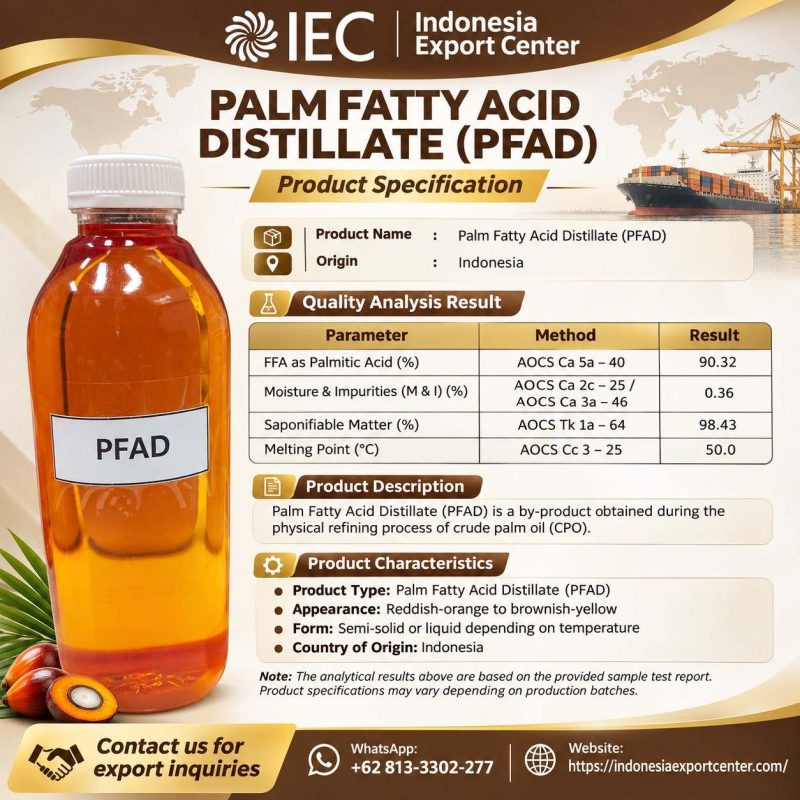
International industrial buyers researching PFAD vs palm stearin need more than a product label. Palm Fatty Acid Distillate (PFAD) is a palm oil refining stream that may be considered for oleochemical, soap, and biodiesel applications, depending on the grade and technical requirements. This guide from Indonesia Export Center explains how to assess the product and build a commercially useful inquiry. It is intended for factories, importers, manufacturers, procurement teams, and distributors who want to make informed sourcing decisions.
Product: Palm Fatty Acid Distillate (PFAD)
Origin under discussion: Indonesia
Commercial details: Subject to current offer, lot documentation, and confirmation
Website: https://indonesiaexportcenter.com/
WhatsApp: +62 813-3302-277 — https://wa.me/628133302277
PFAD and palm stearin are not the same product
Buyers sometimes encounter palm fatty acid distillate, palm stearin, crude palm oil, and refined palm oil in the same marketplace. They should not be substituted based only on a common palm origin. PFAD is associated with the deodorization and refining process and is relatively rich in free fatty acids. Palm stearin is a higher-melting fraction obtained through fractionation of palm oil, and its composition and uses differ. Each material requires its own technical specification and process suitability assessment.
How processing history changes the material
Production route is fundamental to feedstock identity. Refining removes or modifies certain components to meet the requirements of a refined product, with PFAD recovered as a distillate stream. Fractionation separates palm oil into liquid and solid fractions, producing products including palm olein and palm stearin. A commodity name may still cover several qualities or further processed grades. If the seller uses an unfamiliar acronym, ask for the process origin and a sample analysis rather than inferring composition from trade terminology.
Choosing by process rather than headline price
An industrial biodiesel or oleochemical facility may value free fatty acid content differently from a food-processing or soap manufacturing facility. Equipment designed for one class of feedstock may require pretreatment or modification to use another. Comparing purchase price per tonne without considering chemical composition, useful yield, process losses, and quality requirements can produce an incorrect decision. Have the technical team review the feedstock options side by side, with measured properties and material-balance implications.
What to put in a comparison matrix
For PFAD, palm stearin, and alternative feedstocks, record product origin, FFA or acid value, moisture and impurities, iodine value, saponification value where relevant, melting or handling behaviour, intended use, regulatory requirements, and available test results. Add commercial factors including transport, storage, current price basis, supplier qualification, and payment terms. Differences in sustainability accounting may be material in certain markets and should be verified independently. This framework supports better decisions than relying on unsourced tables of typical values.
Ask for the right material
When making an inquiry, name the exact feedstock and intended end use. State whether substitution is acceptable and what conditions would need to be met. Indonesia Export Center can receive PFAD-related procurement questions and discuss current commercial possibilities, but product comparisons are educational rather than a warranty of equivalence. An application-specific COA, validated process trial, and formal purchase specification should determine your final selection.
A practical decision checklist for this topic
For a successful feedstock comparison, have procurement, technical, and logistics staff review the same set of information before approving a purchase. Confirm the product description against the proposed certificate of analysis. Verify whether quoted values are measured, typical, or binding contractual limits. Confirm the named loading and destination locations, purchase quantity, delivery dates, and payment responsibilities. Check with customs professionals about the import market and with the receiving plant about unloading and storage. If any essential information remains unknown, record it explicitly as pending instead of treating a commercial assumption as a confirmed fact.
What information should buyers include in the first message?
A good first message lets the commercial team determine whether an inquiry is actionable. Include your company name, importing country, intended industrial use, quantity in metric tonnes, preferred shipment period, destination port, and requested Incoterm. Share any key chemical limits that must be met and whether the material is for trial or established production. Mention whether the transaction requires independent inspection, origin evidence, a particular payment instrument, or regulatory declarations. Avoid simply writing “best price” without a destination or quantity: sellers cannot quote shipping costs or confirm suitability accurately without those details.
Quality control and contract acceptance
Before confirming a purchase, distinguish between descriptive promotional material, representative sample results, a current certificate of analysis, and binding contract specifications. Ask who takes samples, which laboratory and methods are accepted, and what constitutes a passing result. Define an approach for weight disputes, rejection, retesting, notification windows, and replacement or other remedies where commercially relevant. These topics can feel administrative during negotiations, but they help both sides avoid confusion when the shipment is already in transit. Technical acceptance must be decided by the buyer’s own process team.
Payment, compliance and trade risk
Cross-border raw material trade involves commercial as well as technical risk. Verify the legal identity of contracting parties, bank account ownership, contractual payment milestones, and any documentary requirements before transferring funds. Work with qualified customs and legal professionals on import duties, product classification, sanctions, local licensing, and documentation. If certification is essential to your customers, confirm both certificate scope and validity for the proposed goods. Neither a website description nor a generic historical certificate should be interpreted as proof of an individual cargo’s compliance.
Why transparency is more useful than generic promises
B2B buyers benefit from practical answers, not unsupported claims such as “guaranteed best price,” “unlimited stock,” or “certified everywhere.” A responsible conversation identifies what is known, what must be confirmed with the production source, and which contract points remain open. Ask for the evidence that matters to your application and allow enough time for sample evaluation or document review. Indonesia Export Center aims to make initial inquiries clear and efficient; each requested volume, specification, packaging configuration, and shipment timeline remains subject to confirmation through the applicable commercial offer.
Frequently asked questions
Can PFAD be used for every industrial process?
No. Process compatibility depends on chemical analysis, operating conditions, quality requirements, and customer validation.
Is a sample available before a large order?
Sample arrangements depend on the actual source and commercial agreement. Include the intended tests and sample quantity in your inquiry.
Is PFAD the same as refined palm oil?
No. PFAD is a distillate associated with palm oil refining, while refined palm oil is a different commercial product. Verify your required product identity before purchasing.
Can I request a certificate of analysis?
Yes, ask for the COA applicable to the proposed lot or source. Availability, test scope, laboratory, and batch linkage must be confirmed.
Do you quote FOB or CIF?
Please state your preferred delivery basis and named port. The availability of a specific FOB or CIF offer depends on the shipment and commercial arrangement.
What is the minimum order quantity?
MOQ is not fixed on this informational page. Send the required quantity in metric tonnes so availability and suitable shipment options can be reviewed.
Can palm stearin replace PFAD in an existing formula?
Only after technical evaluation. The two materials are different, and replacing one with the other may change acidity, physical properties, handling, process yield, and finished-product performance.
Request a PFAD quotation from Indonesia Export Center
If you are evaluating PFAD vs palm stearin for a legitimate industrial requirement, contact Indonesia Export Center with your specification, volume, destination, and intended application. Include any must-have inspection or documentation requirements so the conversation can focus on a suitable commercial proposal. Quoted prices, shipment availability, manufacturer status, product specifications, certification, and delivery dates will be confirmed only when supporting information is available for a specific transaction.
Website: https://indonesiaexportcenter.com/
WhatsApp: +62 813-3302-277
Direct inquiry: https://wa.me/628133302277
