

IEC | INDONESIA EXPORT CENTER
Your Global Sourcing Partner
Technical Quality Guide for Palm Fatty Acid Distillate Buyers
Palm Fatty Acid Distillate quality assessment is an essential part of industrial procurement.
For biodiesel manufacturers, oleochemical processors, quality assurance laboratories, and commodity buyers, a clear technical specification helps establish whether a proposed PFAD cargo is appropriate for its intended use.
However, a general product brochure is not a substitute for a current Certificate of Analysis.
Indonesia Export Center (IEC) facilitates sourcing inquiries involving potential Indonesian PFAD suppliers and provides reference information to support buyer discussions.
IEC does not guarantee laboratory results or product conformity without cargo-specific verification.
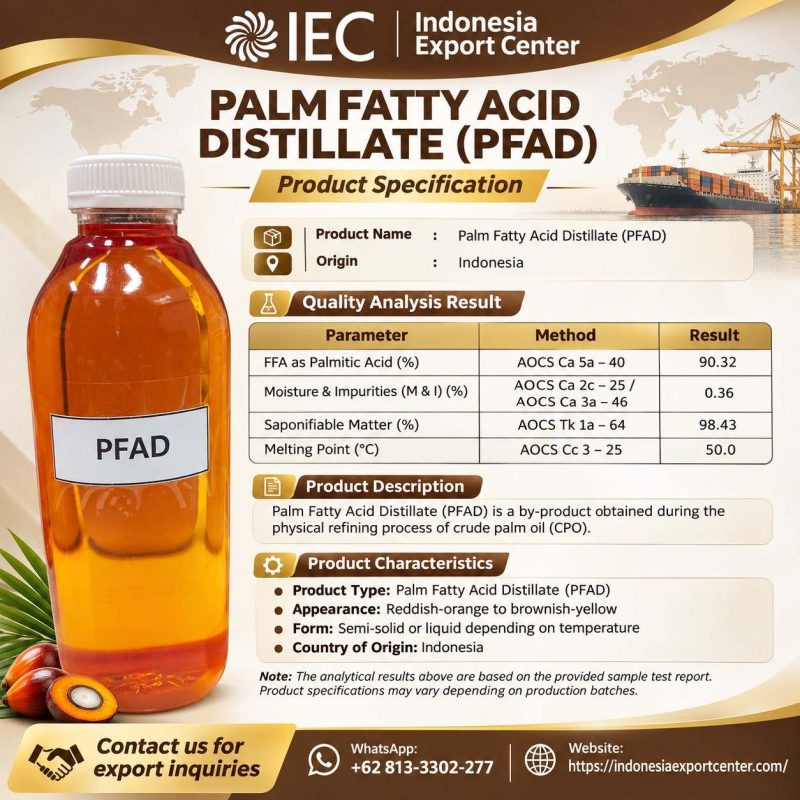
IEC PFAD Reference Specification Table
| Parameter | Reference Specification | Unit or Basis |
|---|---|---|
| Free Fatty Acids | Minimum 90 | % as Palmitic |
| Moisture & Impurities | Maximum 1.0 | % |
| Iodine Value | Maximum 50 | Method-dependent iodine value |
| Melting Point | 36–46 | °C |
| Colour | Maximum 7 | Gardner |
| Appearance | White / Off White Solid | Visual |
Important: These figures are copied from the supplied IEC PFAD product reference. They are not independently verified lot results. The applicable test methods, acceptance rules, and cargo-specific results must be confirmed.
1. Free Fatty Acid Content
FFA is a major PFAD quality parameter.
It describes the amount of free fatty acids in the material as determined by an agreed analytical method.
Why FFA Matters
FFA may influence:
- Feedstock suitability.
- Processing route.
- Chemical conversion.
- Commercial valuation.
- Material balance.
- Quality acceptance.
Reporting Basis
The IEC reference states FFA as Palmitic.
This distinction matters because FFA can be expressed on different fatty acid bases.
A buyer should verify the basis before comparing supplier results.
Recommended Contract Wording
Free Fatty Acids: Minimum 90.0%, expressed as palmitic acid, determined by the mutually agreed analytical method.
This is proposed contract language, not confirmation of a particular cargo.
2. Moisture and Impurities
The IEC reference lists a combined maximum of 1.0%.
Moisture and impurities are important because unwanted water or solids may affect storage, handling, and manufacturing.
Buyers should clarify:
- Whether the reported value is combined.
- Whether separate moisture and insoluble impurity results are available.
- Which analytical methods are used.
- How samples are prepared.
- Whether the value is measured at loading or another defined point.
3. Iodine Value
Iodine value is used to evaluate the degree of unsaturation in fats and oils.
The IEC reference target is maximum 50.
Why It Matters
Iodine value may be relevant to:
- Feedstock characterization.
- Processing requirements.
- Product consistency.
- Certain downstream chemical properties.
Testing Considerations
The contract should specify an agreed recognized analytical method and reporting convention.
4. Melting Point
The IEC reference states 36–46°C.
This range is relevant to PFAD storage, pumping, and transport planning.
However, the term “melting point” can require further definition for complex fatty mixtures.
Buyers should confirm the exact test method and whether the reported result is a melting range, slip melting point, or another defined measurement.
Important Handling Distinction
A reported melting point does not establish the appropriate operational heating temperature.
Actual heating procedures require separate technical assessment.
5. Gardner Colour
The IEC reference lists Gardner Colour maximum 7.
Gardner colour is a colour measurement scale used for certain industrial materials.
The result may depend on:
- Sample condition.
- Temperature.
- Clarity.
- Test method.
- Measurement equipment.
The agreed testing procedure should be specified.
6. Appearance
The reference appearance is:
White / Off White Solid
Actual PFAD appearance may vary with temperature, composition, and processing history.
Visual appearance alone is insufficient to determine product conformity.
Additional Tests Buyers May Request
Depending on the industrial application, buyers may request:
| Additional Parameter | Potential Relevance |
|---|---|
| Acid Value | Characterization of acidic components |
| Saponification Value | Chemical characterization |
| Fatty Acid Profile | Process compatibility |
| Unsaponifiable Matter | Non-saponifiable constituents |
| Metals | Process or catalyst sensitivity |
| Ash | Inorganic residue |
| Oxidation-Related Parameters | Material condition |
| Other Contaminants | Application-specific risk assessment |
These are possible buyer-requested tests, not parameters guaranteed by the IEC brochure.
Understanding a PFAD Certificate of Analysis
A useful COA should identify:
- Supplier or issuing laboratory.
- Product name.
- Lot or batch identification.
- Sample identification.
- Test date.
- Analytical parameters.
- Results.
- Units.
- Test methods.
- Authorized issuer.
A generic COA unrelated to the proposed shipment may not establish the quality of the cargo.
Reference Specification vs Actual COA
| Document | Purpose |
|---|---|
| Product Brochure | Describes intended or reference product characteristics |
| Technical Data Sheet | Provides supplier technical information |
| Certificate of Analysis | Reports results for an identified sample or lot |
| Independent Inspection Report | Documents the agreed inspection findings |
| Purchase Contract | Establishes binding quality and acceptance terms |
Sampling and Laboratory Testing
A reliable testing process should address:
- Representative sample collection.
- Appropriate sampling location.
- Homogenization where required.
- Sample containers.
- Sample sealing.
- Chain of custody.
- Laboratory selection.
- Retained samples.
- Testing method.
- Reporting and dispute procedures.
PFAD’s thermal behavior should be considered when developing sampling procedures.
Quality Tolerances and Contract Acceptance
Buyers and sellers should agree on:
- Specification limits.
- Test methods.
- Sampling point.
- Inspection provider.
- Measurement uncertainty where relevant.
- Retesting arrangements.
- Dispute resolution.
- Off-specification cargo treatment.
Do not assume that every numerical deviation automatically has the same commercial consequence.
Example PFAD Quality Schedule
| Parameter | Proposed Contract Requirement | Actual Result |
|---|---|---|
| FFA as Palmitic | Minimum 90% | To be tested |
| Moisture & Impurities | Maximum 1.0% | To be tested |
| Iodine Value | Maximum 50 | To be tested |
| Melting Point | 36–46°C | To be tested |
| Gardner Colour | Maximum 7 | To be tested |
| Appearance | White / Off White Solid | To be inspected |
This is a template based on the supplied reference, not a completed quality certificate.
PFAD Technical RFQ Template
Subject: PFAD Technical Specifications and COA Request
Company: [Name]
Country: [Country]
Product: Palm Fatty Acid Distillate
Application: [Details]
Required Quantity: [MT]
FFA Requirement: [Specify]
FFA Reporting Basis: As Palmitic
Moisture & Impurities: [Specify]
Iodine Value: [Specify]
Melting Point: [Specify]
Gardner Colour: [Specify]
Additional Tests: [Specify]
Required Test Methods: [Specify]
Inspection Requirements: [Specify]
Destination Port: [Port]
Please provide a current specification sheet, relevant COA, and information on potential supply availability.
Frequently Asked Questions
What is the IEC reference FFA specification?
Minimum 90%, expressed as palmitic acid.
Is the reference specification a guarantee?
No. Actual cargo quality requires verification.
Why does the FFA reporting basis matter?
Different reporting bases can produce different numerical results.
What is the reference iodine value?
Maximum 50.
What is the reference melting point?
36–46°C, subject to clarification of the test method.
What is Gardner colour?
A colour measurement scale used for certain industrial materials.
Should buyers request a COA?
Yes. A current, relevant COA is important for quality evaluation.
Can independent testing be requested?
Yes. Testing and inspection should be agreed with the supplier.
Request Verified PFAD Technical Information
Submit your required PFAD parameters and request supplier documentation for technical evaluation.
REQUEST PFAD SPECIFICATION AND COA INFORMATION
IEC | INDONESIA EXPORT CENTER
Website: https://indonesiaexportcenter.com/
WhatsApp: +62 813-3302-277
Related Resources
PFAD for Oleochemical Industry
