

IEC | INDONESIA EXPORT CENTER
Your Global Sourcing Partner
Industrial PFAD Sourcing for Fatty Acid Ester Production
Fatty acid esters are used across a range of industrial applications, including selected chemical intermediates, lubricants, processing aids, and fuel-related manufacturing.
The production of fatty acid esters requires suitable fatty acid-containing raw materials and an appropriate conversion process.
Palm Fatty Acid Distillate may be evaluated as a feedstock for certain esterification operations because it contains a relatively high proportion of free fatty acids.
However, feedstock suitability depends on composition, process technology, impurities, and the required final ester product.
Indonesia Export Center (IEC) facilitates sourcing inquiries involving potential Indonesian PFAD suppliers.
IEC does not guarantee ester conversion yields, process efficiency, finished product purity, or specific industrial performance.
What Are Fatty Acid Esters?
Fatty acid esters are compounds formed through reactions involving fatty acids and suitable alcohols.
Their characteristics depend on the fatty acid composition, alcohol used, reaction conditions, and purification procedures.
Different ester products can have very different industrial applications.
Why PFAD May Be Considered
PFAD is a fatty acid-rich material generated during certain palm oil refining processes.
Its high FFA content can make it relevant to manufacturers whose conversion systems are designed for free fatty acid feedstocks.
However, PFAD is not a purified single-component fatty acid.
The buyer must evaluate whether its composition is suitable for the target ester.
Understanding Esterification
Esterification is a chemical process in which fatty acids react with suitable alcohols to form esters under appropriate conditions.
The manufacturing process may involve catalysts, controlled reaction conditions, separation, and purification.
Process design and chemical handling must be performed by qualified personnel.
This sourcing guide does not provide operating instructions or promise a particular yield.
PFAD vs Other Ester Feedstocks
| Feedstock | Main Procurement Consideration |
|---|---|
| PFAD | High-FFA industrial distillate |
| Distilled Fatty Acids | More specifically processed fatty acid feedstock |
| Palm Acid Oil | Variable composition and impurity profile |
| Refined Palm Oil | Predominantly triglyceride oil |
| Palm Stearin | Higher-melting triglyceride-rich fraction |
| Other Vegetable Oils | Composition and conversion route vary |
The correct feedstock depends on the intended ester product.
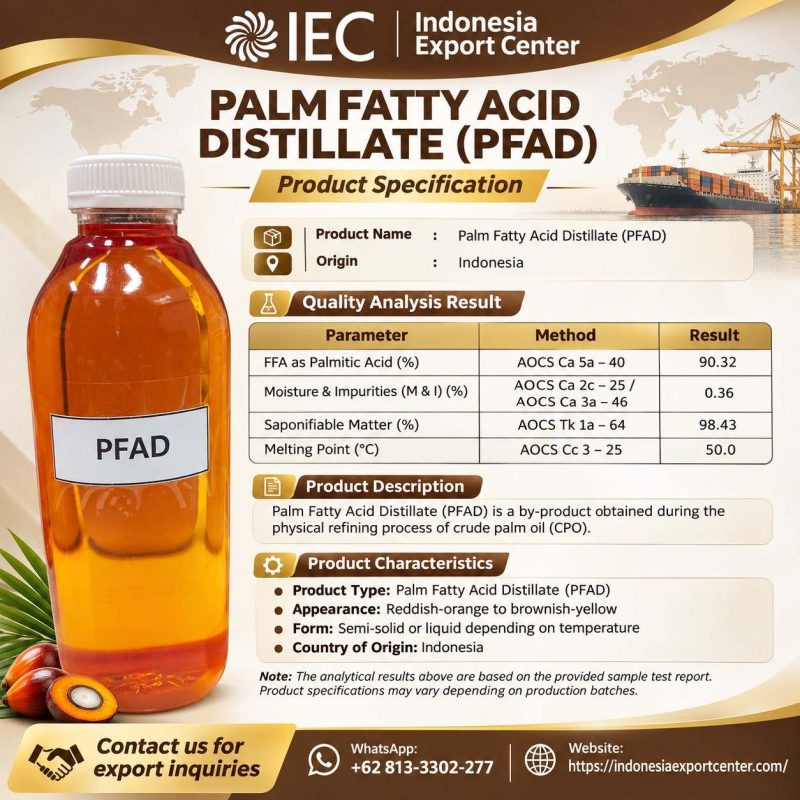
IEC PFAD Reference Specifications
| Parameter | Reference Target |
|---|---|
| FFA, as Palmitic | Minimum 90% |
| Moisture & Impurities | Maximum 1.0% |
| Iodine Value | Maximum 50 |
| Melting Point | 36–46°C |
| Colour (Gardner) | Maximum 7 |
| Appearance | White / Off White Solid |
These figures are brochure references only and require cargo-specific verification.
Why Acid Value Matters
Acid value is a useful analytical parameter for characterizing acidic components in fatty materials.
For ester feedstock procurement, buyers may evaluate acid value alongside FFA content.
The two measurements are related but use different reporting conventions.
The applicable laboratory methods should be stated clearly.
Why Moisture Matters
Moisture can influence certain chemical processing operations.
Manufacturers should determine acceptable water content based on their process and product requirements.
Why Fatty Acid Composition Matters
Different fatty acids can produce esters with different characteristics.
Consequently, a detailed fatty acid profile may be important for:
- Product specification.
- Process design.
- Feedstock comparison.
- Quality consistency.
- Final product performance.
A minimum FFA value alone does not establish the full composition.
Why Iodine Value Matters
Iodine value provides an indication of unsaturation.
It may be relevant to the characteristics of certain downstream ester products.
The actual importance depends on the intended application.
Feedstock Qualification Process
Step 1 – Define the Target Ester
Identify the chemical product and its required quality.
Step 2 – Establish Feedstock Acceptance Limits
Specify FFA, acid value, fatty acid profile, moisture, impurities, and relevant contaminants.
Step 3 – Request Product Documentation
Obtain a specification sheet and recent COA.
Step 4 – Evaluate Representative Samples
Conduct appropriate laboratory or pilot-scale qualification.
Step 5 – Assess Commercial Economics
Consider purchase cost, freight, pretreatment, processing requirements, and losses.
Step 6 – Confirm Supply Capability
Verify available quantity and shipment schedule.
Feedstock Cost Considerations
A useful comparison may include:
- Price per metric ton.
- Free fatty acid content.
- Actual fatty acid composition.
- Moisture and impurities.
- Pretreatment costs.
- Processing efficiency.
- Energy requirements.
- Product purification.
- Waste management.
- Transportation.
No universal PFAD-to-ester yield can be guaranteed.
Storage and Shipping
The IEC brochure identifies bulk tanks and flexibags as potential packaging arrangements.
Because PFAD may solidify or become highly viscous under certain conditions, the shipment plan should include technical evaluation of heating, pumping, equipment compatibility, and destination discharge.
Supplier Screening Checklist
| Parameter | Buyer Action |
|---|---|
| Product Identity | Confirm PFAD |
| FFA | Verify reporting basis |
| Acid Value | Request if required |
| Fatty Acid Profile | Review composition |
| Moisture | Confirm result |
| Impurities | Confirm result |
| Additional Contaminants | Define process-specific tests |
| COA | Verify lot relevance |
| Sample | Conduct qualification |
| Volume | Confirm availability |
| Shipment | Verify feasibility |
Fatty Acid Ester Feedstock RFQ
Subject: Indonesian PFAD for Fatty Acid Ester Manufacturing
Company: [Name]
Country: [Country]
Application: Fatty Acid Ester Production
Target Ester Product: [Details]
Required Feedstock: PFAD
Initial Quantity: [MT]
Monthly Requirement: [MT]
FFA Requirement: [Minimum, as Palmitic]
Acid Value Requirement: [If Applicable]
Fatty Acid Composition: [Requirements]
Moisture & Impurities: [Maximum]
Additional Tests: [Details]
Destination Port: [Port]
Preferred Incoterm: [Term]
Shipment Period: [Dates]
Please provide potential supplier information, current analytical documentation, and commercial quotation requirements.
Frequently Asked Questions
Can PFAD be used for fatty acid ester production?
It may be suitable for certain esterification processes.
Is PFAD a pure fatty acid?
No. It is a fatty acid-rich material with variable composition.
Is acid value the same as FFA percentage?
They are related but reported differently.
Does 90% FFA guarantee ester yield?
No. Yield depends on composition and process conditions.
Should buyers request fatty acid composition testing?
It may be important where the target ester requires a particular profile.
Can IEC guarantee ester-grade PFAD?
No. Actual suitability must be established by the buyer and supplier.
Can bulk supply be requested?
Yes, subject to supplier confirmation.
Request PFAD Fatty Acid Ester Feedstock
Explore Indonesian PFAD sourcing opportunities for industrial ester manufacturing with clearly defined analytical and commercial requirements.
REQUEST PFAD ESTER FEEDSTOCK QUOTATION
IEC | INDONESIA EXPORT CENTER
Website: https://indonesiaexportcenter.com/
WhatsApp: +62 813-3302-277
Related Resources
PFAD for Oleochemical Industry
