

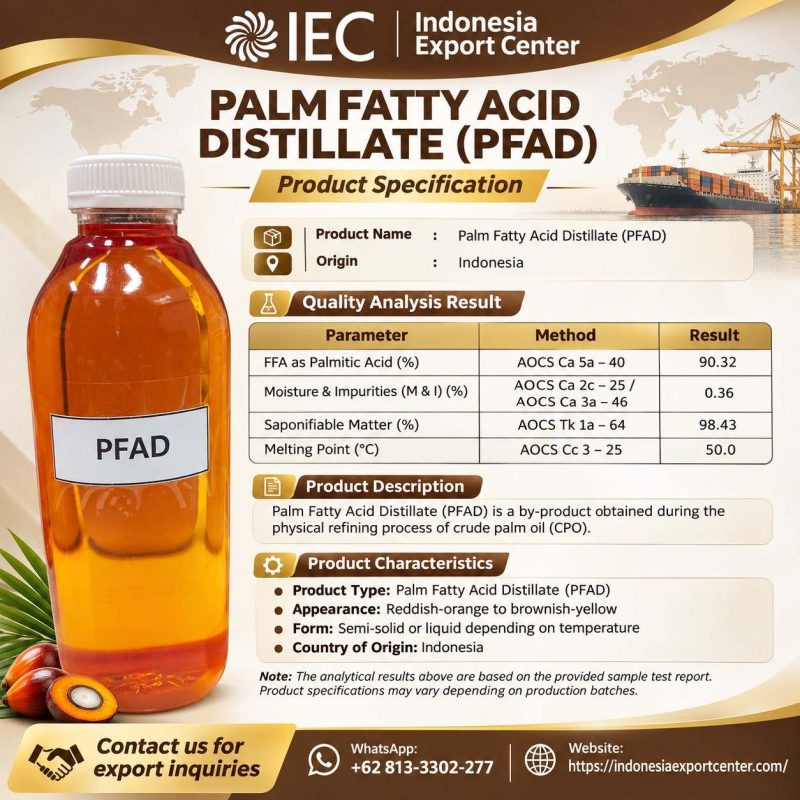
International industrial buyers researching palm fatty acid distillate specification need more than a product label. Palm Fatty Acid Distillate (PFAD) is a palm oil refining stream that may be considered for oleochemical, soap, and biodiesel applications, depending on the grade and technical requirements. This guide from Indonesia Export Center explains how to assess the product and build a commercially useful inquiry. It is intended for factories, importers, manufacturers, procurement teams, and distributors who want to make informed sourcing decisions.
Product: Palm Fatty Acid Distillate (PFAD)
Origin under discussion: Indonesia
Commercial details: Subject to current offer, lot documentation, and confirmation
Website: https://indonesiaexportcenter.com/
WhatsApp: +62 813-3302-277 — https://wa.me/628133302277
Why there is no single PFAD specification for every buyer
A search for a palm fatty acid distillate specification often returns different numbers because suppliers, batches, analytical methods, and end uses are not identical. PFAD is a material arising from palm oil refining, not a universal product defined by one global commercial grade. Rather than copying a set of typical values from an unrelated seller, build the specification around the properties your process can accept. A representative certificate of analysis provides measured information, while a contractual specification defines the values the seller and buyer agree to enforce.
Free fatty acid and acid value
FFA and acid value both relate to acidity, but they are not interchangeable numbers without considering reporting basis and method. FFA may be expressed as a selected fatty acid equivalent, while acid value generally reports the amount of potassium hydroxide required to neutralize acidic substances in a defined mass of material. Buyers should request the units, test method, and reporting convention. A high or low value is not automatically good or bad; it must be interpreted relative to the intended downstream process.
Moisture, impurities and physical properties
Water and insoluble impurities can affect storage, pumping, chemical conversion, and overall process efficiency. A supplier may describe these together or separately, so ask exactly what the stated percentage includes. Colour, odour, and physical consistency can also matter for soap and oleochemical manufacture. If the cargo needs heating or is sensitive to handling conditions, document the expected loading and discharge practices. The COA should identify the sample and test date; generic marketing tables should not be mistaken for current batch results.
Iodine and saponification values
Iodine value is commonly used as an indicator related to unsaturation, while saponification value provides information associated with the amount of alkali required for saponification and neutralization under the test procedure. Both may help a technical team understand raw material consistency, but neither alone establishes fitness for a finished product. Compare measured values using compatible methods and units. Where a process requires a narrow range, make that range part of the purchase contract rather than a verbal assurance.
How to request and verify a COA
Ask for a representative certificate showing product name, laboratory or issuer, test methods, numerical results with units, sampling information, and an identifiable lot or batch when available. Determine whether an independent surveyor must take and seal samples. Confirm the acceptance criteria, retesting rules, and deadline for claims in your agreement. Indonesia Export Center can discuss requests for PFAD specification documentation, subject to actual source availability and the documents supplied for the proposed lot.
A practical decision checklist for this topic
For a successful COA evaluation, have procurement, technical, and logistics staff review the same set of information before approving a purchase. Confirm the product description against the proposed certificate of analysis. Verify whether quoted values are measured, typical, or binding contractual limits. Confirm the named loading and destination locations, purchase quantity, delivery dates, and payment responsibilities. Check with customs professionals about the import market and with the receiving plant about unloading and storage. If any essential information remains unknown, record it explicitly as pending instead of treating a commercial assumption as a confirmed fact.
What information should buyers include in the first message?
A good first message lets the commercial team determine whether an inquiry is actionable. Include your company name, importing country, intended industrial use, quantity in metric tonnes, preferred shipment period, destination port, and requested Incoterm. Share any key chemical limits that must be met and whether the material is for trial or established production. Mention whether the transaction requires independent inspection, origin evidence, a particular payment instrument, or regulatory declarations. Avoid simply writing “best price” without a destination or quantity: sellers cannot quote shipping costs or confirm suitability accurately without those details.
Quality control and contract acceptance
Before confirming a purchase, distinguish between descriptive promotional material, representative sample results, a current certificate of analysis, and binding contract specifications. Ask who takes samples, which laboratory and methods are accepted, and what constitutes a passing result. Define an approach for weight disputes, rejection, retesting, notification windows, and replacement or other remedies where commercially relevant. These topics can feel administrative during negotiations, but they help both sides avoid confusion when the shipment is already in transit. Technical acceptance must be decided by the buyer’s own process team.
Payment, compliance and trade risk
Cross-border raw material trade involves commercial as well as technical risk. Verify the legal identity of contracting parties, bank account ownership, contractual payment milestones, and any documentary requirements before transferring funds. Work with qualified customs and legal professionals on import duties, product classification, sanctions, local licensing, and documentation. If certification is essential to your customers, confirm both certificate scope and validity for the proposed goods. Neither a website description nor a generic historical certificate should be interpreted as proof of an individual cargo’s compliance.
Why transparency is more useful than generic promises
B2B buyers benefit from practical answers, not unsupported claims such as “guaranteed best price,” “unlimited stock,” or “certified everywhere.” A responsible conversation identifies what is known, what must be confirmed with the production source, and which contract points remain open. Ask for the evidence that matters to your application and allow enough time for sample evaluation or document review. Indonesia Export Center aims to make initial inquiries clear and efficient; each requested volume, specification, packaging configuration, and shipment timeline remains subject to confirmation through the applicable commercial offer.
Frequently asked questions
Can I request a certificate of analysis?
Yes, ask for the COA applicable to the proposed lot or source. Availability, test scope, laboratory, and batch linkage must be confirmed.
Do you quote FOB or CIF?
Please state your preferred delivery basis and named port. The availability of a specific FOB or CIF offer depends on the shipment and commercial arrangement.
What is the minimum order quantity?
MOQ is not fixed on this informational page. Send the required quantity in metric tonnes so availability and suitable shipment options can be reviewed.
Can PFAD be used for every industrial process?
No. Process compatibility depends on chemical analysis, operating conditions, quality requirements, and customer validation.
Is a sample available before a large order?
Sample arrangements depend on the actual source and commercial agreement. Include the intended tests and sample quantity in your inquiry.
Is PFAD the same as refined palm oil?
No. PFAD is a distillate associated with palm oil refining, while refined palm oil is a different commercial product. Verify your required product identity before purchasing.
Can I rely on an online PFAD specification table?
Use an online table only as initial orientation. A contract should reference agreed limits and methods, and shipment acceptance should rely on appropriately identified laboratory results rather than unverified averages.
Request a PFAD quotation from Indonesia Export Center
If you are evaluating palm fatty acid distillate specification for a legitimate industrial requirement, contact Indonesia Export Center with your specification, volume, destination, and intended application. Include any must-have inspection or documentation requirements so the conversation can focus on a suitable commercial proposal. Quoted prices, shipment availability, manufacturer status, product specifications, certification, and delivery dates will be confirmed only when supporting information is available for a specific transaction.
Website: https://indonesiaexportcenter.com/
WhatsApp: +62 813-3302-277
Direct inquiry: https://wa.me/628133302277
