

IEC | INDONESIA EXPORT CENTER
Your Global Sourcing Partner
Understanding Indonesian Palm Fatty Acid Distillate
Palm Fatty Acid Distillate, commonly abbreviated as PFAD, is an industrial palm-derived material associated with the refining of palm oil.
It is an important product category for buyers who require fatty acid-rich feedstocks for suitable industrial manufacturing processes.
For first-time international importers, understanding what PFAD is, where it comes from, and how its quality is measured can help prevent product selection mistakes and improve procurement decisions.
Indonesia Export Center (IEC) facilitates sourcing inquiries involving potential Indonesian PFAD suppliers.
IEC does not claim to own a refinery, maintain guaranteed PFAD inventory, or act as the direct exporter for every transaction.
What Is Palm Fatty Acid Distillate?
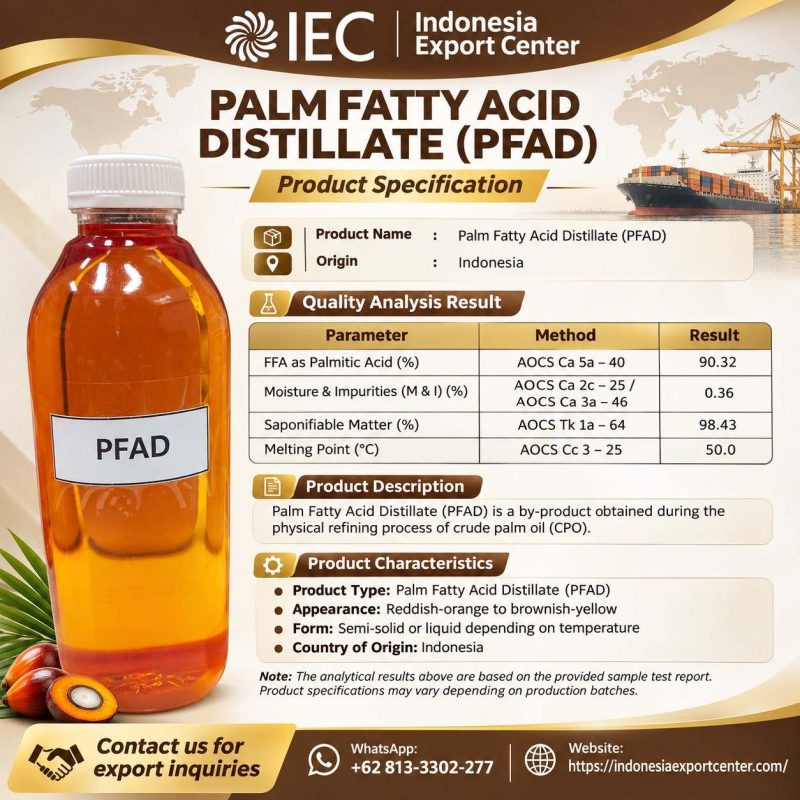
PFAD is a fatty acid-rich by-product generated during certain palm oil refining operations.
It typically contains a substantial proportion of free fatty acids along with other components derived from the original oil.
The exact composition varies according to feedstock quality, refinery technology, and operating conditions.
PFAD is not a single universally identical product.
Different refinery sources may produce materials with different analytical profiles.
How PFAD Is Generated
Palm oil refining involves processes designed to improve oil quality for downstream applications.
In physical refining systems, free fatty acids and certain volatile components may be removed during deodorization and deacidification.
The resulting distillate stream is known as PFAD.
A simplified production pathway is:
Oil Palm Fruit → Crude Palm Oil → Refinery → Refined Palm Oil + Fatty Acid-Rich Distillate
The precise process depends on the refinery.
Why PFAD Is Commercially Important
PFAD may offer a useful raw material option for manufacturers with processes capable of handling high-FFA feedstocks.
Potential commercial uses include:
- Biodiesel feedstock processing.
- Oleochemical manufacturing.
- Industrial fatty acid conversion.
- Selected industrial chemical applications.
- Commodity trading and distribution.
Application suitability must be confirmed through technical evaluation.
Typical Characteristics of PFAD
PFAD may have a solid or semi-solid appearance at certain ambient temperatures.
Its handling characteristics depend on its composition and thermal history.
The IEC reference describes the product as white to off-white solid with a melting point range of 36–46°C.
This description must be checked against the actual cargo.
IEC PFAD Reference Specification
| Parameter | Reference Value |
|---|---|
| FFA, as Palmitic | Minimum 90% |
| Moisture & Impurities | Maximum 1.0% |
| Iodine Value | Maximum 50 |
| Melting Point | 36–46°C |
| Gardner Colour | Maximum 7 |
| Appearance | White / Off White Solid |
These are reference targets only, not a current product COA.
Understanding FFA as Palmitic
FFA results may be expressed using different fatty acid reference bases.
For the IEC product reference, the stated basis is palmitic acid.
Buyers should not compare values reported on different bases without understanding the analytical method and conversion.
Understanding Moisture and Impurities
Moisture and impurities can influence industrial processing and handling.
Importers should request a clear definition of the parameter and the method used to determine it.
Understanding Iodine Value
Iodine value indicates the relative degree of unsaturation.
It can help technical buyers assess whether the material fits a particular processing requirement.
Understanding Melting Point
PFAD may require heated handling depending on storage and transport conditions.
A melting point range does not by itself establish the correct pumping temperature.
Actual handling procedures must be determined by qualified operators.
Understanding Gardner Colour
Gardner colour provides a colour-related quality indicator.
The buyer should specify the testing method and sample preparation procedure.
PFAD vs Crude Palm Oil
| Topic | PFAD | CPO |
|---|---|---|
| Origin | Palm oil refining by-product | Unrefined oil extracted from fruit |
| FFA Characteristic | Typically high | Depends on crude oil quality |
| Commercial Use | Selected industrial conversion | Refinery and industrial feedstock |
| Quality Specification | PFAD-specific | CPO-specific |
| Handling | May require heating | Depends on cargo properties |
PFAD vs Palm Fatty Acid Products
PFAD should also be distinguished from purified or further-distilled fatty acids.
A buyer requiring a specific fatty acid composition or purity may need a different product.
Importer Qualification Questions
Before buying, ask:
- What is the actual product origin?
- Which refining process generated the PFAD?
- Is a recent COA available?
- What is the FFA reporting basis?
- Are additional compositional tests available?
- What quantity can the supplier confirm?
- Which packaging or shipment options are feasible?
- Who is the contracting seller?
- Who is responsible for export formalities?
- Can independent inspection be arranged?
PFAD Packaging
The supplied product reference lists:
- Bulk in tank.
- Flexibag.
The feasibility of each arrangement depends on the cargo and logistics provider.
Documents to Request
Depending on the transaction, buyers may request:
- Product specification sheet.
- Certificate of Analysis.
- Commercial quotation.
- Seller company information.
- Commercial invoice.
- Packing or quantity documents.
- Bill of lading.
- Origin documentation where applicable.
- Other required export or import records.
First-Time Importer RFQ Template
Subject: Palm Fatty Acid Distillate Indonesia – New Importer Inquiry
Company: [Name]
Country: [Country]
Product: PFAD
Intended Application: [Details]
Required Quantity: [MT]
Technical Specifications: [Details]
Preferred Packaging: [Details]
Destination: [Port]
Preferred Incoterm: [Term]
Target Shipment Date: [Date]
Please provide information about potential Indonesian suppliers, product documentation, and commercial quotation requirements.
Frequently Asked Questions
Is PFAD the same as crude palm oil?
No. PFAD is a refining by-product, while CPO is unrefined palm oil.
Is PFAD a pure fatty acid?
Not necessarily. Its composition must be verified.
Does PFAD always look white?
No. Actual appearance can vary, and the IEC reference description should be confirmed for the offered lot.
Is PFAD used in biodiesel?
Yes, in suitable processing systems.
Can PFAD be exported from Indonesia?
Potential export transactions must comply with currently applicable rules and the responsible exporter’s qualifications.
Does IEC guarantee a refinery source?
No. The actual source must be independently verified.
What should a first-time importer request?
At minimum, clear product specifications, supplier identity, a current COA, and a dated quotation.
Explore Indonesian PFAD Sourcing Opportunities
Understand the product, confirm the specifications, and connect your industrial procurement requirements with potential Indonesian suppliers.
REQUEST PALM FATTY ACID DISTILLATE INFORMATION
IEC | INDONESIA EXPORT CENTER
Website: https://indonesiaexportcenter.com/
WhatsApp: +62 813-3302-277
Related Resources
PFAD for Oleochemical Industry
