

IEC | INDONESIA EXPORT CENTER
VERIFY ORGANIC PALM SUGAR CERTIFICATION BEFORE INTERNATIONAL PROCUREMENT
Certified Operators | Certificate Validity | Traceability | EU and USDA Organic Requirements
Understanding Organic Palm Sugar Certification in Indonesia
For international buyers, organic palm sugar certification Indonesia is an important part of supplier qualification and regulatory compliance.
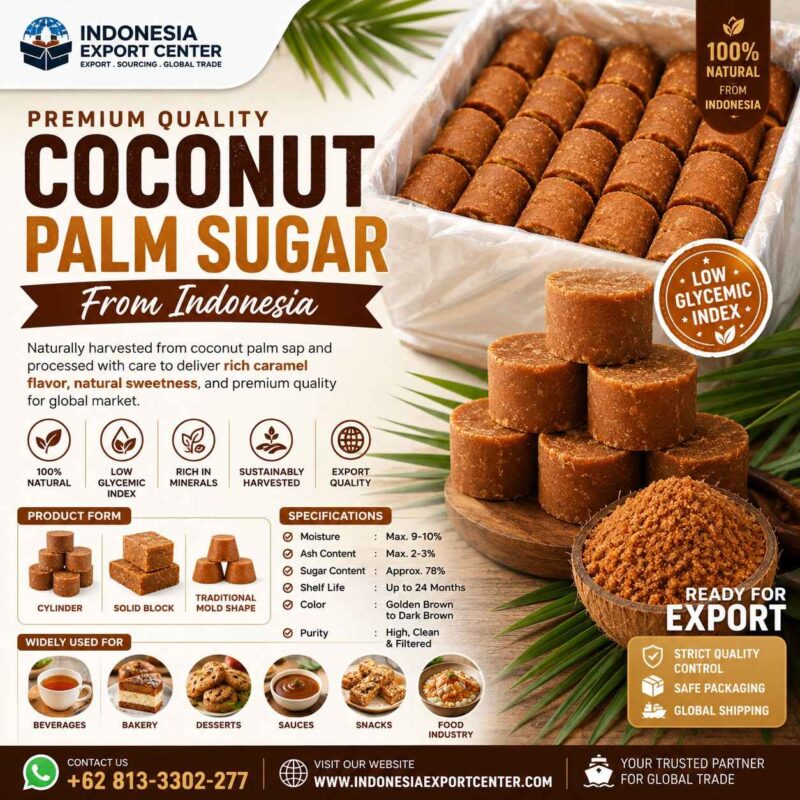
IEC | Indonesia Export Center facilitates sourcing enquiries for Indonesian palm sugar, including certified organic variants where suitable suppliers and valid certification can be verified.
Organic status should not be assumed because a product is traditionally processed, derived from palm sap, or described as natural.
Importers must confirm that the relevant product, operator, handling activities, and commercial transaction meet the applicable organic requirements.
This is particularly important for buyers supplying the European Union and United States.
REQUEST CERTIFIED ORGANIC PALM SUGAR SOURCING
Which Palm Sugar Product Is Being Certified?
Organic certification must relate to a clearly identified product.
| Product | Botanical Name |
|---|---|
| Arenga Palm Sugar | Arenga pinnata |
| Coconut Blossom Sugar | Cocos nucifera |
These products should not be treated as identical.
The certificate scope and product declaration should match the actual product being purchased.
Why Organic Certification Verification Matters
International importers may need to demonstrate that their organic ingredients originate from an appropriately certified supply chain.
Verification helps reduce the risk of inaccurate product claims, incomplete documentation, or supply-chain inconsistencies.
Step 1: Identify the Certification Standard
Buyers should determine which organic standard applies to the destination market.
For example, EU and US organic requirements are not automatically interchangeable.
The relevant certification arrangement must support the intended import and sale.
Step 2: Verify the Certification Body
Check the identity and authorization of the certification body under the relevant system.
Where possible, confirm certificate details through official registers or directly with the issuing organization.
Step 3: Review Certificate Validity
A certificate should be valid for the relevant period.
Buyers should check the operator name, address, covered activities, product scope, and validity status.
Step 4: Confirm the Certified Product Scope
A supplier may hold an organic certificate that covers only certain products or activities.
Buyers should verify that palm sugar and the relevant processing or handling activities are included.
Step 5: Review Traceability
Traceability may involve records relating to raw material collection, processing, storage, packaging, transport, and commercial transactions.
Buyers should confirm that organic and non-organic products are appropriately managed according to the applicable certification system.
Step 6: Review Transaction and Import Documents
Depending on the market, organic imports may require specific transaction documentation.
European Union
EU importers should verify the applicable organic import framework, recognized certification arrangements, and electronic Certificate of Inspection procedures through TRACES where required.
United States
US importers should verify USDA National Organic Program requirements, including applicable certification and electronic import certificate procedures.
Step 7: Verify Labeling and Marketing Claims
Organic labeling must comply with the destination market’s rules.
Buyers should confirm whether the product qualifies for the intended organic designation and logo use.
Organic Certification Verification Checklist
| Verification Item | Buyer Action |
|---|---|
| Botanical Source | Confirm Product Identity |
| Certified Operator | Verify Legal Identity |
| Certification Body | Check Authorization |
| Certificate Validity | Confirm Current Status |
| Product Scope | Match Actual Product |
| Processing Activities | Confirm Coverage |
| Traceability | Review Batch Records |
| Import Documents | Confirm Destination Requirements |
| Labeling | Review Organic Claims |
| Quality Testing | Evaluate Separately |
Organic Certification Is Not a Substitute for Food Safety
Organic certification does not automatically establish compliance with microbiological limits, contaminant requirements, or all food safety obligations.
Buyers should evaluate these matters independently.
Frequently Asked Questions
Is all Indonesian palm sugar organic?
No. Organic certification must be verified.
Can IEC provide certified organic palm sugar?
IEC can facilitate sourcing enquiries, subject to verified supplier availability.
Does a Certificate of Analysis prove organic status?
No. A COA and an organic certificate serve different purposes.
Can the same certificate be used for EU and US imports?
Not necessarily. The relevant destination requirements must be checked.
Request Organic Palm Sugar Documentation
Share your destination country, required organic standard, product specifications, packaging, and estimated quantity.
CONTACT IEC | INDONESIA EXPORT CENTER
WhatsApp: +62 813-3302-277
Website: https://www.indonesiaexportcenter.com
YOUR TRUSTED PARTNER FOR GLOBAL TRADE
