

INDONESIA EXPORT CENTER | IEC
COCOPOT – COCONUT FIBER POT
OEM Coconut Coir Plant Pot Sourcing for Private-Label Garden Brands, Nursery Suppliers & International Importers
Technical Drawings | Tooling Review | Prototype Samples | Product Approval | Packaging Artwork | Bulk Production | Export Procurement
Looking for an OEM coir pots manufacturer in Indonesia to develop coconut fiber plant pots for your garden brand, horticultural product range, or wholesale distribution business?
OEM procurement involves more than placing an order for standard plant pots.
Depending on the project, buyers may need custom product dimensions, a specific pot shape, dedicated tooling, approved samples, branded packaging, and documented quality requirements.
A successful OEM project should follow a controlled development process, from the initial product brief to the final production and packaging approvals.
Indonesia Export Center (IEC) facilitates sourcing and export inquiries for coconut fiber plant pots from Indonesia.
IEC welcomes OEM project inquiries involving technical specifications, potential manufacturing sources, tooling feasibility, sample development, packaging artwork, MOQ, and bulk export requirements.
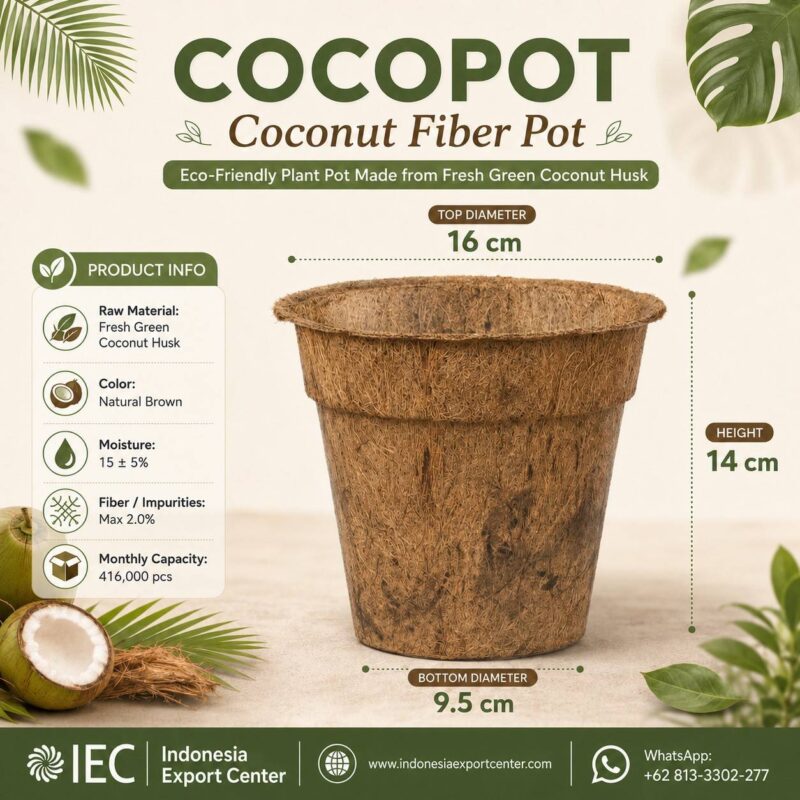
The supplied IEC cocopot reference describes a natural brown coconut fiber plant pot made from fresh green coconut husk.
Its reference dimensions are:
- Top Diameter: 16 cm
- Height: 14 cm
- Bottom Diameter: 9.5 cm
Buyers requiring different specifications may submit their project requirements for feasibility review.
IEC is a sourcing and export facilitation partner, not automatically the physical manufacturer or owner of production equipment.
Actual OEM manufacturing capability, tooling availability, packaging services, and production commitments must be confirmed with the proposed supplier.
REQUEST AN OEM COCONUT COIR POT QUOTATION
WhatsApp: https://wa.me/628133302277
Website: https://indonesiaexportcenter.com/
OEM Coconut Coir Pots – Product Reference
| Specification | IEC Reference / Inquiry Status |
|---|---|
| Product | Cocopot / Coconut Fiber Plant Pot |
| Sourcing Country | Indonesia |
| Raw Material | Fresh Green Coconut Husk |
| Color | Natural Brown |
| Moisture | 15 ± 5% |
| Fiber / Impurities | Maximum 2.0%, definition to be confirmed |
| Reference Top Diameter | 16 cm |
| Reference Height | 14 cm |
| Reference Bottom Diameter | 9.5 cm |
| Stated Monthly Capacity | 416,000 Pieces |
| OEM Product Development | Subject to Supplier Capability |
| Custom Dimensions | Subject to Feasibility Review |
| Custom Shapes | Subject to Feasibility Review |
| Existing Tooling | To Be Confirmed |
| New Mold Development | Subject to Supplier Capability |
| Prototype Samples | Subject to Availability |
| Private-Label Packaging | Subject to Supplier Capability |
| Artwork Approval | To Be Agreed |
| MOQ | To Be Confirmed |
| OEM Unit Price | Request Quotation |
| Production Lead Time | To Be Confirmed |
| Export Terms | Subject to Commercial Agreement |
Important: The stated monthly capacity is a supplied reference figure, not a verified guarantee of OEM production allocation or custom tooling capacity.
1. What Is OEM Coir Plant Pot Manufacturing?
OEM stands for Original Equipment Manufacturer.
In a horticultural procurement context, OEM coir pot manufacturing generally refers to producing coconut fiber plant pots according to agreed buyer specifications.
The scope may involve:
- Product dimensions
- Product shape
- Wall thickness
- Material composition
- Quality tolerances
- Packaging
- Branding
- Labeling
- Repeat-order specifications
The actual scope of customization depends on the manufacturer’s equipment, production process, and commercial arrangements.
Why OEM Matters
OEM purchasing allows brands to specify product requirements rather than relying entirely on existing catalog products.
However, OEM manufacturing should not be assumed to be available until the proposed supplier confirms technical and commercial feasibility.
2. OEM vs. Private Label vs. Standard Wholesale
These purchasing models are related but different.
| Model | Primary Focus |
|---|---|
| Standard Wholesale | Purchasing an existing product specification |
| Private Label | Selling an agreed product under the buyer’s brand |
| OEM Manufacturing | Producing a product according to buyer-defined specifications |
| Custom-Size Manufacturing | Modifying product dimensions or geometry |
| Custom Packaging | Developing buyer-specific retail or shipping packaging |
Key Difference
An OEM project may include both product customization and private-label packaging.
A private-label order may only require branded packaging around an existing product.
3. Who Needs OEM Coconut Coir Pots?
OEM coconut fiber pot sourcing may be relevant to:
- Private-label garden brands
- Nursery product distributors
- Horticultural wholesalers
- Commercial nursery supply companies
- Garden center product developers
- International importers
- Retail product sourcing teams
Common Procurement Objectives
- Develop a defined product specification
- Match an existing nursery system
- Introduce a branded product line
- Maintain consistent quality
- Control packaging presentation
- Support recurring purchasing
4. IEC Coconut Fiber Pot Reference Specifications
The supplied IEC reference provides the following product information.
| Parameter | Reference Value |
|---|---|
| Product | Cocopot / Coconut Fiber Pot |
| Raw Material | Fresh Green Coconut Husk |
| Color | Natural Brown |
| Moisture | 15 ± 5% |
| Fiber / Impurities | Maximum 2.0% |
| Stated Monthly Capacity | 416,000 Pieces |
Material Clarification
The supplied information identifies the raw material but does not establish the complete composition of the finished product.
Buyers should request information about any binders, adhesives, coatings, or additives.
Specification Clarification
The precise meaning and measurement method of the “fiber / impurities” parameter require confirmation.
5. Reference Product Dimensions
| Dimension | Measurement |
|---|---|
| Top Diameter | 16 cm / 160 mm |
| Height | 14 cm / 140 mm |
| Bottom Diameter | 9.5 cm / 95 mm |
These dimensions describe the reference product.
They do not establish available tooling for other sizes.
6. OEM Project Development Workflow
A structured OEM project can be organized into the following stages.
Product Brief → Technical Drawing → Feasibility Review → Tooling Decision → Prototype Sample → Product Approval → Packaging Artwork → Packaging Approval → Commercial Confirmation → Bulk Production → Quality Inspection → Export
Each stage should have clear responsibilities and approval requirements.
Stage 1 – Product Brief
The buyer defines the intended product and application.
Stage 2 – Technical Drawing
The buyer or designated technical team prepares dimensions and critical specifications.
Stage 3 – Feasibility Review
The proposed manufacturer evaluates whether the design can be produced.
Stage 4 – Tooling Decision
Existing tooling or new tooling requirements are assessed.
Stage 5 – Prototype Sample
A sample may be prepared if the proposed supplier supports the requested development process.
Stage 6 – Product Approval
The buyer reviews the sample and approves the final product specification.
Stage 7 – Packaging Artwork
The buyer prepares or approves branding and packaging artwork.
Stage 8 – Packaging Approval
The final packaging design is checked for accuracy and suitability.
Stage 9 – Commercial Confirmation
MOQ, pricing, lead time, payment terms, and production allocation are agreed.
Stage 10 – Bulk Production
Manufacturing proceeds under the agreed specification.
Stage 11 – Quality Inspection
The finished product is evaluated against agreed acceptance criteria.
Stage 12 – Export Coordination
The parties confirm shipment terms, documentation, and logistics.
This is a recommended OEM workflow. It does not imply that IEC directly performs each manufacturing or packaging stage.
7. OEM Product Brief Requirements
A complete product brief helps the proposed manufacturer understand the project.
Recommended Information
- Product name
- Intended application
- Target market
- Required shape
- Dimensions
- Material requirements
- Unit weight
- Wall thickness
- Quality tolerances
- Order quantity
- Packaging
- Branding
- Target delivery date
Buyer Recommendation
Provide technical drawings whenever possible.
8. Technical Drawings for OEM Coir Pots
Technical drawings should identify the critical product dimensions.
| Drawing Parameter | Buyer Requirement |
|---|---|
| Top Diameter | mm |
| Bottom Diameter | mm |
| Height | mm |
| Wall Thickness | mm |
| Shape | Round / Square / Polygon / Other |
| Taper | If Required |
| Internal Volume | If Required |
| Unit Weight | g |
| Drainage Configuration | If Required |
| Dimensional Tolerance | mm |
Important Note
Achievable dimensions and tolerances must be confirmed by the proposed manufacturer.
9. Design for Manufacturing Review
Before tooling is approved, the proposed manufacturer should evaluate whether the design is practical to produce.
Review Areas
- Overall geometry
- Wall thickness
- Shape complexity
- Material distribution
- Demolding requirements
- Product consistency
- Production cycle
- Tooling availability
Why This Matters
A design that looks acceptable in a drawing may require changes before it can be manufactured consistently.
10. Tooling Process for OEM Coir Pots
Tooling refers to the equipment or forms used to produce a particular product shape.
Depending on the manufacturing method, custom coir pots may require molds or other dedicated production tools.
Recommended Tooling Process
- Review the technical drawing.
- Confirm the manufacturing method.
- Check existing tooling.
- Identify whether new tooling is required.
- Review tooling feasibility.
- Request tooling quotation.
- Confirm ownership and maintenance terms.
- Approve tooling development.
- Evaluate prototype samples.
- Approve or revise the tooling.
Important Note
No verified tooling development service, tooling cost, or tooling lead time has been supplied.
11. Existing Tooling vs. New Tooling
Existing Tooling
May reduce the need for a completely new development process if a suitable tool is available.
New Tooling
May be necessary when the buyer requires a product geometry not supported by existing equipment.
Buyer Recommendation
Confirm actual tooling availability before assuming that a particular size can be produced.
12. Tooling Ownership and Intellectual Property
OEM buyers should document tooling and design rights.
Questions to Clarify
- Who pays for the tooling?
- Who owns the tooling?
- Can it be used for other customers?
- Who is responsible for maintenance?
- Can the buyer request tooling transfer?
- What happens if the supplier relationship ends?
- Who owns the approved technical drawing?
Buyer Recommendation
Record these arrangements in the supply agreement.
13. Prototype Samples
Prototype samples help buyers evaluate the physical product before committing to bulk manufacturing.
Recommended Checks
- Dimensions
- Shape
- Wall thickness
- Unit weight
- Moisture
- Appearance
- Handling
- Intended nursery performance
Important Note
Prototype availability, costs, and development timelines require supplier confirmation.
14. Sample Approval and Golden Sample
A golden sample is an approved physical reference for subsequent production.
Recommended Approval Records
- Sample identification
- Drawing revision
- Material specification
- Dimensions
- Unit weight
- Visual acceptance criteria
- Approval date
- Authorized approver
Why This Matters
The approved sample provides a common reference for buyer and manufacturer.
15. Design Revision Control
OEM development may involve several revisions.
For example:
- Revision A: Initial design
- Revision B: Modified height
- Revision C: Adjusted wall thickness
- Revision D: Final approved version
Buyer Recommendation
The purchase order should identify the approved drawing revision and golden sample.
This helps reduce the risk of producing an outdated specification.
16. Material Composition for OEM Coir Pots
The supplied IEC reference identifies fresh green coconut husk as the raw material.
However, the complete finished-product composition has not been supplied.
Buyers Should Request
- Coconut fiber content
- Binder information
- Adhesive information
- Coating information
- Other additives
- Relevant material test results
Important Note
Natural fiber content alone does not establish that the finished product is binder-free, plastic-free, or certified compostable.
17. Moisture Specification
The supplied IEC reference states:
Moisture: 15 ± 5%
If interpreted as percentage points, this corresponds to approximately 10–20% moisture.
Buyer Recommendation
Confirm the test method and acceptance criteria.
18. Dimensional Tolerances
Dimensional tolerances define allowable variation in a manufactured product.
Example
A buyer may specify a top diameter of 160 mm with a tolerance of ±3 mm.
This would allow a measured diameter between 157 mm and 163 mm.
This example is illustrative and does not represent a confirmed IEC manufacturing tolerance.
Recommended Controls
- Critical dimensions
- Measurement method
- Sampling frequency
- Acceptance criteria
- Corrective action procedures
19. Product Quality Control
OEM quality control should be based on the approved specification.
Recommended Inspection Parameters
- Dimensions
- Wall thickness
- Unit weight
- Moisture
- Shape consistency
- Material composition
- Surface condition
- Visible defects
- Packaging condition
Buyer Recommendation
Define measurable acceptance criteria before production.
20. Pre-Production Approval
Before bulk production begins, the buyer should confirm:
- Final technical drawing
- Approved sample
- Material specification
- Quality criteria
- Packaging requirements
- Artwork revision
- MOQ
- Unit price
- Lead time
- Payment terms
Why This Matters
Pre-production approval reduces uncertainty and helps prevent specification disputes.
21. Private-Label Packaging for OEM Projects
OEM buyers may require branded packaging.
Potential Packaging Requests
- Printed retail cartons
- Branded sleeves
- Product labels
- Barcode stickers
- Instruction inserts
- Buyer-branded master cartons
Important Note
These are potential buyer-requested options, not confirmed available IEC packaging services.
22. Packaging Artwork Development
Packaging artwork may include:
- Brand logo
- Product name
- Product dimensions
- Product quantity
- Product images
- Barcode
- Country-of-origin information
- Product instructions
- Applicable legal information
Buyer Recommendation
Finalize product specifications before approving packaging artwork.
23. Packaging Dielines
A dieline defines the layout of a printed package.
Common Elements
- Cut lines
- Fold lines
- Glue areas
- Bleed
- Safe text areas
- Barcode placement
Important Note
The packaging producer should confirm the dieline before artwork approval.
24. Artwork Approval Process
A structured approval process is recommended.
Step 1 – Confirm Packaging Dimensions
Verify the actual product and pack configuration.
Step 2 – Obtain the Dieline
Request the approved packaging template.
Step 3 – Prepare Artwork
Apply the buyer’s branding and product information.
Step 4 – Review Content
Check text, dimensions, barcode data, and regulatory statements.
Step 5 – Review Digital Proof
Evaluate the proposed print layout.
Step 6 – Review Physical Sample
Check fit, print quality, and handling where required.
Step 7 – Approve Final Revision
Provide written approval before printing.
25. Artwork Revision Control
Packaging artwork should be managed using revision numbers.
Recommended Records
- File name
- Revision number
- Approval date
- Approved proof
- SKU
- Packaging specification
Why This Matters
Artwork errors can affect retail distribution, inventory management, and customer trust.
26. Barcode and Retail Labeling
OEM buyers may require product identifiers and barcode labels.
Buyer Responsibilities
- Provide valid barcode data
- Confirm barcode format
- Review label accuracy
- Check destination-market requirements
- Approve final artwork
Important Note
Barcode registration and allocation are not represented as included IEC services.
27. Environmental Claims on OEM Packaging
Coconut fiber is a natural plant-derived material.
However, finished-product environmental claims require evidence.
Claims Requiring Verification
- Biodegradable
- Compostable
- Home compostable
- Plastic-free
- Chemical-free
- Certified sustainable
- Direct-plantable
Buyer Recommendation
Verify claims before printing them on retail packaging.
28. Packaging Sample Approval
Packaging samples can help verify the final retail presentation.
Recommended Checks
- Product fit
- Carton dimensions
- Print quality
- Color consistency
- Text accuracy
- Barcode readability
- Product protection
- Shipping suitability
Sample availability and costs require supplier confirmation.
29. Packaging MOQ vs. Product MOQ
OEM projects may have separate minimum order quantities.
Product MOQ
The minimum quantity required for the finished cocopot.
Packaging MOQ
The minimum quantity required for a custom packaging format or print run.
Tooling MOQ
Some manufacturing arrangements may also involve minimum production quantities linked to tooling or setup economics.
Buyer Recommendation
Request all applicable MOQ figures before finalizing the project budget.
30. OEM Cost Structure
OEM quotations may contain one-time and recurring costs.
| Cost Category | Typical Treatment |
|---|---|
| Product Development | May be one-time |
| Tooling | May be one-time |
| Samples | May be charged separately |
| Unit Manufacturing | Recurring |
| Packaging | Recurring |
| Printing Setup | May be one-time |
| Inspection | Depends on agreement |
| Freight | Depends on shipment terms |
Important Note
No verified current OEM price or tooling cost has been supplied.
31. OEM MOQ and Production Lead Time
MOQ and lead time depend on the actual project.
Potential Factors
- Product complexity
- Tooling availability
- Sample revisions
- Material requirements
- Production scheduling
- Packaging development
- Order quantity
Buyer Recommendation
Request separate lead times for tooling, samples, packaging, and bulk production.
32. Production Capacity
The supplied IEC reference states:
Monthly Capacity: 416,000 Pieces
This figure does not independently establish available OEM production capacity.
Buyers Should Confirm
- Actual manufacturer
- Product-specific production output
- Available production allocation
- Tooling availability
- Packaging capacity
- Production schedule
33. Repeat OEM Orders
OEM garden brands may require recurring supply of an approved product.
Recommended Controls
- Approved technical drawing
- Golden sample
- Material specification
- Quality inspection criteria
- Approved artwork
- Packaging specification
- Forecast quantities
- Change approval procedure
Repeat-order commitments require supplier confirmation and agreement.
34. Export Packaging
Export packaging should be appropriate for the finished product and agreed shipping method.
Required Information
- Pieces per retail pack
- Retail packs per master carton
- Master carton dimensions
- Net weight
- Gross weight
- Product protection
- Shipping marks
No verified carton packing configuration has been supplied for OEM orders.
35. Container Loading
Container loading depends on the finished product and packaging.
Main Variables
- Pot dimensions
- Unit weight
- Carton dimensions
- Pieces per carton
- Palletization
- Container type
A loading estimate should be based on verified packing data.
36. Export Documentation
Depending on the destination and transaction, documents may include:
- Commercial invoice
- Packing list
- Bill of lading
- Certificate of Origin, where applicable
- Product specification sheet
- Inspection records, where agreed
- Applicable regulatory documents
- Customs declarations
Requirements vary by destination country and product classification.
37. Commercial Roles in OEM Export Projects
International buyers should identify:
- Actual manufacturer
- Tooling provider
- Packaging producer
- Contractual seller
- Exporter of record
- Payment beneficiary
IEC’s Role
Indonesia Export Center facilitates sourcing and export inquiries.
IEC should not automatically be treated as the physical manufacturer, tooling owner, packaging printer, or exporter of record.
38. OEM Procurement Checklist
Product Development
-
Product brief completed
-
Technical drawing prepared
-
Dimensions confirmed
-
Material composition reviewed
-
Tolerances defined
Tooling
-
Existing tooling checked
-
New tooling feasibility reviewed
-
Tooling cost confirmed
-
Tooling ownership agreed
-
Tooling lead time confirmed
Samples
-
Prototype sample reviewed
-
Sample revisions completed
-
Golden sample approved
-
Drawing revision recorded
Packaging
-
Packaging format selected
-
Dieline approved
-
Artwork approved
-
Barcode verified
-
Packaging sample approved
-
Packaging MOQ confirmed
Commercial
-
Product MOQ confirmed
-
Unit price confirmed
-
Production allocation confirmed
-
Lead time confirmed
-
Payment terms agreed
Export
-
Contractual seller identified
-
Exporter of record identified
-
Destination port confirmed
-
Incoterm agreed
-
Export documents reviewed
OEM Coir Plant Pots Manufacturing – RFQ Template
Subject: OEM Coconut Coir Plant Pots – Tooling, Samples, Packaging Artwork & Export Inquiry
Dear Indonesia Export Center Team,
We are interested in sourcing OEM coconut fiber plant pots from Indonesia for our private-label garden product business.
Please review our technical, tooling, packaging, and commercial requirements.
Buyer Information
Company Name: [Company Name]
Brand Name: [Brand Name]
Country: [Country]
Business Type: [Private-Label Brand / Importer / Distributor]
Contact Person: [Name]
Email: [Email]
WhatsApp: [Number]
Product Requirements
Product: Coconut Fiber Plant Pot / Cocopot
Required Shape: [Round / Square / Polygon / Other]
Top Diameter: [mm]
Bottom Diameter: [mm]
Height: [mm]
Wall Thickness: [mm]
Target Unit Weight: [g]
Dimensional Tolerances: [Details]
Technical Drawing Available: [Yes / No]
Intended Application: [Details]
Tooling Requirements
Existing Mold Acceptable: [Yes / No]
New Tooling Required: [Yes / No / To Be Confirmed]
Tooling Ownership Requirement: [Details]
Prototype Samples Required: [Yes / No]
Sample Quantity: [Pieces]
Material Requirements
Raw Material: Coconut Husk Fiber
Full Material Composition Required: [Yes / No]
Binder Information Required: [Yes / No]
Moisture Requirement: [Percentage / Tolerance]
Environmental Test Evidence Required: [Yes / No]
Packaging and Artwork
Private-Label Packaging Required: [Yes / No]
Packaging Format: [Printed Carton / Sleeve / Label / Other]
Brand Logo Available: [Yes / No]
Artwork Available: [Yes / No]
Dieline Required: [Yes / No]
Barcode Available: [Yes / No]
Packaging Sample Required: [Yes / No]
Artwork Approval Required: [Yes / No]
Quantity
Initial Order Quantity: [Pieces]
Expected Annual Volume: [Pieces]
Number of SKUs: [Number]
Shipping
Destination Country: [Country]
Destination Port: [Port]
Preferred Incoterm: [EXW / FCA / FOB / CFR / CIF / Other]
Target Shipment Date: [Date]
Please provide:
- Proposed manufacturer information
- OEM manufacturing feasibility
- Existing tooling availability
- New tooling requirements
- Tooling cost and ownership terms
- Prototype sample availability
- Sample costs and lead time
- Achievable dimensional tolerances
- Material composition information
- Product MOQ
- Packaging MOQ
- Unit price
- Product-specific production capacity
- Production lead time
- Packaging options
- Dieline availability
- Artwork approval requirements
- Packaging sample availability
- Quality control procedures
- Carton packing specifications
- Estimated container loading
- Export quotation
- Exporter of record identity
- Payment terms
- Quotation validity
We look forward to receiving your OEM sourcing proposal.
Best regards,
[Your Name]
[Company Name]
[Country]
SEND YOUR OEM RFQ VIA WHATSAPP:
https://wa.me/628133302277
Frequently Asked Questions About OEM Coir Pot Manufacturing
What is OEM coir pot manufacturing?
It refers to manufacturing coconut fiber plant pots according to agreed buyer specifications.
Can I source OEM coconut coir pots from Indonesia?
OEM sourcing inquiries may be submitted, subject to manufacturer capability and commercial confirmation.
Does IEC manufacture OEM coir pots directly?
IEC is positioned as a sourcing and export facilitation partner, not automatically as the physical manufacturer.
Can I request custom dimensions?
Custom-dimension inquiries may be submitted for feasibility review.
Can I request custom shapes?
Custom-shape inquiries may be submitted, subject to tooling and manufacturing feasibility.
Are existing molds available?
Existing tooling availability must be confirmed with the proposed manufacturer.
Can new molds be developed?
New tooling inquiries may be submitted for feasibility review.
Who owns custom tooling?
Tooling ownership should be agreed in writing.
Can I request prototype samples?
Sample inquiries may be submitted, subject to supplier capability and commercial arrangements.
What is a golden sample?
An approved physical product used as a reference for bulk production.
Can I approve technical drawings before production?
Technical drawing approval should be part of the agreed OEM development process.
What is the raw material?
The supplied IEC reference identifies fresh green coconut husk.
What are the reference dimensions?
16 cm top diameter, 14 cm height, and 9.5 cm bottom diameter.
What is the reference moisture specification?
15 ± 5%.
What is the stated monthly capacity?
416,000 pieces, subject to verification.
Does the monthly capacity guarantee OEM production availability?
No. Available production allocation must be confirmed separately.
Can I request private-label packaging?
Private-label packaging inquiries may be submitted for feasibility review.
Can I use my own brand artwork?
Buyer-supplied artwork may be reviewed as part of a proposed packaging project.
What is artwork approval?
It is the process of reviewing and authorizing the final packaging design before printing.
Can I request branded cartons?
Branded carton inquiries may be submitted, subject to packaging supplier capability.
What is the MOQ for OEM coir pots?
MOQ depends on the project and must be confirmed.
Are tooling costs included in the unit price?
This depends on the quotation. Buyers should request a cost breakdown.
Are coconut coir pots biodegradable?
Finished-product biodegradability requires product-specific verification.
Can I place repeat OEM orders?
Repeat-order arrangements may be discussed, subject to supplier availability and agreement.
What documents should I provide for an OEM quotation?
Provide your technical drawing, required dimensions, tooling requirements, packaging artwork, order quantity, and destination port.
Request OEM Coconut Coir Pot Manufacturing & Export Quotation
Develop Your Coconut Fiber Plant Pot Product with an OEM Sourcing Partner in Indonesia
Indonesia Export Center (IEC) welcomes inquiries from private-label garden brands, horticultural distributors, nursery supply companies, and international importers.
Product: Cocopot / Coconut Fiber Plant Pot
Reference Raw Material: Fresh Green Coconut Husk
Reference Color: Natural Brown
Reference Moisture: 15 ± 5%
Reference Fiber / Impurities: Max. 2.0%, Definition Subject to Confirmation
Reference Top Diameter: 16 cm
Reference Height: 14 cm
Reference Bottom Diameter: 9.5 cm
Stated Monthly Capacity: 416,000 Pieces, Subject to Verification
OEM Manufacturing: Subject to Supplier Capability
Custom Tooling: Subject to Feasibility Review
Prototype Samples: Subject to Availability
Private-Label Packaging: Subject to Supplier Capability
Artwork Approval: To Be Agreed
MOQ: To Be Confirmed
OEM Unit Price: Request Quotation
Production Lead Time: To Be Confirmed
Export Terms: Subject to Commercial Agreement
Contact IEC to discuss your OEM product requirements, technical drawings, tooling feasibility, sample development, artwork approval, MOQ, wholesale pricing, and export arrangements.
INDONESIA EXPORT CENTER | IEC
Your Export & Sourcing Partner from Indonesia
Website: https://indonesiaexportcenter.com/
WhatsApp: +62 813-3302-277
REQUEST YOUR OEM COCONUT COIR POT QUOTATION
Please include your company name, technical drawing, tooling requirements, private-label packaging requirements, initial order quantity, and destination country.
OEM Capability Disclaimer: IEC facilitates sourcing and export inquiries. The supplied reference does not independently establish ownership of a cocopot factory, existing tooling, new mold development services, prototype capability, or branded packaging production. All OEM manufacturing, tooling, sampling, packaging, MOQ, pricing, production allocation, quality control, and export arrangements require verification with the proposed supplier.
