

IEC | INDONESIA EXPORT CENTER
COCONUT SHELL CHARCOAL BRIQUETTES FROM INDONESIA
Indonesian Coconut Charcoal for Japanese Grilling Fuel Importers, BBQ Distributors & Commercial Buyers
Hexagonal BBQ Briquettes | Quality Consistency | Buyer Inspection | FOB Indonesia
Looking for Indonesian coconut charcoal for Japan with documented specifications, consistent briquette dimensions, and export sourcing support?
Indonesia Export Center (IEC) facilitates sourcing and export inquiries for Indonesian coconut shell charcoal briquettes, helping Japanese importers and grilling fuel distributors assess product specifications, quality verification, packaging, and international shipping arrangements.
For Japanese buyers, consistent product quality can be especially important when developing repeat-order supply relationships. Briquette dimensions, moisture, ash content, burning performance, breakage, and packaging should be evaluated against clearly agreed purchasing specifications.
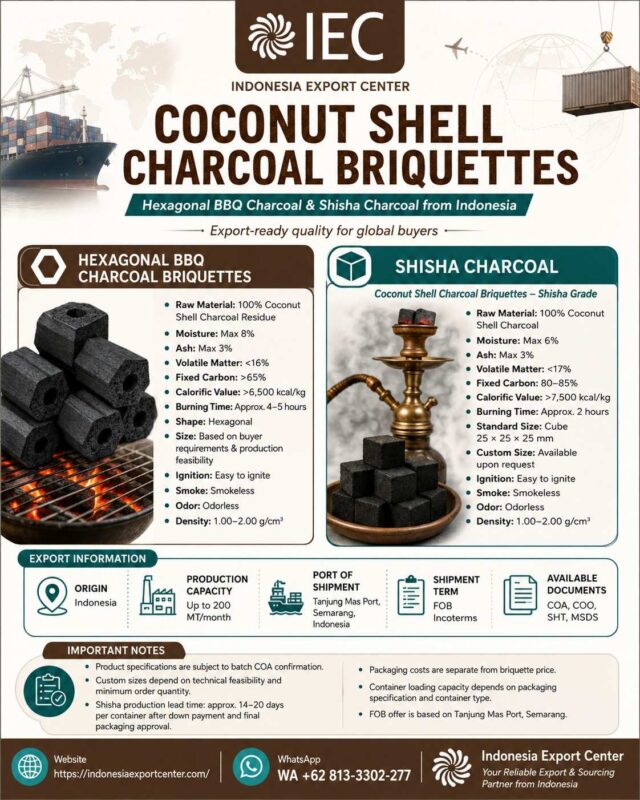
IEC’s supplied hexagonal BBQ charcoal reference features 100% coconut shell charcoal residue as raw material, maximum 8% moisture, maximum 3% ash, fixed carbon greater than 65%, and calorific value greater than 6,500 kcal/kg.
These are reference specifications, subject to supplier confirmation, sample testing, and batch-specific quality verification.
Request an Indonesian Coconut Charcoal Quotation for Japan:
https://wa.me/628133302277
Indonesian Coconut Charcoal for Japanese Wholesale Buyers
IEC welcomes inquiries from businesses involved in:
- BBQ charcoal importing
- Grilling fuel wholesale
- Restaurant supply distribution
- Outdoor cooking retail
- Specialty charcoal distribution
- Private-label charcoal products
- International trading
Potential Japanese distribution markets include:
- Tokyo
- Osaka
- Nagoya
- Yokohama
- Kobe
- Fukuoka
- Other Japanese cities
Actual supply availability, import eligibility, and shipping arrangements require confirmation for each transaction.
Hexagonal Coconut BBQ Charcoal Specifications for Japan
The following specifications are based on the supplied IEC BBQ charcoal reference.
| Specification | Reference Details |
|---|---|
| Product | Hexagonal Coconut BBQ Charcoal Briquettes |
| Raw Material | 100% Coconut Shell Charcoal Residue |
| Moisture | Maximum 8% |
| Ash | Maximum 3% |
| Volatile Matter | Less than 16% |
| Fixed Carbon | Greater than 65% |
| Calorific Value | Greater than 6,500 kcal/kg |
| Burning Time | Approximately 4–5 hours |
| Shape | Hexagonal |
| Size | Based on buyer requirements and production feasibility |
| Ignition | Described as easy to ignite; verification required |
| Smoke | Described as smokeless; verification required |
| Odor | Described as odorless; verification required |
| Density | 1.00–2.00 g/cm³ |
Quality note: These are supplied reference specifications, not independently verified results for a particular shipment. Final acceptance should be based on representative samples, agreed testing methods, and batch-specific Certificate of Analysis (COA) documentation.
The description “100% coconut shell charcoal residue” identifies the charcoal feedstock. It does not independently establish that the finished briquettes contain no binders or additives.
Coconut Charcoal for Japanese Grilling Applications
Restaurant Grilling Fuel
Japanese restaurant supply businesses may evaluate coconut charcoal briquettes for grilling applications where the product’s dimensions, heat characteristics, and handling requirements are suitable.
Potential evaluation criteria include:
- Heat consistency
- Ignition behavior
- Burning duration
- Ash generation
- Briquette integrity
- Cost per operating session
Suitability for a particular restaurant or grill system must be established through practical testing.
BBQ and Outdoor Cooking
Outdoor cooking distributors may assess coconut charcoal briquettes for compatible charcoal grills and BBQ equipment.
Buyers should verify:
- Briquette dimensions
- Grill compatibility
- Required airflow
- Ignition method
- Cooking temperature
- Burning duration
Commercial Fuel Distribution
Wholesale fuel distributors may prioritize:
- Repeat-order consistency
- Predictable packaging
- Traceable batches
- Product documentation
- Reliable order specifications
Coconut Charcoal vs. Traditional Japanese Charcoal
Japanese buyers may already be familiar with different grilling fuels, including traditional wood charcoal and binchotan-style products.
Coconut shell charcoal briquettes are a separate product category.
They should not automatically be described as binchotan, white charcoal, or equivalent to a specific traditional Japanese charcoal grade.
Performance comparisons should be supported by relevant testing.
Why Quality Consistency Matters for Japanese Buyers
Consistent Dimensions
Briquette size can affect:
- Packaging
- Unit weight
- Handling
- Heat distribution
- Customer expectations
- Repeat-order acceptance
Consistent Moisture
The supplied reference specifies maximum 8% moisture.
Buyers may require testing across production batches.
Consistent Ash Content
The supplied reference specifies maximum 3% ash.
Ash content should be verified by an agreed laboratory method.
Consistent Fixed Carbon
The supplied reference specifies fixed carbon greater than 65%.
Fixed carbon should be assessed together with moisture, ash, volatile matter, and practical grilling performance.
Consistent Packaging
Repeat-order buyers may require stable:
- Net weight
- Carton dimensions
- Packaging materials
- Label information
- Shipping marks
- Pallet configuration
Japanese Buyer Quality Control Checklist
Japanese importers may establish a written quality control procedure before approving bulk production.
| Quality Parameter | Recommended Verification |
|---|---|
| Raw material | Supplier declaration and supporting evidence |
| Briquette shape | Visual inspection |
| Briquette dimensions | Measurement against agreed tolerance |
| Average unit weight | Sample weighing |
| Moisture | Laboratory testing |
| Ash | Laboratory testing |
| Volatile matter | Laboratory testing |
| Fixed carbon | Laboratory testing |
| Calorific value | Laboratory testing |
| Density | Agreed testing method |
| Ignition performance | Practical test |
| Burning duration | Practical test |
| Smoke and odor | Practical evaluation |
| Breakage | Defined sampling and acceptance method |
| Packaging | Inspection against approved specification |
| Net weight | Weight verification |
| Batch identification | Traceability review |
| COA | Batch-specific documentation |
Acceptance limits should be agreed in writing before production.
Sample Approval Before Bulk Orders
Representative Samples
Japanese buyers may request samples to evaluate product suitability before a larger order.
Sample Testing
A useful evaluation may include:
- Laboratory analysis
- Dimension measurements
- Weight measurements
- Grilling performance tests
- Breakage inspection
- Packaging review
Approved Reference Sample
Where agreed, an approved reference sample may be retained for comparison with later production.
Sample-to-Batch Consistency
Sample approval does not automatically guarantee that all later production will match.
Buyers should agree on:
- Written product specifications
- Batch testing
- Sampling procedures
- Inspection rights
- Acceptance criteria
- Dispute resolution
Laboratory Testing and Certificate of Analysis
Technical Parameters
Buyers may request laboratory verification of:
- Moisture
- Ash
- Volatile matter
- Fixed carbon
- Calorific value
- Density
Batch-Specific COA
A useful COA should identify:
- Product description
- Batch or sample number
- Laboratory
- Test date
- Test methods
- Reported values
- Reporting basis
A generic specification sheet should not be treated as evidence for every shipment.
Independent Testing
Where agreed, buyers may request third-party laboratory testing.
Testing availability, sampling methods, and costs require confirmation.
Hexagonal Briquette Dimensions and Custom Sizes
Size Requirements
The supplied reference does not specify one fixed hexagonal briquette size.
Dimensions depend on buyer requirements and production feasibility.
Japanese buyers may request information about:
- Briquette length
- Outer diameter or cross-sectional dimensions
- Central-hole dimensions, if applicable
- Average unit weight
- Dimensional tolerance
- Breakage tolerance
Custom Dimensions
Custom sizes may be discussed, subject to:
- Technical feasibility
- Production capability
- Minimum order quantity
- Tooling requirements
- Packaging configuration
Alternative dimensions should not be assumed available without supplier confirmation.
Grilling Performance and Practical Testing
Burning Time
The supplied reference indicates approximately 4–5 hours of burning time.
Actual performance depends on:
- Briquette size
- Briquette weight
- Airflow
- Ignition method
- Grill design
- Operating conditions
This reference is not a guaranteed cooking duration.
Ignition
The supplied product description identifies the charcoal as easy to ignite.
No fixed ignition time has been supplied.
Smoke and Odor
The supplied product description uses the terms smokeless and odorless.
These descriptions require verification under agreed conditions.
Safety warning: Burning charcoal can generate dangerous carbon monoxide even when visible smoke is limited. Proper ventilation and safe handling are essential.
Breakage and Dust
Buyers may inspect:
- Cracked briquettes
- Broken pieces
- Excessive dust
- Crumbling
- Packaging damage
No fixed breakage tolerance has been supplied. Buyers should agree on an acceptable limit and measurement method before production.
Wholesale Packaging for Japanese Importers
Bulk Packaging
Bulk packaging may be suitable for Japanese importers supplying commercial fuel distributors or repacking operations.
Buyers should confirm:
- Net weight per carton
- Gross weight
- Carton dimensions
- Packaging material
- Moisture protection
- Carton strength
- Shipping marks
No fixed bulk packaging configuration has been supplied.
Retail Packaging
Japanese buyers may request retail packaging suitable for the intended sales channel.
Potential information may include:
- Product identity
- Net quantity
- Country of origin
- Importer or distributor details
- Usage instructions
- Safety warnings
- Batch identification
- Barcode
The exact requirements depend on the product and applicable Japanese laws.
Japanese-Language Packaging
Buyers may request Japanese-language artwork, subject to supplier feasibility.
Example Japanese Packaging Terminology
| English | Japanese |
|---|---|
| Coconut Charcoal | ココナッツ炭 |
| Coconut Shell Charcoal | ヤシ殻炭 |
| Charcoal Briquettes | 成形炭 |
| BBQ Charcoal | バーベキュー用炭 |
| Net Weight | 内容量 |
| Country of Origin | 原産国 |
| Indonesia | インドネシア |
| Batch Number | ロット番号 |
| Safety Precautions | 安全上の注意 |
These are terminology examples, not a complete legally approved label.
Private-Label Packaging
Japanese buyers may request:
- Custom brand artwork
- Retail bags or boxes
- Master cartons
- Barcodes
- Product instructions
- Safety warnings
- Batch identification
Availability, MOQ, printing costs, and production feasibility require confirmation.
Packaging Costs
The supplied reference states:
Packaging costs are separate from the briquette price.
Buyers should request itemized quotations for charcoal, packaging, and printing.
Japan Import Compliance and Customs Checks
Customs Classification
Finished coconut charcoal briquettes should be classified according to their actual characteristics and the applicable Japanese customs tariff.
No verified Japanese tariff classification has been supplied for the finished briquettes.
Japanese importers should confirm the correct classification with Japan Customs or a qualified customs broker.
Import Duties and Consumption Tax
Applicable duties and consumption tax depend on product classification, origin, customs treatment, and current rules.
IEC does not provide unverified fixed Japanese duty or tax rates.
Product Safety and Labeling
Importers should assess applicable Japanese product safety, consumer information, and labeling requirements.
Material Composition
Buyers may request:
- Charcoal feedstock information
- Binder disclosure
- Additive disclosure
- Relevant safety documentation
- Supporting laboratory evidence
No binder-free, additive-free, organic, or sustainability certification has been established by the supplied reference.
Food-Service Applications
Where charcoal is marketed for restaurant grilling, buyers should confirm suitability for the intended use and any applicable product requirements.
No specific Japanese food-service approval or certification has been verified.
Environmental Claims
Claims such as:
- Carbon neutral
- Zero emissions
- Chemical-free
- Certified sustainable
- Completely smokeless
- Environmentally certified
should not be used without appropriate substantiation.
Export Documents for Japanese Importers
IEC’s supplied export reference identifies:
| Document | Description |
|---|---|
| COA | Certificate of Analysis |
| COO | Certificate of Origin |
| SHT | Document identified as SHT; exact meaning and applicability require confirmation |
| MSDS | Material Safety Data Sheet / Safety Data Sheet |
Additional documents may include:
- Commercial invoice
- Packing list
- Bill of lading
- Insurance documentation, where applicable
- Customs documents
- Other required documentation
Actual availability and applicability require confirmation.
Shipping Coconut Charcoal from Indonesia to Japan
Reference Indonesian Loading Port
Tanjung Mas Port, Semarang, Indonesia
The supplied export reference uses this port for FOB quotations.
Actual loading arrangements require confirmation.
Potential Japanese Destination Ports
Tokyo
Tokyo may be considered by importers serving the capital region and connected distribution networks.
Yokohama
Yokohama may be considered by importers serving the greater Tokyo metropolitan area.
Nagoya
Nagoya may be considered by businesses serving central Japan.
Osaka
Osaka may be considered by importers serving the Kansai region.
Kobe
Kobe may be considered depending on shipping services and inland logistics.
These are potential destination ports, not confirmed shipping routes or freight offers.
Maritime Transport Safety
Charcoal may present self-heating and fire hazards during maritime transport.
The relevant parties should verify:
- Cargo classification
- Current IMDG Code requirements
- Applicable testing
- Packaging and container suitability
- Carrier acceptance
- Shipping documentation
An MSDS or SDS alone does not establish that charcoal is exempt from applicable maritime transport requirements.
Do not assume that coconut charcoal briquettes can be booked as unrestricted general cargo.
Carrier acceptance should be confirmed before relying on a shipping schedule.
FOB Indonesia and Freight Quotations to Japan
FOB Tanjung Mas, Semarang
The supplied reference shipment term is:
FOB – Tanjung Mas Port, Semarang, Indonesia
The final contract should specify the named port and applicable Incoterms edition.
FCA for Containerized Cargo
For containerized shipments handed over to a carrier before vessel loading, FCA may be more appropriate than FOB depending on the actual arrangements.
CFR and CIF Japan Requests
Japanese buyers may request an assessment of:
- CFR Tokyo
- CIF Yokohama
- CFR Nagoya
- CIF Osaka
- CIF Kobe
These are quotation structures, not confirmed freight offers.
Total Landed Cost in Japan
Importers should consider:
- Briquette price
- Packaging costs
- Ocean freight
- Insurance, where applicable
- Destination port charges
- Customs clearance
- Applicable duties and consumption tax
- Inland transportation
- Warehousing
- Compliance-related costs
The lowest FOB price does not necessarily result in the lowest total landed cost.
Container Planning for Japanese Importers
Container Loading Capacity
Actual loading quantity depends on:
- Container type
- Packaging
- Carton dimensions
- Gross weight
- Palletization
- Permitted payload
- Transport safety requirements
No fixed container loading weight has been supplied.
Loading Plan Information
Japanese buyers may request:
- Net weight per carton
- Gross weight per carton
- Carton dimensions
- Number of cartons
- Pallet configuration
- Estimated total net weight
- Estimated total gross weight
Container Loading Inspection
Where agreed, buyers may request inspection covering:
- Product identification
- Package quantity
- Packaging integrity
- Container condition
- Stowage
- Sealing
- Loading documentation
Inspection availability and costs require confirmation.
Wholesale Distribution and Warehousing in Japan
Distribution Channels
Japanese importers may supply:
- Grilling fuel wholesalers
- Restaurant supply distributors
- BBQ equipment retailers
- Specialty charcoal shops
- E-commerce businesses
- Private-label brands
Warehouse Planning
Warehouse operators should assess:
- Product-specific fire safety
- Dry and suitable storage conditions
- Packaging integrity
- Pallet stacking limits
- Lot traceability
- Handling procedures
- Insurance conditions
Charcoal should not be treated as hazard-free solely because it is a finished briquette product.
Batch Traceability
Useful inventory records may include:
- Product SKU
- Batch number
- Arrival date
- Quantity
- Warehouse location
- COA reference
- Customer shipment history
Repeat-Order Quality Review
Japanese buyers may maintain:
- Approved reference samples
- Historical COAs
- Batch inspection records
- Packaging specifications
- Supplier corrective-action records
Production Capacity and Lead Time
Stated Production Capacity
The supplied export reference indicates:
Up to 200 metric tons per month
This is a stated potential capacity, not guaranteed available stock or confirmed allocation.
BBQ Charcoal Production Lead Time
No separate verified production lead time has been supplied for hexagonal BBQ charcoal briquettes.
Japanese buyers should request a production schedule based on:
- Order quantity
- Product dimensions
- Packaging
- Production availability
- Inspection requirements
The supplied 14–20 day production reference applies to shisha charcoal and should not automatically be applied to BBQ briquettes.
Indonesian Coconut Charcoal Wholesale Pricing for Japan
Request a Price per Metric Ton
IEC does not publish an unverified fixed wholesale price for Japan.
Prices depend on:
- Product grade
- Order quantity
- Briquette dimensions
- Packaging
- Private-label requirements
- Inspection
- Shipment terms
Recommended Quotation Details
| Quotation Item | Required Information |
|---|---|
| Product | Hexagonal Coconut BBQ Charcoal Briquettes |
| Quantity | Metric tons |
| Unit Price | Price per metric ton |
| Currency | USD or agreed currency |
| Packaging | Itemized costs |
| MOQ | Supplier-confirmed |
| Incoterm | Named term and location |
| Production Lead Time | Supplier-confirmed |
| Payment Terms | Agreed conditions |
| Quotation Validity | Stated expiry date |
Verify the Contracting Parties
Before payment, buyers should verify:
- Actual manufacturer
- Contractual seller
- Exporter of record
- Commercial invoice issuer
- Payment beneficiary
IEC operates as a sourcing and export facilitation intermediary. It should not be assumed to be the factory owner, contractual seller, or exporter of record unless explicitly confirmed for the transaction.
Japanese Coconut Charcoal Importer Checklist
| Purchasing Area | What to Verify |
|---|---|
| Product | Hexagonal coconut BBQ charcoal |
| Raw material | Verified |
| Briquette dimensions | Agreed |
| Dimensional tolerance | Defined |
| Moisture | Agreed maximum |
| Ash | Agreed maximum |
| Fixed carbon | Agreed minimum |
| Calorific value | Agreed minimum |
| Burning performance | Approved sample |
| Material composition | Verified |
| Breakage | Defined tolerance |
| Packaging | Approved |
| Japanese labeling | Applicable requirements |
| Customs classification | Confirmed |
| Import duties and taxes | Confirmed |
| Product safety | Applicable obligations reviewed |
| COA | Batch-specific |
| Third-party inspection | Agreed where required |
| Shipping classification | Verified |
| Carrier acceptance | Confirmed |
| Destination port | Agreed |
| Container loading | Confirmed |
| Inland distribution | Planned |
| Incoterm | Named term and location |
| Payment | Verified beneficiary |
| Delivery schedule | Confirmed |
How to Import Indonesian Coconut Charcoal to Japan
Step 1 – Send Your Inquiry
Provide your Japanese company details, destination city, and required quantity.
Step 2 – Confirm Product Specifications
Specify briquette dimensions, moisture, ash, fixed carbon, and grilling requirements.
Step 3 – Request Samples
Evaluate representative samples before committing to a bulk order.
Step 4 – Approve Quality Criteria
Agree on testing methods, dimensional tolerances, breakage limits, and performance requirements.
Step 5 – Verify Material Composition
Request relevant finished-product composition and safety documentation.
Step 6 – Confirm Japanese Import Requirements
Verify tariff classification, applicable duties and taxes, product safety, and labeling.
Step 7 – Approve Packaging
Confirm wholesale, retail, or private-label packaging and Japanese-language information where required.
Step 8 – Request a Written Quotation
Confirm pricing, MOQ, packaging costs, Incoterm, payment terms, and validity.
Step 9 – Verify Shipping Arrangements
Confirm cargo classification, carrier acceptance, destination port, and shipping documentation.
Step 10 – Prepare Japanese Distribution
Coordinate customs clearance, warehousing, inventory traceability, and delivery.
Indonesian Coconut Charcoal Japan RFQ Template
Subject: Request for Quotation – Indonesian Coconut BBQ Charcoal Briquettes for Japan
Dear Indonesia Export Center Team,
We are interested in sourcing hexagonal coconut shell BBQ charcoal briquettes from Indonesia for wholesale distribution in Japan.
Please advise whether suitable supply arrangements are available and provide a quotation based on the following requirements.
Buyer Information
Company Name: [Company Name]
Country: Japan
City / Prefecture: [City / Prefecture]
Business Type: [Importer / Wholesaler / Restaurant Supplier / Distributor / Private-Label Brand]
Contact Person: [Name]
Email: [Email]
WhatsApp: [Number]
Product Requirements
Product: Hexagonal Coconut BBQ Charcoal Briquettes
Raw Material: Coconut Shell Charcoal Residue
Required Shape: Hexagonal
Required Length: [mm]
Required Cross-Section Dimensions: [mm]
Central-Hole Dimensions, if Applicable: [mm]
Average Briquette Weight: [g]
Maximum Moisture: [Percentage]
Maximum Ash: [Percentage]
Maximum Volatile Matter: [Percentage]
Required Fixed Carbon: [Percentage]
Minimum Calorific Value: [kcal/kg]
Target Burning Time: [Duration and Test Conditions]
Smoke and Odor Requirements: [Details]
Dimensional Tolerance: [mm]
Maximum Breakage: [Percentage and Measurement Method]
Binder and Additive Disclosure Required: [Yes / No]
Packaging Requirements
Packaging Type: [Bulk / Retail / Private Label]
Net Weight per Package: [kg]
Gross Weight per Carton: [kg]
Carton Dimensions: [Dimensions]
Retail Packages per Master Carton: [Quantity]
Japanese-Language Labeling Required: [Yes / No]
Private Label Required: [Yes / No]
Artwork Available: [Yes / No]
Barcode Required: [Yes / No]
Safety Warning Requirements: [Details]
Japan Import Requirements
Customs Tariff Classification: [Confirmed / Pending]
Customs Broker Appointed: [Yes / No]
Product Safety Requirements Reviewed: [Yes / No]
Japanese Labeling Requirements Reviewed: [Yes / No]
Required Import Documents: [List]
Destination Port: [Tokyo / Yokohama / Nagoya / Osaka / Kobe / Other]
Final Delivery City: [City]
Quantity and Shipment
Initial Order Quantity: [Metric Tons]
Expected Repeat Orders: [Quantity and Frequency]
Preferred Loading Port: [Tanjung Mas, Semarang / Please Advise]
Preferred Incoterm: [FOB / FCA / CFR / CIF / Other]
Quotation Currency: [USD / JPY]
Target Shipment Date: [Date]
Preferred Payment Terms: [Details]
Quality Requirements
Samples Required: [Yes / No]
Approved Reference Sample Required: [Yes / No]
Batch COA Required: [Yes / No]
Independent Laboratory Testing: [Required / Not Required]
Third-Party Inspection: [Required / Not Required]
Dimensional Inspection: [Required / Not Required]
Breakage Inspection: [Required / Not Required]
Please provide:
- Available hexagonal BBQ charcoal specifications
- Standard and custom dimensions
- Finished-product material composition
- Sample availability and costs
- MOQ
- Production availability
- Price per metric ton
- Wholesale packaging options
- Japanese retail packaging options
- Private-label feasibility
- Packaging and printing costs
- BBQ production lead time
- Batch COA availability
- Independent laboratory testing options
- Third-party inspection options
- Container loading estimate
- FOB Semarang quotation
- Freight-inclusive Japan quotation feasibility
- Shipping options to Japan
- Cargo classification and carrier requirements
- Export documentation
- Payment terms
- Quotation validity
We look forward to receiving your quotation and supporting product information.
Best regards,
[Your Name]
[Company Name]
Japan
[Contact Information]
SEND YOUR JAPAN COCONUT CHARCOAL RFQ VIA WHATSAPP:
https://wa.me/628133302277
Frequently Asked Questions About Indonesian Coconut Charcoal for Japan
Can Japanese companies source coconut charcoal from Indonesia?
Japanese companies may explore imports subject to supplier availability and applicable customs, product, and transport requirements.
Does IEC manufacture coconut charcoal briquettes?
IEC operates as a sourcing and export facilitation intermediary, not a confirmed manufacturer.
What type of charcoal is covered?
The primary product covered is hexagonal coconut shell BBQ charcoal briquettes.
What is the raw material?
100% coconut shell charcoal residue, according to the supplied reference.
What is the moisture specification?
Maximum 8%, subject to batch verification.
What is the ash specification?
Maximum 3%, subject to batch verification.
What is the fixed carbon specification?
Greater than 65%, subject to batch verification.
What is the calorific value specification?
Greater than 6,500 kcal/kg, subject to batch verification.
How long does the charcoal burn?
The supplied reference indicates approximately 4–5 hours under unspecified conditions.
Can Japanese buyers request custom briquette dimensions?
Yes, subject to production feasibility and MOQ.
Can buyers request batch-specific laboratory testing?
Yes, subject to testing arrangements and supplier confirmation.
Can buyers request a third-party inspection?
Yes, subject to inspection availability and agreement.
Is this charcoal the same as Japanese binchotan?
No such equivalence has been established. Buyers should evaluate the products separately.
Are the briquettes guaranteed binder-free?
No such guarantee has been supplied. Buyers should request finished-product composition information.
Can buyers request Japanese-language packaging?
Yes, subject to supplier feasibility and applicable labeling requirements.
Can buyers request private-label packaging?
Yes, subject to production feasibility, MOQ, and packaging arrangements.
Are packaging costs included?
The supplied reference states that packaging costs are separate from the briquette price.
Which Japanese ports may be considered?
Tokyo, Yokohama, Nagoya, Osaka, and Kobe may be considered depending on shipping services and cargo acceptance.
Is shipping to Yokohama confirmed?
No specific carrier service or booking has been confirmed.
What is the reference Indonesian loading port?
Tanjung Mas Port, Semarang, Indonesia.
What shipment term is referenced?
FOB Tanjung Mas Port, Semarang, subject to the final agreement.
Can buyers request CIF Japan quotations?
Buyers may request a freight-inclusive quotation assessment, subject to supplier and carrier confirmation.
What is the BBQ charcoal production lead time?
No separate verified BBQ charcoal production lead time has been supplied. Buyers should request confirmation.
What is the minimum order quantity?
No fixed MOQ has been supplied.
What is the stated production capacity?
Up to 200 metric tons per month, subject to verification.
What documents are identified?
COA, COO, SHT, and MSDS are identified in the supplied reference. Actual availability and applicability require confirmation.
What customs duty applies in Japan?
No verified duty rate has been supplied. The importer should confirm the current tariff classification and applicable duties and taxes.
Are charcoal briquettes unrestricted general cargo?
Not automatically. Maritime transport classification and carrier acceptance must be verified.
How can Japanese buyers request a quotation?
Send your required quantity, briquette dimensions, packaging preferences, destination port, and preferred shipment terms to IEC via WhatsApp.
Request Indonesian Coconut Charcoal Quotation for Japan
Looking for Indonesian Coconut Charcoal for Your Japanese Wholesale Business?
Indonesia Export Center (IEC) welcomes B2B inquiries from Japanese grilling fuel importers, restaurant supply distributors, BBQ wholesalers, private-label brands, and trading companies.
Product: Hexagonal Coconut BBQ Charcoal Briquettes
Origin: Indonesia
Raw Material: 100% Coconut Shell Charcoal Residue
Shape: Hexagonal
Dimensions: Based on Buyer Requirements and Production Feasibility
Moisture Reference: Max 8%
Ash Reference: Max 3%
Fixed Carbon Reference: Greater than 65%
Calorific Value Reference: Greater than 6,500 kcal/kg
Indicative Burning Time: Approximately 4–5 Hours
Stated Production Capacity: Up to 200 MT/Month, Subject to Confirmation
Reference Loading Port: Tanjung Mas Port, Semarang, Indonesia
Reference Shipment Term: FOB
Potential Japanese Destination Ports: Tokyo • Yokohama • Nagoya • Osaka • Kobe, Subject to Logistics Verification
BBQ Production Lead Time: To Be Confirmed
Packaging: Wholesale • Retail • Japanese-Language Requests • Private Label
Quality Verification: Samples • Laboratory Testing • Batch COA • Third-Party Inspection
Japanese Buyer Priorities: Quality Consistency • Dimensional Tolerance • Grilling Performance • Repeat-Order QC
Contact IEC to discuss wholesale sourcing, hexagonal BBQ charcoal specifications, Japanese buyer quality control, packaging, shipping terms, and export quotations.
Indonesia Export Center (IEC)
Your Reliable Export & Sourcing Partner from Indonesia
Website: https://indonesiaexportcenter.com/
WhatsApp: +62 813-3302-277
REQUEST QUOTE VIA WHATSAPP:
https://wa.me/628133302277
Please include your Japanese company name, destination city and port, required quantity, briquette dimensions, packaging requirements, and target shipment date.
