

IEC | INDONESIA EXPORT CENTER
Curcuma longa L. | B2B Procurement Checklist | Botanical Ingredient Compliance | Quality Assurance | Supplier Qualification | International Logistics
A Practical Guide to Turmeric Extract B2B Sourcing from Indonesia
Buying botanical extracts internationally requires a structured procurement process.
For ingredient importers, a successful purchase depends on product identity, technical suitability, supplier credibility, documentation, and commercial execution.
Companies researching Indonesia turmeric extract B2B sourcing should approach the process as a supplier qualification project rather than a simple price inquiry.
IEC | Indonesia Export Center facilitates sourcing communication for Indonesian turmeric-derived ingredients and helps buyers organize requests for specifications, samples, documents, and supplier-approved quotations.
No particular turmeric extract grade, certification, stock level, or production capacity has been verified.
START A TURMERIC EXTRACT SOURCING INQUIRY
Step 1: Define the Required Ingredient
The term turmeric extract can describe different products.
A complete requirement should identify:
| Requirement | Buyer Input |
|---|---|
| Botanical Source | Curcuma longa L. |
| Plant Part | Required botanical material |
| Product Format | Powder or another specified form |
| Extraction Method | Required or acceptable process |
| Curcuminoid Content | Target assay |
| Carrier Composition | Acceptable ingredients |
| Intended Use | Food, supplement, cosmetic, or other |
| Destination | Country of import |
| Quality Limits | Contaminants, microbiology, moisture |
| Commercial Quantity | Trial and recurring volume |
The supplier should confirm whether the requested specification is technically and commercially achievable.
Step 2: Identify the Correct Regulatory Category
The same botanical ingredient may be treated differently depending on its intended use and destination.
Food ingredients, food additives, supplement ingredients, and cosmetic ingredients can be subject to different requirements.
Buyers should confirm the relevant classification before purchasing.
A supplier’s marketing description does not establish regulatory approval.
Step 3: Verify the Supplier
Supplier verification should address business identity, manufacturing location, quality systems, traceability, and commercial credibility.
If the seller is a trading company, the buyer should understand its relationship with the manufacturer.
Where relevant, an independent audit may be appropriate.
IEC can facilitate inquiries but does not replace formal due diligence.
Step 4: Review Technical Specifications
A Technical Data Sheet should describe the actual product and relevant quality parameters.
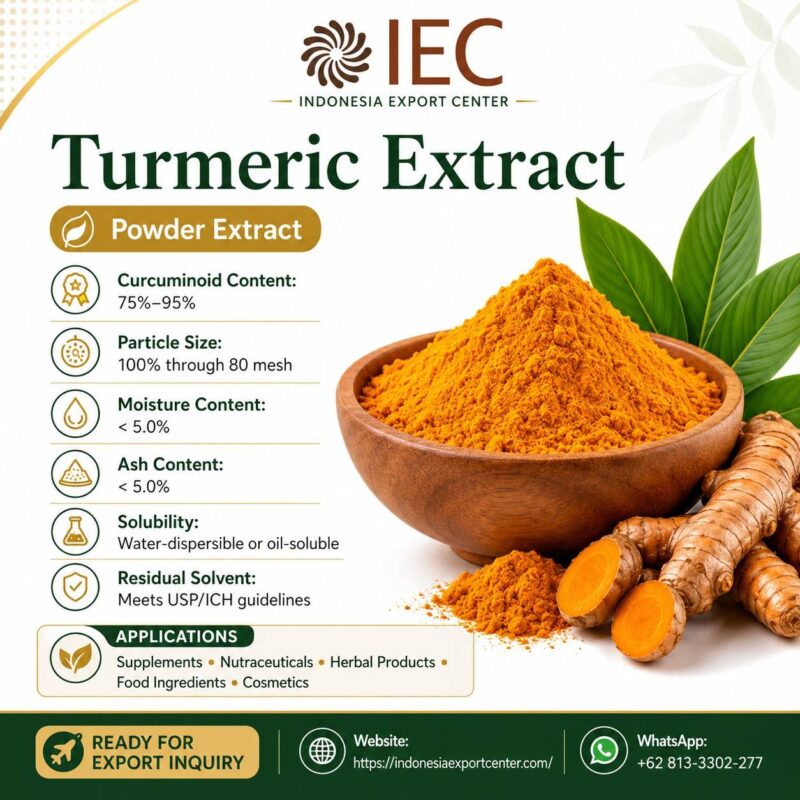
For turmeric extract powder, these may include botanical identity, assay, extraction method, carriers, moisture, particle size, residual solvents, heavy metals, and microbiological criteria.
The buyer should distinguish between a general product description and a binding purchase specification.
Step 5: Request Quality Documentation
A batch-specific Certificate of Analysis may provide evidence that the tested material meets selected specifications.
Additional reports may be required for supplier qualification.
| Document | Procurement Function |
|---|---|
| TDS | Product specification |
| COA | Batch testing |
| Botanical Identity | Species verification |
| Curcuminoid Assay | Composition assessment |
| Residual Solvent Report | Extraction safety |
| Heavy Metal Report | Contaminant control |
| Microbiology | Product quality |
| Ingredient Declaration | Regulatory review |
| Certification Evidence | Customer requirements |
| Shelf-Life Data | Storage planning |
Step 6: Conduct Sample Testing
A buyer should compare samples with the required specification and intended formulation.
Analytical testing may be necessary, especially when purchasing a standardized extract.
The sample should be traceable to the proposed supplier and product.
A successful sample trial should be followed by verification that commercial production can meet the same specification.
Step 7: Evaluate Commercial Terms
Commercial evaluation should consider more than unit price.
Relevant factors include:
- Minimum order quantity.
- Trial order quantity.
- Packaging.
- Production lead time.
- Testing and release time.
- Payment terms.
- Incoterms.
- Freight and insurance.
- Import costs.
- Quality claims procedures.
Total landed cost may be more informative than the initial quoted price.
Step 8: Plan Logistics and Import Compliance
The importer should determine the correct customs classification, required documents, import permits or notifications where applicable, and shipment conditions.
Packaging should protect the ingredient during transport and storage.
The actual exporter of record and importer of record should be identified.
IEC does not guarantee customs clearance.
B2B Procurement Risk Checklist
| Risk | Recommended Verification |
|---|---|
| Wrong Product Format | Confirm extract versus ground powder |
| Unverified Assay | Request appropriate analytical evidence |
| Undisclosed Carriers | Obtain full composition |
| Solvent Residues | Review relevant testing |
| Regulatory Mismatch | Check destination requirements |
| Unverified Certifications | Validate issuer and scope |
| Capacity Shortfall | Confirm realistic output |
| Batch Variability | Establish acceptance limits |
| Packaging Damage | Review packing specification |
| Delivery Delays | Confirm production and shipping schedules |
Request for Quotation: What to Include
A complete RFQ helps suppliers respond more accurately.
Provide the product name, botanical source, required assay, application, destination, estimated quantity, packaging, documentation requirements, target delivery period, and preferred Incoterm.
If a specific regulatory or certification requirement applies, include it at the beginning of the inquiry.
IEC Sourcing Support
IEC facilitates supplier communication and technical clarification.
Potential support includes coordinating document requests, sample inquiries, supplier verification questions, and commercial quotation discussions.
IEC does not claim ownership of production facilities or verified inventory.
Frequently Asked Questions
How should a buyer begin turmeric extract sourcing?
Start with a detailed technical specification and intended market.
Can IEC identify potential Indonesian suppliers?
IEC can facilitate sourcing inquiries.
Is a COA sufficient to qualify a supplier?
Not necessarily. Additional quality, regulatory, and operational checks may be needed.
Can buyers request third-party laboratory testing?
Such testing can be discussed with the relevant parties.
Does IEC guarantee supplier certifications?
No. Certificates must be verified.
Can buyers request recurring shipments?
Recurring supply requires supplier capacity and commercial confirmation.
Start Your Indonesia Turmeric Extract B2B Inquiry
IEC welcomes procurement inquiries from international manufacturers, botanical ingredient distributors, supplement brands, and trading companies.
REQUEST SPECS & SUPPLIER-APPROVED QUOTATION
Website: https://indonesiaexportcenter.com/
WhatsApp: +62 813-3302-277
Related page: Turmeric Extract Manufacturer Sourcing Guide
SEO METADATA
SEO Title: Indonesia Turmeric Extract B2B Sourcing | IEC
Meta Description: Plan turmeric extract B2B sourcing from Indonesia. Review supplier checks, product specifications, quality documents, compliance, logistics, and RFQs.
Focus Keyword: indonesia turmeric extract b2b
Secondary Keywords: turmeric extract B2B Indonesia, turmeric extract importer guide, botanical ingredient procurement Indonesia, turmeric extract supplier verification
URL Slug: indonesia-turmeric-extract-b2b
Canonical URL: https://indonesiaexportcenter.com/indonesia-turmeric-extract-b2b/
Search Intent: Commercial / B2B Procurement Research
Primary CTA: Request Specs & Supplier-Approved Quotation
